
In my experience with casting thick-section nodular cast iron components, I have often encountered challenges related to shrinkage defects. Nodular cast iron, also known as ductile iron, exhibits a tendency toward shrinkage porosity and voids due to its prolonged solidification time and the formation of large, sparse graphite nodules. This is particularly problematic for heavy castings with complex geometries, such as machine tool stands. Traditionally, large risers are employed to feed these shrinkages, but this approach can be inefficient, material-wasting, and sometimes ineffective due to the pasty solidification mode of nodular cast iron. The graphite expansion during solidification can force liquid metal back into the risers, exacerbating shrinkage in the casting itself. In this article, I will detail my analysis and optimization of the casting process for a specific nodular cast iron stand, ultimately demonstrating the feasibility and advantages of a riser-free casting methodology.
The stand in question is a critical component for a machine tool, with a specified material grade of QT400-18. Its overall dimensions are approximately 2230 mm in length, 1750 mm in width, and 550 mm in height, with a weight of around 2483 kg. The geometry is internally complex, featuring multiple cavities and significant variations in wall thickness, ranging from a minimum of 20 mm to a maximum of 80 mm at the top support frames for shaft holes. These thick sections, especially around the Φ70 mm shaft hole supports, are primary areas of concern for achieving sound microstructure and mechanical properties. The casting quality requirements are stringent, conforming to EN 12890 Grade H2 and dimensional accuracy of DIN ISO 8062-CT12, with no allowances for defects like sand inclusion, shrinkage cavities, or porosity on the machined surfaces.
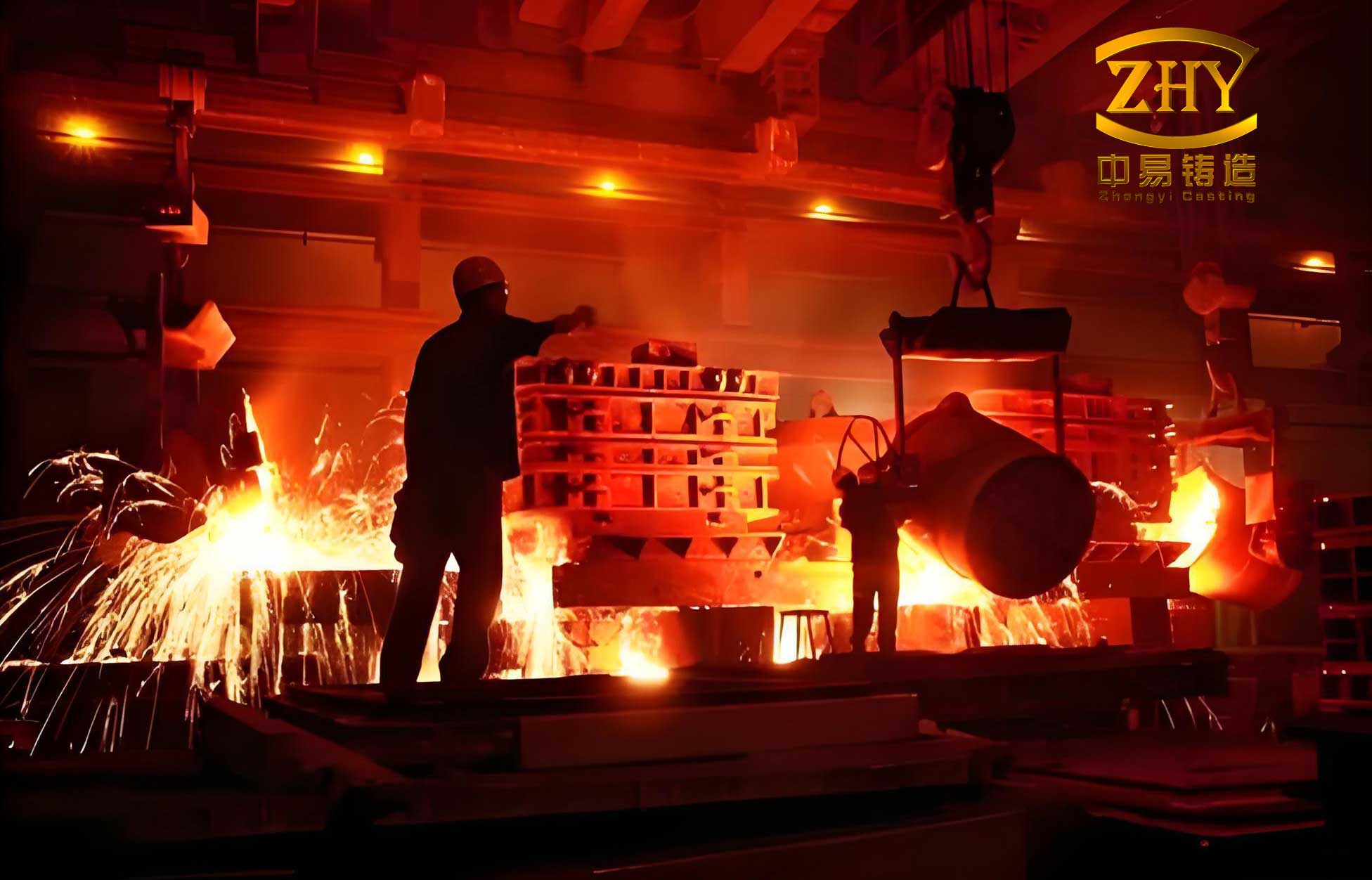
The initial casting process utilized furan resin no-bake sand for manual molding. The gating system was a stepped, open type with multiple ingates to promote balanced filling and solidification. The chemical composition was tightly controlled. The base iron was prepared using steel scrap and carburizer, aiming for a composition of 3.6–4.0% C, 1.3–1.6% Si, Mn ≤ 0.5%, S ≤ 0.03%, and P ≤ 0.04%. After treatment with a calcium-containing rare earth magnesium alloy (approx. 1.4% addition), the final melt composition targeted 3.5–3.9% C, 2.2–2.5% Si, Mn ≤ 0.45%, S ≤ 0.02%, P ≤ 0.04%, and residual Mg ≤ 0.05%. The pouring temperature was maintained between 1310°C and 1330°C. To address the thick shaft hole supports, two large risers were initially placed on top of them for feeding. However, production trials consistently revealed minor shrinkage porosity at the junctions between these risers and the casting body, leading to rejection.
To understand this phenomenon, I conducted a thorough numerical simulation of the solidification process using AnyCasting software. The simulation of the original design confirmed that the thermal hotspots, or the last regions to solidify, were indeed located in the top thick sections near the shaft holes. The solidification sequence indicated that the risers could solidify before the critical sections of the casting, rendering them useless for feeding. This is a classic issue with nodular cast iron’s pasty solidification. The solidification time for a section can be approximated by Chvorinov’s rule:
$$ t = B \left( \frac{V}{A} \right)^2 $$
where \( t \) is the solidification time, \( B \) is a mold constant, \( V \) is the volume of the section, and \( A \) is its cooling surface area. For the thick shaft support, the high \( V/A \) ratio leads to a long local solidification time, creating a shrinkage risk. The simulation output visually highlighted this delayed solidification zone.
Given the inefficiency of the risers, I explored the principles of riser-free casting for nodular cast iron. The core idea leverages the graphite expansion during eutectic solidification. If the mold is rigid enough and the gating system is designed to freeze early, the expansion pressure can compensate for the liquid and solidification shrinkage, eliminating the need for external feeding. The volume change due to graphite precipitation can be conceptually modeled. The net volume change \( \Delta V_{net} \) during solidification is the sum of liquid contraction \( \Delta V_{l} \), solidification contraction \( \Delta V_{s} \), and graphite expansion \( \Delta V_{g} \):
$$ \Delta V_{net} = \Delta V_{l} + \Delta V_{s} + \Delta V_{g} $$
For successful riser-free casting, the system must be designed so that \( \Delta V_{g} \) counteracts \( \Delta V_{l} + \Delta V_{s} \), aided by mold wall movement restraint. Key enablers include a high-strength mold (furan resin sand with a rigid steel flask), a low pouring temperature to minimize liquid contraction, and multiple thin ingates that solidify quickly to “seal” the casting from the gating system early in the process.
Based on this analysis, I proposed and tested an optimized riser-free process. All other parameters, such as alloy composition, pouring temperature range, and molding sand, were kept identical to ensure a fair comparison. The modifications were as follows:
- The two top risers were replaced with flat, wedge-shaped vent holes.
- The ingate cross-section was reduced in thickness to ensure it solidified prior to the casting body.
- External or internal chills were applied adjacent to the shaft hole support regions to accelerate local cooling and refine the microstructure.
- Two sub-options were considered for the shaft holes: casting them directly or leaving them as solid masses for subsequent machining.
The new gating system design was simulated. The results showed a clear change in the solidification pattern. The thin ingates and vent holes solidified first, effectively isolating the casting. The use of chills significantly reduced the local solidification time at the critical thick sections, promoting directional solidification towards the chills and making the overall temperature field more uniform. The revised solidification time field confirmed that the last points to solidify were no longer isolated hotspots but were more integrated into the overall cooling pattern, greatly reducing the risk of macro-shrinkage.
The table below summarizes the key differences between the original and optimized process parameters:
| Parameter | Original Process | Optimized Riser-Free Process |
|---|---|---|
| Top Feeders | Two large risers | Wedge-shaped vent holes |
| Ingate Thickness | Standard thickness | Reduced to 18 mm (flat rectangle) |
| Cooling Aids at Shaft Supports | None | External or Internal Chills |
| Shaft Hole Formation | Cast (or machined later) | Option A: Cast with external chills Option B: Not cast, machined later with chills |
| Theoretical Feeding Mechanism | Pressure feeding from risers | Graphite expansion pressure within a sealed, rigid mold cavity |
Production trials were conducted for the optimized schemes. In all cases—using external chills with the hole cast, internal chills, or leaving the hole solid for machining—the resulting nodular cast iron stand castings were found to be sound and met all quality specifications upon inspection. No shrinkage porosity was detected at the previous trouble spots. The microstructure in the shaft support area, especially when chills were used, showed a finer graphite nodule distribution and pearlite/ferrite matrix, implying improved mechanical properties. The successful implementation validated the riser-free approach.
To further elaborate on the material science aspect, the effectiveness of chills can be quantified by estimating the increased cooling rate. The heat extraction rate \( Q \) from a chill can be approximated by:
$$ Q = h \cdot A_c \cdot (T_{cast} – T_{chill}) $$
where \( h \) is the heat transfer coefficient at the chill-casting interface, \( A_c \) is the contact area, \( T_{cast} \) is the casting surface temperature, and \( T_{chill} \) is the initial chill temperature. This rapid extraction reduces the local solidification time, refines the secondary dendrite arm spacing (SDAS), and improves density. The following table compares the expected outcomes for different chill configurations:
| Chill Type | Contact Efficacy | Microstructure Refinement | Ease of Application | Suitability for This Stand |
|---|---|---|---|---|
| External Chill | High (direct contact with sand mold) | Significant at surface and sub-surface | Easy to place in mold | Excellent for non-cast hole option |
| Internal Chill | Very High (fused into casting) | Very significant, throughout section | Requires careful placement and compatible material | Excellent for cast hole option, ensures soundness |
| No Chill | N/A | Baseline, coarser structure in thick sections | Simplest | Risky for thick sections; not recommended alone |
The decision to sometimes leave the shaft hole as a solid mass for machining deserves explanation. While casting the hole directly seems efficient, it creates a massive thermal mass (the core) that can slow down cooling. By making the support a solid block and applying chills on its sides, the cooling is dramatically accelerated, and the subsequent drilling operation guarantees perfect dimensional accuracy and surface finish for the bearing seat. This hybrid approach combines the benefits of casting and machining.
The success of the riser-free process for this nodular cast iron stand hinges on a delicate balance of factors. The early freezing of the ingates is critical. Their solidification time must be less than that of the casting’s main sections. Using Chvorinov’s rule again, if the ingate has a modulus \( (V/A)_{gate} \) and the casting’s critical section has a modulus \( (V/A)_{crit} \), the condition for the gate to freeze first is:
$$ B \left( \frac{V}{A} \right)_{gate}^2 < B \left( \frac{V}{A} \right)_{crit}^2 \implies \left( \frac{V}{A} \right)_{gate} < \left( \frac{V}{A} \right)_{crit} $$
By designing the ingates as thin, wide rectangles, their surface area \( A \) is maximized relative to their volume \( V \), ensuring a low modulus and rapid solidification. Furthermore, the use of a stepped gating system with multiple ingates promotes a more uniform temperature distribution during filling, reducing thermal gradients that can lead to shrinkage.
From an operational and economic perspective, the elimination of risers offers substantial benefits. The yield or casting efficiency, defined as the weight of the usable casting divided by the total weight of metal poured (casting + gating system + risers), increases significantly. The simplified molding process reduces labor and material costs associated with riser formation and removal. The table below provides a quantitative comparison of key performance indicators:
| Performance Indicator | Original Process (With Risers) | Optimized Process (Riser-Free) |
|---|---|---|
| Estimated Process Yield | ~65-70% | ~78-82% |
| Molding Complexity | Higher (riser core-making/placement) | Lower (only vents and chill placement) |
| Post-casting Work (Riser Removal) | Significant cutting and grinding | Minimal (only gating system removal) |
| Consistency of Shaft Support Quality | Variable, prone to shrinkage | Consistently sound, especially with chills |
| Material Utilization | Lower | Higher |
In conclusion, my investigation into the casting of this large nodular cast iron stand clearly demonstrates that traditional riser-based feeding can be counterproductive due to the material’s pasty solidification behavior and graphite expansion characteristics. Through numerical simulation and practical experimentation, I successfully developed and validated a riser-free casting process. This optimized methodology relies on a rigid furan resin sand mold, a stepped gating system with thin, rapidly solidifying ingates, the replacement of risers with vent holes, and the strategic use of external or internal chills at critical thick sections. The nodular cast iron stand produced via this method exhibited no shrinkage defects, met all quality standards, and offered improved process yield and lower manufacturing complexity. This case study serves as a strong testament to the viability of riser-free casting for complex, thick-section nodular cast iron components when the process conditions are meticulously designed to harness the intrinsic graphite expansion potential of the material itself. The principles applied here—emphasizing mold rigidity, controlled cooling, and early g system isolation—can be effectively adapted to other challenging nodular cast iron casting applications.