
In my research, I focused on the formability and defect analysis of sand casting products, particularly for critical components in railway applications. As manufacturing industries evolve, the demand for high-quality sand casting products has intensified, especially in sectors like locomotive manufacturing where components such as bearing housings and brackets must withstand heavy loads and high speeds. These sand casting products are typically produced via steel casting processes, and their performance directly impacts overall system reliability. The traditional trial-and-error approach in casting process design is time-consuming and costly, prompting the adoption of numerical simulation techniques to predict defects and optimize parameters. This article details my investigation into using advanced simulation tools to enhance the quality of sand casting products, with an emphasis on defect prevention and process efficiency.
The significance of numerical simulation in casting cannot be overstated. For sand casting products, the process involves complex physical phenomena during mold filling, solidification, and cooling, which can lead to defects like shrinkage porosity, hot tears, and gas pores if not properly controlled. Through simulation, I aimed to visualize these processes and predict potential issues before actual production. The development of casting simulation has a rich history, starting in the 1960s with basic temperature field calculations and evolving into comprehensive tools that model fluid flow, stress fields, and microstructure formation. Today, software like ProCAST, MAGMA, and Flow-3D are widely used for sand casting products, enabling virtual prototyping that reduces material waste and shortens development cycles. In my work, I utilized ProCAST as the simulation platform, coupled with UG NX for 3D modeling, to analyze and refine casting processes.
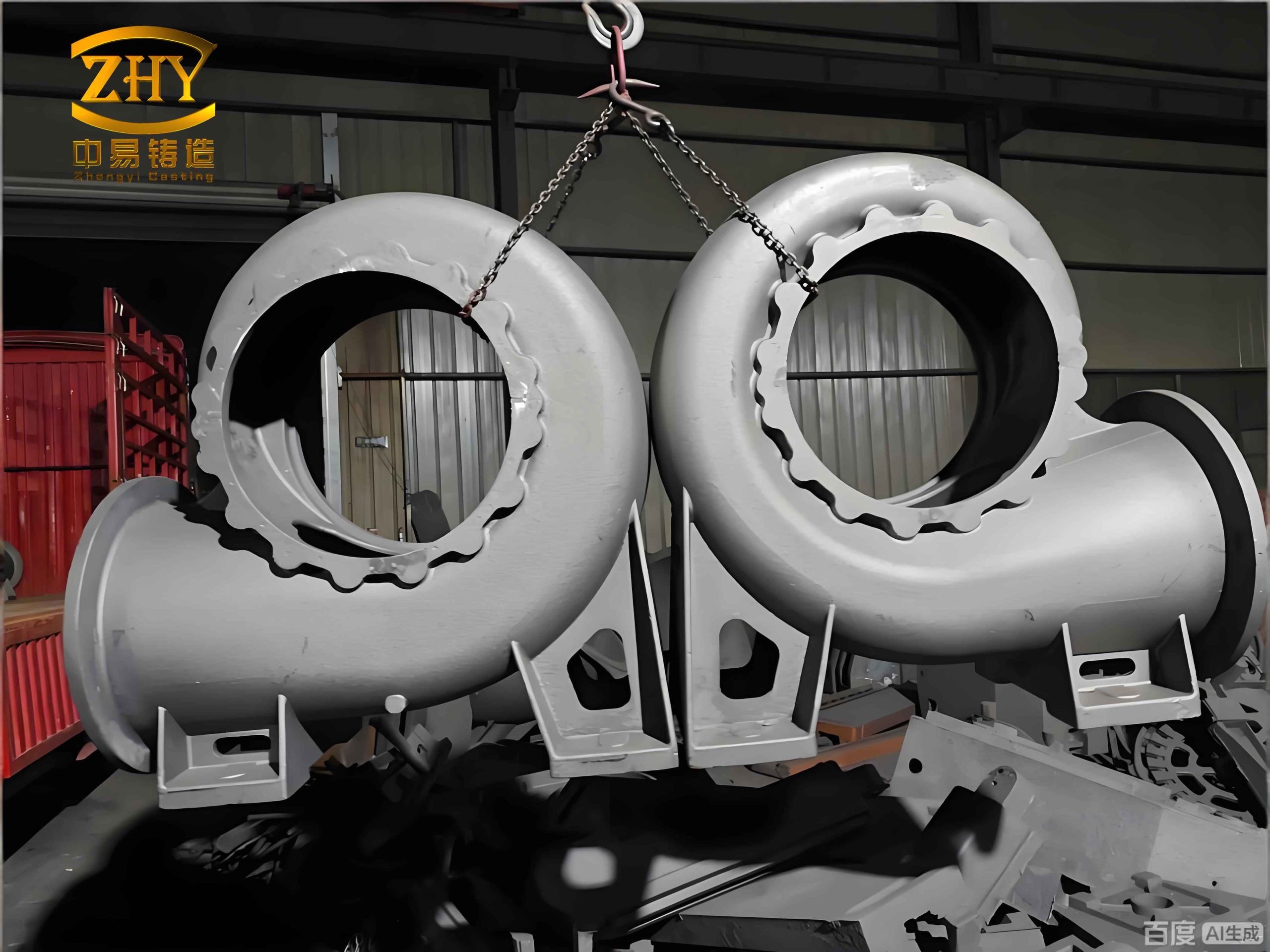
To understand the context, it is essential to review the casting process preparation for sand casting products. Steelmaking in an electric arc furnace involves several stages: raw material collection, melting, oxidation, and reduction. For high-integrity sand casting products, the steel composition must be carefully controlled to minimize impurities that cause defects. The molding materials, such as water-glass sand, play a crucial role. In my experience, modified water-glass with ester hardeners improves mold strength and collapsibility, which is vital for complex sand casting products. However, defects like gas holes, sand inclusions, shrinkage cavities, and cracks remain common challenges. I analyzed these defects to develop preventive measures, as summarized in the table below.
| Defect Type | Characteristics | Common Causes in Sand Casting Products | Preventive Measures |
|---|---|---|---|
| Shrinkage Porosity | Irregular cavities in hot spots; rough walls | Inadequate feeding; poor solidification control | Optimize riser design; use chills and padding |
| Hot Tears | Cracks along grain boundaries; oxidized surfaces | High residual stress; restricted contraction | Improve mold yield; adjust alloy composition |
| Gas Pores | Round holes with smooth walls; often subsurface | Gas entrapment from mold or metal | Enhance venting; reduce moisture in sand |
| Sand Inclusions | Non-metallic inclusions; surface or internal | Erosion of mold; improper gating | Strengthen mold coatings; design smooth gating |
Numerical simulation relies on mathematical models to predict these defects. For instance, the Niyama criterion is widely used to assess shrinkage porosity in sand casting products. It relates the temperature gradient (G) and cooling rate (R) as follows: $$G/\sqrt{R}$$. A lower value indicates a higher risk of microporosity. In ProCAST, I applied this criterion along with others like the solid fraction and thermal modulus to evaluate casting quality. The simulation process typically involves pre-processing (3D modeling and meshing), solving (calculating temperature, flow, and stress fields), and post-processing (visualizing results). Through this, I could identify defect-prone areas and test alternative designs virtually, which is especially beneficial for sand casting products with intricate geometries.
My case studies involved two key sand casting products: a bearing housing and a bracket for railway locomotives. Both are critical sand casting products that require high fatigue resistance and dimensional accuracy. For the bearing housing, initial casting trials revealed cracks and shrinkage cavities at the junction between flanges and bolt pads. Using ProCAST, I simulated the stress distribution during solidification. The analysis showed that the original gating system created hot spots and stress concentration. By relocating the ingates and adding transition blocks, I redistributed the stresses and improved feeding. The modified design was simulated again, confirming a reduction in residual stress and defect risk. This demonstrates how simulation can guide process optimization for sand casting products.
For the bracket, a sand casting product with sudden thickness variations, shrinkage defects were predicted in the cylindrical bosses. The initial design used open risers, but simulation indicated inadequate feeding due to premature riser solidification. I switched to insulated risers to slow cooling, enhancing directional solidification. The thermal analysis was quantified using the following formula for solidification time (t), based on Chvorinov’s rule: $$t = k \cdot V^n / A^m$$ where V is volume, A is surface area, and k, n, m are constants dependent on the sand casting product material and mold conditions. By adjusting riser dimensions based on simulation feedback, I achieved a sound casting with minimal porosity. The table below compares the simulation outcomes for different riser designs in this sand casting product.
| Riser Design | Riser Dimensions (mm) | Simulated Shrinkage Porosity Level | Remarks |
|---|---|---|---|
| Open Riser (Original) | 150 × 150 × 300 | High (Defects present) | Poor feeding; riser cooled too fast |
| Insulated Riser (Revised) | 120 × 120 × 280 | Moderate (Minor defects) | Improved thermal retention |
| Optimized Insulated Riser | 140 × 140 × 300 | Low (No defects) | Best balance for this sand casting product |
The simulation results were validated through actual casting trials. For both sand casting products, the improved processes yielded defect-free components, confirming the accuracy of ProCAST predictions. This highlights the practical value of numerical simulation in enhancing sand casting products. Moreover, the integration of simulation into process design reduces reliance on empirical methods, leading to faster development and cost savings. In my work, I also explored the effects of varying pouring temperatures and gating velocities on sand casting products. Using finite element analysis, I modeled the fluid flow during mold filling, which is critical for avoiding turbulence-related defects. The momentum equation for incompressible flow was considered: $$\rho \left( \frac{\partial \mathbf{u}}{\partial t} + \mathbf{u} \cdot \nabla \mathbf{u} \right) = -\nabla p + \mu \nabla^2 \mathbf{u} + \mathbf{f}$$ where ρ is density, u is velocity, p is pressure, μ is viscosity, and f represents body forces. This helped in designing gating systems that ensure smooth filling for sand casting products.
Beyond defect prediction, numerical simulation aids in optimizing the mechanical properties of sand casting products. By simulating microstructure evolution, I could assess how cooling rates influence grain size and phase distribution. For steel sand casting products, the solidification path affects final strength and toughness. Using ProCAST’s microstructural module, I predicted the formation of dendrites and secondary phases, which informed heat treatment strategies. This comprehensive approach ensures that sand casting products meet stringent performance standards, particularly in safety-critical applications like railways.
In conclusion, my research underscores the transformative role of numerical simulation in advancing sand casting products. Through case studies and theoretical analysis, I demonstrated how tools like ProCAST can identify and mitigate defects, leading to higher quality and reliability. The key takeaways include the importance of accurate modeling of thermal and stress fields, the effectiveness of criteria like Niyama for shrinkage prediction, and the need for iterative design optimization. As industries move towards digitalization, the adoption of simulation will become standard for sand casting products, driving efficiency and innovation. Future work could focus on integrating artificial intelligence to further automate process design for complex sand casting products, paving the way for smarter manufacturing ecosystems.