
In industrial applications, high manganese steel casting components, such as tooth plates, are critical for their wear resistance and durability in heavy machinery. However, during production, we often encounter cold shut defects on the tooth surfaces of large high manganese steel casting parts. These defects manifest as surface irregularities that can extend inward, leading to layered structures within the cast material. This article delves into the casting process characteristics, root causes of cold shut defects, and their propensity, while proposing effective preventive measures based on our extensive experience. We emphasize the importance of optimizing the casting process for high manganese steel casting to minimize such issues, incorporating mathematical models and tabular summaries for clarity.
High manganese steel casting involves alloys with high manganese content, typically around 11-14%, which provide excellent toughness and work-hardening properties. However, the large linear shrinkage and low high-temperature strength of high manganese steel casting make it prone to thermal cracking and defects like cold shuts. In our production of tooth plates, which feature multiple teeth and reinforcing ribs to reduce weight, the casting process must be meticulously designed. The tooth surfaces serve as functional areas, requiring them to be oriented downward during casting to ensure denser microstructure. This setup creates a complex mold with inverted tooth shapes in the lower part and hanging sands in the upper part for rib formation. As a result, the molten metal flow during pouring becomes turbulent, leading to disordered filling that exacerbates defect formation in high manganese steel casting.
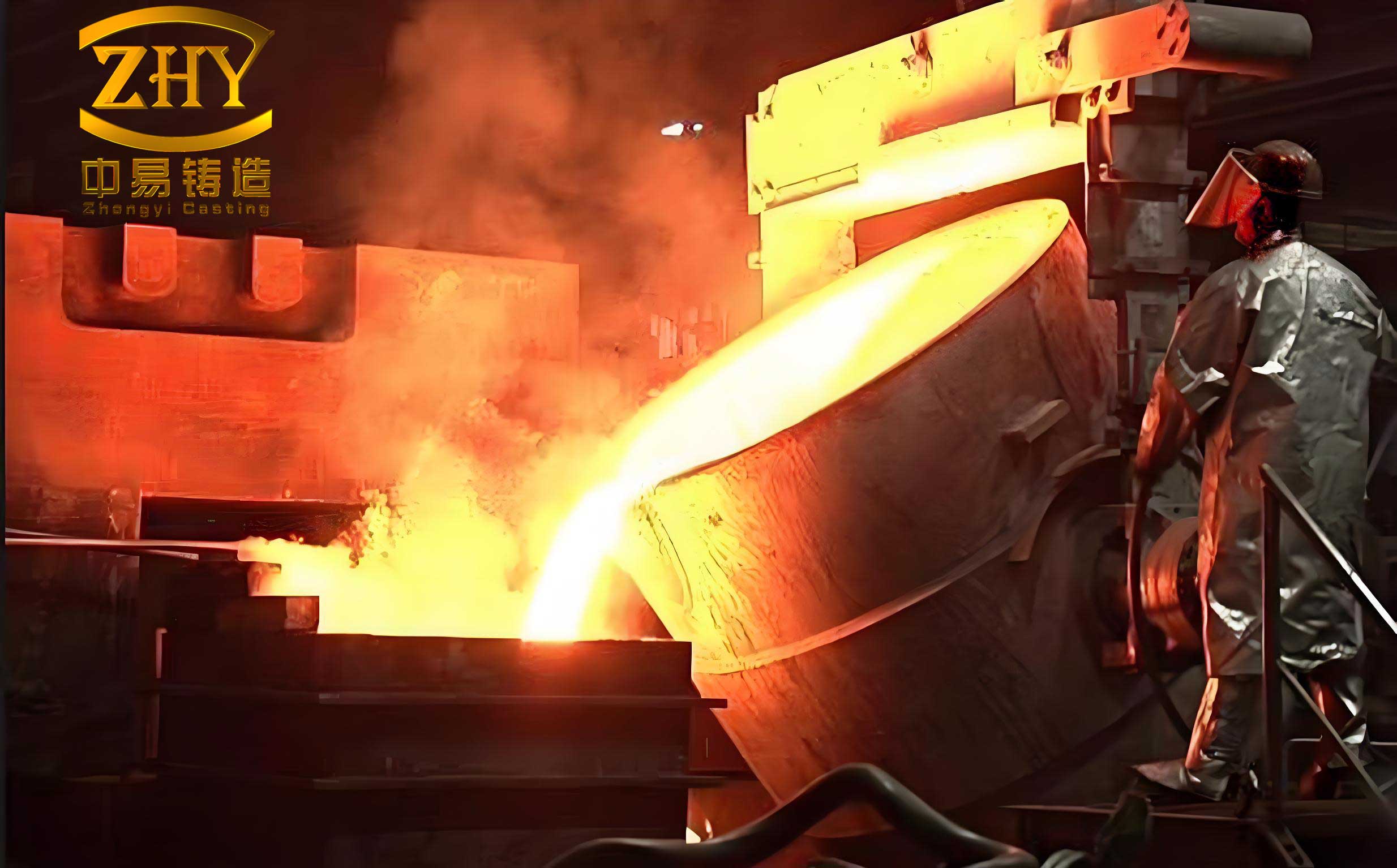
The primary cause of cold shut defects in high manganese steel casting tooth plates is the disordered flow of molten metal during mold filling. In large castings, the extended filling time allows certain branches of the metal flow front to solidify prematurely due to heat loss, without timely replenishment from subsequent high-temperature metal. When the later metal flows in, it fuses with the already solidified inner layers but fails to merge with the outer layers due to the chilling effect of the sand mold. This results in short-range layered structures that appear as cold shut lines after heat treatment, such as water toughening. The oxidation on the cast surface masks these defects initially, but they become visible post-treatment, compromising the integrity of high manganese steel casting components.
To analyze the casting process characteristics of high manganese steel casting tooth plates, we consider factors like gating system design and mold geometry. The high linear shrinkage of high manganese steel casting necessitates multiple ingates to prevent localized overheating, which could lead to hot tearing. For large tooth plates, we typically use 4 to 8 ingates, depending on the casting weight and dimensions. The mold configuration, with teeth facing downward, creates obstacles that disrupt laminar flow. The metal stream impacts the hanging sands, causing splashing and turbulence. This chaotic filling process can be described using fluid dynamics principles. For instance, the Reynolds number (Re) for flow in such molds can be expressed as:
$$Re = \frac{\rho v D}{\mu}$$
where $\rho$ is the density of the molten high manganese steel casting, $v$ is the flow velocity, $D$ is the hydraulic diameter, and $\mu$ is the dynamic viscosity. High Re values indicate turbulent flow, which increases the likelihood of cold shuts. Additionally, the solidification behavior can be modeled using the Fourier number (Fo) for heat transfer:
$$Fo = \frac{\alpha t}{L^2}$$
where $\alpha$ is the thermal diffusivity, $t$ is time, and $L$ is the characteristic length. Rapid solidification at the flow front due to high Fo values contributes to layer formation in high manganese steel casting.
The propensity for cold shut defects in high manganese steel casting is influenced by several factors, which we have categorized and summarized in the table below. Each factor’s impact is analyzed based on practical observations and theoretical models.
| Factor | Description | Effect on Cold Shut Propensity | Mathematical Relation |
|---|---|---|---|
| Gating System Type | Use of closed or semi-closed systems with thin ingates | Increases due to high velocity and喷射现象 | Velocity $v \propto \frac{1}{\sum F_{\text{gate}}}$; high v increases turbulence |
| Ingate Location | Position relative to tooth axis (perpendicular or parallel) | Varies; perpendicular reduces disorder, parallel increases it | Flow path length $L_p$ affects filling time $t_f = \frac{V}{A v}$ |
| Tilt Casting | Inclining mold with ingate end or opposite end raised | Opposite end raise reduces propensity; ingate end raise increases it | Gradient effect: $\Delta h$ influences flow stability |
| Pouring Temperature | Temperature of molten high manganese steel casting | Higher temperature reduces propensity but risks other defects | Solidification time $t_s \propto \frac{1}{(T_p – T_s)^2}$ |
| Pouring Speed | Rate of metal introduction into mold | Faster pouring reduces propensity by minimizing heat loss | Filling rate $Q = A v$; high Q maintains metal fluidity |
| Tooth Plate Geometry | Number and size of teeth, rib thickness | Larger teeth and fewer teeth reduce propensity; thin ribs increase it | Aspect ratio AR = tooth height/width; low AR favors ordered filling |
Starting with the gating system type, closed or semi-closed systems with thin ingates are often used for easy removal but lead to high metal velocity, promoting喷射现象 and turbulence. This amplifies disordered flow in high manganese steel casting. In contrast, an open gating system, where the total cross-sectional areas satisfy $\sum F_{\text{direct}} < \sum F_{\text{runner}} < \sum F_{\text{gate}}$, ensures lower velocities and more uniform flow. The optimal ratio is $\sum F_{\text{runner}} : \sum F_{\text{gate}} = 1 : (1.0 \sim 1.2)$. Deviations from this can cause uneven flow distribution, increasing cold shut risks. The relationship between flow velocity and ingate area can be expressed as:
$$v = \frac{Q}{\sum F_{\text{gate}}}$$
where $Q$ is the volumetric flow rate. Lower $v$ reduces kinetic energy and splashing in high manganese steel casting.
Regarding ingate location, positioning them perpendicular to the tooth axis allows for sequential filling of teeth, promoting ordered flow. However, velocity inhomogeneities can still cause premature filling of adjacent teeth, leading to scattered cold shuts. Mathematically, the filling sequence can be modeled using a time-dependent flow front position $x(t)$:
$$\frac{dx}{dt} = v(x) – \frac{\partial v}{\partial x} \Delta x$$
where $v(x)$ varies along the flow path. For ingates parallel to the tooth axis, metal initially fills nearby teeth and then overflows to others, resulting in highly disordered flow and increased defect propensity in high manganese steel casting. The filling efficiency $\eta$ can be defined as:
$$\eta = \frac{\text{Orderly filled volume}}{\text{Total volume}}$$
Lower $\eta$ values correlate with higher cold shut occurrence.
Tilt casting involves inclining the mold to utilize gravity for stabilizing flow. When the end opposite the ingates is raised, gravity partially counteracts flow inhomogeneities, reducing cold shut propensity. Conversely, raising the ingate end eliminates sequential filling, worsening defects. The effect of tilt angle $\theta$ on flow stability can be described by the Froude number (Fr):
$$Fr = \frac{v}{\sqrt{g L \sin \theta}}$$
where $g$ is gravity. Optimal $\theta$ values enhance laminar flow in high manganese steel casting.
Pouring temperature is a critical parameter; higher temperatures improve fluidity and reduce cold shuts by delaying solidification. However, for large high manganese steel casting components, elevated temperatures increase risks of deformation, cracking, and shrinkage defects. The solidification time $t_s$ is inversely proportional to the square of the superheat $(T_p – T_s)$, where $T_p$ is pouring temperature and $T_s$ is solidus temperature. Thus, we avoid relying solely on temperature adjustments for defect control in high manganese steel casting.
Pouring speed, or the rate of metal introduction, plays a significant role. Faster pouring minimizes heat loss and maintains metal temperature, reducing the time for premature solidification at the flow front. The relationship between pouring speed $v_p$ and defect propensity can be quantified as:
$$P_{\text{cold shut}} \propto e^{-k v_p}$$
where $k$ is a constant dependent on mold geometry and metal properties. In practice, rapid pouring is beneficial for high manganese steel casting, provided the gating system is designed to handle the flow without excessive turbulence.
Tooth plate geometry, such as the number and size of teeth and rib thickness, directly influences flow dynamics. Thinner ribs bring hanging sands closer to ingates, intensifying splashing and turbulence. Larger teeth with fewer numbers allow longer filling times per tooth, enhancing ordered flow. The propensity $P$ can be modeled as:
$$P = C \cdot \frac{1}{N_t} \cdot \frac{1}{H_t} \cdot \exp\left(-\frac{t_f}{\tau}\right)$$
where $C$ is a constant, $N_t$ is the number of teeth, $H_t$ is tooth height, $t_f$ is filling time, and $\tau$ is a time constant for solidification. This highlights the importance of design optimization in high manganese steel casting.
Based on our analysis, we propose comprehensive preventive measures for cold shut defects in high manganese steel casting tooth plates. The core strategy involves redesigning the gating system and process parameters to promote ordered filling. Specifically, we recommend using an open gating system with the ratio $\sum F_{\text{direct}} : \sum F_{\text{runner}} : \sum F_{\text{gate}} = 1 : (1.0 \sim 1.2) : (1.0 \sim 1.2)$. Ingates should be positioned perpendicular to the tooth axis, with risers placed on the opposite end. During pouring, the mold should be tilted with the riser end raised to leverage gravity for flow stabilization. This approach not only ensures smooth filling and adequate venting but also enhances feeding for shrinkage compensation in high manganese steel casting.
Additionally, we advocate for controlled pouring speeds to minimize heat loss while avoiding excessive turbulence. The optimal pouring speed $v_{\text{opt}}$ can be derived from fluid dynamics equations:
$$v_{\text{opt}} = \sqrt{\frac{2 g \Delta h}{C_d}}$$
where $\Delta h$ is the head difference and $C_d$ is the discharge coefficient. Implementing these measures has proven effective in our production, significantly reducing cold shut defects in high manganese steel casting components.
In conclusion, cold shut defects in high manganese steel casting tooth plates stem from disordered metal flow during mold filling, influenced by gating design, process parameters, and component geometry. Through detailed analysis and practical adjustments, we have demonstrated that optimized gating systems, appropriate ingate placement, tilt casting, and controlled pouring speeds can effectively mitigate these defects. High manganese steel casting requires careful consideration of these factors to ensure high-quality, durable components. Our experience confirms that these preventive measures are reliable for eliminating or minimizing cold shuts, underscoring the importance of process refinement in industrial casting applications.