
In my extensive career working with nodular cast iron components, particularly for heavy-duty diesel engine blocks, I have consistently faced the challenge of shrinkage-related defects. These defects not only compromise the structural integrity of castings but also lead to significant economic losses due to scrap and rework. This article delves into a detailed case study involving shrinkage defects in large diesel engine blocks made from nodular cast iron, specifically QT500-7 grade. I will share my insights on the defect analysis, the iterative process of identifying root causes, and the effective preventive measures implemented. The focus will be on leveraging engineering principles, including thermal modulus calculations and chill design, to eliminate these defects. Throughout this discussion, the term ‘nodular cast iron’ will be emphasized to underscore its unique properties and the associated casting challenges.
Nodular cast iron, also known as ductile iron, is favored for applications requiring high strength, toughness, and fatigue resistance, such as diesel engine blocks. Its microstructure, characterized by graphite spheroids in a ferritic or pearlitic matrix, imparts excellent mechanical properties. However, the solidification behavior of nodular cast iron is markedly different from that of gray iron or steel. Due to the expansion during graphite nodule formation, nodular cast iron experiences a complex contraction pattern, making it prone to shrinkage porosity and cavities if proper feeding and cooling are not ensured. The engine block in question, with a weight of approximately 8.5 tons and overall dimensions of 3940 mm × 1462 mm × 1297 mm, represents a典型 example where thick sections and intricate geometry exacerbate these risks.
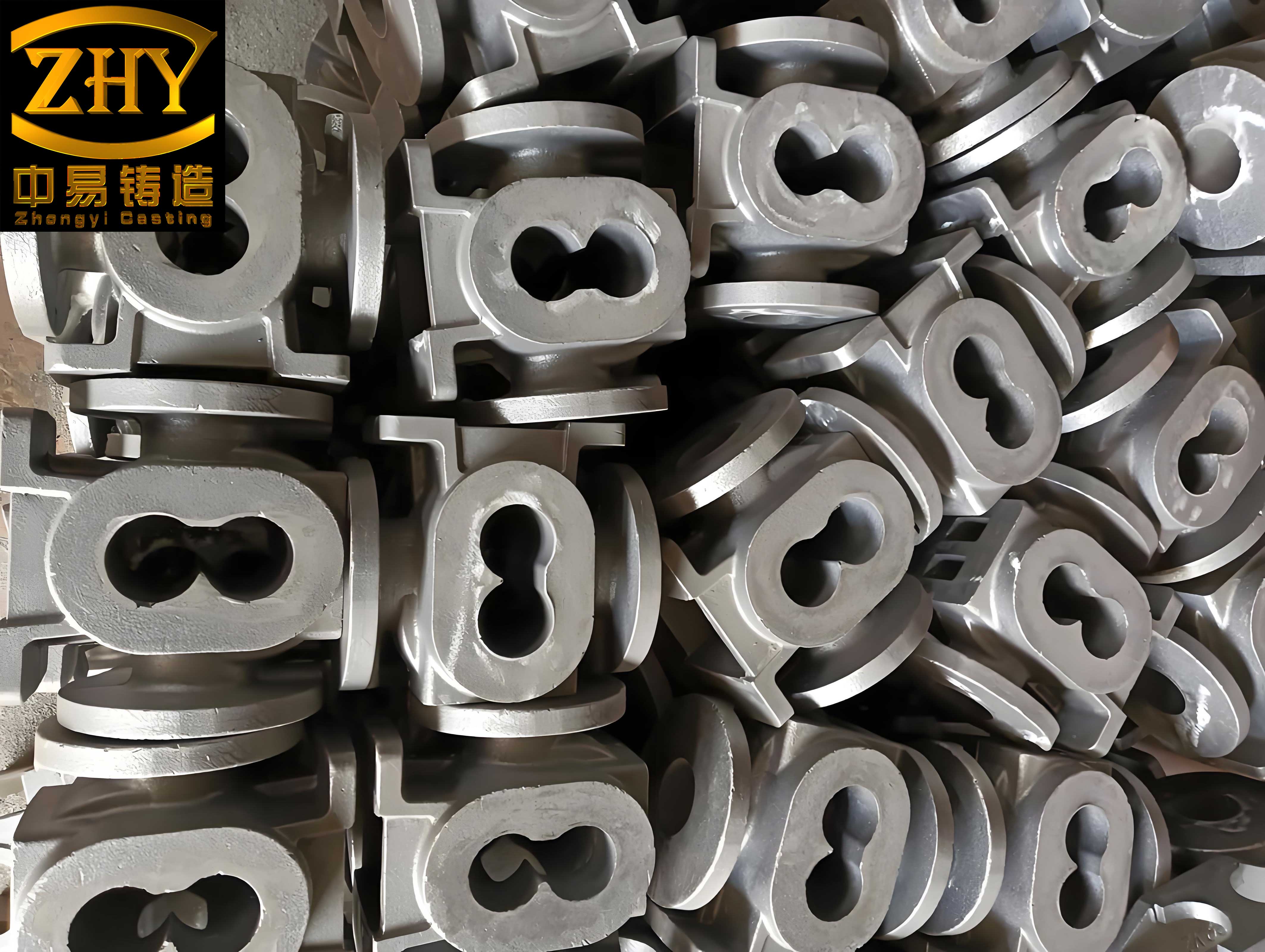
The casting process for these nodular cast iron blocks initially employed a top-gating system with green sand molds. Later, the molding method transitioned to resin-bonded sand using a split-box technique, which improved dimensional accuracy but introduced new thermal dynamics. The gating system was modified from top-pouring to a bottom-gating system to reduce turbulence and oxidation. Despite these adjustments, defects persisted in the cylinder head bolt holes, which are critical thick sections. These holes, designed as stepped bores with a 52 mm diameter smooth section and an M48 threaded section, consistently exhibited cavity defects, primarily in the initial threads. Ultrasonic inspection revealed that nearly all bolt holes had underlying shrinkage porosity, though machining often removed the central portions.
The defect morphology typically presented as scattered pores or voids with relatively smooth surfaces, sometimes described as gas holes. This appearance initially misled the investigation toward gas entrapment or inclusion theories. However, a systematic analysis over several production batches revealed key patterns: defects occurred exclusively in the hottest spots, their frequency increased with higher pouring temperatures, and the shift from green sand to resin sand correlated with a rise in defect occurrence. These observations pointed toward a shrinkage-driven mechanism, exacerbated by the extended solidification time in resin sand molds.
To understand the defect genesis, it is crucial to examine the solidification physics of nodular cast iron. The solidification of nodular cast iron involves several stages: primary austenite formation, eutectic reaction with graphite precipitation, and final solidification. The expansion from graphite nodulization can compensate for some shrinkage, but in isolated heavy sections, the lack of adequate feeding leads to microshrinkage or macroshrinkage. The localized hot spots, such as the cylinder head bolt bosses, act as thermal centers that solidify last. If the surrounding regions solidify earlier, liquid metal cannot feed these hot spots, resulting in shrinkage cavities. Moreover, the negative pressure developed in these cavities can cause dissolved gases, such as hydrogen or nitrogen, to precipitate, expanding the voids and giving them a gas-hole appearance—hence the term ‘shrinkage-gas porosity’.
My analysis proceeded in three distinct phases, each refining the understanding of the defect in nodular cast iron castings:
| Phase | Assumed Defect Type | Corrective Actions Taken | Outcome |
|---|---|---|---|
| 1 | Oxidation slag inclusions | Changed from top-gating to bottom-gating; removed internal chills | Defects persisted |
| 2 | Gas invasion (from molds or cores) | Improved baking processes; enhanced venting; increased pouring temperature | Defects worsened, especially with higher temperature |
| 3 | Shrinkage porosity (with gas precipitation) | Designed and applied external chills based on modulus calculations | Defects effectively eliminated |
The pivotal realization was that the internal chills used initially were undersized and lost their chilling effect quickly due to the high heat capacity of the massive nodular cast iron section. In nodular cast iron, the prolonged solidification time allows chills to reach thermal equilibrium with the metal, diminishing their efficacy. Therefore, the solution lay in accelerating the cooling of the hot spot to align its solidification with the surrounding regions. This is achieved through external chills, which extract heat more efficiently due to direct contact with the mold.
The design of external chills requires a quantitative approach based on the thermal modulus method. The modulus (M) is defined as the volume (V) to cooling surface area (A) ratio: $$ M = \frac{V}{A} $$ For the cylinder head bolt boss, the volume and surface area were calculated considering the cylindrical geometry and adjacent walls. The initial modulus (M_o) was determined to be approximately 2.5 cm. To prevent shrinkage, the modulus after chilling (M_r) should be reduced to match or be slightly higher than that of the surrounding sections, typically aiming for M_r ≈ 1.1 × M_surrounding. Given the surrounding wall modulus of about 1 cm, the target M_r was set to 1.1 cm.
The required chill weight (W) can be estimated using the formula derived from heat balance principles: $$ W = \frac{10.3 \times V_o \times (M_o – M_r)}{M_o} $$ where W is in grams, V_o is the volume of the hot spot in cm³, M_o is the initial modulus in cm, and M_r is the reduced modulus after chilling. Substituting the values: V_o = 1140 cm³, M_o = 2.5 cm, M_r = 1.1 cm, we get: $$ W = \frac{10.3 \times 1140 \times (2.5 – 1.1)}{2.5} = 6849 \text{ grams} $$ This calculation guided the design of external chills: a cylindrical chill with a diameter of 90 mm and height of 80 mm was placed at the bottom of the bolt boss, and custom-shaped chills with a thickness of 55 mm were applied on the side walls. These chills significantly increased the cooling rate, effectively eliminating the thermal gradient that caused shrinkage.
The implementation of external chills transformed the production outcomes. Post-modification, non-destructive testing and machining inspections confirmed the complete absence of cavity defects in the cylinder head bolt holes. This success underscores the importance of tailored cooling strategies for nodular cast iron components. Below is a summary table comparing key parameters before and after the intervention:
| Parameter | Initial Process | Optimized Process |
|---|---|---|
| Gating System | Top-pouring | Bottom-pouring |
| Mold Material | Green sand → Resin sand | Resin sand with external chills |
| Chill Type | Internal chills in hot spots | External chills on boss surfaces |
| Pouring Temperature | Varied, often increased | Controlled, moderate range |
| Defect Rate in Bolt Holes | ~81% (52 out of 64) | 0% |
| Solidification Control | Poor, isolated hot spots | Balanced, uniform cooling |
Beyond this specific case, the principles applied here have broader implications for casting nodular cast iron. The solidification behavior of nodular cast iron can be modeled using thermal analysis. The rate of heat extraction (q) from a chill follows Fourier’s law: $$ q = -k \cdot A \cdot \frac{dT}{dx} $$ where k is the thermal conductivity of the chill material, A is the contact area, and dT/dx is the temperature gradient. For steel chills, k is relatively high, promoting rapid heat transfer. In nodular cast iron castings, the goal is to achieve directional solidification toward feeders or risers. The use of chills modifies the temperature field, which can be simulated using finite element analysis (FEA) to predict shrinkage zones.
Another critical aspect is the chemical composition of the nodular cast iron. Elements like carbon, silicon, and magnesium influence graphite nodule count and size, which in turn affect shrinkage propensity. For QT500-7, typical compositions aim for 3.6-3.8% C, 2.3-2.7% Si, and 0.03-0.05% Mg. The carbon equivalent (CE) is a useful indicator: $$ CE = \%C + \frac{\%Si + \%P}{3} $$ Higher CE generally improves fluidity but may increase shrinkage risk if not balanced with cooling. In our engine blocks, maintaining CE around 4.3-4.5 helped, but the geometrical factors dominated.
To further elaborate on defect prevention, I often employ modulus calculations for various sections of nodular cast iron castings. The modulus ratio between adjacent sections should ideally not exceed 1.5 to ensure progressive solidification. For complex geometries, computer-aided simulation software can visualize thermal gradients and predict shrinkage locations. However, practical rules-of-thumb, such as the chill weight formula above, remain invaluable for on-the-spot decisions.
In summary, the journey to eliminate shrinkage defects in these large nodular cast iron engine blocks taught me that a deep understanding of material behavior is paramount. Nodular cast iron, with its unique solidification characteristics, demands careful thermal management. The shift from internal to external chills, guided by modulus-based calculations, proved decisive. This approach not only resolved the immediate issue but also enhanced the overall reliability of the casting process for nodular cast iron components. Future work could explore advanced chilling materials, such as copper or graphite, which offer higher thermal conductivity, or investigate the role of inoculants in refining graphite structure to reduce shrinkage tendency.
As casting technologies evolve, the lessons from this case remain relevant: always question initial assumptions, rely on data-driven analysis, and remember that in nodular cast iron, controlling solidification is key to quality. The successful prevention of shrinkage defects in such critical components underscores the synergy between empirical foundry knowledge and engineering principles, ensuring that nodular cast iron continues to be a material of choice for demanding applications.