
From my perspective as an engineer deeply involved in the manufacturing sector, the advent of additive manufacturing (AM), colloquially known as 3D printing, represents not merely an incremental improvement but a fundamental paradigm shift. This technology, which builds physical objects layer by layer from digital models, is redefining the very principles of production. Nowhere is this transformation more palpable and urgent than in the foundational industry of sand casting. The traditional methods for producing sand casting parts, often characterized by labor-intensive patterns, complex tooling, and lengthy lead times, are being challenged by the digital, flexible, and efficient nature of 3D printing. This article delves into the specific application of binder jetting 3D printing technology for sand molds and cores, analyzing its advantages, the evolving ecosystem, and its profound implications for the future of manufacturing sand casting parts.
The core principle of the relevant technology, Three-Dimensional Printing (3DP), is elegantly simple yet powerful. It operates analogously to an inkjet printer, but instead of paper, it uses a fine powder bed (typically silica sand, zircon sand, or ceramic beads), and instead of ink, it deposits a liquid binding agent (such as furan or phenolic resin). The process is cyclical: a recoater spreads a thin layer of powder across a build platform; an industrial printhead then selectively jets binder onto the powder according to the cross-sectional data from a sliced 3D CAD model; the binder solidifies the powder in that specific area; finally, the build platform descends by one layer thickness, and the process repeats. This layer-wise accretion continues until the complete, three-dimensional sand mold or core is formed within the powder bed, later to be retrieved and cleaned. The precision of this method can be described in terms of layer thickness and droplet placement accuracy. If we define the final part accuracy $\Delta$ as a function of these parameters, we can model it as:
$$\Delta \approx f(h, d_{drop}, \rho_{sand})$$
where $h$ is the layer thickness, $d_{drop}$ is the binder droplet placement resolution, and $\rho_{sand}$ is the particle packing density of the sand powder. Modern industrial systems achieve remarkable precision, with features often held within $\pm 0.3$ mm, a tolerance that is exceptionally competitive for prototype and production sand casting parts.
The contrast with traditional sand casting processes is stark and reveals the compelling advantages of 3D printing. The conventional route is a multi-step, sequential process heavily reliant on hard tooling. It necessitates the design and machining of a positive pattern (often from wood or metal), which is then used to create the negative impression in molding sand. For cores, a separate core box must be manufactured. This entire workflow is not only time-consuming but also expensive and inflexible. Any design change mandates modifying or completely remaking the pattern and core boxes. In contrast, the 3D printing workflow is a direct digital-to-physical transition. The table below summarizes this disruptive simplification:
| Process Stage | Traditional Sand Casting | 3D Printed Sand Casting |
|---|---|---|
| Pattern/Mold Creation | Manual or CNC machining of physical pattern & core boxes. Leads to high cost and long lead time (weeks). | Direct printing from CAD data. No patterns or core boxes required. Lead time reduced to days or even hours. |
| Design Complexity | Limited by draft angles, parting lines, and core assembly feasibility. High complexity drives cost exponentially. | Virtually unlimited geometric freedom. Internal channels, organic lattices, and consolidated assemblies are printed as one piece. |
| Tooling Cost | High initial investment in tooling. Economical only for medium to high-volume production runs. | Near-zero tooling cost. Makes economic sense for prototypes, one-offs, and low-volume batches of sand casting parts. |
| Setup & Changeover | Lengthy setup for new parts; changeover requires physical tool changes. | Instant digital changeover by simply loading a new CAD file into the printer. |
| Labor & Environment | Labor-intensive, skilled pattern-making and core setting. Often dusty, hot, and physically demanding. | Automated process. Operator role shifts to monitoring and post-processing. Clean, controlled factory environment. |
The quantitative benefits are significant. Evidence suggests that the production cycle for complex sand casting parts can be shortened by over 50%. Dimensional errors can be halved, from typical benchmarks of around 1.0 mm to 0.5 mm or better. Furthermore, the yield rate can improve by 20-30% due to the reduction in core assembly errors and improved dimensional consistency. This translates to a dramatic increase in overall manufacturing efficiency, often by a factor of 3 to 5. The paradigm shifts from “subtractive and assembly-based” to “additive and integrated.” A powerful visual example of the complex, ready-to-cast geometries made possible by this technology can be seen below:
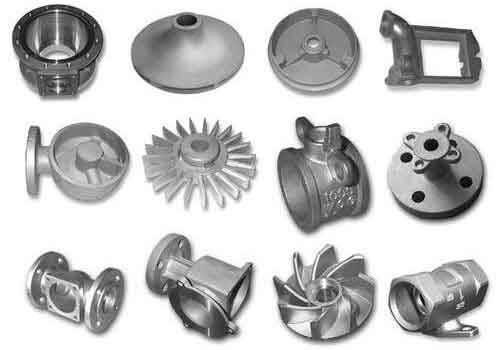
The applications of 3D printed sand molds and cores are vast and growing, fundamentally altering how industries approach the production of metal components. These applications can be categorized as follows:
- Rapid Prototyping and Design Validation: This is the most immediate application. Engineers can now design a part, print its sand mold, cast it in the intended metal, and have a functional prototype in hand within days. This accelerates iteration cycles, allowing for more design exploration and optimization before committing to expensive hard tooling.
- Low-Volume and High-Mix Production: For industries like aerospace, defense, and heavy machinery, where production runs are small but part complexity and performance are critical, 3D printing is ideal. It enables the cost-effective manufacturing of legacy part replacements, custom components, and specialized tooling without the burden of pattern costs.
- Manufacturing of Complex, Consolidated Geometries: This is perhaps the most transformative aspect. Traditional casting limits designs due to the need to extract patterns and assemble cores. 3D printing removes these constraints. It allows for the creation of topology-optimized structures, integrated conformal cooling channels within mold tooling itself, and the consolidation of multiple assembled cores into a single, printed piece. This leads to lighter, stronger, and more performant final sand casting parts. The weight savings and performance gains can be modeled. For a topology-optimized bracket, the reduction in mass $m_{reduced}$ while maintaining stiffness can be a primary goal, often achieved through lattice structures that were previously impossible to core.
- Bridge Tooling and Short-Run Production: While permanent tooling (e.g., die-casting molds) is being manufactured, 3D printed sand molds can be used to produce initial batches of sand casting parts for market testing, certification, or early-stage production, significantly shortening time-to-market.
The growth of this technology is supported by a maturing, interconnected ecosystem or industry chain. Its development cannot be viewed in isolation but as part of a synergistic value network:
| Industry Chain Segment | Key Components & Status | Impact on Sand Casting Parts Production |
|---|---|---|
| Upstream (Inputs) | Materials: Foundry sands (SiO2, ZrSiO4, Ceramic), Binders (Furan, Phenolic, inorganic). Hardware Components: Precision printheads, linear motion systems, servo drives. Software: CAD/CAM, slicing, process simulation, build preparation tools. |
Material properties directly affect cast surface finish and dimensional accuracy. Reliable, high-performance printheads are critical for speed and detail. Advanced software ensures optimal support generation, nesting, and printing parameters to minimize defects in the final cast part. |
| Midstream (Enablers) | 3D Printer Manufacturers: Companies developing industrial-scale binder jetting systems for sand. Technology & Service Platforms: Offering printing-as-a-service, technical consulting, and application development. |
This segment creates the physical capability. Printer evolution focuses on larger build volumes (e.g., 2m x 4m), higher print speeds (via multi-printhead arrays), and improved reliability to make the production of large or batch sand casting parts viable. |
| Downstream (Applications) | End-Use Industries: Aerospace (engine components, turbine housings), Automotive (prototype engine blocks, cylinder heads), Heavy Machinery, Pump & Valve bodies, Art & Architecture. | This is the demand driver. Adoption in these high-value industries validates the technology, pushes performance boundaries, and creates the economic pull for upstream and midstream innovation. The ability to produce a complex pump volute or an integrally cored turbine inlet as a single sand piece is a game-changer. |
Looking forward, the trajectory for 3D printing in sand casting is one of accelerated integration and sophistication. Several key trends are emerging:
- Hyper-Efficiency and Productivity Gains: The current focus is on dramatically increasing the volumetric print rate $V_{print}$ to reduce the cost-per-part. This is being pursued through multi-level strategies:
$$V_{print} = \frac{A_{bed} \cdot h}{t_{cycle}}$$
Where $A_{bed}$ is the build area, $h$ is the layer thickness, and $t_{cycle}$ is the time per layer. Innovations aim to maximize $A_{bed}$ with larger machines, optimize $h$ for speed vs. resolution, and minimize $t_{cycle}$ through faster recoating, higher-frequency printheads, and parallel processing (e.g., dual-build chambers). The goal is to make the technology competitive for higher-volume series of sand casting parts. - Advanced Material Systems: Research is ongoing into next-generation sands and binders. This includes engineered sands with superior thermal stability and collapse characteristics, and novel binder chemistries that improve bench life, cold-box-like curing speeds, and gas evolution during pouring to minimize casting defects. The relationship between binder composition, curing kinetics, and final mold strength is a critical area of study, often guided by chemical rate equations.
- Full Process Integration and Automation: The vision is the “lights-out” digital foundry. This involves integrating the 3D printer with automated post-processing stations (de-powdering, curing), robotic handling for mold assembly and pouring, and closed-loop sand reclamation systems. This creates a continuous, digitally managed flow from CAD file to finished sand casting parts, maximizing uptime and consistency.
- Intelligent Process Control and AI: Machine learning algorithms are beginning to be applied to optimize print parameters, predict and compensate for potential distortions, and perform real-time quality assurance via in-situ monitoring (e.g., visual, thermal). This moves the process from experience-based to data-driven, ensuring higher and more predictable quality for critical sand casting parts.
- Standardization and Qualification: As the technology moves from prototyping to certified production, especially in aerospace and defense, the development of industry-wide standards for materials, processes, and quality assurance becomes paramount. This will provide the confidence needed for widespread adoption in safety-critical applications.
The integration of additive manufacturing into sand casting is far more than a novel prototyping trick. It is a cornerstone technology for the future of smart, agile, and sustainable manufacturing. By decoupling the cost of production from the complexity of the part, it democratizes innovation, allowing designers and engineers to create previously unimaginable geometries. It makes small-batch production economically viable, supports mass customization, and significantly reduces the environmental footprint of casting through near-zero waste sand and the elimination of pattern-making waste streams. The transformation of the foundry from a “blacksmith’s shop” to a digitally-controlled, clean, and highly efficient production center is already underway. The production of sand casting parts is being redefined, leading us toward a future where manufacturing complexity is free, lead times are measured in hours, and human creativity is the only true limit.