
In the field of wind energy, the operational environment for turbines is notoriously harsh. Support components, such as hubs, main frames, bearing housings, and gearbox casings, must endure long-term exposure to wind loads, impact forces, and low temperatures. Therefore, these parts require excellent mechanical properties, resistance to low-temperature impact, good damping characteristics, and high fatigue strength. Nodular cast iron, also known as spheroidal graphite iron, has emerged as a material of choice due to its high strength, good fatigue resistance, moderate toughness, excellent wear resistance, and superior damping capacity. Its lower notch sensitivity compared to steel and favorable castability make it ideal for large, complex castings in wind turbines. However, a persistent challenge in producing high-quality nodular cast iron castings is the occurrence of shrinkage porosity, a defect that can severely compromise mechanical integrity.
Shrinkage porosity in nodular cast iron typically manifests as dispersed, fine cavities within the casting, often hidden from visual inspection. This defect can reduce tensile strength by approximately 60% and fatigue strength by 40% to 50%, posing significant risks to component reliability. As an engineer specializing in large casting design and production, I have extensively studied the root causes of shrinkage in nodular cast iron and implemented various preventive strategies. In this article, I will delve into a comprehensive analysis of shrinkage formation from five key perspectives and propose effective control measures across three critical domains. The goal is to provide a detailed guide for foundries to enhance the quality and yield of wind turbine castings.
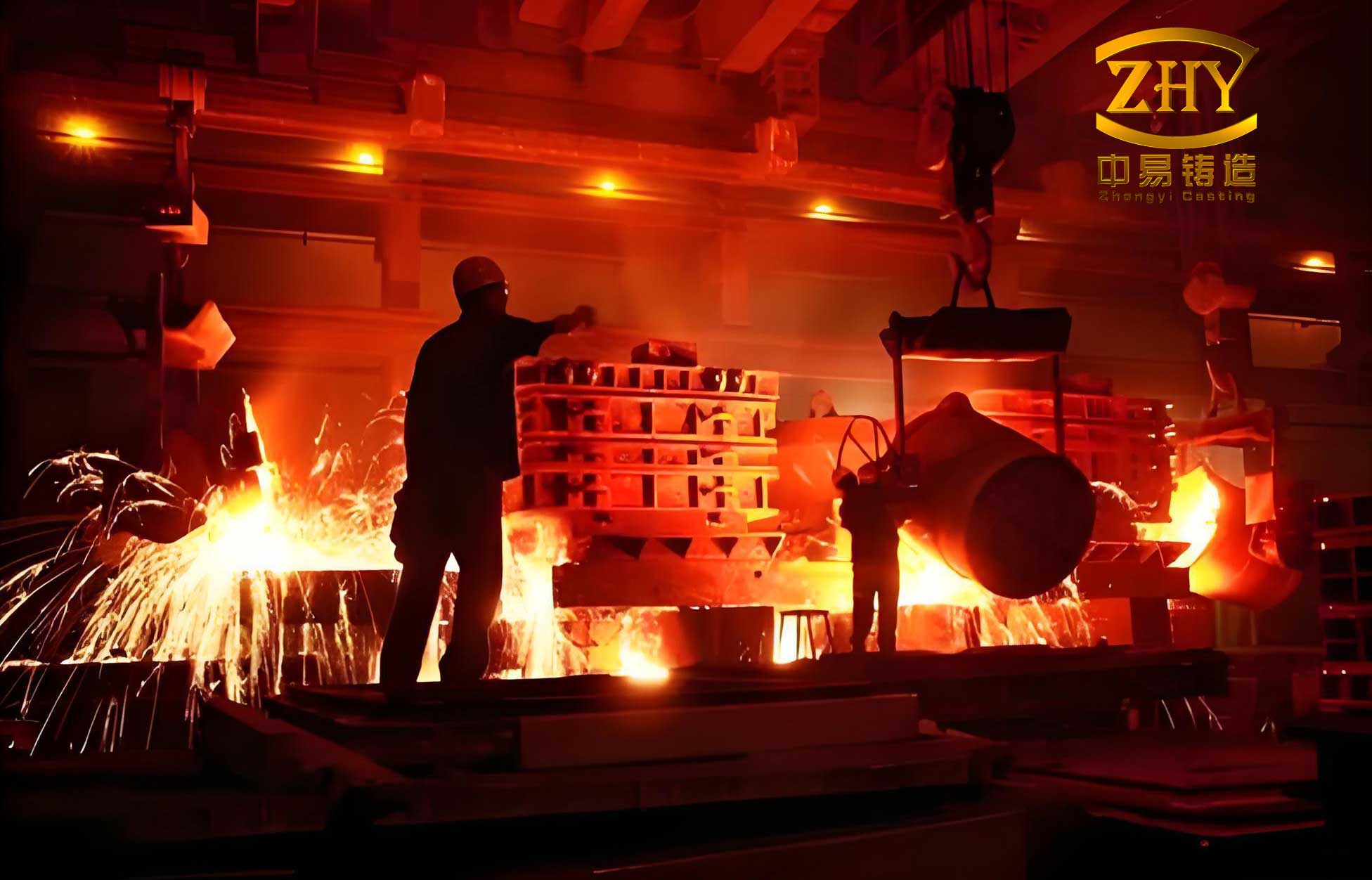
The fundamental reason for shrinkage porosity in nodular cast iron lies in its solidification characteristics. Unlike gray iron, nodular cast iron solidifies in a “mushy” manner, with a prolonged eutectic solidification time, a high number of eutectic cells, and significant expansion pressure during graphite precipitation. These factors create a tendency for internal shrinkage cavities to form if the solidification process is not properly controlled. The formation is influenced by a complex interplay of factors, which I will categorize and analyze in detail.
1. Causes of Shrinkage Porosity in Nodular Cast Iron Castings
Based on my experience and industry research, the primary causes can be attributed to the casting design, mold quality, gating and feeding system design, melting chemistry, and pouring parameters. Each factor contributes uniquely to the risk of shrinkage defects.
1.1 Casting Geometry and Design
Wind turbine components are characterized by complex geometries, large dimensions, and significant weight—often exceeding 30 tons. Wall thicknesses can vary from 60 mm to 120 mm or more. In such heavy-section nodular cast iron castings, areas with substantial thickness or abrupt changes in cross-section are prone to shrinkage. During solidification, the outer surfaces of thick sections cool rapidly, forming a solid shell. The interior metal, however, remains hot and liquid for an extended period, leading to increased液态收缩 (liquid contraction). This creates a demand for feed metal that, if unmet, results in shrinkage porosity at thermal centers or hot spots.
Mathematically, the susceptibility to shrinkage in a thick section can be related to the modulus (volume-to-surface area ratio). A higher modulus indicates slower cooling and a greater tendency for shrinkage. The required feed volume \( V_{feed} \) can be estimated as:
$$ V_{feed} = V_{casting} \times (\beta_{liquid} + \beta_{solidification}) $$
where \( \beta_{liquid} \) is the液态收缩 coefficient (typically 1-2% for nodular cast iron) and \( \beta_{solidification} \) is the凝固收缩 coefficient (around 4-6% due to graphite expansion partially offsetting contraction). For isolated heavy sections, the feeding path becomes critical, and inadequate design leads to shrinkage.
1.2 Sand Mold Quality
The mold material plays a crucial role in dimensional stability during pouring and solidification. For nodular cast iron castings, we typically use furan resin-bonded sand. If the sand mold lacks sufficient refractoriness, high-temperature strength, or compactness, it can deform under the combined pressures of metal static head, graphite expansion, and thermal loading. This mold wall movement enlarges the mold cavity, effectively increasing the volume that must be fed by the molten metal, thereby promoting shrinkage.
Moreover, high moisture content in the sand can reduce the thickness of the dried mold surface layer and increase the moisture condensation zone. This enhances the mold’s ability to yield, exacerbating shrinkage. A quantitative measure is the mold’s yield strength at elevated temperatures. If the stress \( \sigma_{mold} \) exceeds its high-temperature strength \( S_{HT} \), deformation occurs:
$$ \sigma_{mold} = P_{metal} + P_{graphite} – P_{sand\_resistance} $$
where \( P_{metal} \) is the metallostatic pressure, \( P_{graphite} \) is the expansion pressure from graphite precipitation (which can be significant in nodular cast iron), and \( P_{sand\_resistance} \) is the sand’s resistance to deformation. Inadequate sand properties lead to \( \sigma_{mold} > S_{HT} \), causing mold wall movement and shrinkage.
1.3 Gating and Feeding System Design
A poorly designed gating and feeding system fails to promote directional solidification, which is essential for feeding shrinkage in nodular cast iron. Key issues include:
- Ingate Placement: If ingates are located in thick sections and are themselves thick, they act as hot spots, remaining liquid long after the surrounding casting has solidified. Under graphite expansion pressure, liquid metal may even flow back into the gating system, creating shrinkage cavities in the casting.
- Riser Design: Risers (feeders) must be correctly positioned, sized, and numerous enough to feed the thermal centers. The riser efficiency \( \eta_{riser} \) for nodular cast iron is lower than for steel due to graphite expansion, often requiring larger risers. The required riser volume \( V_{riser} \) can be estimated using Chvorinov’s rule modified for feeding demand:
$$ V_{riser} \geq \frac{V_{casting} \times (\beta_{total})}{\eta_{riser} \times f_{feeding}} $$
where \( \beta_{total} \) is the total shrinkage potential, and \( f_{feeding} \) is a factor accounting for feeding path obstacles. - Use of Chills and Venting: Improper application of chills can disrupt directional solidification. Additionally, if blind risers are not topped with venting risers, gas pressure build-up can hinder feed metal flow.
1.4 Melting and Chemistry Control
The chemical composition of the molten nodular cast iron profoundly influences shrinkage tendency. Key elements include:
| Element | Typical Range for QT400-18AL-1 | Effect on Shrinkage |
|---|---|---|
| Carbon (C) | 3.75–3.95% | Increases fluidity and graphite nodule count up to a point; beyond optimal, reduces fluidity. |
| Silicon (Si) | 1.8–2.3% | Promotes graphitization but must be controlled for low-temperature impact toughness. |
| Magnesium (Mg) | 0.035–0.06% | Essential for nodularization but increases chilling tendency and收缩. |
| Rare Earth (RE) | 0.005–0.015% | Aids nodularization but can promote carbides if excessive. |
| Phosphorus (P) | ≤0.04% | Forms low-melting phosphides, expands freezing range, impairs feeding. |
| Sulfur (S) | ≤0.015% | Inhibits graphitization, reduces fluidity, increases shrinkage. |
High gas content (hydrogen, nitrogen, oxygen) in the melt can lead to microporosity that exacerbates shrinkage. During solidification, gas bubbles nucleate and act as sites for shrinkage cavity formation, as the surrounding liquid cannot feed these areas effectively.
Inoculation is critical for nodular cast iron. Proper inoculation with ferrosilicon or other inoculants increases graphite nodule count, refines the graphite structure, and promotes the formation of ferrite. This enhances the feeding characteristics by reducing the carbon diffusion distance and smoothing the eutectic cell interfaces, allowing better liquid metal flow to compensate for shrinkage. Inadequate inoculation leads to carbide formation, increasing solidification收缩 and shrinkage propensity.
The relationship between nodule count \( N \) and shrinkage tendency can be expressed as:
$$ S_{index} \propto \frac{1}{\sqrt{N}} $$
where a higher \( N \) (achieved through effective inoculation) reduces the shrinkage index \( S_{index} \).
1.5 Pouring Temperature and Practice
Pouring temperature is a double-edged sword. Too low a temperature (e.g., below 1320°C) reduces fluidity and the feeding capability of risers, making it difficult to feed distant sections in large nodular cast iron castings. Conversely, too high a temperature (e.g., above 1380°C) increases the total液态收缩量 and imposes greater thermal load on the mold, promoting mold wall movement and increasing the required feed volume.
The optimal pouring temperature range for heavy-section nodular cast iron castings is typically 1340–1360°C. Additionally, practices such as not filling risers completely or failing to top up open risers with hot metal reduce the effective feeding pressure and volume, leading to shrinkage.
2. Preventive Measures for Shrinkage Porosity
To mitigate shrinkage defects in nodular cast iron components for wind turbines, a holistic approach encompassing chemical composition control, casting process optimization, and stringent melting practices is essential. Based on my practical experience, the following measures have proven effective.
2.1 Chemical Composition Control
Precise control of chemistry is paramount. For wind turbine castings requiring QT400-18AL-1 grade with -30°C impact toughness, I recommend the following composition ranges, which balance mechanical properties and castability:
| Element | Target Weight % | Rationale |
|---|---|---|
| C | 3.80–3.90 | Ensures good fluidity and graphitization potential without excessive eutectic cells. |
| Si | 1.9–2.1 | Sufficient for ferrite formation while maintaining low-temperature toughness. |
| Mn | 0.15–0.25 | Kept low to avoid pearlite stabilization and segregation. |
| P | ≤0.035 | Minimized to reduce phosphide networks and freezing range. |
| S | ≤0.012 | Minimized to improve nodularization efficiency and fluidity. |
| Mg | 0.040–0.055 | Optimal for nodularization without excessive chilling effect. |
| RE | 0.008–0.012 | Assists nodularization and controls trace element effects. |
The carbon equivalent (CE) is a useful parameter to assess castability and shrinkage tendency:
$$ CE = \%C + \frac{\%Si + \%P}{3} $$
For nodular cast iron, a CE between 4.3 and 4.5 is often targeted to ensure good fluidity while minimizing shrinkage risks.
2.2 Casting Process Control
Advanced casting工艺 design is critical for large nodular cast iron castings.
Mold Making: Use high-quality furan resin sand with adequate binder content (e.g., 1.0–1.2% resin) to ensure high strength and low deformation. The sand should be thoroughly mixed and compacted to achieve a uniform hardness (e.g., 85-90 on the Brinell hardness scale for molds). Pre-drying molds before pouring can reduce moisture-related issues.
Gating and Feeding Design: Employ computer simulation software like ProCAST or MAGMA to optimize the system. Key principles include:
- Design ingates to enter thinner sections, promoting directional solidification toward risers.
- Use multiple risers sized according to the modulus method. For nodular cast iron, riser necks should be designed to remain open longer than the feeding sections.
- Strategic placement of chills (internal or external) to accelerate cooling in hot spots and create favorable temperature gradients. The chill size can be determined by the modulus matching principle: \( M_{chill} \approx M_{casting} \) at the contact area.
- Ensure adequate venting for blind risers to avoid gas pressure build-up.
Simulation helps visualize solidification sequences, predict shrinkage locations, and iterate designs virtually, saving time and cost.
2.3 Melting and Pouring Practice Control
Strict control over melting and pouring operations is non-negotiable for quality nodular cast iron.
Melting: Use medium-frequency induction furnaces for precise temperature control and homogeneous chemistry. Implement real-time spectroscopy to monitor chemical composition and adjust promptly. Degassing treatments (e.g., nitrogen bubbling or vacuum degassing) can reduce gas content. The target hydrogen content should be below 2 ppm, and nitrogen below 80 ppm to minimize gas porosity synergies with shrinkage.
Inoculation Practice: Adopt a dual inoculation approach: primary inoculation during tapping (e.g., 0.4–0.6% FeSi alloy) and late stream inoculation during pouring (e.g., 0.1–0.2% FeSi). This ensures a high nodule count throughout the casting. The efficiency of inoculation can be monitored by thermal analysis, where the recalescence temperature indicates graphite nucleation potential.
Temperature Control: Maintain precise temperature logs. The tap temperature should be controlled at 1450±10°C, and the pouring temperature at 1350±10°C for large nodular cast iron castings. Use automated pouring systems for consistency. For open risers, practice hot topping with excess metal to enhance feeding.
A comprehensive quality control framework should include mechanical testing, microstructural analysis, and non-destructive testing (NDT) per standards like EN 12680 (ultrasonic testing) and EN 1369 (magnetic particle testing).
3. Conclusion
Shrinkage porosity in nodular cast iron castings for wind turbines is a multifaceted defect stemming from material properties, design factors, and process variables. Through detailed analysis of casting geometry, mold quality, gating design, chemistry, and thermal parameters, foundries can identify root causes. Implementing stringent controls on chemical composition, leveraging advanced casting simulation for工艺 optimization, and adhering to rigorous melting and pouring protocols are proven strategies to mitigate shrinkage. As wind turbine components continue to grow in size and complexity, ongoing research and adaptation of these principles will be essential to achieve high-quality, reliable nodular cast iron castings that meet the demanding standards of the renewable energy industry. The continuous improvement in producing sound nodular cast iron components not only enhances turbine performance but also contributes to the sustainability and cost-effectiveness of wind energy.