
In the foundry production of upper core plate components at our facility, a recurring and severe quality issue was identified, leading to significant batch rejection. The defect manifested as porosity, specifically located at the fillet radius where the convex circle meets the large planar surface, as well as at the midpoint opposite the two ingates and the central axis between them. The presence of these casting defects was unacceptable for the component’s performance requirements. Consequently, we initiated a thorough investigation to analyze the root causes, focusing primarily on the porosity problem. Our analysis pointed to several interrelated factors:
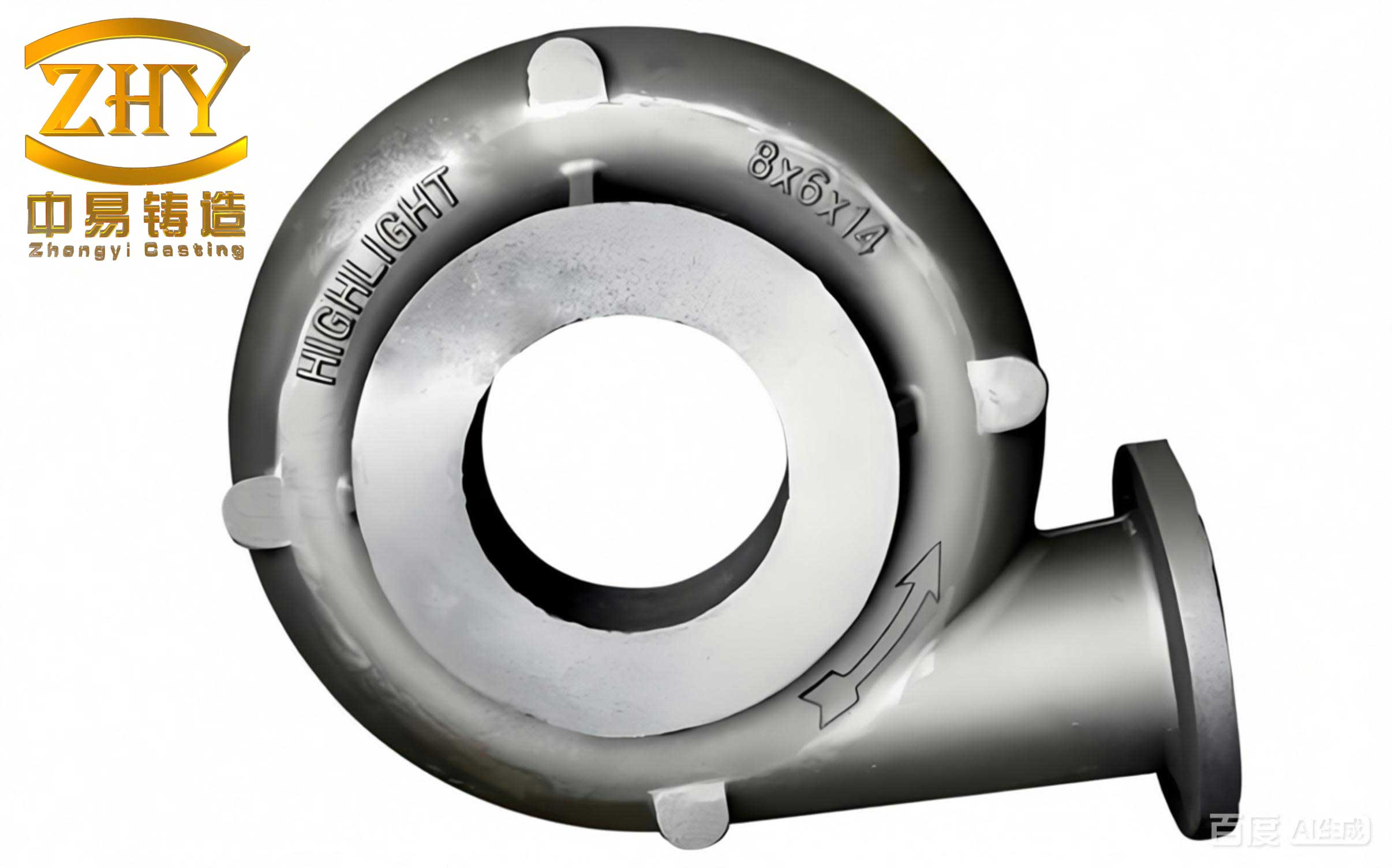
- Turbulent Flow and Metal Stream Convergence: The initial filling of the mold cavity created turbulent flow. The convergence of two opposing streams of molten steel led to localized areas of concentrated, clustered porosity.
- Thermal Challenges at Re-entrant Sections: The geometry, particularly concave fillets (re-entrant angles), presents a significant challenge. The intense and prolonged thermal action from the molten metal in these areas creates a high propensity for various casting defects such as sand burn-on/burning, and both exogenous and reaction-type porosity.
- Deoxidizer Control: The appropriateness of the residual aluminum content in the steel melt relative to the casting section thickness is critical, as it influences the formation of subsurface pinholes or microporosity.
- Chill Condition: The surface condition of external chills, including the presence of scale, rust, or oil contamination, severely compromises their heat-extraction efficiency and can be a source of gas.
- Molding Sand Moisture: Excessive moisture content in the facing sand or backing sand beyond specified limits is a major contributor to gas generation.
This report details the theoretical analysis of these issues, formulates targeted corrective actions, and presents the validation results from their implementation, culminating in a revised and stabilized production process for the upper core plate.
Theoretical Analysis of Defect Formation
1. Porosity from Flow Dynamics and Oxide Entrainment
The original gating design was an open system with oversized ingates relative to the theoretical pouring weight. This design results in a low initial entry velocity of molten steel into the cavity. Coupled with a top-gating arrangement (as in the original process), this leads to a sequential solidification pattern where the metal falls from a height. Upon entering, the stream splits and flows toward the lowest parts of the mold. During this prolonged flow, the high-temperature steel is excessively exposed to air within the cavity, leading to significant oxidation. The surface layer of the flowing metal becomes enriched with oxygen ($\text{O}$).
At the confluence plane—the symmetrical axis between the two ingates—these two oxygen-enriched streams meet. As the casting cools and solidifies, the solubility of oxygen in steel decreases drastically. The excess oxygen is rejected from the solidifying metal, forming degassing-type or precipitated porosity. The characteristic of this casting defect is its location along the ingate symmetry axis and the presence of a dark gray, oxidized layer on the inner surface of the pores. The reaction can be conceptually simplified as the rejection of dissolved oxygen upon solidification:
$$ [O]_{liquid\ steel} \rightarrow \frac{1}{2} O_{2(g)} \uparrow $$
The driving force is the change in solubility, $S$, with temperature $T$:
$$ \frac{dS}{dT} > 0 $$
Thus, cooling leads to supersaturation and gas precipitation.
2. Defects in Thermal Hot Spots (Re-entrant Sections)
Re-entrant corners or concave fillets act as natural thermal hot spots due to their unfavorable volume-to-surface-area ratio for heat dissipation. The effective cooling area is small, leading to:
– Prolonged liquid state of the metal.
– Increased severity of metal oxidation (higher $[O]$ content).
– Intense and sustained heating of the mold sand.
This combination creates a perfect environment for multiple casting defects:
– Chemical Burn-on/Sand Fusion: At high temperatures, the iron oxide ($FeO$) from oxidized steel reacts with silica ($SiO_2$) in the sand to form low-melting-point iron silicates (e.g., Fayalite, $2FeO \cdot SiO_2$), which bind sand grains to the casting surface.
$$ 2FeO + SiO_2 \rightarrow (2FeO \cdot SiO_2) $$
– Reaction Porosity: The same $FeO$ can react with carbon in the steel ($[C]$) to produce carbon monoxide gas, which may become trapped.
$$ FeO + [C] \rightarrow Fe + CO_{(g)} \uparrow $$
– Mechanical Penetration: Prolonged heating reduces the sand’s strength and increases metal fluidity, allowing metal to penetrate sand grain interstices.
– Gas Entrapment: The degraded sand layer has poor permeability, trapping gases generated from binders or moisture.
The heat transfer challenge can be modeled using the general heat conduction equation. In a simple 1D approximation for a sand wall of thickness $L$, the temperature profile $T(x,t)$ is given by:
$$ \frac{\partial T}{\partial t} = \alpha \frac{\partial^2 T}{\partial x^2} $$
where $\alpha$ is the thermal diffusivity. A small concave area has a high geometric modulus ($M_g = V/A_{cooling}$), leading to a longer local solidification time $t_f$, approximately by Chvorinov’s rule:
$$ t_f = k \cdot M_g^n $$
where $k$ and $n$ are constants. A larger $M_g$ directly increases $t_f$, extending the time window for defect formation.
3. Other Contributing Factors
Residual Aluminum: Aluminum is a potent deoxidizer. An incorrect amount can lead to the formation of alumina ($Al_2O_3$) inclusions or react with moisture to form hydrogen gas, causing pinhole porosity. There is a critical window for optimal deoxidation.
Contaminated Chills: Surface contaminants on chills vaporize instantly upon contact with molten metal, creating a gas layer that insulates the chill (chill boiling) and leads to local shrinkage or gas defects.
Excessive Sand Moisture: Moisture in facing or backing sand migrates over time. When heated by molten metal, it generates large volumes of steam ($H_2O_{(g)}$):
$$ H_2O_{(l)} \xrightarrow{\Delta} H_2O_{(g)} \uparrow $$
If the mold’s gas permeability is insufficient or the gas evolution rate is too high, the steam pressure $P_{gas}$ can exceed the metallostatic pressure $P_{metal}$ at the metal-mold interface, forcing gas into the solidifying metal and creating exogenous (blowhole) porosity.
$$ P_{gas} > P_{metal} = \rho g h $$
| Defect Type | Primary Location | Root Cause Category | Key Mechanism |
|---|---|---|---|
| Clustered Porosity (Oxide-rich) | Mid-axis between/opposite ingates | Gating & Filling | Oxide entrainment at converging flow fronts, oxygen precipitation. |
| Sand Burn-on & Reaction Porosity | Concave fillet radii (re-entrant sections) | Geometry & Thermal | Localized overheating, prolonged liquid time, sand-metal reaction ($FeO+SiO_2$). |
| Exogenous (Blowhole) Porosity | Random, often near hot spots or chill faces | Mold Materials & Gases | Excessive sand moisture, contaminated chills, low permeability. |
| Potential Pinhole Porosity | Subsurface, throughout casting | Metallurgy | Improper deoxidation control (residual Al). |
Corrective Measures and Process Optimization
Based on the root cause analysis, a multi-faceted corrective plan was designed and implemented to tackle each identified source of casting defects.
1. Redesign of Gating and Feeding System
The gating philosophy was completely reversed. We transitioned from a top-pouring, open system to a bottom-up, pressurized system with a reverse tilt (pouring from the lower side of the casting). The primary objectives were:
– To promote tranquil, non-turbulent filling from the bottom of the mold cavity.
– To minimize the entrainment of air and oxides during the filling process.
– To establish a strong temperature gradient conducive to directional solidification toward the feed head.
The riser (feed head) was relocated to the side opposite the ingates, placing it at the highest point of the casting. Furthermore, insulating riser sleeves were adopted to improve feeding efficiency and significantly increase the casting yield. The contrast between old and new systems is summarized below:
| Parameter | Original Process | Revised Process | Intended Effect |
|---|---|---|---|
| Gating Type | Open System, Top Gating | Pressurized System, Bottom Gating | Reduces turbulence, minimizes oxide formation. |
| Ingate Size (Relative) | Oversized | Theoretically calculated (reduced) | Increases entry velocity, promotes rapid filling. |
| Metal Flow Path | Falls, Splits, Flows Down | Enters at bottom, fills upward | Prevents splashing and air entrapment; smoother front. |
| Riser Position | Near ingates (higher in mold) | Opposite ingates (highest point) | Creates better thermal gradient for directional solidification. |
| Riser Type | Open (Conventional) Riser | Insulated Riser Sleeve | Enhances feeding efficiency, improves yield. |
| Expected Porosity | Oxide-related on symmetry axis | Eliminated or drastically reduced | Directly addresses the primary defect. |
2. Enhanced Cooling and Barrier at Hot Spots
To address the casting defects in the concave fillet areas, a combined approach was taken:
– Increased Sand Compaction: The mold sand in these specific areas was rammed to a higher hardness value to improve its thermal capacity ($\rho c_p$) and conductivity ($k$), thereby extracting heat faster. The goal was to reduce the local solidification time $t_f$.
– Application of an Exothermic/Insulative Wash: A zircon-based alcohol-borne coating was applied to the sand surface in the concave regions. This coating serves three critical functions:
1. It creates a refractory barrier, physically inhibiting sand-metal reactions and gas penetration.
2. Its exothermic nature helps keep the metal fluid locally for feeding, while its insulating properties protect the sand.
3. It improves the surface finish of the casting in that area.
3. Strict Process Control Measures
Standard Operating Procedures (SOPs) were tightened to control variability:
– Deoxidation Practice: The ladle addition of aluminum was strictly controlled and logged. The target was to maintain the residual aluminum within a narrow, optimal range to ensure effective deoxidation without causing subsequent reaction-related casting defects.
– Chill Preparation: A formal chill preparation procedure was instituted. All external chills are now grit-blasted to bright metal, pre-heated to around 150-200°C to remove moisture, and used immediately to prevent re-oxidation. The condition is verified before mold assembly.
– Sand Moisture Management: The moisture content of both facing and backing sand is now checked at frequent intervals using a calibrated moisture teller. Strict upper limits are enforced. The relationship between moisture content and potential gas volume is critical. The volume of steam generated from a unit mass of sand can be estimated from the ideal gas law:
$$ V_{gas} = \frac{nRT}{P} $$
where $n$ is moles of $H_2O$ from the moisture, $R$ is the gas constant, $T$ is the boiling point temperature, and $P$ is atmospheric pressure. Controlling moisture directly controls $n$, and thus $V_{gas}$.
Implementation Results and Conclusion
The comprehensive set of corrective measures was implemented in a controlled production run. The results were monitored and evaluated through visual inspection, non-destructive testing, and subsequent machining of the castings.
Outcome: The implementation was unequivocally successful. The characteristic clustered porosity along the ingate symmetry axis was completely eliminated. The incidence of sand burn-on and roughness in the concave fillet areas was reduced to within acceptable limits, with no major reaction defects observed. The overall internal soundness of the castings improved significantly, as verified during machining operations. Furthermore, the use of insulated risers increased the casting yield, providing a tangible economic benefit alongside the quality improvement.
| Aspect | Before Improvement | After Improvement | Impact |
|---|---|---|---|
| Primary Porosity Defect | Chronic, batch-rejecting levels | Eliminated | Zero rejection for this defect. |
| Fillet Surface Quality | Severe burn-on, potential for scrap | Minor, acceptable finish | Reduced cleaning cost, reliable quality. |
| Casting Yield | Standard yield with open risers | Increased by ~15% | Reduced melting cost per good casting. |
| Process Consistency | High variability | Stable and controlled | Predictable production outcomes. |
Theoretical and Practical Conclusions
- The formation of casting defects, particularly gas-related ones, is rarely due to a single cause. It is often the synergistic result of fluid dynamics, thermal conditions, mold material properties, and metallurgical factors. A systematic, root-cause analysis is essential.
- Gating design is paramount in controlling the initial condition of the molten metal in the mold. A system that minimizes turbulence and air entrainment (e.g., bottom filling) is fundamental to preventing oxide-related defects. The modified gating can be analyzed using Bernoulli’s principle and the law of continuity for incompressible flow:
$$ P + \frac{1}{2}\rho v^2 + \rho gh = constant $$
A properly designed pressurized system manages the velocity $v$ and pressure $P$ at the ingate to achieve the desired filling pattern. - Geometric hot spots are inevitable in complex castings. Proactive measures such as localized chilling (using clean, effective chills), application of specialty coatings, and increased sand compaction are necessary to manage the local solidification time and prevent sand-metal interactions.
- Process control over auxiliary factors—deoxidizer residuals, chill condition, and sand moisture—is not secondary. It provides the consistent foundation without which even a good design can fail. The control of these variables reduces the noise in the system, allowing the primary design improvements to function as intended.
In conclusion, by applying a rigorous analytical framework to diagnose the sources of porosity and other casting defects, and by implementing a holistic set of corrective actions addressing gating, cooling, and process control, we successfully stabilized the production process for the upper core plate. This case underscores that resolving persistent casting defects requires an integrated approach combining sound theoretical principles with disciplined practical execution.