
In my experience with the commissioning of a new lost foam casting production line for steel components, I encountered persistent issues with crack formation during the heat treatment process. This article documents my first-hand investigation into the root causes, focusing on carbon pickup, slag inclusions, and gas porosity as primary factors. Through systematic experimentation and data analysis, I identified effective solutions to mitigate these defects in lost foam casting processes. The lost foam casting method involves coating a foam pattern with refractory material, placing it in a sand mold, and filling with dry or self-setting sand. During pouring, the high-temperature metal causes the foam to decompose and be replaced by the molten metal, resulting in the final casting. While lost foam casting offers advantages such as high precision, design flexibility, and lower operational costs, it is prone to defects like cracks, which compromise component integrity.
The formation of cracks in steel castings, particularly after quenching and tempering, is often attributed to inhomogeneities in chemical composition and internal flaws. In lost foam casting, carbon pickup occurs due to incomplete vaporization of the foam pattern, typically made of polystyrene, leading to residual carbon in the casting. This elevates the carbon content beyond specified limits, causing increased hardness, machining difficulties, and internal stresses that predispose the casting to cracking. Additionally, slag inclusions and gas porosity exacerbate these issues by creating weak points in the microstructure. My initial hypothesis was that optimizing process parameters in lost foam casting could reduce these defects. To test this, I conducted experiments using ZG27SiMn steel (with a nominal carbon content of 0.24–0.32%) as a model material, comparing ladle chemistry with casting samples to analyze carbon variation.
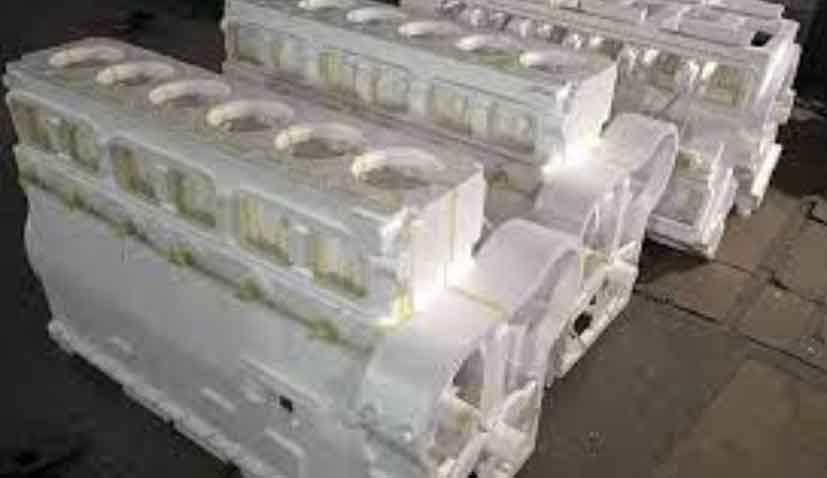
The first phase of experiments examined the effect of foam density on carbon pickup in lost foam casting. I used foam patterns with densities ranging from 8 to 18 kg/m³, poured under a vacuum of 50 kPa, and maintained ladle carbon at the lower specification limit (0.24–0.27%). Chemical analysis was performed on samples taken from the casting surface to the core at 5 mm intervals. The results, summarized in Table 1, show severe carbon pickup, especially near the surface, indicating incomplete foam decomposition. For instance, in the first batch with 18 kg/m³ foam, carbon content increased from 0.22–0.25% in the ladle to over 0.32% in castings, exceeding acceptable limits. This gradient can be modeled by a diffusion equation: $$ \frac{\partial C}{\partial t} = D \nabla^2 C $$ where \( C \) is carbon concentration, \( t \) is time, and \( D \) is the diffusion coefficient. The high surface carbon led to bright carbon defects and stress concentrations, increasing crack susceptibility during heat treatment.
| Sample Point | Heat A (%) | Heat B (%) | Heat C (%) |
|---|---|---|---|
| Surface (a) | 0.35 | 0.34 | 0.33 |
| b | 0.32 | 0.31 | 0.30 |
| c | 0.29 | 0.28 | 0.27 |
| d | 0.27 | 0.26 | 0.25 |
| Core (e) | 0.25 | 0.24 | 0.23 |
Subsequent batches with lower foam densities (14 kg/m³ and 8–10 kg/m³) showed reduced carbon pickup, as seen in Tables 2 and 3. For example, with 14 kg/m³ foam, surface carbon decreased to around 0.30%, but still exceeded specifications. The 8–10 kg/m³ foam resulted in acceptable overall carbon levels, though a gradient persisted. This improvement can be quantified by a linear relationship: $$ \Delta C = k \cdot \rho $$ where \( \Delta C \) is the carbon increase, \( \rho \) is foam density, and \( k \) is a process-dependent constant. However, lower density foams introduced challenges like deformation and coating penetration, leading to surface defects. Post-heat treatment inspection revealed that cracks in these batches were associated with carbon inhomogeneity and internal voids, confirming the multifactorial nature of defects in lost foam casting.
| Sample Point | Heat A (%) | Heat B (%) | Heat C (%) |
|---|---|---|---|
| Surface (a) | 0.31 | 0.30 | 0.29 |
| b | 0.28 | 0.27 | 0.26 |
| c | 0.26 | 0.25 | 0.24 |
| d | 0.24 | 0.23 | 0.22 |
| Core (e) | 0.22 | 0.21 | 0.20 |
| Sample Point | Heat A (%) | Heat B (%) | Heat C (%) |
|---|---|---|---|
| Surface (a) | 0.29 | 0.28 | 0.27 |
| b | 0.27 | 0.26 | 0.25 |
| c | 0.25 | 0.24 | 0.23 |
| d | 0.23 | 0.22 | 0.21 |
| Core (e) | 0.21 | 0.20 | 0.19 |
The second phase of experiments aimed to enhance carbon expulsion and reduce slag inclusions in lost foam casting. I switched from blind risers to open riser systems, including full mold and shell casting methods. Slag was carefully removed from the ladle, and refractory covers were used to minimize reoxidation. In open riser full mold casting (Table 4), carbon pickup was reduced, with maximum increases of about 0.04%, resulting in compliant compositions. The carbon gradient persisted but was less pronounced, indicating improved foam decomposition. For shell casting (Table 5), where the foam is burned out before pouring, carbon distribution became uniform, with negligible pickup. This approach effectively eliminated carbon-related cracks, as confirmed by post-treatment inspections showing no defects. The success of shell casting in lost foam casting can be attributed to better gas and slag removal, modeled by the ideal gas law: $$ P V = n R T $$ where \( P \) is pressure, \( V \) is volume, \( n \) is moles of gas, \( R \) is the gas constant, and \( T \) is temperature, highlighting how open risers facilitate degassing.
| Sample Point | Heat A (%) | Heat B (%) | Heat C (%) |
|---|---|---|---|
| Surface (a) | 0.27 | 0.26 | 0.28 |
| b | 0.25 | 0.24 | 0.26 |
| c | 0.23 | 0.22 | 0.24 |
| d | 0.21 | 0.20 | 0.22 |
| Core (e) | 0.19 | 0.18 | 0.20 |
| Sample Point | Heat A (%) | Heat B (%) | Heat C (%) |
|---|---|---|---|
| Surface (a) | 0.28 | 0.27 | 0.25 |
| b | 0.28 | 0.27 | 0.25 |
| c | 0.28 | 0.27 | 0.25 |
| d | 0.28 | 0.27 | 0.25 |
| Core (e) | 0.28 | 0.27 | 0.25 |
Despite the effectiveness of shell casting in lost foam casting, several practical challenges emerged. The coating must have sufficient strength to prevent cracking during foam burnout, which requires thicker layers and complete drying. However, excessive thickness can impede gas escape, leading to porosity. The relationship between coating thickness \( \delta \) and gas permeability can be expressed as: $$ Q = \frac{k A \Delta P}{\mu \delta} $$ where \( Q \) is gas flow rate, \( k \) is permeability, \( A \) is area, \( \Delta P \) is pressure difference, and \( \mu \) is viscosity. Optimizing this balance is crucial in lost foam casting. Additionally, maintaining adequate vacuum pressure is essential to prevent mold collapse, and proper holding times after pouring are needed to ensure solidification without stress buildup. For example, the holding time \( t_h \) can be estimated using Chvorinov’s rule: $$ t_h = B \left( \frac{V}{A} \right)^n $$ where \( B \) and \( n \) are constants, \( V \) is volume, and \( A \) is surface area. Coordination among operators is vital to avoid defects like塌箱 (mold collapse), and slag control measures, such as ladle lining and covering agents, must be integrated into the lost foam casting process.
In conclusion, my investigation demonstrates that crack defects in lost foam casting of steel are primarily driven by carbon pickup, slag inclusions, and gas porosity. Through controlled experiments, I validated that reducing foam density and adopting open riser shell casting significantly mitigates these issues. The data show that carbon homogeneity improves with lower density foams, and shell casting eliminates residual carbon, thereby reducing stress concentrations. However, successful implementation of lost foam casting requires attention to coating properties, vacuum control, and operational coordination. Future work should focus on refining these parameters to enhance the reliability of lost foam casting for high-integrity steel components. This approach not only addresses immediate crack problems but also contributes to the broader advancement of lost foam casting technology.