
In my extensive experience in foundry engineering, particularly with medium-sized cast iron parts such as flywheels, gears, and pulley wheels, I have found that the design of the gating system is paramount to achieving high-quality castings. Among various gating configurations, the annular gating system has proven exceptionally effective for these cast iron parts, especially when dealing with diameters ranging from 200 mm to 1000 mm and weights up to 500 kg. This system not only ensures smooth metal flow but also enhances the metallurgical integrity of the final cast iron parts. In this article, I will delve into the structural characteristics, design parameters, and practical applications of the annular gating system, drawing from my hands-on work to optimize casting processes for diverse industrial components. The goal is to provide a comprehensive guide that leverages tables and formulas to summarize key aspects, ensuring reproducibility and reliability in producing defect-free cast iron parts.
The annular gating system is specifically tailored for rotational symmetric cast iron parts, which are ubiquitous in machinery like woodworking and papermaking equipment. These cast iron parts often suffer from defects such as shrinkage porosity, gas inclusions, and thermal stresses if the gating is not properly designed. Through iterative testing and refinement, I have developed a methodology that integrates a closed-open gating structure, which I will elaborate on. To begin, let me emphasize that the success of this system hinges on a deep understanding of fluid dynamics and solidification behavior in cast iron parts.
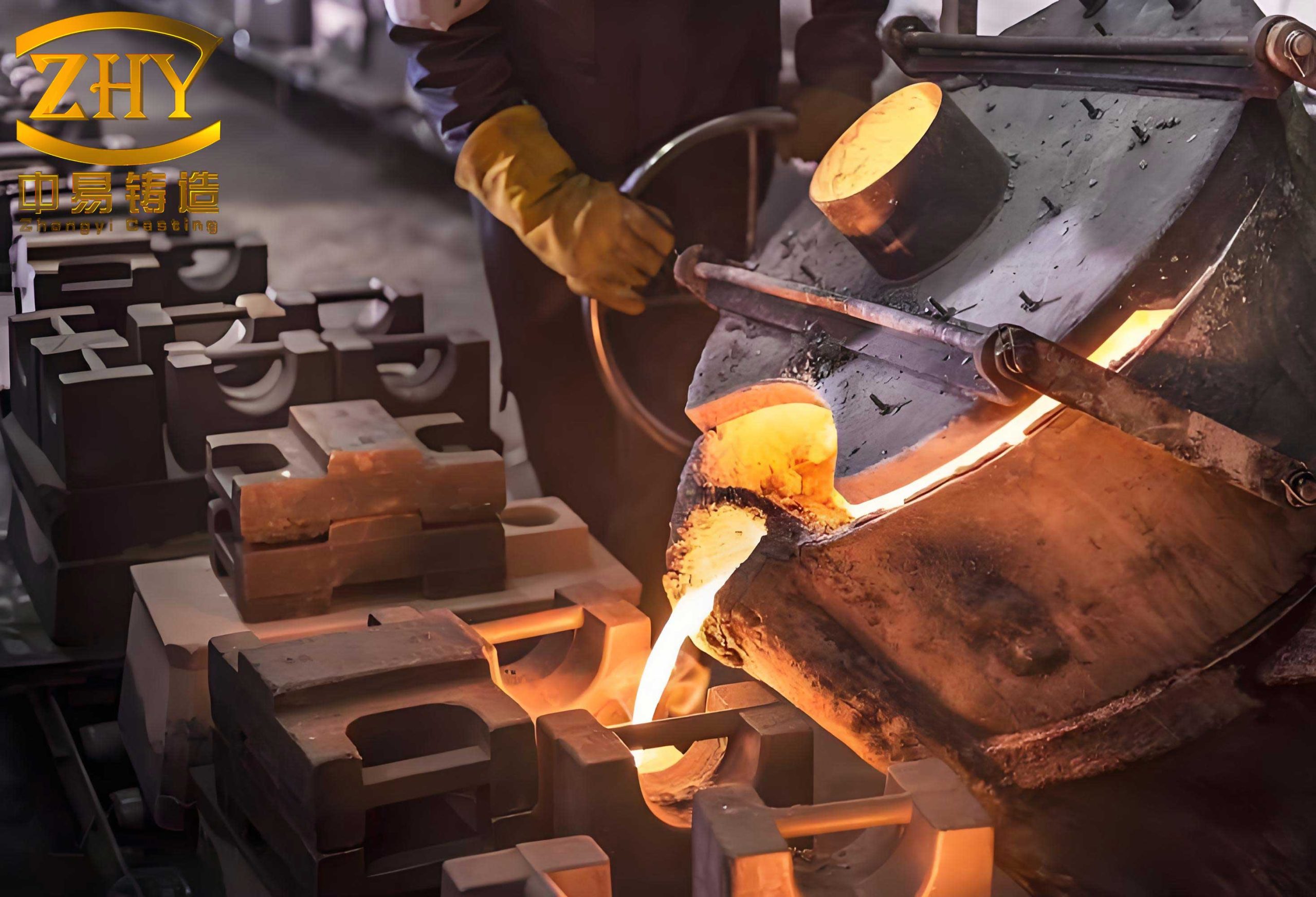
This image illustrates typical cast iron parts that benefit from annular gating, showcasing the complexity and scale involved. In my practice, I have consistently observed that implementing an annular gating system reduces scrap rates and improves the mechanical properties of cast iron parts, making it a cornerstone of modern casting techniques for medium-sized components.
The structural design of the annular gating system, as I have applied it, features a unique configuration that balances metal flow and thermal management. The system comprises a sprue, a horizontal runner, an annular runner, and multiple ingates arranged uniformly around the mold cavity. One of its primary advantages is the enhanced slag trapping and degassing capability, which is critical for producing clean cast iron parts. The transition from the sprue to the horizontal runner is designed as a closed section, promoting turbulence that helps in separating impurities and gases from the molten iron. Conversely, the section from the annular runner to the ingates is open, allowing for a calm and controlled filling of the mold cavity. This dual approach minimizes turbulence during pouring, thereby reducing the likelihood of oxide formation and gas entrapment in the cast iron parts. Furthermore, the use of multiple flat and vertical ingates ensures an even distribution of heat across the mold, which mitigates thermal gradients that could lead to stress, distortion, or cracking in the cast iron parts. From my perspective, this均匀 temperature field is essential for maintaining dimensional stability and integrity in large cast iron parts.
Another significant benefit I have noted is the improved feeding and compensation for shrinkage in cast iron parts. The annular gating system operates on a top-feeding principle, which creates a favorable temperature gradient from the bottom to the top of the casting. During solidification, the lower sections of the cast iron parts solidify first and undergo graphite expansion, which effectively compensates for the contraction in the upper sections. Meanwhile, the multiple ingates allow for continuous metal supply from the annular runner to address any shrinkage needs. As the cast iron parts fully enter the graphite expansion phase, the thin ingates solidify and seal, thereby maximizing the utilization of this expansion to eliminate shrinkage porosity and voids. This results in denser and more reliable cast iron parts, which are crucial for high-stress applications. In my work, I have validated that this system outperforms conventional gating methods for轮类 cast iron parts, particularly in reducing rejection rates due to shrinkage defects.
To quantitatively design the annular gating system for cast iron parts, I follow a systematic approach that involves several key parameters and calculations. The first step is to determine the total cross-sectional area of the ingates, denoted as $A_{\text{in-total}}$. This is calculated based on the weight of the cast iron part and the effective pressure head. The formula I use is:
$$ A_{\text{in-total}} = \frac{G}{0.31 \sqrt{H}} $$
where $G$ is the weight of the cast iron part in kilograms, and $H$ is the effective pressure head in centimeters, which includes the height of the sprue and the pouring cup. The coefficient 0.31 is an empirical value derived from my experience with gray cast iron parts, ensuring optimal flow rates without excessive velocity. For instance, for a cast iron part weighing 200 kg with an effective head of 30 cm, the total ingate area would be computed as follows:
$$ A_{\text{in-total}} = \frac{200}{0.31 \sqrt{30}} \approx \frac{200}{0.31 \times 5.477} \approx \frac{200}{1.698} \approx 117.8 \, \text{cm}^2 $$
This calculation sets the foundation for sizing other components of the gating system. Next, the number of ingates, $n$, is determined based on the diameter of the cast iron part. From my observations, a higher number of ingates promotes better temperature distribution, but it must be balanced against complexity. I have compiled a table that correlates铸件直径 (casting diameter) with the recommended number of ingates, as shown below:
| Casting Diameter (mm) | Number of Ingates, $n$ |
|---|---|
| 200–400 | 6–8 |
| 400–600 | 8–10 |
| 600–800 | 10–12 |
| 800–1000 | 12–14 |
This table ensures that the ingates are spaced evenly around the annular runner, which is vital for uniform filling of the cast iron parts. Subsequently, the average width of each ingate, $b_{\text{in}}$, is specified to maintain a flat and vertical profile, which enhances the feeding efficiency. Based on the diameter of the cast iron part, I use the following reference table:
| Casting Diameter (mm) | Average Ingate Width, $b_{\text{in}}$ (mm) |
|---|---|
| 200–400 | 15–20 |
| 400–600 | 20–25 |
| 600–800 | 25–30 |
| 800–1000 | 30–35 |
With $A_{\text{in-total}}$ and $n$ known, the cross-sectional area per ingate, $A_{\text{in-single}}$, can be derived as $A_{\text{in-single}} = A_{\text{in-total}} / n$. The height of the ingate, $h_{\text{in}}$, is then calculated using $h_{\text{in}} = A_{\text{in-single}} / b_{\text{in}}$, ensuring a flat shape that solidifies quickly to isolate the casting from the gating system. Moving on, the cross-sectional ratios of the annular gating system are critical for maintaining proper flow dynamics. In my designs, I adhere to the following proportion:
$$ A_{\text{in-total}} : A_{\text{ring}} : A_{\text{horizontal}} : A_{\text{sprue}} = 1 : 1.2 : 1.4 : 1.6 $$
where $A_{\text{ring}}$ is the cross-sectional area of the annular runner, $A_{\text{horizontal}}$ is that of the horizontal runner, and $A_{\text{sprue}}$ is that of the sprue. This ratio ensures a progressive reduction in flow resistance, promoting a smooth transition from the sprue to the ingates. For example, if $A_{\text{in-total}} = 120 \, \text{cm}^2$, then $A_{\text{ring}} = 144 \, \text{cm}^2$, $A_{\text{horizontal}} = 168 \, \text{cm}^2$, and $A_{\text{sprue}} = 192 \, \text{cm}^2$. These areas are essential for calculating the dimensions of each component, which I will detail further.
The annular runner itself requires careful sizing to fit around the cast iron part without interfering with the mold cavity. The average width of the annular runner, $b_{\text{ring}}$, is determined by the formula:
$$ b_{\text{ring}} = \frac{A_{\text{ring}}}{h_{\text{ring}}} $$
where $h_{\text{ring}}$ is the height of the annular runner, typically set between 20 mm to 40 mm based on the size of the cast iron part. The minimum inner diameter of the annular runner, $D_{\text{ring-in}}$, must accommodate the casting’s outer diameter at the parting line, denoted as $D_{\text{part-max}}$. I use the relation:
$$ D_{\text{ring-in}} = D_{\text{part-max}} + 50 \, \text{mm} $$
This provides a clearance to prevent direct contact and ensure proper metal distribution. For instance, for a cast iron part with a maximum outer diameter of 600 mm, the annular runner’s inner diameter would be 650 mm. These calculations, combined with the tables, form a robust framework for designing annular gating systems for various cast iron parts.
Beyond the core design parameters, I have identified several practical considerations that are crucial for successfully implementing the annular gating system in foundry operations. First, the mold must possess sufficient rigidity to withstand the metallostatic pressure and the expansion forces during solidification of cast iron parts. I strongly recommend using dry sand molds for this purpose, as they offer better dimensional stability and reduce the risk of mold wall movement. Second, venting is essential to allow gases to escape rapidly from the mold cavity. For轮缘 (rim) sections of cast iron parts, I uniformly place排气孔 (vent holes) with diameters ranging from 6 mm to 10 mm, spaced every 100 mm to 150 mm along the perimeter. This prevents gas entrapment and minimizes blowholes in the cast iron parts. Third, the clamping of mold boxes must be tight and maintained until the casting has fully solidified. Premature loosening of the clamps can compromise the utilization of graphite expansion, leading to shrinkage defects in the cast iron parts. I advise using sturdy箱卡 (box clamps) and checking their integrity before pouring.
Fourth, the pouring practice significantly impacts the quality of cast iron parts. I advocate for fast pouring to maintain a full pouring cup, which ensures a consistent metal head and minimizes turbulence. The pouring time, $t$, can be estimated using the formula:
$$ t = k \sqrt{G} $$
where $k$ is an empirical coefficient, typically around 0.6 to 0.8 for cast iron parts, and $G$ is the weight in kg. For example, a 300 kg cast iron part would require a pouring time of approximately $0.7 \sqrt{300} \approx 0.7 \times 17.32 \approx 12.1$ seconds. This rapid filling helps in achieving the desired temperature gradient. Fifth, for cast iron parts with spokes or ribs, such as spoked wheels, I place external chills at the junctions between spokes and the rim. These chills, made of cast iron or copper, accelerate cooling in thicker sections, preventing hot spots and promoting uniform solidification in the cast iron parts. The size of the chills is typically 20% to 30% of the junction’s volume, and they are positioned on the outer side of the mold to draw heat effectively.
To illustrate the application of these principles, I will describe a few典型实例 (typical examples) from my work, though without referencing specific proprietary details. The first example involves a woodworking band saw flywheel, which is a common cast iron part in machinery. This cast iron part had a diameter of 800 mm and a weight of 250 kg, made from gray cast iron (HT250). Using the annular gating system, I designed the gating with 10 ingates uniformly distributed around the annular runner. The total ingate area was calculated as 130 cm², with each ingate having a width of 25 mm and height of 52 mm. The annular runner had an inner diameter of 850 mm and a cross-sectional area of 156 cm². The mold was dry sand, and vent holes of 8 mm diameter were placed every 120 mm on the rim. After pouring, the cast iron part exhibited no shrinkage defects or gas pores, demonstrating the effectiveness of the system for such medium-sized cast iron parts.
The second example pertains to a paper rewinder pulley wheel, another critical cast iron part in industrial equipment. This casting weighed 400 kg with a diameter of 900 mm. I applied the annular gating system with 12 ingates, each with an average width of 30 mm. The total ingate area was 180 cm², and the annular runner dimensions were derived from the ratios mentioned earlier. External chills were added at the spoke-rim junctions to control solidification. The result was a sound casting with excellent surface finish and mechanical properties, highlighting how the annular gating system can be adapted for heavier cast iron parts. In both cases, the use of tables and formulas ensured precision and repeatability, reducing trial-and-error in the foundry.
In conclusion, the annular gating system is a highly effective method for producing medium-sized cast iron parts with complex geometries. Through my experience, I have shown that its structural design promotes slag removal, degassing, and controlled solidification, leading to superior quality cast iron parts. The design parameters, encapsulated in formulas like $A_{\text{in-total}} = G / (0.31 \sqrt{H})$ and tables for ingate number and width, provide a systematic approach for foundry engineers. Practical considerations such as mold rigidity, venting, clamping, and pouring speed further enhance the system’s performance. As the demand for durable and precise cast iron parts grows in industries like woodworking and papermaking, mastering the annular gating system becomes increasingly important. I encourage continued experimentation and documentation to refine these techniques, ensuring that cast iron parts meet the highest standards of quality and reliability. The integration of computational modeling with empirical data could further optimize the design, but the principles outlined here remain foundational for successful casting of轮类 cast iron parts.