
In my extensive practice within foundry engineering, I have consistently relied on virtual simulation tools to optimize the production of sand casting products. The casting process is inherently complex, with molten metal flow and solidification hidden within mold cavities, making direct observation impossible. Digital simulation technologies, such as AnyCasting, have revolutionized my approach by providing visual insights into filling and solidification sequences, thereby enabling proactive defect mitigation. This article delves into my firsthand experience applying AnyCasting virtual simulation in sand casting, focusing on defect analysis and process improvement for high-quality sand casting products.
The significance of casting process design cannot be overstated, as it directly impacts the dimensional accuracy, mechanical properties, and overall integrity of sand casting products. Traditional trial-and-error methods are time-consuming and costly. However, with AnyCasting, I can digitally replicate the casting process before physical production, allowing for rapid design validation and optimization. This software suite comprises three core modules: AnyPRE for pre-processing, AnySOLVER for computational solving, and AnyPOST for post-processing analysis. Through these, I gain a comprehensive understanding of phenomena like filling patterns, temperature gradients, and defect formation, which are critical for manufacturing reliable sand casting products.
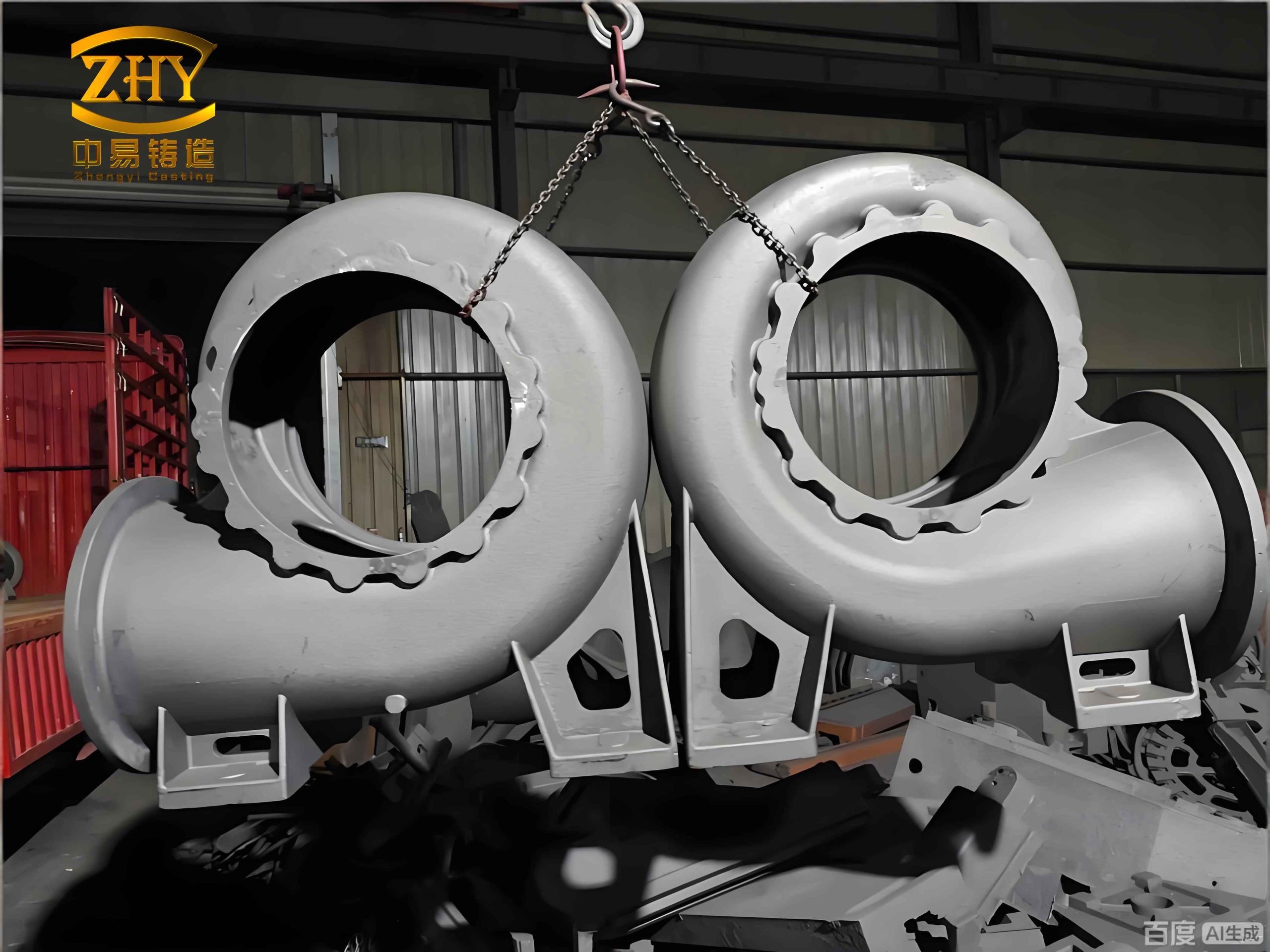
My workflow begins with AnyPRE, where I import CAD data, typically in STL format, representing the casting, gating system, mold, and cores. For instance, in a recent project involving a side pillow component—a common sand casting product—I set up the simulation for green sand casting. The material selected was an Al-Si eutectic alloy with a pouring temperature of 720°C, while the mold was composed of ordinary clay sand with an initial temperature of 25°C. Defining the entity properties and solving domain is crucial. I assign appropriate heat transfer coefficients (HTC) between different materials, as summarized in Table 1, which I have compiled based on empirical data for sand casting products.
| Entity 1 | Entity 2 | HTC (W/m²·K) | Remarks |
|---|---|---|---|
| Air | All | 0.001 | Negligible heat transfer |
| Casting | Mold/Core | 0.1 | Primary interface for sand casting products |
| Casting | Attachments | 0.2 | For chills or inserts |
| Mold | Core | 0.6 | Internal sand interfaces |
| Mold | Mold | 0.6 | Self-contact in sand |
| Exothermic Material | Casting | 0.1 | For riser aids |
| Exothermic Material | Mold | 0.001 | Insulating effect |
After configuring the gating conditions—gravity-driven pouring from the pouring cup—and setting the shrinkage model with a critical solid fraction of 0.5, I generate a non-uniform mesh. The mesh report, as seen in my side pillow model, ensures computational efficiency without sacrificing accuracy. For sand casting products, I also enable options for oxide inclusion and particle tracking to account for defects like slag entrapment. Once all parameters are set, I save the file in *.gsc format and proceed to AnySOLVER.
AnySOLVER is the computational engine that solves the governing equations for fluid flow and heat transfer during casting. It employs finite difference methods to simulate filling and solidification. In my simulations for sand casting products, I often monitor key variables such as velocity, pressure, and temperature. The solving process is iterative, and I observe the filling percentage and solidification percentage until completion. The software efficiently handles models for shrinkage, surface tension, and vacuum venting, which are vital for predicting defects in sand casting products. For example, the continuity and momentum equations during filling are represented as:
$$ \frac{\partial \rho}{\partial t} + \nabla \cdot (\rho \mathbf{v}) = 0 $$
$$ \rho \left( \frac{\partial \mathbf{v}}{\partial t} + \mathbf{v} \cdot \nabla \mathbf{v} \right) = -\nabla p + \mu \nabla^2 \mathbf{v} + \rho \mathbf{g} $$
where $\rho$ is density, $\mathbf{v}$ is velocity, $t$ is time, $p$ is pressure, $\mu$ is dynamic viscosity, and $\mathbf{g}$ is gravitational acceleration. For heat transfer during solidification, the energy equation is:
$$ \rho c_p \frac{\partial T}{\partial t} = \nabla \cdot (k \nabla T) + \dot{q} $$
with $c_p$ as specific heat, $T$ as temperature, $k$ as thermal conductivity, and $\dot{q}$ as latent heat release due to phase change. These equations form the backbone of AnySOLVER’s predictions for sand casting products.
Upon completion, I use AnyPOST for detailed analysis. This module visualizes results in 2D and 3D, offering animations of filling sequences, temperature contours, pressure distributions, and velocity vectors. For the side pillow casting—a representative sand casting product—I observed the filling sequence (Fig. 4 in original context, but here described narratively). The molten metal initially fills the sprue, then runners, and finally the mold cavity, with the last areas to fill being potential sites for misruns. By animating this process, I identify turbulence or premature solidification that could affect the quality of sand casting products.
Defect prediction is a cornerstone of my simulation work. In the side pillow model, AnyPOST’s advanced casting analysis highlighted shrinkage porosity, typically located at thermal centers or hot spots. Shrinkage occurs when liquid and solidification contraction are not compensated by feeding. The probability defect parameter maps show areas with high risk, often corresponding to sections with high volume-to-surface area ratios. For sand casting products, this is critical as shrinkage can undermine mechanical strength. I analyze temperature profiles during solidification; for instance, the temperature gradient $G$ and solidification rate $R$ influence shrinkage formation, often summarized by the Niyama criterion for microporosity:
$$ N_y = \frac{G}{\sqrt{R}} $$
where low $N_y$ values indicate susceptibility to shrinkage pores. In my simulation, regions with prolonged high temperatures, such as near sand cores, showed delayed solidification, leading to shrinkage cavities. To address this, I design the gating and risering systems to promote directional solidification, ensuring that sand casting products solidify progressively from remote sections toward feeders.
Another common defect in sand casting products is gas porosity, often caused by air entrainment during filling. Through velocity vector simulations and particle tracking in AnyPOST, I visualize regions where air may be entrapped. For example, in the side pillow model, vortex formation in the pouring cup led to air aspiration into the sprue. The distribution of entrained gas particles helps pinpoint potential gas pore locations, which typically appear as scattered small voids within the casting. To mitigate this, I optimize pouring practices, such as using tapered sprues or filters, to reduce turbulence and ensure laminar flow for sand casting products.
Horizontal vortex phenomena in the pouring cup are particularly intriguing. My simulations reveal that vortex formation depends on pouring height and cup geometry. When metal enters the sprue, it can generate rotational flow, creating a low-pressure zone at the vortex center that draws in air and slag. This is quantified by analyzing the angular velocity $\omega$ and radial pressure distribution $p(r)$:
$$ \omega = \frac{v_\theta}{r}, \quad \frac{\partial p}{\partial r} = \rho \frac{v_\theta^2}{r} $$
where $v_\theta$ is tangential velocity and $r$ is radial distance. A negative pressure gradient near the center can lead to aspiration. Based on my observations, I recommend maintaining high metal levels in the pouring cup and positioning ladles close to the cup to minimize horizontal velocity components, thereby improving the integrity of sand casting products.
To systematically address defects, I have developed strategies summarized in Table 2, which outlines common issues in sand casting products, their simulated indicators, and corrective actions derived from my AnyCasting analyses.
| Defect Type | Simulation Indicators | Probable Causes | Corrective Measures |
|---|---|---|---|
| Shrinkage Porosity | Hot spots, low temperature gradients, prolonged solidification times | Inadequate feeding, poor riser design, thick sections | Implement directional solidification with chills or risers; optimize gating for sequential cooling; reduce pouring temperature for sand casting products |
| Gas Porosity | Entrained air particles, vortex formation, negative pressure zones | Turbulent filling, air aspiration from pouring, mold gas evolution | Design smooth gating systems; use pouring basins with baffles; increase mold permeability; employ degassing techniques for alloys in sand casting products |
| Misruns and Cold Shuts | Incomplete filling, premature solidification fronts | Low pouring temperature, slow filling rates, inadequate gate sizes | Raise pouring temperature within limits; increase gate cross-sectional areas; preheat molds for thin-section sand casting products |
| Inclusions (Slag/Oxide) | Particle trajectories, high oxide concentration zones | Slag entrainment during pouring, reaction with atmosphere | Use filters in gating; employ skim gates; control pouring height to minimize turbulence in sand casting products |
| Horizontal Vortex | Rotational flow in pouring cup, pressure drops | High pouring height, low cup metal level, steep sprue entry | Maintain high metal level in cup; position ladle close to cup; use offset sprues or vortex-suppression designs for sand casting products |
Beyond defect analysis, AnyCasting aids in optimizing process parameters for sand casting products. For instance, I often conduct sensitivity studies to evaluate the impact of varying pouring temperatures, mold materials, or gating geometries. By running multiple simulations, I can establish quantitative relationships between process variables and casting quality. This empirical approach, combined with theoretical models, enhances the reproducibility of high-performance sand casting products. A key formula I use for solidification time estimation is Chvorinov’s rule:
$$ t_s = B \left( \frac{V}{A} \right)^n $$
where $t_s$ is solidification time, $V$ is volume, $A$ is surface area, $B$ is a mold constant, and $n$ is an exponent typically around 2. This helps in designing risers for sand casting products by ensuring that feeders solidify last.
In my practice, I also leverage AnyCasting’s result merging function to composite 2D and 3D defect predictions, providing a holistic view of potential issues. For example, overlaying shrinkage probability with temperature contours allows me to identify critical zones where both shrinkage and gas porosity may coalesce, compromising sand casting products. This integrated analysis informs decisions on vent placement, core design, and alloy selection.
The economic benefits of virtual simulation are substantial for producers of sand casting products. By reducing physical prototypes and minimizing scrap rates, AnyCasting lowers production costs and shortens lead times. In one case, I optimized a valve body casting—a complex sand casting product—by simulating multiple gating designs. The final design reduced shrinkage defects by 40% and improved yield, demonstrating the tangible value of simulation-driven design.
Looking forward, I continuously explore advanced features of AnyCasting, such as microstructure prediction and stress analysis, to further enhance the performance of sand casting products. Coupling flow-thermal simulations with mechanical property forecasts represents the next frontier in foundry technology. However, even with current capabilities, the software remains an indispensable tool in my arsenal for achieving defect-free sand casting products.
In conclusion, my experience with AnyCasting virtual simulation has fundamentally transformed how I approach sand casting process design. From pre-processing to post-analysis, it provides deep insights into filling and solidification dynamics, enabling precise defect prediction and remediation. By repeatedly applying these techniques, I have consistently improved the quality and reliability of sand casting products, underscoring the critical role of digital simulation in modern foundry engineering. As the demand for high-integrity sand casting products grows, tools like AnyCasting will remain essential for innovation and efficiency in the industry.