
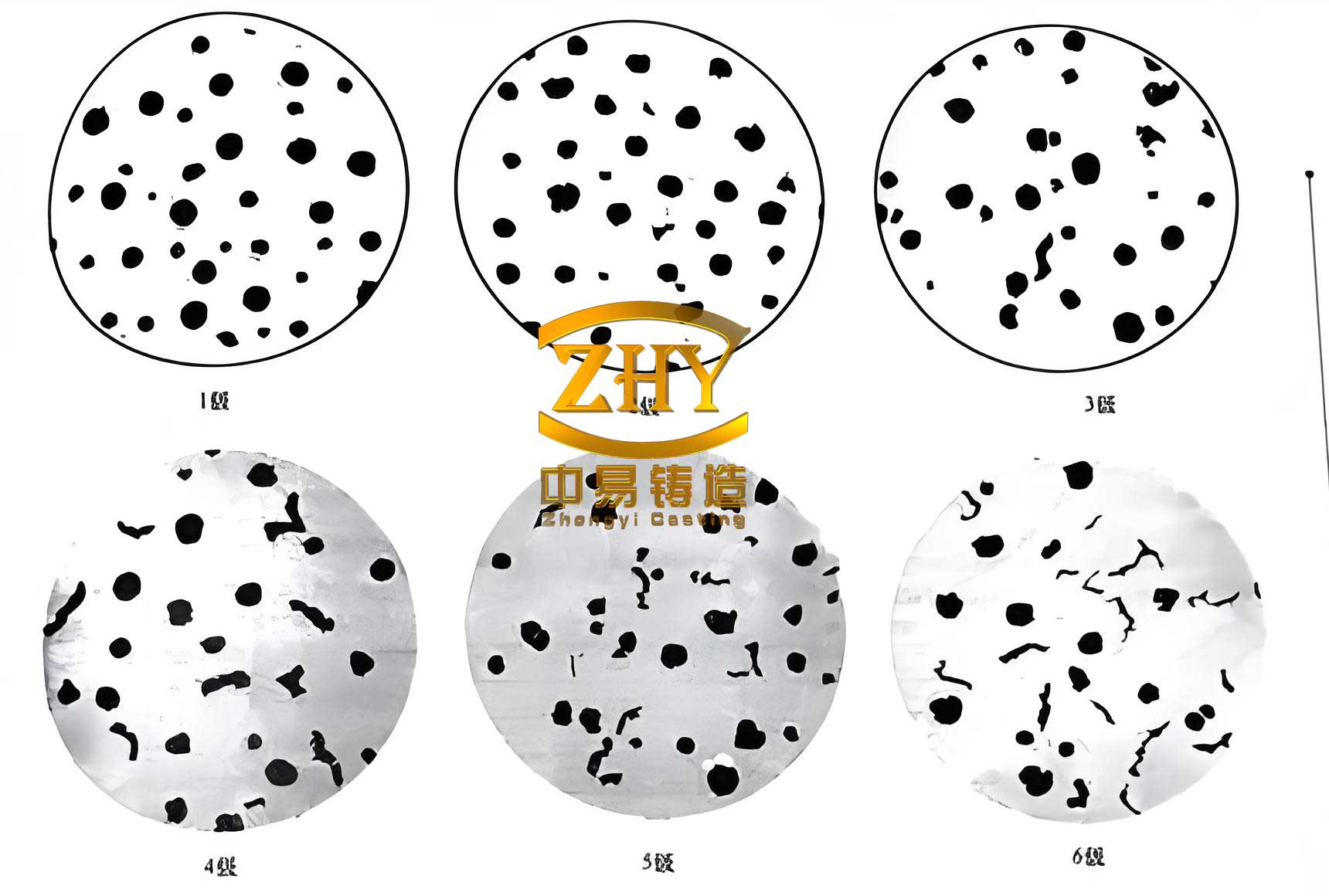
The production of high-integrity spheroidal graphite iron castings presents a persistent challenge when utilizing furan resin sand, a molding medium prized for its dimensional accuracy and efficiency. A critical defect manifesting in such castings is the formation of a surface layer containing degenerate graphite forms, such as flake or compacted/vermicular graphite, rather than the desired spherical nodules. This anomalous layer, often termed a “degenerate graphite layer” or “sulfide chill layer,” severely compromises the mechanical properties, particularly fatigue strength, and undermines the service reliability of critical components like elevator traction sheaves and agricultural machinery differential carriers. My research and practical experience have consistently identified sulfur penetration from the mold as the primary culprit behind this phenomenon. This article, from my perspective as a practitioner in the field, details the mechanistic understanding of sulfur penetration and systematically develops and validates a novel class of composite coatings designed to effectively mitigate this issue, thereby enhancing the surface quality and performance of spheroidal graphite iron castings.
The core problem lies in the interaction between the molten spheroidal graphite iron and the chemically bonded sand. Furan resin binders are typically cured with sulfonic acid-based catalysts (e.g., para-toluene sulfonic acid). During the pouring of high-temperature metal, these organic compounds undergo thermal decomposition. In the presence of oxygen, this process releases sulfur dioxide ($SO_2$) gas into the mold cavity atmosphere. The mechanism of sulfur infiltration into the casting surface can be described as a multi-stage process:
1. Decomposition: At elevated temperatures, the catalyst in the sand decomposes. A simplified representation of this reaction is:
$$ \text{Catalyst (e.g., } CH_3C_6H_4SO_3H\text{)} + O_2 \rightarrow CO_2 + CO + H_2O + \text{Hydrocarbons} + SO_2 \uparrow $$
2. Adsorption and Dissociation: The evolved $SO_2$ gas is adsorbed onto the surface of the molten spheroidal graphite iron. Upon contact with the hot metal surface, the $SO_2$ molecule dissociates:
$$ SO_2 (g) \rightarrow [S]_{ad} + 2[O]_{ad} $$
where $[S]_{ad}$ and $[O]_{ad}$ represent adsorbed sulfur and oxygen atoms.
3. Diffusion and Reaction: The adsorbed sulfur atoms diffuse into the subsurface layer of the molten iron. This creates a steep concentration gradient from the surface inwards. Sulfur has a high affinity for key nodularizing elements like Magnesium (Mg) and Rare Earth (RE). It readily reacts with them to form stable sulfides (e.g., MgS, CeS), effectively removing these elements from their role in promoting graphite spheroidization. The consequent local depletion of nodularizers leads to the precipitation of degenerate graphite forms at the casting surface.
Addressing this issue requires a barrier between the mold and the metal. While traditional coatings offer some protection, their efficacy against sulfur penetration is often insufficient. My approach is based on designing coatings that operate on one or more of the following principles, illustrated conceptually below:
1. Barrier-Type Mechanism: The coating formulation is designed to sinter rapidly upon contact with the molten spheroidal graphite iron, forming a dense, impervious ceramic-like layer. This physical barrier aims to block the infiltration path of $SO_2$ gas. The effectiveness depends on the coating’s sinterability, the uniformity of application, and the integrity of the sintered layer.
2. Absorptive-Type Mechanism: The coating incorporates reactive, basic compounds that chemically capture $SO_2$. As the gas diffuses through the coating layer, it reacts to form solid sulfates, trapping the sulfur before it reaches the metal. The capacity and kinetics of this reaction determine the coating’s performance.
3. Shielding-Type Mechanism (Combined): This is the most robust strategy, combining both high sinterability for a physical barrier and reactive components for chemical gettering of sulfur. A shielding coating provides defense in depth, significantly enhancing protection for the spheroidal graphite iron casting surface.
The formulation of an effective coating begins with the selection of refractory fillers. The primary requirements are appropriate refractoriness, thermal properties, chemical compatibility, and cost-effectiveness for spheroidal graphite iron casting production.
| Refractory Material | Primary Composition | Key Role in Coating | Selected wt.% |
|---|---|---|---|
| Quartz Flour | $SiO_2$ | Primary acidic refractory; forms glassy phase with fluxes to create a sintered barrier. | 52 |
| Flake Graphite | $C$ | Neutral refractory; provides excellent non-wettability, high thermal conductivity, and aids in surface finish of spheroidal graphite iron castings. | 15 |
| Dolomite Powder | $CaMg(CO_3)_2$ | Basic refractory; decomposes to $CaO$ and $MgO$ at high temperature, acting as a potent chemical getter for $SO_2$. | 15 |
| Amorphous Graphite | $C$ | Enhances sinterability of the coating layer compared to pure flake graphite. | 8 |
| Flux A / Flux B | Proprietary | Low-melting point additives that promote the sintering and formation of a dense, continuous barrier layer. | 6 / 4 |
The physical and chemical properties of the main constituents are critical for their function. Quartz flour, while abundant and cost-effective, has a relatively high thermal expansion coefficient ($\alpha \approx 12.3 \times 10^{-6} \, ^\circ\mathrm{C}^{-1}$) which must be managed. Dolomite powder decomposes endothermically:
$$ CaMg(CO_3)_2 \xrightarrow{\Delta} CaO + MgO + 2CO_2 \uparrow $$
The resulting $CaO$ and $MgO$ are highly reactive towards $SO_2$:
$$ 2CaO + 2SO_2 + O_2 \rightarrow 2CaSO_4 $$
$$ 2MgO + 2SO_2 + O_2 \rightarrow 2MgSO_4 $$
To verify the absorptive capacity of dolomite, coatings with varying dolomite content (5-25%) were applied to furan resin sand specimens and exposed to molten spheroidal graphite iron. Post-casting analysis revealed a clear correlation: the sulfur content in the coating increased with dolomite addition, plateauing after approximately 15 wt.%, confirming its role as an effective sulfur getter and justifying its selected concentration.
Beyond refractories, a functional coating requires a balanced binder system and carrier. A combination of phenolic resin and rosin was used to provide adequate green strength and burnout characteristics. Polyvinyl butyral (PVB) was added in minimal amounts (0.1%) as a temporary binder and thickening agent. Sodium magnesium aluminosilicate (Bentonite derivative) served as the primary suspending agent to prevent settling and provide good rheology. Ethanol was chosen as the carrier liquid for its fast drying, clean burnout, and safety.
Based on the defined mechanisms, three distinct coating formulations were designed and proportioned, as summarized below.
| Component | Coating 1: Barrier-Type (wt.%) | Coating 2: Absorptive-Type (wt.%) | Coating 3: Shielding-Type (wt.%) |
|---|---|---|---|
| Quartz Flour | 61.2 | 57.8 | 52.0 |
| Flake Graphite | 17.6 | 16.7 | 15.0 |
| Amorphous Graphite | 9.4 | 8.8 | 8.0 |
| Dolomite Powder | 0.0 | 16.7 | 15.0 |
| Flux A | 7.1 | 0.0 | 6.0 |
| Flux B | 4.7 | 0.0 | 4.0 |
| Suspension Agent | 6.0 | 6.0 | 6.0 |
| Phenolic Resin | 0.6 | 0.6 | 0.6 |
| Rosin | 1.4 | 1.4 | 1.4 |
| PVB | 0.1 | 0.1 | 0.1 |
| Ethanol | qs | qs | qs |
The production trials were conducted on industrial-scale castings of elevator traction sheaves, made from grade QT700-2 spheroidal graphite iron. The target chemical composition of the iron is shown in the table below.
| Element | wt.% Range |
|---|---|
| C | 3.5 – 3.7 |
| Si | 2.0 – 2.4 |
| Mn | 0.4 – 0.8 |
| P | ≤ 0.07 |
| S | ≤ 0.02 |
| Mg | 0.04 – 0.06 |
| RE | 0.02 – 0.04 |
The metal was melted in a medium-frequency induction furnace and treated via the sandwich method with 1.2% nodularizing alloy. Pouring temperature was controlled at $1,350 \pm 10^\circ C$. The molds were made with a nitrogen-free furan resin system (1.5% on sand) catalyzed with para-toluene sulfonic acid (40% on resin). To ensure consistency and complete coverage, the coatings were applied using a flow-coating process, adjusted to a consistent Baume degree, resulting in a dry coating thickness of 200-250 μm.
After casting, shakeout, and shot blasting, samples were extracted from defined locations on the castings for metallographic analysis. The samples were sectioned, polished, and etched with 4% nital to reveal the microstructure. The depth of the degenerate graphite layer was meticulously measured from the surface inward, examining zones at 0-1 mm, 1-2 mm, and 2-3 mm depths.
The results provided a clear ranking of the coating’s effectiveness in protecting the spheroidal graphite iron:
- Coating 1 (Barrier-Type): The coating, reliant on sintering from quartz and fluxes, formed a barrier. However, the degenerate layer was observed to penetrate approximately 1.1-1.15 mm deep. The barrier was not fully impervious to the diffusing $SO_2$ over the entire solidification period.
- Coating 2 (Absorptive-Type): With 16.7% dolomite and no specific fluxes, this coating acted primarily as a chemical filter. The degenerate layer depth was reduced to between 0.65 and 1.0 mm. The dolomite successfully trapped a significant portion of the sulfur, but the lack of a strongly sintered layer allowed some gaseous penetration to the metal surface.
- Coating 3 (Shielding-Type): This composite coating yielded the best results. The synergistic combination of fluxes (A & B) promoting a dense sintered barrier and dolomite powder acting as a chemical getter effectively minimized sulfur penetration. The depth of the degenerate graphite layer on the spheroidal graphite iron casting was drastically reduced to a mere 0.25-0.3 mm.
The mechanism of Coating 3 can be described as a two-tiered defense. First, the rapid formation of a dense, sintered shell ($S$) provides a physical impedance to gas flow. Simultaneously, within this shell, the dolomite-derived oxides ($MO$, where $M = Ca, Mg$) react with any $SO_2$ that permeates. The overall effectiveness ($E$) in preventing sulfur from reaching the metal surface ($[S]_{metal}$) can be conceptually related to the sinter layer density ($\rho_s$), its thickness ($d$), the concentration of getter ($C_g$), and its reaction rate constant ($k$):
$$ E \propto \left( \rho_s \cdot d \right) + \left( k \cdot C_g \cdot \int [SO_2] \, dt \right) $$
$$ [S]_{metal} \approx f\left(\frac{[SO_2]_{mold}}{E}\right) $$
Where a higher $E$ leads to a lower sulfur concentration at the spheroidal graphite iron surface.
In conclusion, the problem of surface degradation in spheroidal graphite iron castings produced with furan resin sand is fundamentally linked to sulfur penetration. While simple graphite-based coatings are inadequate, strategically designed composite coatings offer a powerful solution. The experimental work confirms that:
1. A composite base of quartz and graphite powders provides a good foundation for coatings used on spheroidal graphite iron.
2. The incorporation of dolomite powder significantly increases the post-casting sulfur content within the coating layer, proving its efficacy as a chemical absorbent for sulfurous gases.
3. The most effective defense is achieved by a shielding-type coating that synergistically combines sintering agents (Flux A and B) to create a dense physical barrier with dolomite powder to chemically trap any penetrating sulfur. This dual-action approach successfully minimizes the formation of the deleterious degenerate graphite layer, ensuring the surface integrity and enhanced mechanical performance of the spheroidal graphite iron casting. This development provides foundries with a practical and effective method to overcome a longstanding quality challenge, paving the way for more reliable high-performance components.