
In my years of research and engineering within the specialized field of advanced foundry technology, the pursuit of lighter, stronger, and more reliable materials has been a constant driver. Among these, magnesium alloys hold a particularly compelling position for aerospace applications. The imperative to reduce mass in airframes, engines, and spacecraft systems directly translates to enhanced fuel efficiency, increased payload capacity, and improved overall performance. While composites and advanced aluminum alloys receive significant attention, the specific density advantage of magnesium—approximately 1.74 g/cm³, which is about 35% lighter than aluminum and 75% lighter than steel—makes it an indispensable material for weight-critical applications. This article, drawn from my professional experience, delves into the science, technology, challenges, and future directions of utilizing magnesium alloys for high-integrity aerospace castings.
The core appeal of magnesium for aerospace castings lies in its outstanding strength-to-weight ratio. However, the journey from a promising light metal to a reliable engineering component is paved with intricate material science and precise manufacturing control. The development of cast magnesium alloys for aerospace has evolved through generations, each addressing specific property ceilings and environmental limitations of its predecessors.
Material Science of Aerospace Magnesium Alloys
The performance envelope of a magnesium alloy casting is fundamentally dictated by its composition and the resulting microstructure. Alloying elements are added primarily to enhance strength, creep resistance, and corrosion stability. We can categorize the mainstream systems for aerospace castings as follows:
| Alloy System | Key Alloying Elements | Primary Strengthening Mechanism | Typical Applications in Aerospace | Key Advantages & Limitations |
|---|---|---|---|---|
| Mg-Al-RE (e.g., AE44) | Al, Rare Earths (Ce, Nd) | Precipitation of Al-RE phases, grain refinement | Gearbox housings, intermediate casings | Good castability, improved creep resistance over AZ91, moderate cost. |
| Mg-Zn-RE (e.g., ZE41, ZE63) | Zn, Rare Earths (Y, Nd, Gd) | Precipitation of complex intermetallics (e.g., Mg-Zn-RE) | Helicopter transmission casings, engine accessory components | Good strength and ductility combination, weldable. Can suffer from micro-porosity. |
| Mg-Y-RE (Weber-type, e.g., WE43, WE54) | Y, Heavy Rare Earths (Gd, Nd, Dy) | Formation of fine, thermally stable β’ precipitates | High-temperature engine components (e.g., compressor casings), spacecraft fittings | Superior high-temperature (up to 300°C) creep and corrosion resistance. High cost, complex melting. |
| Mg-Ag-RE | Ag, Rare Earths (Nd, Gd) | Enhanced age-hardening response, dense precipitate formation | Experimental high-strength structural castings | Very high specific strength. Prohibitively expensive for most applications. |
| Mg-Al-Ca / Mg-Al-Sr | Al, Ca or Sr | Formation of thermally stable (Mg,Al)2Ca or Al4Sr phases | Engine brackets, housings requiring good creep resistance | Cost-effective alternative to RE-containing alloys for moderate temperatures. Castability can be challenging. |
The selection of an alloy for a specific aerospace casting is a multi-variable optimization problem. It involves balancing mechanical properties (ultimate tensile strength UTS, yield strength YS, elongation El, fatigue strength), density (ρ), and cost (C). A simplified merit index (M) for a lightweight structural component under tensile load could be expressed as:
$$ M = \frac{YS \cdot El^{0.5}}{\rho \cdot C^{k}} $$
where *k* is a cost exponent (typically between 0.1 and 0.3) reflecting the program’s cost sensitivity. For a component dominated by stiffness, the index would prioritize Young’s Modulus (E):
$$ M_{stiffness} = \frac{E^{1/2}}{\rho \cdot C^{k}} $$
These indices, while simplified, guide the initial down-selection of alloy systems for a given set of aerospace casting requirements.
Melting, Holding, and Molten Metal Treatment
The processing of magnesium alloys for aerospace castings begins with utmost care during melting. Magnesium’s high affinity for oxygen necessitates rigorous protection from air. Molten magnesium is typically shielded using a mixture of inert gases like Argon or Nitrogen with small, controlled additions of SF6 or SO2 (historically), which form a protective surface film. The search for environmentally friendlier alternatives to SF6, such as HFC-134a or Novec™ 612, is an active area of process development.
Impurity control, particularly of Fe, Ni, Cu, and Si, is critical for ensuring corrosion resistance. These elements drastically reduce the corrosion performance by forming cathodic intermetallics. The permissible limits are extremely low, often in the range of tens of parts per million. This is governed by the tolerance limit equation, where the corrosion rate increases dramatically above a critical concentration [X]crit. For Iron in many Mg-Al alloys, the relationship can be described by a sudden increase in corrosion current density *icorr*:
$$ i_{corr} \propto \exp\left(\frac{[Fe]}{[Fe]_{crit}}\right) \quad \text{for} \quad [Fe] > [Fe]_{crit} $$
To achieve this purity, high-purity primary metal and careful handling of returns are mandatory. Flux-based refining, though effective, is being supplanted by fluxless processes using gas sparging (Argon or Nitrogen) for degassing and impurity settling to minimize inclusions in critical aerospace castings.
Advanced Casting Processes for Aerospace Components
The manufacturing route is chosen based on the component’s geometry, required integrity, and production volume. Sand casting, investment casting, and permanent mold (gravity and low-pressure) casting are all employed, each with distinct advantages for producing aerospace castings.
| Process | Typical Tolerance (mm/mm) | Surface Finish (Ra, μm) | Minimum Section (mm) | Best Suited for Aerospace Casting Types |
|---|---|---|---|---|
| Sand Casting (Resin-Bonded) | ±0.5 to ±1.0% | 3.2 – 12.5 | 3 – 4 | Large, complex, low-volume structures like gearbox casings, frames, and housings. |
| Investment Casting (Lost Wax) | ±0.2 to ±0.5% | 1.6 – 3.2 | 1 – 2 | Complex, thin-walled components with excellent detail: turbine engine components, intricate brackets, manifolds. |
| Permanent Mold Gravity | ±0.3 to ±0.7% | 1.6 – 6.3 | 2 – 3 | Medium-volume parts with consistent quality: engine blocks, door frames, structural supports. |
| Low-Pressure Die Casting (LPDC) | ±0.2 to ±0.5% | 1.6 – 4.0 | 2 – 2.5 | High-integrity, pressurized housings and components requiring good metallurgical soundness. |
Process modeling and simulation are indispensable tools in my work. They allow for the prediction of filling patterns, solidification sequences, thermal stresses, and the formation of defects like shrinkage porosity and hot tears. The governing equations for fluid flow and heat transfer during casting are the Navier-Stokes and energy equations, often simplified for incompressible flow:
$$ \nabla \cdot \mathbf{u} = 0 $$
$$ \frac{\partial \mathbf{u}}{\partial t} + (\mathbf{u} \cdot \nabla) \mathbf{u} = -\frac{1}{\rho} \nabla p + \nu \nabla^2 \mathbf{u} + \mathbf{g} $$
$$ \frac{\partial T}{\partial t} + (\mathbf{u} \cdot \nabla) T = \alpha \nabla^2 T + \frac{L}{c_p} \frac{\partial f_s}{\partial t} $$
where $\mathbf{u}$ is velocity, $p$ pressure, $\nu$ kinematic viscosity, $\mathbf{g}$ gravity, $T$ temperature, $\alpha$ thermal diffusivity, $L$ latent heat, $c_p$ specific heat, and $f_s$ solid fraction. Solving these numerically for a specific mold and gating design is key to achieving sound aerospace castings.
Typical Aerospace Casting Applications and Case Studies
The application of magnesium alloy castings in aerospace is diverse, spanning from commercial airliners to military jets, helicopters, and satellites. One of the most significant success stories is in helicopter transmission systems. A magnesium alloy casting for an intermediate or main gearbox housing can save tens of kilograms compared to its aluminum counterpart. This weight saving, located high on the aircraft, has a multiplied effect on performance and stability.
In gas turbine engines, despite the high-temperature environment, specific zones such as the front compressor casings, accessory gearboxes, and various housings utilize creep-resistant magnesium alloys like WE43. These castings must maintain dimensional stability and structural integrity under cyclic thermal and mechanical loads. Another critical area is in airframe components: seat frames, instrument panels, door frames, and wing root fairings. The lightweight nature of magnesium directly contributes to increased fuel efficiency or payload.
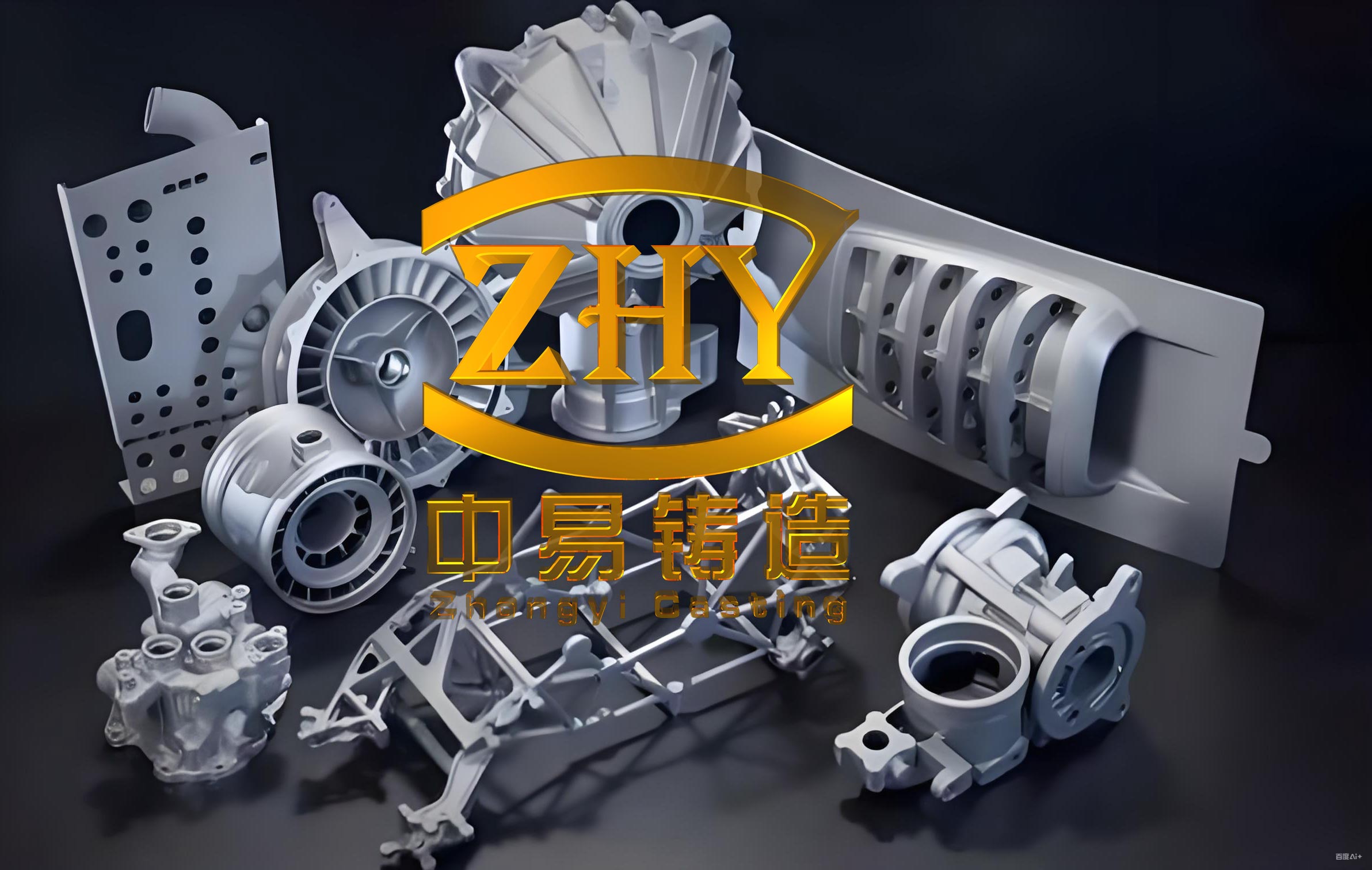
The image above illustrates the complexity and scale that can be achieved with modern magnesium sand casting processes. Such large, integrally cast structures for aerospace applications eliminate numerous joints and fasteners, leading to further weight savings and improved structural efficiency. The design of these castings often employs topology optimization and generative design algorithms, which define material layout based on load paths, resulting in organic, lightweight shapes ideally suited for the casting process. The objective function in such optimization for a stiffness-maximization problem under a mass constraint can be stated as:
$$ \begin{aligned}
& \underset{\rho}{\text{minimize}}
& & C(\rho) = \mathbf{U}^T \mathbf{K} \mathbf{U} = \sum_{e=1}^{N} E_e(\rho_e) \mathbf{u}_e^T \mathbf{k}_0 \mathbf{u}_e \\
& \text{subject to}
& & \frac{V(\rho)}{V_0} = f \\
& & & \mathbf{K} \mathbf{U} = \mathbf{F} \\
& & & 0 < \rho_{min} \leq \rho_e \leq 1
\end{aligned} $$
where $C$ is compliance, $\rho$ is the design variable (density), $\mathbf{U}$ and $\mathbf{F}$ are global displacement and force vectors, $\mathbf{K}$ is the global stiffness matrix, $E_e$ is the element Young’s modulus, $\mathbf{k}_0$ is the element stiffness matrix for solid material, $V$ and $V_0$ are the material and design domain volume, and $f$ is the volume fraction constraint.
Current Challenges and Technical Hurdles
Despite the advantages, the widespread adoption of magnesium for aerospace castings faces persistent challenges. Corrosion resistance, though greatly improved with modern high-purity and RE-containing alloys, still requires careful management through coatings (e.g., anodizing, plating, proprietary chemical treatments) and design to avoid galvanic couples with more noble metals like aluminum or steel.
High-temperature capability remains a limiting factor. While WE-series alloys push the service temperature to around 300°C, this is still below the operational range of many core engine sections. The development of new alloy systems with stable precipitate phases or reinforcement strategies is ongoing. Furthermore, the inherent brittleness and lower ductility of magnesium compared to aluminum can be a concern for damage tolerance. This is addressed at the design stage with appropriate factors of safety and at the material level through alloy development and microstructural control to maximize toughness.
The foundry process itself for high-integrity aerospace castings demands extreme control. The propensity for hot tearing, particularly in alloys with wide freezing ranges, must be mitigated through optimal mold design, controlled cooling, and grain refinement. The relationship between hot tearing susceptibility (HTS) and alloy/process parameters is complex but can be conceptually linked to the coherency strength and the strain accumulation in the mushy zone during the final stages of solidification.
Future Trends and Concluding Perspective
The future of magnesium alloy aerospace castings is bright and hinges on several convergent trends. Material development will focus on novel, lower-cost alloy systems with comparable or superior properties to existing RE-heavy alloys. This includes further exploration of Ca, Sr, and Sn-based systems, as well as the development of nanocomposites and hybrid materials where magnesium matrices are reinforced with ceramic nanoparticles or fibers for specific property enhancements.
Process innovation will be dominated by digitalization and advanced manufacturing. The integration of real-time process monitoring (temperature, pressure, flow) with AI-driven adaptive control systems will ensure consistently perfect castings. Additive manufacturing (AM) or 3D sand printing of complex molds and cores will enable previously impossible geometries for aerospace castings, consolidating assemblies into single, optimized cast components. This hybrid approach—AM for the tooling, followed by traditional casting—combines design freedom with the superior metallurgical properties and economic viability of casting for medium-to-large parts.
Sustainability is becoming a core driver. The drive for lower carbon footprints in aviation aligns perfectly with magnesium’s light-weighting benefits. Furthermore, improving the recyclability of magnesium aerospace castings and developing more environmentally benign melting protection technologies will be essential.
In conclusion, magnesium alloy castings are a vital and growing segment of the aerospace materials landscape. Their unparalleled light-weighting potential continues to drive innovation in alloy design, foundry technology, and digital engineering. Overcoming the historical challenges related to corrosion and high-temperature performance through sustained research and process control is key. As these hurdles are addressed, I foresee an expansion in the application envelope of magnesium, securing its role as a critical enabler for the next generation of fuel-efficient, high-performance aircraft and spacecraft. The journey of transforming reactive molten metal into a reliable, flying component encapsulates the very essence of advanced manufacturing, and magnesium aerospace castings sit at the fascinating intersection of material science, physics, and engineering artistry.