
In my extensive experience with lost foam casting, also known as expendable pattern casting (EPC), I have encountered numerous challenges related to gating system design. This casting method, which utilizes foam patterns made from expandable polystyrene (EPS) in organic self-hardening sand molds, offers exceptional advantages such as high dimensional accuracy, superior surface finish, and environmentally friendly production processes. However, the gating system plays a pivotal role in determining the quality of the final castings, and over the years, I have explored various approaches to optimize it. One particularly intriguing method I have adopted is the “centipede leg” gating system, which exhibits remarkable flexibility and adaptability for diverse casting applications in lost foam casting. Despite its benefits, this system is not without limitations, and through rigorous practice, I have identified areas for improvement to enhance its performance in EPC processes.
Lost foam casting (EPC) has become a mainstream technique for producing automotive body panel stamping dies and machine tool castings due to its precision and efficiency. The process involves creating a foam pattern that vaporizes upon contact with molten metal, leaving behind the desired casting shape. However, the gating system in EPC must be carefully designed to manage the substantial gas generation from foam decomposition. Based on my measurements, EPS foam can produce 5–6 times its volume in gas for iron castings and 6–8 times for steel castings within a very short timeframe. This rapid gas evolution often leads to issues like “back-splash” or “reverse spraying,” where gas escapes through the sprue, posing safety risks and causing defects such as cold shuts or incomplete filling. Therefore, a well-designed gating system is crucial to ensure smooth metal flow, minimize turbulence, and reduce defects like carbon inclusions and porosity in lost foam casting.
The centipede leg gating system, as I have implemented it, addresses many of these challenges through a unique configuration. Its core principle involves a multi-branched layout reminiscent of a centipede’s legs, which distributes molten metal evenly across the mold cavity. In my applications, I use ceramic tubes for the sprue, foam strips for the runners, and either ceramic or paper tubes for the ingates. This setup follows an open gating system approach, where the choke section is located at the sprue, and the cross-sectional areas increase progressively to slow down the metal flow. The key parameters for such a system in large-scale EPC iron castings typically adhere to a ratio of sprue area to runner area to ingate area, expressed as: $$ S_{sprue} : S_{runner} : S_{gate} = 1 : 1.5 : 2 $$ This ratio helps maintain a non-pressurized flow, reducing velocity and minimizing oxidation. The dispersed ingates, arranged in a shower-like pattern, promote uniform foam vaporization and decrease localized overheating, thereby mitigating carbon slag defects. Over the years, I have experimented with various configurations, including unilateral, bilateral, stepped, and three-dimensional layouts, each tailored to specific casting geometries in lost foam casting.
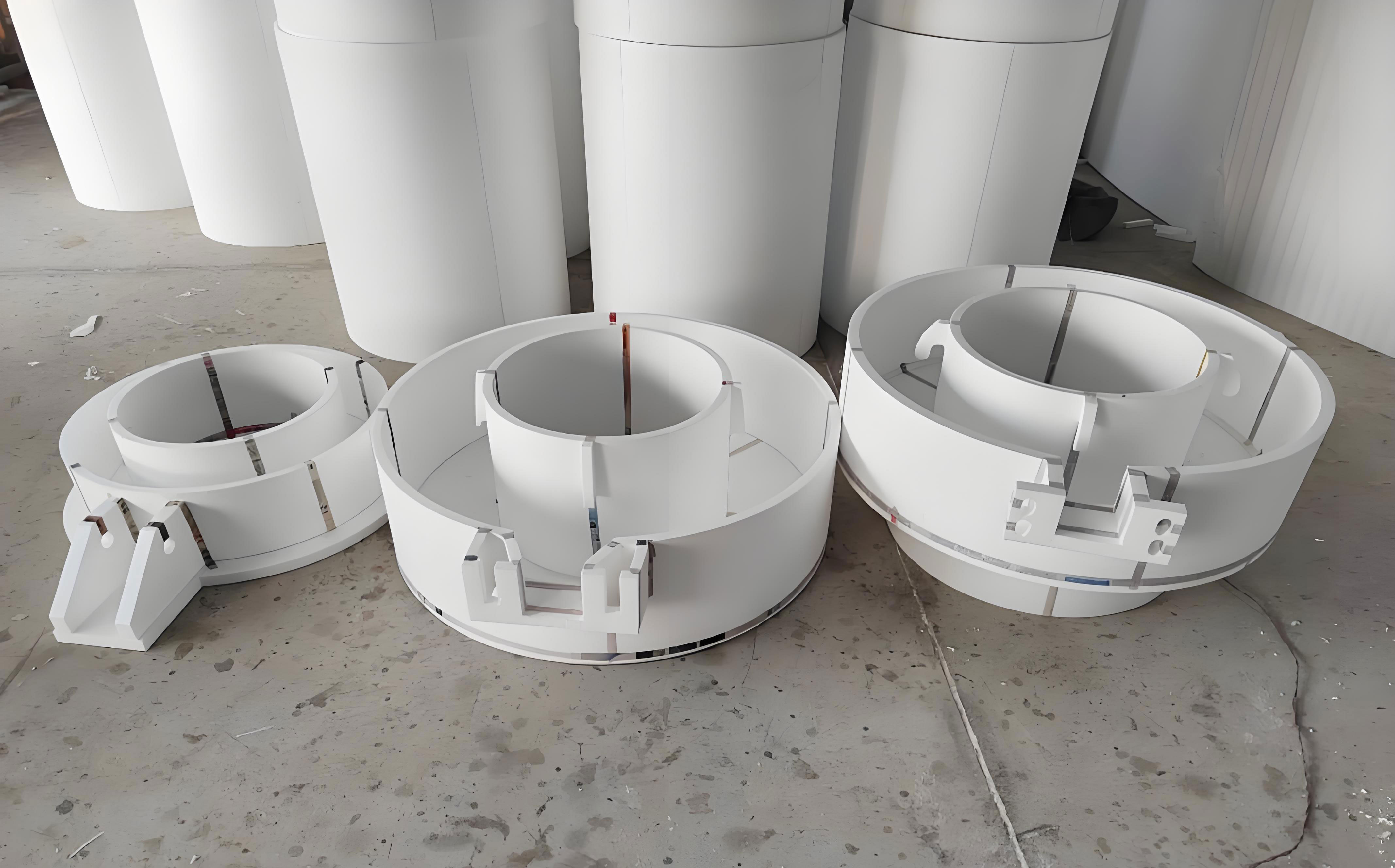
To quantify the benefits and drawbacks of the centipede leg gating system in EPC, I have developed several formulas and tables based on empirical data. For instance, the gas generation volume $V_{gas}$ from foam decomposition can be modeled as: $$ V_{gas} = k \cdot V_{foam} $$ where $k$ is a material-dependent constant (e.g., $k = 5$ to $6$ for iron, $k = 6$ to $8$ for steel in lost foam casting). This highlights the need for rapid pouring to maintain metal front advancement and ensure complete vaporization. Additionally, the metal flow velocity in EPC is significantly lower than in empty mold casting, approximately one-third, as given by: $$ v_{EPC} = \frac{1}{3} v_{empty} $$ This reduction necessitates larger gating sections to compensate for flow resistance. The table below summarizes the typical cross-sectional area ratios I have observed in various EPC applications, demonstrating the system’s adaptability:
| Component | Area Ratio Range | Common Configuration |
|---|---|---|
| Sprue (Ceramic Tube) | 1 (Base) | Fixed choke point |
| Runner (Foam Strip) | 1.2–1.8 | Gradual expansion |
| Ingate (Ceramic/Paper Tube) | 1.8–2.5 | Dispersed layout |
Despite its advantages, the centipede leg gating system in lost foam casting has several inherent limitations that I have documented through repeated trials. Firstly, the foam runners contribute to gas and residue contamination, as they account for 20–30% of the total gating volume. The decomposition products can infiltrate the casting, leading to slag inclusions. Mathematically, the contamination risk $C$ can be approximated as: $$ C \propto \frac{V_{foam\_runner}}{V_{casting}} \cdot t_{vaporization} $$ where $t_{vaporization}$ is the time for complete foam disappearance. Secondly, the variable cross-sections cause flow instabilities, increasing the likelihood of back-splash. In my observations, the pressure drop $\Delta P$ across the gating system can be expressed as: $$ \Delta P = f \cdot \frac{\rho v^2}{2} \cdot L_{eff} $$ where $f$ is the friction factor, $\rho$ is metal density, $v$ is flow velocity, and $L_{eff}$ is the effective length of the gating system in EPC. This pressure imbalance often results in turbulence, entrapping gases and coating fragments. The table below contrasts the pros and cons I have encountered with this system:
| Advantages | Disadvantages |
|---|---|
| High flexibility for different castings | Gas and residue contamination from foam |
| Reduced heat loss due to shorter flow paths | Flow resistance leading to velocity fluctuations |
| Uniform metal distribution and vaporization | Coating damage and sand inclusion risks |
| Adaptability to filters and slag traps | Inconsistent cross-sectional ratios causing defects |
To optimize the centipede leg gating system in EPC, I have focused on improving foam vaporization efficiency and minimizing turbulence. One approach involves using paper tubes for ingates, which offer consistent cross-sections and reduce gas generation compared to foam. The ideal pouring rate $Q$ can be derived from the foam vaporization rate $R_v$: $$ Q = A_{gate} \cdot v_{critical} $$ where $v_{critical}$ is the minimum velocity to maintain metal front advancement in lost foam casting, typically estimated as: $$ v_{critical} = \frac{R_v}{\rho_{metal}} $$ Additionally, incorporating filters at runner junctions, as I have tested, enhances slag removal but requires careful placement to avoid flow disruptions. The overall effectiveness $E$ of the gating system can be modeled as: $$ E = \eta_{flow} \cdot \eta_{vaporization} \cdot (1 – \eta_{defect}) $$ where $\eta_{flow}$ represents flow efficiency, $\eta_{vaporization}$ accounts for foam decomposition completeness, and $\eta_{defect}$ is the defect rate. Through iterative refinements, I have achieved better stability in cross-sectional ratios, narrowing them to a range of 1:1.2:1.8 for sprue, runner, and ingate in specific EPC applications, which reduces variability and improves casting quality.
In conclusion, the centipede leg gating system has proven to be a valuable tool in my lost foam casting practice, offering unparalleled adaptability for complex geometries. However, its shortcomings, such as gas-related contamination and flow instabilities, necessitate continuous optimization. By integrating empirical data with theoretical models, I have enhanced its performance, emphasizing the importance of rapid pouring and consistent gating ratios in EPC. Future work should focus on hybrid materials and advanced simulation techniques to further mitigate defects, ensuring that lost foam casting remains a competitive and reliable manufacturing method.