
In the evolving landscape of metal casting, particularly for components used in industries like plastic injection molding, the demand for high-quality, small to medium-sized spheroidal graphite cast iron parts has surged. As a practitioner deeply involved in process design, I have witnessed the limitations of traditional wood pattern-resin sand molding methods, which often struggle with efficiency, precision, and defect rates. This prompted me to explore and implement the cold core box core assembly molding process, a technique that has shown remarkable success in other metal casting domains. Through this article, I aim to share my firsthand experience and insights into adapting this method for spheroidal graphite cast iron production, emphasizing its superior outcomes in terms of quality, productivity, and cost-effectiveness. The focus will be on detailing the process parameters, material selections, and comparative analyses that underscore the advantages of this innovative approach.
The cold core box process, utilizing triethylamine hardening, represents a paradigm shift in molding technology for spheroidal graphite cast iron. Its core benefits include rapid hardening, high dimensional accuracy, reduced energy consumption, and excellent surface finish. In our foundry, we have applied this to produce a range of components such as small hinges, guide rod supports, and crossheads, each weighing less than 50 kg. The transition required meticulous adjustments in materials, equipment, and melting practices, but the results have been overwhelmingly positive. Below, I will delve into the specifics, supported by data, tables, and formulas, to illustrate why this method is a game-changer for spheroidal graphite cast iron foundries aiming to enhance competitiveness.
Selection of Molding Materials
The foundation of any casting process lies in the choice of materials, and for cold core box molding of spheroidal graphite cast iron, this is critical. We began by evaluating sand types, resins, and coatings to optimize performance.
Sand Selection
For spheroidal graphite cast iron, which involves high-temperature pouring, the refractory properties of sand are paramount. We selected river sand with a silica content exceeding 92% to ensure adequate heat resistance. The grain size impacts surface smoothness and rigidity; finer grains yield better finishes but increase resin consumption and hinder gas evolution. After extensive trials, we settled on a 50/100 mesh size, which balances these factors effectively. The sand’s properties can be summarized using the following formula for optimal grain distribution:
$$ G_{opt} = \frac{\sum_{i=1}^{n} d_i \cdot w_i}{\sum_{i=1}^{n} w_i} $$
where \( G_{opt} \) is the optimal grain size, \( d_i \) is the diameter of grain fraction \( i \), and \( w_i \) is the weight percentage. For our application, \( G_{opt} \approx 0.2 \, \text{mm} \), corresponding to the 50/100 mesh range.
| Parameter | Value | Unit | Significance |
|---|---|---|---|
| SiO2 Content | >92% | % | Ensures high refractoriness for spheroidal graphite cast iron |
| Grain Size | 50/100 mesh | mesh | Balances surface finish and gas permeability |
| AFS Grain Fineness Number | 55 | – | Indicates medium-fine sand for detail reproduction |
| Bulk Density | 1.5 | g/cm³ | Affects mold rigidity and weight |
Resin Formulation
The resin binder system is crucial for mold strength and dimensional stability. We use a triethylamine-cured phenolic urethane resin, with the ratio carefully tuned to avoid deficiencies or waste. Through repeated strength tests, we determined that a resin addition of 1.8% by weight of sand yields optimal results. The relationship between resin content and mold strength can be expressed as:
$$ \sigma_m = k \cdot R_c^{\alpha} $$
where \( \sigma_m \) is the mold compressive strength (in MPa), \( R_c \) is the resin content (in %), \( k \) is a constant dependent on sand type, and \( \alpha \) is an exponent typically around 1.5 for our spheroidal graphite cast iron applications. At 1.8% resin, we achieve \( \sigma_m \approx 4.5 \, \text{MPa} \), sufficient for handling and pouring.
| Resin Content (%) | Compressive Strength (MPa) | Dimensional Accuracy (mm) | Remarks for Spheroidal Graphite Cast Iron |
|---|---|---|---|
| 1.5 | 3.2 | ±0.3 | Inadequate for complex geometries |
| 1.8 | 4.5 | ±0.1 | Optimal for small castings |
| 2.0 | 5.0 | ±0.1 | Excessive, leads to cost inefficiency |
Mold Wall Thickness
Determining the appropriate wall thickness for cold core box molds involves a trade-off between rigidity and material efficiency. Too thin, and the mold may deform or leak during pouring of spheroidal graphite cast iron; too thick, and it becomes cumbersome and wasteful. We established a range of 18–22 mm based on structural analysis. The required thickness \( t \) can be estimated using a simplified stress formula:
$$ t = \frac{P \cdot D}{2 \cdot \sigma_a} + C $$
where \( P \) is the metallostatic pressure (in Pa), \( D \) is the mold diameter (in m), \( \sigma_a \) is the allowable stress of the sand-resin composite (about 1 MPa), and \( C \) is a safety factor (typically 2–3 mm). For our spheroidal graphite cast iron parts, \( t \approx 20 \, \text{mm} \) ensures reliability.
Coating Application
To enhance mold surface integrity and prevent metal penetration, we employ a graphite-based coating applied via full immersion. This method ensures uniform coverage, critical for the high-fluidicity spheroidal graphite cast iron. The coating thickness \( \delta_c \) is controlled to 0.1–0.2 mm, calculated as:
$$ \delta_c = \frac{V_c}{A_m} $$
where \( V_c \) is the coating volume and \( A_m \) is the mold surface area. This uniformity reduces defects like veining and improves the as-cast finish of spheroidal graphite cast iron components.
Molding Equipment and Process Design
The success of cold core box molding for spheroidal graphite cast iron hinges on specialized equipment and thoughtful process design. We utilize dedicated core shooting machines and metal tooling, which offer repeatability and precision.
Equipment Setup
Our core shooter is configured for triethylamine hardening, with automated controls for sand filling, gassing, and curing. The metal core boxes are machined from tool steel, ensuring longevity and consistent dimensions for spheroidal graphite cast iron production. The shooting pressure \( P_s \) is optimized at 0.6 MPa to achieve dense molds without blowouts, given by:
$$ P_s = \frac{F}{A} $$
where \( F \) is the force applied and \( A \) is the shot area. This results in molds with high surface smoothness, essential for reducing machining allowances on spheroidal graphite cast iron parts.
Gating and Venting Design
We adapt traditional gating principles to cold core box molds, typically employing sprue, runner, and ingate systems without filters or extensive risers. The gating ratio is set at 1:2:1.5 to ensure smooth filling for spheroidal graphite cast iron. The flow velocity \( v \) is calculated using Bernoulli’s principle:
$$ v = \sqrt{2gh} $$
where \( g \) is gravity and \( h \) is the metallostatic head. For our components, \( v \approx 1.5 \, \text{m/s} \), minimizing turbulence and slag inclusion. Vents are placed at mold joints to facilitate gas escape, crucial given the gas-generating nature of the resin binder when in contact with molten spheroidal graphite cast iron.
Stacking Configuration
A key innovation in our process is the stack molding approach, where each mold acts as both the cope of one casting and the drag of the next. This maximizes space utilization and flexibility. The number of stack layers \( N \) is variable, determined by production needs and mold stability. The total height \( H \) of a stack is:
$$ H = N \cdot (t_c + t_m) $$
where \( t_c \) is the casting thickness and \( t_m \) is the mold wall thickness. We use adhesives at mold edges to seal joints, enhancing integrity during pouring of spheroidal graphite cast iron.
| Gating Type | Filling Time (s) | Turbulence Index | Defect Rate (%) | Suitability for Cold Core Box |
|---|---|---|---|---|
| Traditional Sand Mold | 10-15 | High | 5-8 | Moderate |
| Cold Core Box Stack Mold | 5-8 | Low | 1-3 | Excellent |
Melting and Pouring Practices for Spheroidal Graphite Cast Iron
The metallurgical aspects are tailored to complement the cold core box process. Spheroidal graphite cast iron requires precise control of temperature, inoculation, and pouring to achieve desired microstructure and properties.
Pouring Temperature
We maintain a pouring temperature range of 1350–1380°C for spheroidal graphite cast iron. Higher temperatures risk mold erosion, while lower ones lead to mistruns. The ideal temperature \( T_p \) can be derived from the superheat equation:
$$ T_p = T_l + \Delta T_s $$
where \( T_l \) is the liquidus temperature of spheroidal graphite cast iron (approximately 1150°C) and \( \Delta T_s \) is the superheat (200–230°C). This ensures fluidity without compromising mold life.
Pouring Time
Pouring is conducted rapidly to maintain metal fluidity and reduce oxide formation. The time \( t_p \) is a function of casting weight \( W \) and gating cross-sectional area \( A_g \):
$$ t_p = \frac{W}{\rho \cdot A_g \cdot v} $$
where \( \rho \) is the density of spheroidal graphite cast iron (7100 kg/m³). For a 50 kg stack, \( t_p \approx 10 \, \text{s} \), achieved through practiced teamwork.
Inoculation and Nodularization
To ensure high nodule count and uniform matrix in spheroidal graphite cast iron, we combine ladle and in-stream inoculation. The treatment involves:
– Ladle addition: 0.5% FeSi75 for primary inoculation.
– During tapping: 0.4% Si-Ca-Ba for nodularization.
– In-pour: 0.10–0.15% sulfur-oxygen inoculant for late-stage nucleation.
The nodule count \( N_n \) per unit area correlates with inoculation efficiency, modeled as:
$$ N_n = \beta \cdot I_e $$
where \( \beta \) is a constant and \( I_e \) is the effective inoculant addition. Our process yields \( N_n \geq 250 \, \text{nodules/mm}^2 \), crucial for ductility in spheroidal graphite cast iron.
| Inoculation Stage | Material | Addition Rate (%) | Function | Resulting Nodule Count (nodules/mm²) |
|---|---|---|---|---|
| Ladle | FeSi75 | 0.5 | Primary graphitization | 180-200 |
| Tapping | Si-Ca-Ba | 0.4 | Nodularization and desulfurization | 220-240 |
| In-Pour | S-O Inoculant | 0.125 | Late nucleation, refinement | 250-270 |
Production Outcomes and Comparative Analysis
Implementing cold core box molding has yielded transformative results for our spheroidal graphite cast iron production. Below, I present a detailed comparison with traditional sand molding across multiple metrics.
Surface Quality and Dimensional Accuracy
The cold core box molds produce spheroidal graphite cast iron parts with superior surface finish, minimal flash, and reduced veining. This is attributed to the high precision of metal tooling and smooth mold surfaces. We measure surface roughness \( R_a \), finding values below 25 µm for cold core box versus 50–75 µm for traditional methods. The improvement ratio \( I_s \) is:
$$ I_s = \frac{R_{a,\text{traditional}} – R_{a,\text{cold box}}}{R_{a,\text{traditional}}} \times 100\% $$
giving \( I_s \approx 60\% \). Additionally, machining allowances can be reduced to under 3 mm, lowering material waste in spheroidal graphite cast iron components.
Metallurgical Characteristics
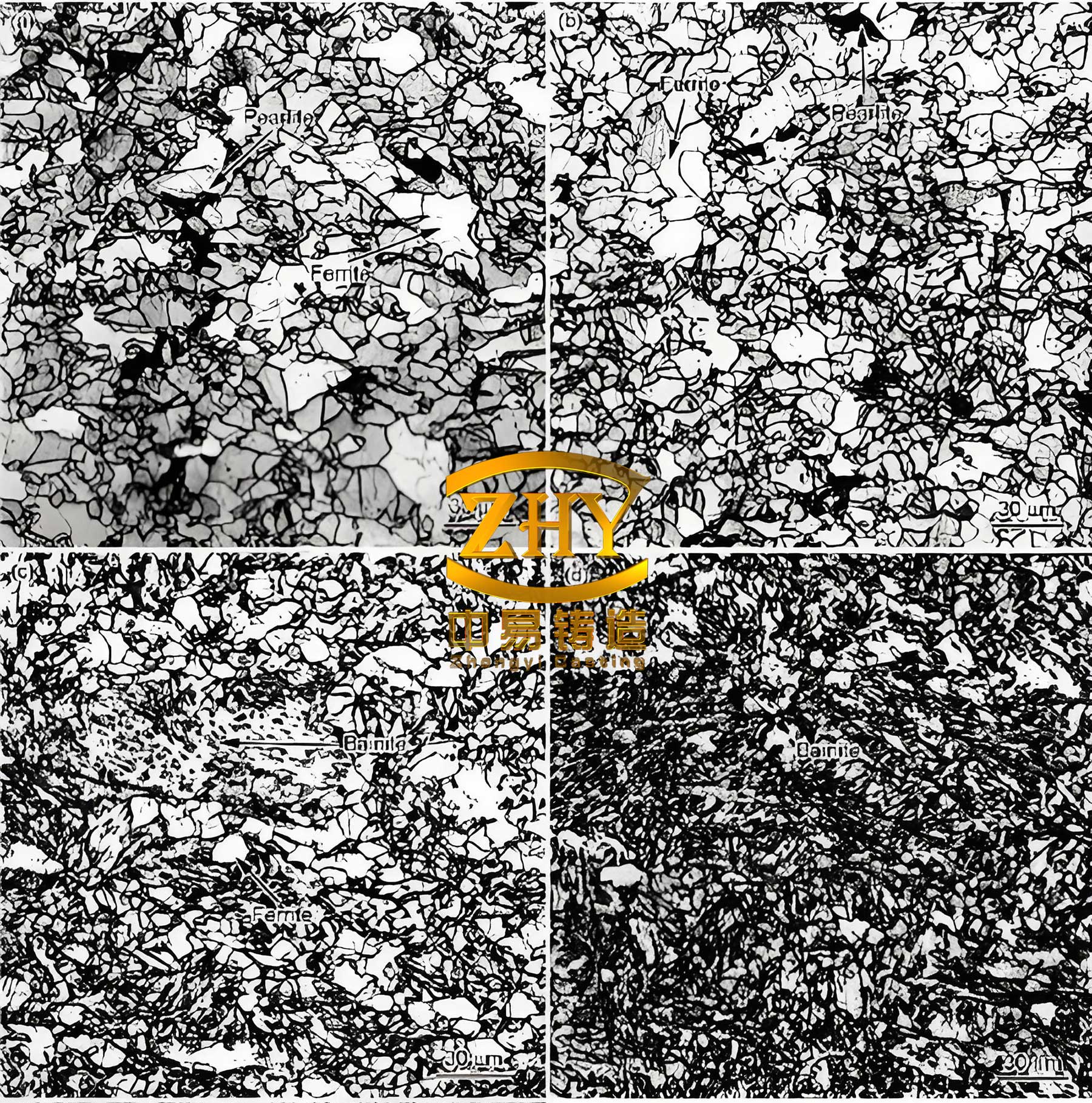
Microstructural analysis of spheroidal graphite cast iron from cold core box molds reveals excellent graphite morphology and matrix uniformity. Typical results include:
– Nodularity: ≥93%, indicating effective nodularization.
– Graphite size: Grade 7 (ASTM A247), corresponding to fine nodules.
– Matrix: Predominantly ferritic-pearlitic, with controlled carbide content.
The nodularity \( \eta \) is quantified as:
$$ \eta = \frac{N_s}{N_t} \times 100\% $$
where \( N_s \) is the number of spheroidal nodules and \( N_t \) is the total graphite particles. Our process consistently achieves \( \eta > 93\% \), ensuring mechanical integrity in spheroidal graphite cast iron.
| Parameter | Traditional Sand Molding | Cold Core Box Molding | Improvement |
|---|---|---|---|
| Nodularity (%) | 85-90 | 93-95 | ~5% increase |
| Graphite Size (ASTM Grade) | 5-6 | 7 | Finer distribution |
| Nodule Count (nodules/mm²) | 150-200 | 250-270 | ~30% increase |
| Hardness (HB) | 170-190 | 165-182 | More consistent |
| Defect Rate (scrap %) | 8-12 | 2-4 | ~70% reduction |
Hardness and Mechanical Properties
Brinell hardness tests on castings show values of 165–182 HB, within client specifications for spheroidal graphite cast iron. The uniformity is enhanced due to controlled cooling in thin-walled molds. Hardness \( H \) can be correlated with pearlite content \( P_c \) via:
$$ H = \alpha_p \cdot P_c + \beta_f $$
where \( \alpha_p \) and \( \beta_f \) are constants. For our spheroidal graphite cast iron, \( H \) remains stable across batches, indicating process robustness.
Productivity and Yield Enhancements
The cold core box process dramatically boosts output. For instance, production of small hinges for plastic injection machines jumped from 8–12 pieces per day with traditional methods to 60–100 pieces per day. This is due to faster mold making and stacking capability. The productivity gain \( G_p \) is:
$$ G_p = \frac{P_{\text{cold box}} – P_{\text{traditional}}}{P_{\text{traditional}}} \times 100\% $$
yielding \( G_p \approx 700\% \). Yield improvements stem from reduced defects like cold shuts, slag inclusions, and shrinkage, common in spheroidal graphite cast iron. The yield \( Y \) is calculated as:
$$ Y = \frac{W_{\text{sound castings}}}{W_{\text{total poured}}} \times 100\% $$
Our data shows \( Y \) increased from 85% to 96% for spheroidal graphite cast iron parts.
Economic Benefits and Cost Analysis
The economic advantages are substantial, encompassing material savings, reduced machining, and lower scrap. A key benefit is the ability to cast holes as small as 15 mm diameter, eliminating drilling operations for spheroidal graphite cast iron components. The cost savings \( S \) per part can be expressed as:
$$ S = (W_r \cdot C_m) + (T_m \cdot C_l) – C_{\text{extra}} $$
where \( W_r \) is the weight reduction (kg), \( C_m \) is the material cost per kg, \( T_m \) is the machining time saved (hours), \( C_l \) is the labor rate, and \( C_{\text{extra}} \) is the additional cost of cold core box materials. Based on our production data, savings range from 7% to 12% per part. The table below illustrates this for specific spheroidal graphite cast iron components.
| Component Name | Weight – Traditional (kg) | Weight – Cold Box (kg) | Reduction (kg) | Reduction (%) | Cost Savings per Part (USD)* |
|---|---|---|---|---|---|
| Long Hinge | 19.5 | 17.90 | 1.60 | 8.2 | 13.60 |
| Small Hinge | 1.8 | 1.55 | 0.25 | 13.9 | 2.13 |
| Hook Hinge 1 | 10.0 | 8.60 | 1.40 | 14.0 | 11.90 |
| Hook Hinge 2 | 9.3 | 8.20 | 1.10 | 11.8 | 9.35 |
*Based on a material cost of 8.5 USD/kg for spheroidal graphite cast iron.
Furthermore, the overall manufacturing cost per ton of spheroidal graphite cast iron has decreased by approximately 15%, factoring in energy savings from room-temperature hardening and reduced tooling maintenance. The return on investment \( ROI \) for switching to cold core box molding can be estimated as:
$$ ROI = \frac{\text{Net Savings per Year}}{\text{Initial Investment}} \times 100\% $$
In our case, \( ROI \) exceeded 200% within the first year, driven by high-volume production of spheroidal graphite cast iron parts.
Challenges and Future Perspectives
While the cold core box process has proven highly effective for spheroidal graphite cast iron, it is not without challenges. Issues such as limited mold size due to equipment constraints, difficulties in exhaust gas management (triethylamine emissions), and the need for further automation persist. However, ongoing advancements in binder chemistry and shooting machine design are addressing these. For example, newer amine systems with lower toxicity are being evaluated for spheroidal graphite cast iron applications. Additionally, integrating robotics for mold handling could elevate productivity further.
From a technical standpoint, the process optimization for spheroidal graphite cast iron involves continuous refinement. We are exploring dynamic simulation software to predict mold filling and solidification, which can be modeled using Navier-Stokes equations coupled with heat transfer:
$$ \rho \left( \frac{\partial \mathbf{v}}{\partial t} + \mathbf{v} \cdot \nabla \mathbf{v} \right) = -\nabla p + \mu \nabla^2 \mathbf{v} + \mathbf{f} $$
where \( \rho \) is density, \( \mathbf{v} \) is velocity, \( p \) is pressure, \( \mu \) is viscosity, and \( \mathbf{f} \) represents body forces. Such models help tailor the process for complex spheroidal graphite cast iron geometries.
Conclusion
In summary, the adoption of cold core box core assembly molding for spheroidal graphite cast iron production has been a transformative step in our foundry operations. Through meticulous attention to material selection, process design, and metallurgical control, we have achieved significant improvements in surface quality, microstructure, productivity, and cost efficiency. The data presented, via tables and formulas, underscores the superiority of this method over traditional sand molding for small to medium-sized spheroidal graphite cast iron components. While challenges remain, the economic and qualitative benefits make it a compelling choice for foundries aiming to thrive in competitive markets. As the technology evolves, I anticipate even broader adoption across the spheroidal graphite cast iron industry, driven by the relentless pursuit of excellence in casting science.