
In the production of lightweight mechanical components such as gearboxes, aluminum alloys are widely used due to their favorable strength-to-weight ratio. Traditional sand casting methods often lead to issues like poor internal and external quality, high costs, and inconsistent results. While die casting can be an alternative, it frequently introduces porosity defects, requires significant investment in equipment and molds, and is less economical for medium-volume production. We explored the use of full metal mold gravity casting as a solution, leveraging its advantages in mechanical properties, dense microstructure, dimensional accuracy, and cost-effectiveness. This foundry technology focuses on thin-walled aluminum castings, such as gearbox bodies and covers, where challenges like core extraction, filling difficulties, and cracking are prevalent. By applying the “shrinkage pipe method” for riser design and the “temperature equalization method” for mold design, we developed a robust process that overcomes these limitations. In this article, I will detail our approach, including feasibility analysis, process design, mold development, experimental trials, and production improvements, emphasizing how this foundry technology enhances quality and efficiency.
The gearbox body and cover, made of ZAlSi12 aluminum alloy, feature complex thin-walled structures with average wall thicknesses of 4 mm and localized thicker sections up to 27 mm. Initial designs posed challenges for metal mold casting, such as large planar areas prone to deformation and uneven cooling. We modified the structures to reduce flat surfaces and incorporate gradients that facilitate directional solidification. For instance, the gearbox cover was redesigned with recessed non-interference areas to minimize distortion during ejection. This foundational step in foundry technology ensured that the castings could be produced without defects like warping or residual stresses. The overall dimensions—307 mm × 319 mm × 90.5 mm for the body and 260 mm × 167 mm × 39 mm for the cover—required precise control over mold parameters to achieve uniform filling and solidification.
Our casting process employed vertical pouring with split molds (left and right blocks) to enable symmetric core extraction and reduce defects. The gating system was designed as a bottom-fed arrangement to promote sequential solidification from the bottom upward. Key aspects included the use of multiple risers based on the shrinkage pipe method, which calculates riser dimensions to compensate for solidification shrinkage. The riser design involves determining the thermal modulus at critical sections, ensuring adequate feeding to prevent shrinkage porosity. For example, the riser dimensions were derived using the following relationships: the riser diameter \( D_m \) is given by \( D_m = 2W + D_p \), where \( W \) is the insulation wall thickness (\( W = 2M_h \)), and \( D_p \) is the shrinkage pipe diameter calculated as \( D_p = \left( \frac{2}{\pi} \cdot V_{op} \right)^{1/3} \). Here, \( V_{op} \) represents the volume allocated to each riser for feeding, and \( M_h \) is the thermal modulus at the hot spot. The riser height \( H \) is set as \( H = H_p + H_m \), with \( H_p = 2D_p \) and a minimum pressure head \( H_m \) of 20 mm. This foundry technology approach ensured that the thick sections, such as bearing bosses, received sufficient liquid metal to avoid defects.
| Riser Label | Thermal Modulus \( M_h \) (mm) | Riser Mid-Diameter (mm) | Riser Neck (mm) | Riser Neck Modulus (mm) | Riser Base (mm) | Riser Top (mm) | Riser Height (mm) |
|---|---|---|---|---|---|---|---|
| a | 3.5 | 27.6 | 30 × 15 | 5.0 | φ30 | φ35 | 100 |
| b | 4.8 | 32.7 | 25 × 15 | 4.7 | 25 × 20 | 30 × 25 | 100 |
| c | 4.0 | 29.7 | 30 × 25 | 6.8 | 35 × 30 | 40 × 35 | 100 |
| d | 2.9 | 25.2 | 30 × 10 | 3.8 | 30 × 10 | 35 × 15 | 87.5 |
To further optimize the foundry technology, we incorporated cooling techniques such as copper rods in thick sections and air cooling in the core to manage temperature gradients. The gating system was positioned near external bosses to aid in contour formation and reduce turbulence. The overall contraction rate for the alloy was set at 3%, and riser volumes were calculated to cover the total casting volume. This methodical riser design, integral to advanced foundry technology, minimized defects like shrinkage cavities in critical areas.
The metal mold design was based on the temperature equalization method, which aims to maintain uniform thermal conditions throughout the casting process. Mold wall thicknesses ranged from 15 mm to 30 mm, with thicker base plates to accommodate the deep cavities of the gearbox body. The total mold thickness (combining moving and fixed halves) was set at 140 mm, derived from the casting height plus the base heights. Key considerations included dimensional accuracy, with mold cavity sizes calculated using the formula: \( A_x = (A_p + A_p K \pm \delta) \pm \Delta A_x \), where \( A_x \) is the cavity dimension, \( A_p \) is the average casting dimension (accounting for tolerances), \( K \) is the comprehensive linear shrinkage rate (typically 1%), \( \delta \) is the coating thickness (0.1–0.3 mm), and \( \Delta A_x \) is the manufacturing tolerance. This foundry technology ensures that the final castings meet precise specifications, especially for mating surfaces like the gearbox body and cover interfaces.
Material selection involved using 5CrMnMo forged steel for mold blocks in contact with aluminum and 45 steel for gating components. Surface treatments, such as QPQ (quench-polish-quench) processing, were applied to enhance durability and prevent sticking. To reduce ejection resistance, we minimized unnecessary holes along the length direction and incorporated ejector pins and slides for complex features. The mold design also addressed ventilation to avoid air entrapment, a common issue in full metal mold casting. This comprehensive approach to mold engineering is a cornerstone of reliable foundry technology, enabling repeated production cycles with consistent quality.
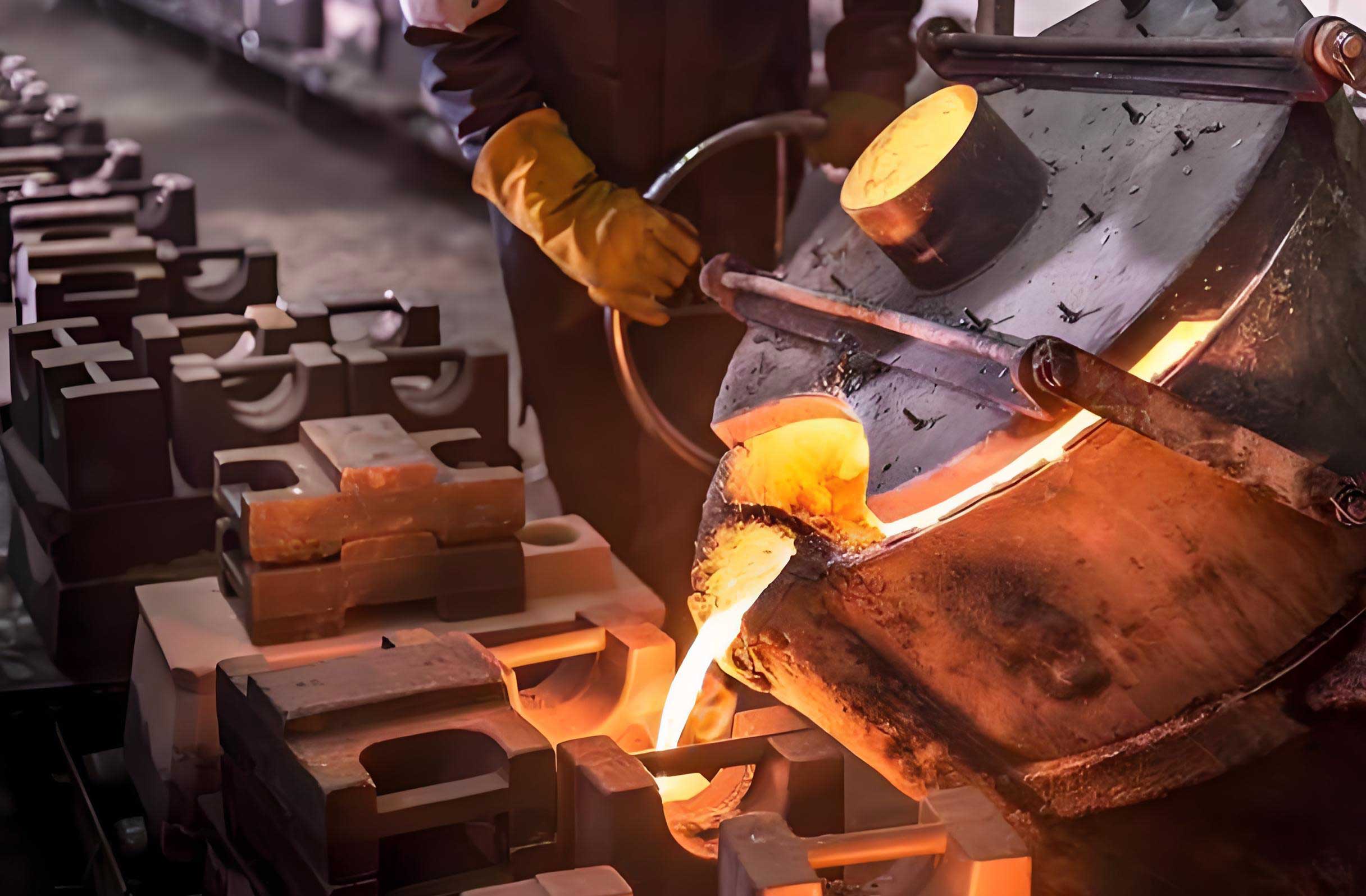
During trial production, we optimized process parameters through iterative testing. The mold was preheated using natural gas flames to a temperature range of 300–350°C, as lower temperatures caused cold shuts and higher ones led to surface porosity. Coating application was critical for thermal management and easy ejection. Pouring temperature was varied between 680°C and 710°C; below this range, misruns occurred, and above it, internal porosity formed. The following equation guided our temperature control: the solidification time \( t_s \) can be estimated as \( t_s = C \cdot \left( \frac{V}{A} \right)^2 \), where \( C \) is a constant dependent on the alloy and mold material, \( V \) is the casting volume, and \( A \) is the surface area. This foundry technology principle helped us achieve a balance between filling and solidification.
| Pouring Temperature (°C) | Observed Defects |
|---|---|
| 640 | Misruns |
| 660 | Local cold shuts |
| 680 | None |
| 700 | None |
| 720 | Minor defects |
| 740 | Internal surface porosity |
Cooling time in the mold was another critical parameter. In summer, dwell times of 70–90 seconds prevented hot tearing, while in winter, 40–60 seconds sufficed. Excessive times caused difficulty in ejection or distortion. We monitored mold temperature stability using infrared thermometers, aiming for an equilibrium where heat absorption and dissipation balanced. For the gearbox body, the production cycle stabilized at 3 minutes in summer and 2.5 minutes in winter, with dwell times adjusted accordingly. This optimization is essential in foundry technology to maintain productivity and quality.
Initial trials revealed shrinkage porosity in the bearing boss areas of the gearbox body, forming ring-shaped defects larger at the top. To address this, we enhanced cooling in the core with air circulation and modified the wall thickness to create a gradient favoring directional solidification. The redesign increased thickness toward the risers, improving feeding paths. Additionally, preheating the mold upper sections ensured a positive temperature gradient, allowing sufficient time for compensation. The riser system was simplified for easier cleaning and ejection, incorporating ejector pins and adjusted draft angles to ensure the casting remained on the moving half during opening. This problem-solving aspect of foundry technology demonstrated the importance of iterative design and process control.
For the gearbox cover, the process proved more adaptable, with stable production at mold temperatures of 300–350°C and dwell times of 40–80 seconds. No additional core cooling was needed, simplifying operations. The final castings exhibited surface quality comparable to die-cast parts but with superior internal integrity and mechanical properties. This success underscores the versatility of full metal mold casting in foundry technology for thin-walled components.
In batch production, we maintained mold temperatures within \( 350 \pm 30 \)°C, with coating sprays used to manage heat and prevent defects. The gearbox body required careful ejection force distribution to avoid deformation; we added ejector pads and optimized draft angles on critical cores. The resulting castings showed minimal distortion and met all dimensional requirements. A comparison with sand casting and metal mold casting with sand cores highlights the advantages: reduced porosity, higher strength, better surface finish, and lower costs for medium volumes. This makes full metal mold gravity casting a preferred foundry technology for applications like gearboxes.
| Dwell Time (s) | Season | Observed Defects |
|---|---|---|
| 60 | Summer | Hot tearing |
| 70 | Summer | No defects |
| 80 | Summer | None |
| 90 | Summer | Minor issues |
| 100 | Summer | Ejection difficulties |
| 30 | Winter | Hot tearing |
| 40 | Winter | No defects |
| 50 | Winter | None |
| 60 | Winter | Minor issues |
| 70 | Winter | Ejection problems |
In conclusion, full metal mold gravity casting is an effective foundry technology for producing thin-walled aluminum gearbox castings in medium batches. The integration of the shrinkage pipe method for riser design and the temperature equalization method for mold design ensures high-quality outcomes with excellent dimensional control and mechanical properties. Our experiments demonstrated that optimal parameters—such as mold temperatures of 300–350°C, pouring temperatures of 680–710°C, and dwell times of 70–90 seconds in summer—yield defect-free parts. This foundry technology not only reduces costs but also enhances consistency, making it ideal for components requiring precision and reliability. Future work could explore automation and further material innovations to expand its applications in the foundry industry.