
In the realm of modern manufacturing, the demand for precision and efficiency in producing machine tool castings has driven the adoption of innovative foundry techniques. Among these, the Full Mold Casting (FMC) process, also known as evaporative pattern casting, has emerged as a promising alternative to traditional sand casting methods. From our practical experience in a specialized foundry setting, we have extensively explored the application of FMC to machine tool castings, focusing on overcoming inherent challenges to unlock significant economic benefits. This article delves into our first-hand journey, detailing the process advantages, experimental trials, procedural adaptations, and quantifiable outcomes, all aimed at advancing the use of FMC for complex, thin-walled machine tool castings.
The Full Mold Casting process utilizes expendable patterns made from foam materials, typically expanded polystyrene (EPS), which are embedded in unbonded sand molds. During pouring, molten metal replaces the pattern as it vaporizes, resulting in a casting that replicates the pattern shape precisely. Compared to conventional wood pattern-based casting, FMC offers several distinct advantages for producing machine tool castings: simplified pattern-making, reduced production lead time, enhanced dimensional accuracy of castings, and lower labor consumption. These benefits stem from the elimination of core boxes for intricate internal cavities, as the foam pattern itself defines the shape, and the use of inexpensive EPS material, which drastically cuts pattern material costs. For instance, while wood like red pine may cost significantly more, EPS boards are economically favorable, making FMC particularly attractive for single-piece or large-scale machine tool castings.
However, the application of FMC to machine tool castings is not without challenges. Due to the relatively low strength and rigidity of foam patterns, especially for complex geometries with thin walls, deformation during sand filling and compaction is a primary concern. Additionally, the vaporization of the foam pattern consumes heat from the molten metal, leading to rapid cooling in the mold cavity. This can result in defects such as cold shuts, slag inclusions, and mistruns, which are particularly problematic for non-thick-walled, intricate machine tool castings. Initially, our use of FMC was limited to thick, massive stamping die blanks. To extend its applicability, we embarked on a systematic experimental campaign targeting a variety of machine tool castings, aiming to refine the process and mitigate these defects.
Our experimental approach followed a progressive methodology, starting with simpler geometries and advancing to more complex components. We selected a range of machine tool castings, including discs, faceplates, table bodies, base frames, slide bodies, fixture bodies, and large conveying bases. These castings varied in weight, dimensions, and structural complexity, providing a comprehensive testbed for evaluating FMC performance. The table below summarizes the key details of the trial castings, all of which are machine tool castings designed for precision applications.
| Cast Part Name | Approximate Weight (kg) | Major Dimensions (mm) | Material Grade | Observed Defects (Initial Trials) | Primary Cause of Defects |
|---|---|---|---|---|---|
| Disc | 150 | Ø600 x 100 | HT250 | Minor cold shuts on ribs | Insufficient gating system design |
| Faceplate | 200 | 800 x 800 x 120 | HT300 | None | N/A |
| Table Body | 350 | 1000 x 600 x 200 | HT250 | Local sand burn-on | Inadequate sand compaction |
| Base Frame | 500 | 1200 x 800 x 300 | HT300 | Deformation in thin sections | Pattern distortion during sand filling |
| Intermediate Base | 400 | 1100 x 700 x 250 | HT250 | Minor slag inclusions | Improper gating ratio |
| Fixture Body | 250 | 900 x 500 x 180 | HT200 | None | N/A |
| Slide Body | 300 | 1000 x 400 x 220 | HT250 | Cold shuts on complex features | Rapid heat loss due to pattern vaporization |
| Large Conveying Base | 800 | 2000 x 1000 x 350 | HT300 | None after optimization | N/A |
Through these trials, we identified that the success of FMC for machine tool castings hinges on addressing two core issues: preventing pattern deformation during mold making and minimizing thermal-related defects like cold shuts. We developed and implemented a series of procedural measures, which are elaborated below with supporting formulas and tables.
Measures to Prevent Pattern Deformation During Sand Filling and Compaction: Machine tool castings often feature box-like structures with multiple walls, internal ribs, and hollow cavities, making them prone to distortion under sand pressure. To counteract this, we adopted the following strategies:
- Uniform Sand Filling and Compaction: For patterns with internal cavities, sand is filled simultaneously inside and around the external walls, ensuring even distribution. The sand layers should not be too thick, and compaction must be applied uniformly from both sides to avoid bulging or inward collapse. The compaction force \( F_c \) should be controlled based on pattern strength, which can be approximated by the foam’s compressive strength \( \sigma_f \) and the contact area \( A \): $$ F_c \leq \sigma_f \times A $$ where \( \sigma_f \) for typical EPS is around 0.1-0.2 MPa, and \( A \) is the projected area of the pattern section.
- Use of Temporary Support Blocks: For patterns with non-penetrating upper or lower cavities, we fabricate thick foam support blocks that match the cavity shape. These blocks are placed during sand filling to prevent collapse, then removed after mold turnover. The upper cavities are subsequently formed using cope sand. This ensures geometric integrity for complex machine tool castings.
- Segmented Pattern Approach: For castings with multi-layer cavities, we divide the pattern into segments. Each segment is filled and compacted separately, then assembled via interlocking joints (e.g., tongue-and-groove) to maintain overall dimensions. This reduces localized stress on the foam, critical for thin-walled machine tool castings.
Measures to Prevent Cold Shuts and Slag Inclusions: The endothermic vaporization of foam patterns leads to quicker metal cooling, exacerbating cold shut formation. Our countermeasures include:
- Enhanced Pouring Parameters: Increasing pouring temperature \( T_p \) and enlarging the gating system to reduce filling time \( t_f \). The relationship can be expressed as: $$ t_f = \frac{V}{Q} $$ where \( V \) is the mold cavity volume and \( Q \) is the volumetric flow rate of molten metal. By maximizing \( Q \) through larger gating cross-sections, we ensure rapid cavity filling, minimizing temperature drop.
- Optimized Gating Design: We employ multiple ingates along the length of the casting, fed by a extended runner that distributes flow evenly. This reduces flow distance and maintains higher metal temperature in the runner. The gating ratio (sprue:runner:ingate) is crucial; for machine tool castings, we recommend a ratio of $$ 1 : 2.5 : 3 $$ to $$ 1 : 3 : 4 $$, depending on part complexity and wall thickness.
- Strategic Ingate Placement: Ingates are positioned at thin sections or vulnerable areas to direct hotter metal to regions prone to cold shuts, ensuring thermal priority in critical zones of machine tool castings.
- Bottom Gating Preference: We favor bottom-gated systems where molten metal rises steadily from the base, avoiding turbulence and flow separation that can cause cold shuts in top-gated designs. This is particularly effective for tall, slender machine tool castings.
Based on our empirical data from both stamping die blanks and machine tool castings, we have derived reference parameters for designing gating systems in FMC. The table below provides guidelines correlating casting weight, wall thickness, and gating dimensions, specifically tailored for machine tool castings.
| Casting Weight Range (kg) | Typical Wall Thickness (mm) | Recommended Gating Ratio (Sprue : Runner : Ingate) | Sprue Cross-Sectional Area (cm²) | Pouring Time Estimate (s) |
|---|---|---|---|---|
| 100-300 | 10-20 | 1 : 2.5 : 3 | 8-12 | 15-25 |
| 300-600 | 15-25 | 1 : 3 : 3.5 | 12-18 | 25-40 |
| 600-1000 | 20-30 | 1 : 3 : 4 | 18-25 | 40-60 |
These values are derived from the empirical formula for sprue area \( A_s \) based on casting weight \( W \) (in kg) and a factor \( k \) that accounts for metal fluidity and complexity: $$ A_s = k \times \sqrt{W} $$ where \( k \) ranges from 0.4 to 0.6 for gray iron machine tool castings, with higher values for thinner walls or complex shapes.
To illustrate the practical application and economic impact, we present a detailed case study of a large conveying base, a quintessential machine tool casting used in manufacturing systems. This component, with a weight of 800 kg and material grade HT300, features a elongated structure with internal ribs and hollow sections, making it ideal for testing FMC adaptations.
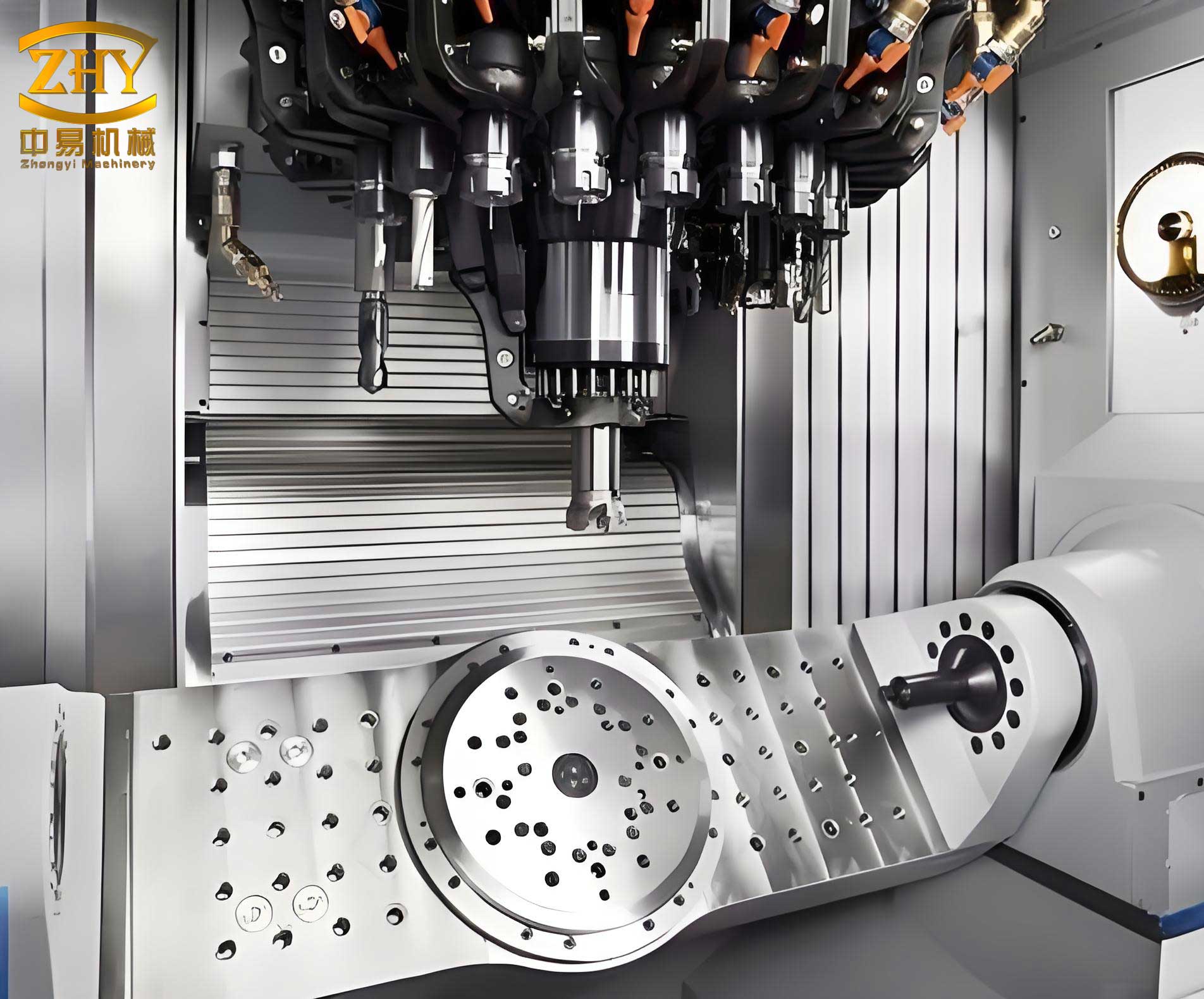
The casting design includes temporary foam support blocks for lower cavities, which are removed after mold turnover, allowing the upper cavity to be formed by cope sand. The gating system runs along one side of the length, with a continuous runner distributing flow through multiple ingates, ensuring uniform filling and temperature distribution. This design mitigates deformation and cold shuts, critical for this large machine tool casting.
Economic Analysis: Full Mold Casting vs. Traditional Wood Pattern Casting For this conveying base, we conducted a cost comparison between FMC using an EPS pattern and conventional casting using a wood pattern. The calculations are as follows:
- Wood Pattern Method:
- Pattern material (red pine): 0.8 m³ required. Cost: 2500 CNY/m³. Total material cost: $$ 0.8 \times 2500 = 2000 \, \text{CNY} $$
- Core boxes: 4 units needed, each consuming 0.2 m³ of wood. Additional material: $$ 4 \times 0.2 \times 2500 = 2000 \, \text{CNY} $$
- Total wood material cost: 2000 + 2000 = 4000 CNY.
- Pattern-making labor: Basic hours: 120 h; auxiliary hours: 30 h. Total hours: 150 h. Labor rate: 50 CNY/h. Labor cost: $$ 150 \times 50 = 7500 \, \text{CNY} $$
- Total cost for wood pattern: 4000 + 7500 = 11,500 CNY.
- Full Mold Casting (EPS Pattern):
- EPS board material: 0.3 m³ required. Cost: 800 CNY/m³. Material cost: $$ 0.3 \times 800 = 240 \, \text{CNY} $$
- Pattern-making labor: Basic hours: 80 h; auxiliary hours: 20 h. Total hours: 100 h. Labor cost: $$ 100 \times 50 = 5000 \, \text{CNY} $$
- Total cost for EPS pattern: 240 + 5000 = 5240 CNY.
The cost saving by adopting FMC for this machine tool casting is: $$ 11,500 – 5240 = 6260 \, \text{CNY} $$ per pattern. This represents a reduction of approximately 54%, highlighting the substantial economic advantage of FMC for single-piece or low-volume production of machine tool castings. Furthermore, the lead time for pattern production is shortened by about 33%, accelerating overall manufacturing cycles.
Our experimental trials encompassed over 10 distinct machine tool castings, with a cumulative weight exceeding 3000 kg, all produced via the optimized FMC process. The results were highly encouraging: after implementing the aforementioned measures, defect rates dropped significantly, and all castings met quality standards with minimal or no rework. For instance, the base frame and intermediate base, which initially exhibited deformation and slag inclusions, were rectified through improved sand compaction and gating adjustments, ultimately qualifying for inventory. The table below summarizes the post-optimization outcomes for key machine tool castings, reinforcing the process viability.
| Machine Tool Casting Type | Quantity Produced | Defect Rate Pre-Optimization (%) | Defect Rate Post-Optimization (%) | Primary Improvement Measure |
|---|---|---|---|---|
| Discs and Faceplates | 5 | 20 | 0 | Increased pouring temperature and gating size |
| Table Bodies and Bases | 4 | 25 | 5 | Uniform sand compaction and bottom gating |
| Slide and Fixture Bodies | 3 | 30 | 0 | Segmented patterns and multiple ingates |
| Large Conveying Bases | 2 | 15 | 0 | Support blocks and optimized runner design |
The overall economic benefit extends beyond direct pattern cost savings. By reducing labor hours, minimizing material waste, and decreasing lead times, FMC enhances production efficiency for machine tool castings. The net savings per ton of casting can be estimated using the formula: $$ S_{\text{net}} = (C_w – C_f) + (L_w – L_f) \times R + \Delta T \times O $$ where \( C_w \) and \( C_f \) are material costs for wood and EPS patterns, \( L_w \) and \( L_f \) are labor hours, \( R \) is the labor rate, \( \Delta T \) is the time reduction in production, and \( O \) is the overhead cost per time unit. For our trials, \( S_{\text{net}} \) averaged around 8000 CNY per ton of machine tool castings, validating the process’s profitability.
In conclusion, our practical exploration demonstrates that Full Mold Casting is a feasible and economically viable process for producing a wide range of machine tool castings, including non-thick-walled, complex geometries. By addressing deformation through careful sand handling and support techniques, and combating thermal defects via optimized gating design and pouring parameters, we have successfully expanded FMC’s applicability beyond thick-section components. The key lies in tailoring the process to the specific demands of machine tool castings, which require high dimensional accuracy and structural integrity. The economic calculations reveal substantial cost reductions, particularly for single-piece or batch production, making FMC an attractive option for foundries specializing in repair or custom manufacturing. As we continue to refine these techniques—perhaps incorporating advanced foam materials or simulation-based gating design—we anticipate further broadening of FMC’s role in the production of precision machine tool castings. This journey underscores the importance of adaptive innovation in foundry practices, paving the way for wider adoption of evaporative pattern casting in the machine tool industry.