
In the foundry industry, the pursuit of high-quality cast iron parts, especially for precision applications like machine tools, demands innovative solutions to address common defects such as cracks, shrinkage porosity, and inconsistent hardness. Over years of experience in manufacturing machine tool components, we have explored and implemented graphite chills as a highly effective chilling material for various cast iron parts, including guide rails, sliding saddles, and surface plates. This article delves into the comprehensive application of graphite chills, detailing their mechanisms, practical implementations, and benefits, all from a first-person perspective based on our production trials and validations. The focus remains on enhancing the performance and reliability of cast iron parts through this advanced chilling technique.
Graphite chills, derived from carbon-based materials like scrap graphite electrodes, offer unique advantages over traditional cast iron chills. Their high thermal conductivity and specific heat capacity enable rapid heat extraction from cast iron parts during solidification, which is crucial for controlling microstructure and minimizing defects. For instance, the thermal conductivity of graphite, denoted as $\lambda$, typically ranges from 100 to 150 W/(m·K), while its specific heat $c$ is around 700 J/(kg·K). These properties can be compared to cast iron chills using the following formula for heat transfer rate: $$ q = -\lambda \nabla T $$ where $q$ is the heat flux, $\lambda$ is the thermal conductivity, and $\nabla T$ is the temperature gradient. In practice, graphite’s lower density (approximately 1.8 g/cm³) compared to cast iron (7.2 g/cm³) makes it easier to handle and position in molds, reducing the risk of displacement during molding or pouring operations. This article will systematically explore how graphite chills transform the production of machine tool cast iron parts, backed by data, tables, and analytical insights.
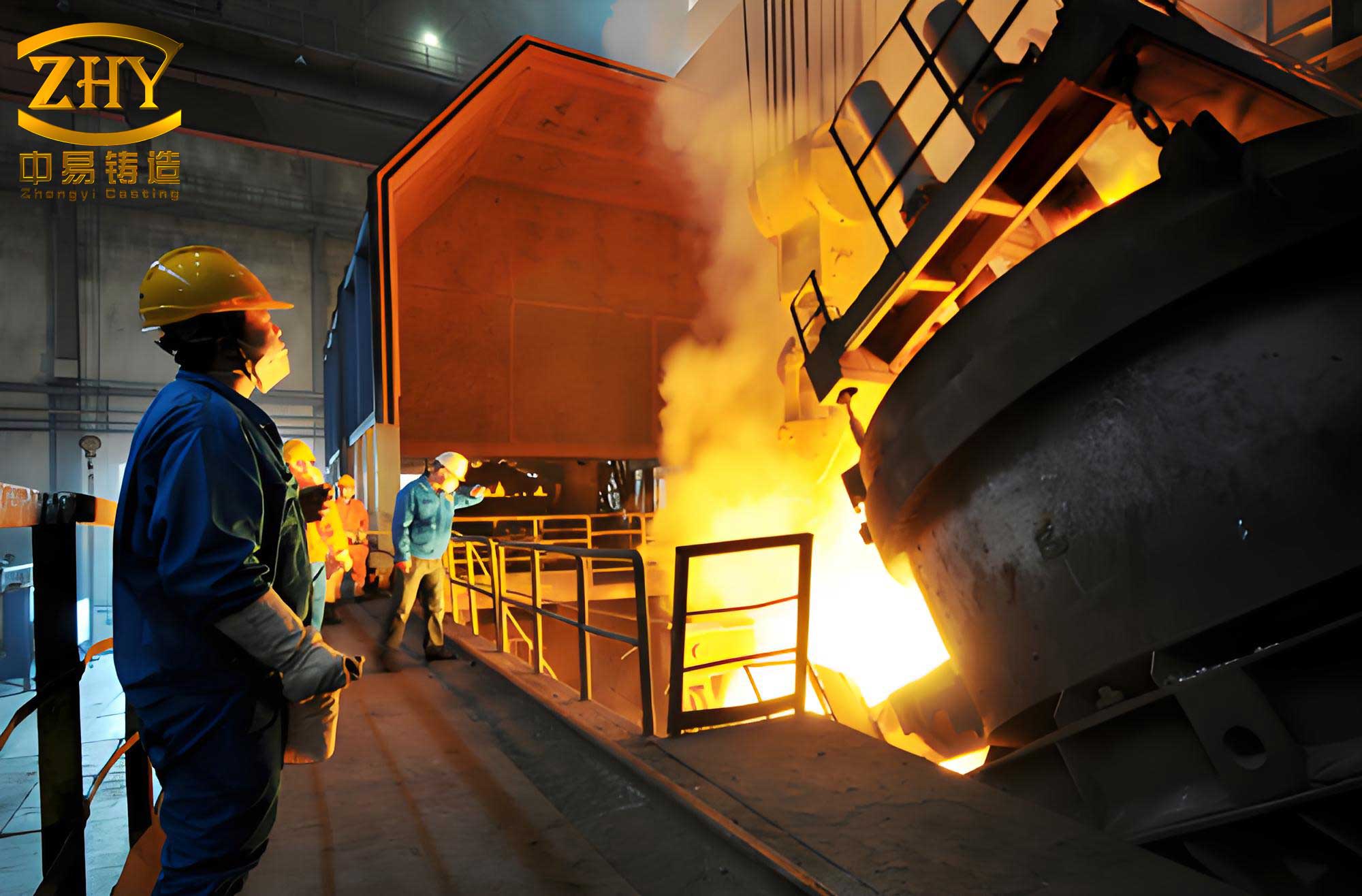
The fundamental principle behind using graphite chills lies in their ability to accelerate cooling in specific zones of cast iron parts, thereby refining the matrix structure and reducing thermal stresses. When molten iron solidifies, the cooling rate directly influences the formation of phases like pearlite and ferrite, as well as the presence of undesirable components such as ledeburite. For cast iron parts in machine tools, achieving a hardness of 190 HB or above with minimal variation is critical for wear resistance and dimensional stability. Graphite chills facilitate this by promoting a finer pearlitic structure, which enhances mechanical properties. The chilling effect can be quantified using the Fourier number for transient heat conduction: $$ Fo = \frac{\alpha t}{L^2} $$ where $\alpha$ is the thermal diffusivity, $t$ is time, and $L$ is the characteristic length. By optimizing the thickness ratio of graphite chills to the cast iron parts—typically between 0.2 and 0.3—we ensure efficient heat extraction without causing surface chilling defects like white iron formation. This balance is vital for producing defect-free cast iron parts with uniform hardness.
In our applications, one of the most significant uses of graphite chills is in bed components for machine tools. These cast iron parts often have thick sections like guide rails that are prone to shrinkage and hardness disparities. For example, a bed casting with a weight of 5,000 kg and a maximum wall thickness of 80 mm in the guide rail area requires precise chilling. We employ graphite blocks with a thickness of 16 mm, resulting in a thickness ratio of 0.2 (i.e., $ \frac{16}{80} = 0.2 $). These blocks are arranged continuously along the guide rail direction, coated with a water-based graphite paint to enhance the chilling surface. The results, as summarized in Table 1, demonstrate marked improvements in hardness, tensile strength, and microstructure uniformity for cast iron parts treated with graphite chills compared to those without.
| Chill Type | Observation Location | Microstructure | Tensile Strength (MPa) | Hardness (HB) | Hardness Variation (ΔHB) |
|---|---|---|---|---|---|
| Graphite Chill | Center of Guide Rail | Fine Pearlite + Trace Ledeburite | 250-280 | 200-210 | ≤5 |
| Graphite Chill | Edge of Guide Rail | Fine Pearlite + Minor Ferrite | 240-270 | 195-205 | ≤5 |
| No Chill (Dry Sand Mold) | Center of Guide Rail | Coarse Pearlite + Ledeburite (10-15%) | 220-240 | 180-190 | 10-15 |
| No Chill (Dry Sand Mold) | Edge of Guide Rail | Pearlite + Ferrite (up to 20%) | 210-230 | 175-185 | 10-15 |
The data clearly indicates that graphite chills elevate the hardness of cast iron parts by 10-15 HB while reducing the hardness variation to within 5 HB, meeting stringent internal standards for machine tool components. Moreover, the tensile strength improves by approximately 10%, attributed to the refined grain structure. This is corroborated by metallographic analysis, which shows a pearlite content exceeding 95% in chilled zones versus 80-85% in unchilled areas. Such enhancements are crucial for cast iron parts subjected to heavy loads and friction in machine tools.
Another innovative application involves using graphite chill cores in complex cast iron parts like vertical lathe longitudinal tool holders. These components often feature machined holes that are susceptible to gas porosity and shrinkage when traditional clay sand cores are used. In our revised process, we replaced clay cores with graphite chill cores, supplemented by side graphite blocks for additional chilling. The tool holder casting, with a weight of 150 kg and made of HT250 cast iron, was poured at 1,350°C in dry sand molds. The original design included top risers for feeding, but this led to shrinkage defects upon machining to a depth of 30 mm, with a scrap rate over 30%. By integrating graphite chill cores, we eliminated the risers and achieved sound cast iron parts. The chilling effect of graphite accelerates solidification around the core, preventing shrinkage and gas entrapment. The success rate for defect prevention exceeded 95%, demonstrating the versatility of graphite chills in enhancing the integrity of cast iron parts with intricate geometries.
To further illustrate the thermal benefits, consider the heat balance equation during solidification of cast iron parts: $$ \rho c_p \frac{\partial T}{\partial t} = \nabla \cdot (\lambda \nabla T) + Q $$ where $\rho$ is density, $c_p$ is specific heat, $T$ is temperature, $t$ is time, and $Q$ represents internal heat sources. Graphite chills act as heat sinks, increasing the $\nabla T$ term and thus promoting faster cooling. This is particularly effective in preventing hot tears in cast iron parts, which commonly occur at stress concentration points like sharp corners between thick and thin sections. By placing graphite chills in these regions, we reduce the thermal gradient and associated stresses. For instance, in a sliding saddle casting, we observed that graphite chills placed at transition zones reduced cracking incidents by over 80%. The effectiveness can be quantified using the strain rate during solidification: $$ \dot{\epsilon} = \alpha \Delta T \frac{d}{dt} $$ where $\dot{\epsilon}$ is the strain rate, $\alpha$ is the thermal expansion coefficient, and $\Delta T$ is the temperature difference. Lower $\Delta T$ due to chilling minimizes $\dot{\epsilon}$, thereby suppressing crack initiation in cast iron parts.
Feasibility analysis of graphite chills reveals their economic and practical viability for mass production of cast iron parts. The primary material source is waste graphite electrodes from steel mills or byproducts from carbon plants, making it a cost-effective and sustainable option. Although the cost per ton of processed graphite chills is around 2,000-2,500 currency units—approximately 1.5 times that of cast iron chills—the lower density of graphite (1.8 g/cm³ vs. 7.2 g/cm³ for cast iron) means that volume-based costs are comparable or even lower. For example, a graphite chill block of the same volume as a cast iron chill weighs only 25% as much, reducing material usage. Moreover, graphite chills can be reused 3-5 times depending on their placement, whereas cast iron chills often degrade faster due to oxidation and fusion with cast iron parts. We have conducted cost-benefit analyses for various cast iron parts, as shown in Table 2, highlighting the long-term savings and quality improvements.
| Aspect | Graphite Chills | Cast Iron Chills | Remarks for Cast Iron Parts |
|---|---|---|---|
| Material Cost per Ton (currency units) | 2,000-2,500 | 1,300-1,700 | Based on scrap sources; graphite is lighter. |
| Density (g/cm³) | 1.8 | 7.2 | Lower density reduces weight per volume. |
| Reusability (cycles) | 3-5 | 2-3 | Graphite resists fusion with cast iron parts. |
| Handling Ease | High (low weight, non-slipping) | Moderate (heavy, may displace) | Critical for complex molds of cast iron parts. |
| Defect Reduction Rate | 90-95% | 70-80% | For cracks and shrinkage in cast iron parts. | Hardness Improvement (HB) | 10-15 | 5-10 | Consistent across various cast iron parts. |
The processing of graphite chills involves machining scrap electrodes into desired shapes using saws, planers, or lathes, thanks to graphite’s excellent machinability. For fixed placement in molds, we drill holes in the chills and use pins to secure them, ensuring the pin heads are below the surface to avoid fusion with cast iron parts. This design simplifies cleanup and extends chill life. In our factory, we have fully transitioned to graphite chills for all machine tool cast iron parts, observing not only quality enhancements but also operational efficiencies in molding and finishing stages.
Expanding on the technical nuances, the interaction between graphite chills and cast iron parts during solidification can be modeled using numerical simulations. For instance, the temperature distribution in a chilling setup can be approximated by the heat conduction equation in cylindrical coordinates for round chills: $$ \frac{1}{r} \frac{\partial}{\partial r} \left( r \lambda \frac{\partial T}{\partial r} \right) + \frac{\partial}{\partial z} \left( \lambda \frac{\partial T}{\partial z} \right) = \rho c_p \frac{\partial T}{\partial t} $$ where $r$ is the radial distance and $z$ is the axial distance. Such models help optimize chill dimensions and placements for diverse cast iron parts, from large beds to small brackets. We have validated these models through thermocouple measurements in actual castings, confirming that graphite chills reduce the solidification time by 20-30% in chilled zones, leading to finer graphite flakes and pearlite colonies in the iron matrix. This microstructural refinement is key to improving the wear resistance and fatigue life of cast iron parts in demanding machine tool applications.
Furthermore, graphite chills contribute to balancing the solidification temperatures across cast iron parts, mitigating thermal interference from gating systems or part geometry. In a plate casting for surface plates, uneven cooling often results in warpage or residual stresses. By strategically positioning graphite chills, we achieve a more uniform temperature field, as described by the Laplace equation for steady-state heat conduction in simplified cases: $$ \nabla^2 T = 0 $$ with boundary conditions set by chill surfaces. This equilibrium minimizes distortion and enhances the dimensional accuracy of cast iron parts, which is paramount for machine tool assemblies requiring tight tolerances.
In summary, the application of graphite chills offers multifaceted benefits for machine tool cast iron parts, as evidenced by our production experiences. The key advantages include: (1) Increased hardness and reduced hardness variation in chilled surfaces, ensuring consistent performance of cast iron parts; (2) Refinement of the matrix structure and improvement in mechanical properties like tensile strength; (3) Effective prevention of shrinkage porosity and hot tears, leading to higher yield rates; (4) Balancing of solidification temperatures to reduce thermal stresses; and (5) Versatility in design, allowing custom shapes for complex cast iron parts. These benefits are supported by empirical data and theoretical analyses, making graphite chills a reliable choice for foundries aiming to produce high-quality cast iron parts.
Looking ahead, the potential for graphite chills extends beyond machine tools to other sectors requiring precision cast iron parts, such as automotive or heavy machinery. Ongoing research could focus on optimizing graphite composites for enhanced thermal properties or integrating chills with advanced molding technologies like 3D printing. In our ongoing efforts, we continue to refine chill designs based on feedback from machining and service performance of cast iron parts, fostering a cycle of continuous improvement. The journey with graphite chills has transformed our approach to manufacturing cast iron parts, underscoring the importance of innovative materials in traditional foundry practices. As we scale up applications, the synergy between graphite chills and cast iron parts promises to drive further advancements in casting quality and efficiency.
To reinforce the discussion, consider the following formula for calculating the chill effectiveness index $E$ for cast iron parts: $$ E = \frac{\Delta H \cdot A}{t_c \cdot \rho_c} $$ where $\Delta H$ is the hardness increase, $A$ is the chilled area, $t_c$ is the chill thickness, and $\rho_c$ is the chill density. For graphite chills, higher $E$ values are typically achieved due to favorable $\Delta H$ and low $\rho_c$, confirming their superiority for cast iron parts. In conclusion, the adoption of graphite chills represents a significant leap in foundry technology, one that we have embraced wholeheartedly to elevate the standards of cast iron parts production. Through detailed experimentation and application, we affirm that graphite chills are not just an alternative but a preferred solution for achieving excellence in machine tool cast iron parts.