
The evolution of global energy systems towards cleaner and more efficient production has driven the development of increasingly large-scale power generation equipment. This trend presents both challenges and significant opportunities for advanced materials. Among these, heavy-section ductile cast iron, a material renowned for its excellent combination of mechanical properties, castability, and cost-effectiveness, has found a vital and expanding role. Characterized by sections typically exceeding 100 mm, these castings are critical components in thermal, hydro, wind, and nuclear power installations, where they often replace forged or fabricated steel parts, offering distinct advantages in performance, weight reduction, and manufacturing economy.
The fundamental appeal of ductile cast iron lies in its unique microstructure, where spherical graphite nodules are embedded within a metallic matrix (ferritic, pearlitic, or austempered). This structure grants it a superior strength-to-weight ratio compared to gray iron and many cast steels, along with good ductility and fatigue resistance. For heavy sections, the primary technical hurdles involve mitigating metallurgical defects such as graphite degradation (chunky, exploded graphite), shrinkage porosity, and ensuring consistent mechanical properties—especially low-temperature toughness—throughout the massive volume. The successful production of sound heavy-section ductile cast iron components hinges on precise control over several key parameters.
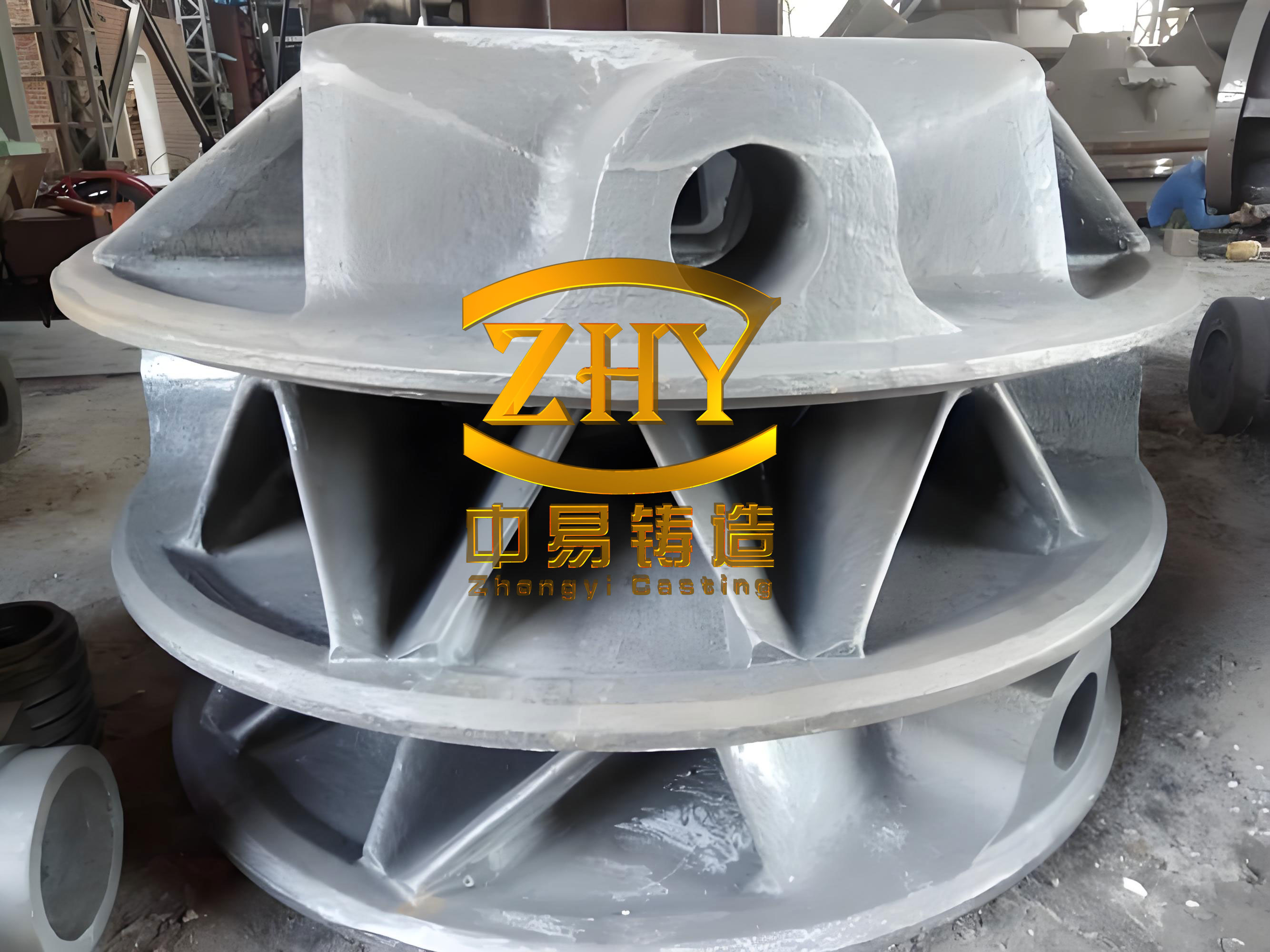
Metallurgical and Production Fundamentals for Heavy-Section Ductile Iron
The production of high-integrity heavy-section ductile cast iron requires a systems approach encompassing charge materials, chemistry design, melting, treatment, and solidification control.
1. Chemistry and Inoculation: The chemical composition is tailored to promote a fully ferritic matrix (for applications requiring high toughness) and to suppress undesirable graphite morphologies. A critical relationship is the Carbon Equivalent (CE), which influences fluidity and shrinkage behavior:
$$CE = \%C + \frac{\%Si}{3} + \frac{\%P}{3}$$
For heavy sections, a carefully balanced CE is chosen to leverage the graphitic expansion during eutectic solidification to counteract shrinkage. Elements like Molybdenum (Mo) and Nickel (Ni) are added for matrix strengthening and to improve hardenability in thicker sections, while trace elements detrimental to nodularity, such as Lead (Pb), Bismuth (Bi), and excessive Titanium (Ti), are strictly controlled. Inoculation is paramount. Multiple-stage inoculation (e.g., ladle, stream, and late) using specialized inoculants containing elements like Barium (Ba), Strontium (Sr), or rare earths is employed to increase graphite nodule count, ensure nodularity in the slow-cooling center, and delay chill. The effectiveness of inoculation can be modeled in terms of fade time and potency factor.
2. Melting and Treatment: High-purity charge materials, including low-residual pig iron and selected steel scrap, are standard. Treatment methods for nodularization, such as the sandwich or tundish cover methods using MgFeSi alloys, or the more precise wire-feeding technique, are chosen based on the required Mg recovery and process stability. The treatment temperature, typically between 1350°C and 1480°C, is critical for reaction kinetics and final slag formation.
3. Solidification and Feeding Design: The thermal dynamics of heavy-section ductile cast iron are complex. Proper gating (often bottom-gated for smooth filling) and risering are designed using modulus calculations and solidification simulation software. The goal is to establish directional solidification towards strategically placed risers or, in some cases, to implement a “riserless” design by precisely balancing the graphitic expansion pressure against the contraction of the metal matrix. The use of chills and controlled cooling systems (e.g., water-cooled cores) is essential to modify the local solidification rate, refine the microstructure, and prevent shrinkage defects in thermal centers. The relationship between cooling rate (v), secondary dendrite arm spacing (SDAS), and mechanical properties is well-established, often expressed as:
$$SDAS = k \cdot v^{-n}$$
where \(k\) and \(n\) are material constants. Slower cooling in heavy sections leads to larger SDAS and coarser microstructures, underscoring the need for active thermal management.
Application in Thermal Power Generation
The push for higher efficiency in coal-fired power plants has led to advanced steam cycles with higher pressures and temperatures. Heavy-section ductile cast iron components are crucial in these systems, offering an excellent balance of pressure resistance, thermal fatigue resistance, and castability for complex shapes.
| Component | Typical Grade | Key Features & Challenges | Technical Requirements |
|---|---|---|---|
| Medium-Pressure Outer Cylinder | QT400-18 / GJS-400-18 | Massive (60-80t), complex thin-walled casing. Long, critical sealing surfaces. Must withstand thermal cycling. | 100% UT & MT. Pressure-tightness test. Graphite nodularity >80% (Grade III+). |
| Bearing Housings & Supports | QT400-18 | Large dimensions (>6m length), varying sections. High static and dynamic load bearing. | Dimensional stability. Soundness in thick sections. Good machinability. |
For instance, outer cylinders for 1000 MW ultra-supercritical turbines are cast as single pieces weighing over 80 tonnes. Production employs advanced molding techniques, high-purity charges with Molybdenum alloying, and intensive inoculation to achieve the required microstructure and pressure integrity. The use of heavy-section ductile cast iron here provides a cost-effective and reliable alternative to fabricated steel assemblies.
Application in Hydropower Generation
Hydroelectric equipment, such as valves and turbine components, demands large, robust castings capable of withstanding high hydraulic pressures and potential water hammer shocks. The corrosion resistance and pressure tightness of ductile cast iron make it an ideal choice.
| Component | Typical Grade | Key Features & Challenges | Technical Requirements |
|---|---|---|---|
| Butterfly Valve Disc & Body | QT450-10 / GJS-450-10 | Large diameter (>4m), hydrodynamic profile. Uniform properties in sections up to 160mm. | Pressure tightness under test. 100% NDT (UT per EN 12680-3). No welding repair allowed. |
| Gate Valve Bodies | QT400-18 / GJS-400-18 | Complex internal passages. High pressure containment. | Soundness in all pressure-bearing walls. Good machinability for sealing surfaces. |
The production of a large butterfly valve disc, for example, involves meticulous control of the mold atmosphere and cooling to prevent porosity. A balanced chemical composition with sufficient silicon and carefully controlled inoculation ensures a fully ferritic matrix, providing the necessary toughness and leak-proof performance under high-pressure testing.
Application in Wind Power Generation
Wind turbines, particularly the nacelle components of multi-megawatt offshore turbines, represent a major growth area for heavy-section ductile cast iron. The harsh operating environment and the critical need for reliability over a 20+ year lifespan impose stringent requirements, primarily excellent low-temperature impact toughness.
| Component | Typical Grade | Key Features & Challenges | Technical Requirements |
|---|---|---|---|
| Hub (Rotor) | QT350-22AL / GJS-350-22U-LT | Complex geometry with thick hubs and thin blades. Subjected to high cyclic loads. | Low-T impact toughness (e.g., >12J at -40°C). Fully ferritic matrix. Stringent UT standards. |
| Main Shaft | QT400-18AL / GJS-400-18U-LT | Large rotational inertia. High torque transmission. Critical fatigue resistance. | High yield strength and uniform elongation. No internal defects in load path. |
| Bedplate & Gearbox Housings | QT400-18AL / GJS-400-18U-LT | Massive, ribbed structures for stiffness. Must maintain alignment under load. | Dimensional accuracy. High stiffness-to-weight ratio. Freedom from shrinkage. |
Achieving the required low-temperature properties in sections exceeding 200mm is a pinnacle of metallurgical control. It involves the use of high-purity raw materials, nickel alloying (typically 0.5-1.0%), and sophisticated multi-stage inoculation to maximize nodule count and ensure a predominantly ferritic matrix. The relationship between impact transition temperature and microstructure can be approximated by considering nodule count and matrix purity:
$$ITT \propto \frac{1}{N} + k\cdot[\%\text{Interstitials}]$$
where \(ITT\) is the impact transition temperature, \(N\) is the nodule count per unit area, and \(k\) is a constant. This drives the production focus towards high nodule counts and clean iron.
Application in Nuclear Power
One of the most demanding applications for heavy-section ductile cast iron is in the fabrication of spent nuclear fuel transport and storage casks. These components require unparalleled structural integrity, radiation shielding, and long-term durability under accident conditions.
| Component | Typical Grade | Key Features & Challenges | Technical Requirements |
|---|---|---|---|
| Spent Fuel Cask Body | GGG40.3 / Special High-Integrity QT | Extremely thick walls (400-500mm). Must withstand 9m drop test and fire. Neutron shielding integration. | Exceptional fracture toughness at -40°C. Homogeneous properties. Ultrasonic transparency (velocity >5500 m/s). |
The manufacturing technology for these casks, mastered by only a few foundries worldwide, involves near-perfect process control. It includes the use of zircon sand molds for high thermal stability, active cooling systems (water-cooled cores) to manage solidification, and ultra-clean melting practices. Chemistry is tightly regulated: Carbon Equivalent is optimized for a riserless design, Silicon is controlled to around 2.0%, and Nitrogen is maintained within a narrow window (80-120 ppm) to optimize properties without promoting porosity. The addition of Cerium (Ce) is used to neutralize the effects of trace elements that promote degenerate graphite. The performance advantage over forged steel lies in the material’s higher yield ratio (0.6-0.7 for ductile iron vs. 0.5-0.6 for steel) and superior impact fatigue resistance under low-energy, high-frequency loading, making heavy-section ductile cast iron an ideal material for this safety-critical application.
Performance Summary and Comparative Advantages
The widespread adoption of heavy-section ductile cast iron across these diverse energy sectors is justified by a compelling set of comparative advantages, which are summarized below.
| Parameter | Heavy-Section Ductile Iron | Cast/Forged Steel (Alternative) | |
|---|---|---|---|
| Yield Ratio (YS/UTS) | 0.60 – 0.75 | 0.50 – 0.65 | Higher strength utilization, favorable for pressure containment. |
| Damping Capacity | High (3-5x Steel) | Low | Superior vibration and noise attenuation in operating machinery. |
| Casting Complexity & Weight | Can be cast integrally as very large, complex shapes; ~10% lighter for same stiffness. | Often requires fabrication/welding of multiple parts. | Reduced part count, lower assembly cost, weight savings. |
| Machinability | Good to Excellent | Fair to Good | Lower tool wear and faster machining rates, reducing cost. |
| Production Cost (Relative) | Low (Base 1.0) | High (1.5 – 2.5) | Significant overall component cost reduction. |
Future Outlook and Concluding Remarks
The trajectory of the global energy sector continues to favor larger, more efficient, and more reliable equipment. This evolution creates a sustained demand for advanced engineering materials that can deliver performance and economy. Heavy-section ductile cast iron, with its unique portfolio of properties, is poised to maintain and expand its critical role. Future developments will likely focus on further enhancing the consistency and properties of these massive castings through even more refined process controls, advanced real-time solidification monitoring, and the development of new alloy variants—such as high-silicon ductile irons or further optimized austempered grades—for specific service conditions. The ongoing digitalization of foundry processes, integrating IoT sensors and AI-driven process optimization, will be key to achieving the next level of quality and reproducibility. For engineers and metallurgists in the field, a deep understanding of the complex interplay between chemistry, treatment, solidification, and microstructure in heavy-section ductile cast iron is essential. By continuing to push the boundaries of this versatile material’s capabilities, the industry will directly contribute to building the robust and sustainable energy infrastructure of the future.