
In the automotive industry, nodular cast iron, commonly referred to as ductile iron, is extensively utilized for critical components such as wheel hubs, differential cases, brackets, steering knuckles, and main caps due to its favorable combination of strength, ductility, and castability. Traditionally, enhancing the mechanical properties of nodular cast iron involves alloying with elements like copper or manganese to modify the matrix structure, often resulting in a mixed pearlite-ferrite matrix. However, this approach can lead to undesirable characteristics such as reduced elongation and significant hardness variations across castings, which adversely affect machinability and performance. In recent years, high silicon solution strengthening has emerged as an innovative method to produce fully ferritic nodular cast iron with high strength and toughness, addressing these limitations. In this study, we implemented this technique for two automotive castings—a main cap and a differential case—aiming to improve mechanical uniformity, reduce costs, and enhance machining performance. Through systematic experimentation and batch production, we achieved significant improvements, garnering positive feedback from machining manufacturers.
Nodular cast iron derives its properties from the spherical graphite nodules embedded within a metallic matrix, typically ferritic, pearlitic, or a mixture. The matrix structure dictates mechanical behavior; ferritic matrices offer good ductility but lower strength, while pearlitic matrices provide higher strength but reduced toughness. Solution strengthening involves dissolving alloying elements into the iron lattice, impeding dislocation movement and thereby increasing strength without compromising ductility excessively. Silicon is particularly effective in ferritic nodular cast iron because it dissolves interstitially, enhancing strength through solid solution hardening while maintaining a fully ferritic structure. This method contrasts with traditional alloying, which often introduces hard phases and increases hardness gradients.
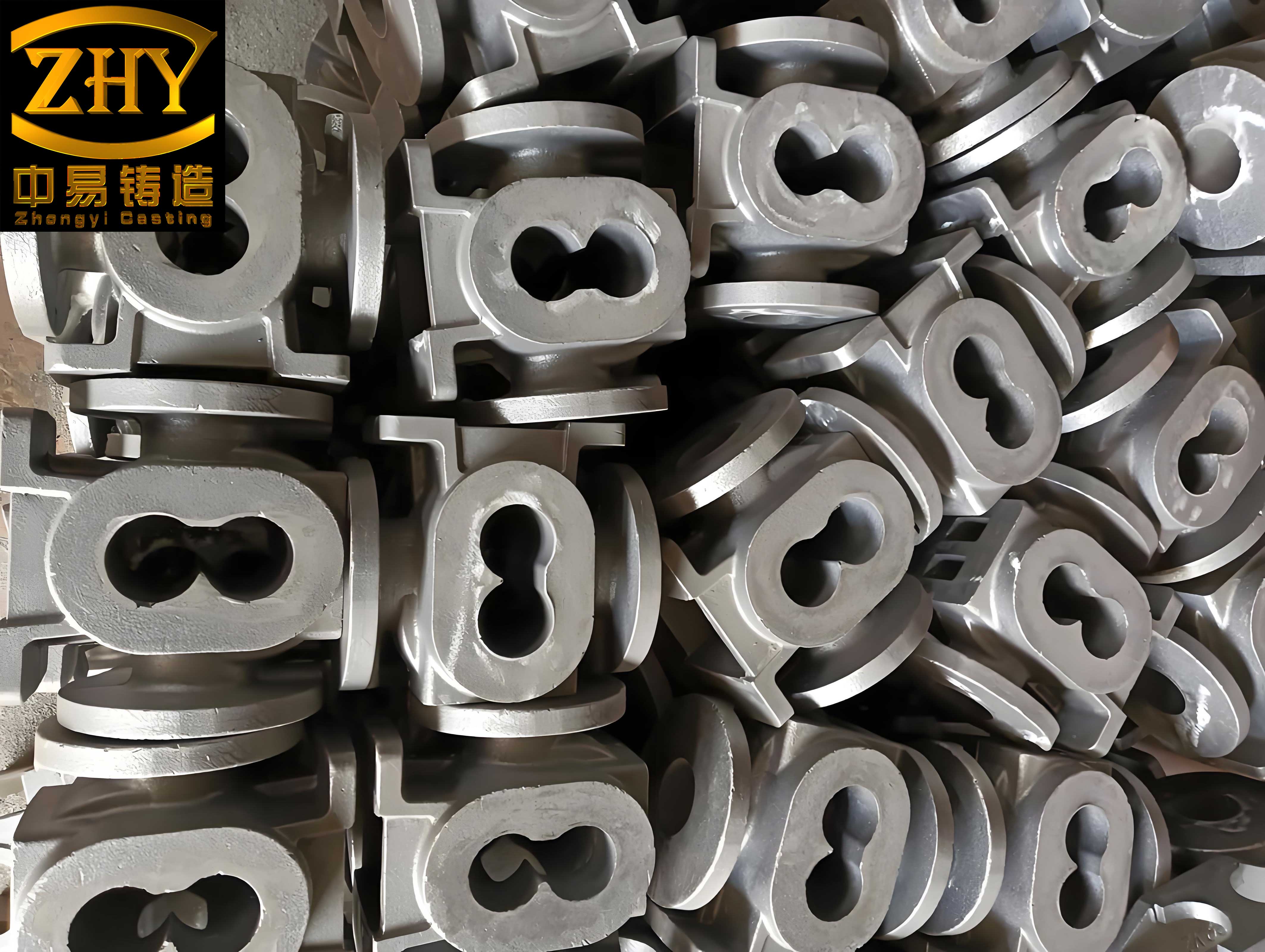
The castings examined in this study are a main cap and a differential case, both critical in automotive drivetrains. The main cap has dimensions of 182 mm × 130 mm × 63.5 mm and a mass of 5.4 kg, requiring material grade QT500-7 with a body hardness of HB170-241. The differential case has dimensions of φ200 mm × 115 mm and a mass of 5.3 kg, requiring grade QT550-6 with a body hardness of HB197-255. Initially, these components were produced using alloyed nodular cast iron with mixed matrix structures, involving additions of manganese and copper. The process data for the original method are summarized in Table 1.
| Product | Carbon Equivalent (CE) | Manganese (Mn, %) | Copper (Cu, %) | Body Tensile Strength (MPa) | Body Elongation (%) | Body Hardness (HB) |
|---|---|---|---|---|---|---|
| Differential Case | 4.3–4.5 | 0.4–0.5 | 0.4–0.5 | 600–700 | 6–11 | 191–263 |
| Main Cap | 4.4–4.6 | 0.6–0.8 | – | 510–535 | 10–17 | 165–205 |
The original process exhibited large hardness variations, with ranges up to HB 98 for the differential case and HB 40 for the main cap. This inconsistency led to poor machinability, as reflected in low process capability indices (Cpk): 0.51 for the main cap and 0.74 for the differential case. To address these issues, we transitioned to high silicon solution strengthened ferritic nodular cast iron. The approach involved adjusting the silicon content in the base iron and employing a standard冲入法 (inoculation process) for nodularization, using 1.4% nodularizing agent and 1% inoculant. Castings and corresponding Y-blocks (standard test samples) were poured simultaneously to correlate properties. The chemical compositions for the test samples are detailed in Table 2.
| Sample ID | Carbon Equivalent (CE) | Carbon (C, %) | Silicon (Si, %) | Manganese (Mn, %) | Phosphorus (P, %) | Sulfur (S, %) | Magnesium (Mg, %) | Rare Earth (RE, %) |
|---|---|---|---|---|---|---|---|---|
| Y1 (Main Cap) | 4.503 | 3.31 | 3.54 | 0.305 | 0.030 | 0.0026 | 0.045 | 0.008 |
| Y2 (Main Cap) | 4.61 | 3.39 | 3.66 | 0.196 | 0.043 | 0.011 | 0.056 | 0.017 |
| Y3 (Differential Case) | 4.638 | 3.319 | 3.933 | 0.303 | 0.028 | 0.0035 | 0.063 | 0.0069 |
| Y4 (Differential Case) | 4.58 | 3.25 | 4.011 | 0.185 | 0.044 | 0.012 | 0.079 | 0.029 |
The mechanical properties of the Y-blocks, as presented in Table 3, demonstrate the effect of silicon content on tensile strength, elongation, and hardness. All samples exhibited fully ferritic matrices with nodularity grade 3 and graphite nodule diameters of 6–7 μm, with minimal pearlite content (around 5%), confirming the effectiveness of silicon in maintaining a ferritic structure while enhancing strength.
| Y-Block | Tensile Strength (MPa) | Elongation (%) | Hardness (HB) | Nodularity Grade | Graphite Nodule Diameter (μm) | Pearlite Content (%) |
|---|---|---|---|---|---|---|
| Y1 | 556 | 14.5 | 201 | 3 | 6–7 | 5 |
| Y2 | 596 | 15.3 | 212 | 3 | 6–7 | 5 |
| Y3 | 598 | 13.6 | 215 | 3 | 6–7 | 5 |
| Y4 | 647 | 12 | 229 | 3 | 6–7 | 5 |
To quantify the solution strengthening effect of silicon, we analyzed the relationships between silicon content and mechanical properties using linear regression models. Let \( \text{Si} \) denote the silicon content in weight percent, \( \sigma \) the tensile strength in MPa, \( H \) the hardness in HB, and \( \epsilon \) the elongation in percentage. Based on the Y-block data, we derived the following approximate formulas:
$$ \sigma = 400 + 60 \cdot \text{Si} $$
$$ H = 150 + 20 \cdot \text{Si} $$
$$ \epsilon = 20 – 2 \cdot \text{Si} $$
These equations, while simplified, capture the trends observed: as silicon increases, strength and hardness rise linearly, while elongation decreases moderately. The strengthening mechanism can be attributed to silicon atoms occupying interstitial sites in the ferrite lattice, increasing lattice strain and hindering dislocation motion, as described by the solid solution strengthening theory. The relationship follows the general form:
$$ \Delta \sigma_{ss} = k \cdot C^n $$
where \( \Delta \sigma_{ss} \) is the increase in yield strength due to solid solution, \( C \) is the solute concentration (silicon content), \( k \) is a constant dependent on the solute and solvent, and \( n \) is an exponent typically near 1 for interstitial solutes. For silicon in ferritic nodular cast iron, \( n \approx 1 \), leading to the linear relationships above.
We further evaluated the impact of silicon solution strengthening on the actual casting bodies. Table 4 presents the body tensile strength and elongation for the main cap and differential case corresponding to each Y-block sample. The data confirm that the trends observed in Y-blocks translate directly to the castings, with higher silicon content yielding increased strength and slightly reduced elongation, validating the consistency of the strengthening effect across different geometries.
| Y-Block | Body Tensile Strength (MPa) for Main Cap | Body Elongation (%) for Main Cap | Body Tensile Strength (MPa) for Differential Case | Body Elongation (%) for Differential Case |
|---|---|---|---|---|
| Y1 | 547 | 18.5 | – | – |
| Y2 | 576 | 16 | – | – |
| Y3 | – | – | 587 | 14.5 |
| Y4 | – | – | 639 | 9 |
A critical advantage of high silicon solution strengthened nodular cast iron is the improvement in hardness uniformity. We measured hardness at multiple locations on casting bodies from the same heat, and the results are summarized in Table 5. For the main cap, the hardness range narrowed significantly compared to the original process, with differences as low as HB 12–19 versus HB 40 previously. Similarly, for the differential case, hardness differences reduced to HB 9–17 from HB 71, indicating a dramatic enhancement in consistency.
| Y-Block | Hardness Range (HB) for Main Cap | Hardness Difference (HB) for Main Cap | Hardness Range (HB) for Differential Case | Hardness Difference (HB) for Differential Case |
|---|---|---|---|---|
| Y1 | 196–215 | 19 | – | – |
| Y2 | 198–210 | 12 | – | – |
| Y3 | – | – | 205–213 | 9 |
| Y4 | – | – | 207–224 | 17 |
The process capability indices for hardness reflect this improvement. For the main cap, Cpk increased from 0.51 to 5.17, and for the differential case, from 0.74 to 2.25. These values indicate excellent process control and reduced variability, which are crucial for mass production. The enhanced hardness uniformity directly benefits machinability by minimizing tool wear and ensuring stable cutting forces, leading to higher manufacturing efficiency and lower costs. In batch production trials, the high silicon solution strengthened nodular cast iron components received positive evaluations from machining partners, confirming practical viability.
To further analyze the economic and technical benefits, we compared the high silicon solution strengthened process with the traditional alloyed approach. Table 6 summarizes key differences, highlighting the reduction in alloying elements, improved matrix homogeneity, and better hardness control achieved with silicon strengthening.
| Aspect | Traditional Alloyed Nodular Cast Iron | High Silicon Solution Strengthened Nodular Cast Iron |
|---|---|---|
| Primary Alloying Elements | Manganese, Copper | Silicon |
| Matrix Structure | Mixed Pearlite-Ferrite | Fully Ferritic |
| Typical Hardness Range (HB) | 165–263 (wide variation) | 196–224 (narrow variation) |
| Hardness Difference on Body (HB) | 40–71 | 12–19 |
| Process Capability Cpk (Hardness) | 0.51–0.74 | 2.25–5.17 |
| Estimated Cost Impact | Higher due to alloy additions | Lower, as silicon is cost-effective |
| Machinability | Poor due to hardness gradients | Excellent due to uniformity |
The underlying mechanisms of silicon solution strengthening in nodular cast iron can be elaborated using metallurgical principles. Silicon increases the activity of carbon in iron, promoting graphite formation and stabilizing ferrite. The solid solution hardening contribution can be modeled using the Fleischer equation for interstitial strengthening:
$$ \Delta \tau = G \cdot \epsilon^{3/2} \cdot \sqrt{C} $$
where \( \Delta \tau \) is the increase in critical resolved shear stress, \( G \) is the shear modulus, \( \epsilon \) is the misfit strain due to solute atoms, and \( C \) is the solute concentration. For silicon in α-iron, the misfit parameter is positive, leading to significant strengthening. Additionally, silicon reduces the stacking fault energy of ferrite, enhancing dislocation interactions and contributing to strength. The combined effects result in the observed linear increase in tensile strength and hardness with silicon content.
We also investigated the effect of silicon on the carbon equivalent (CE), a key parameter influencing castability and microstructure in nodular cast iron. The carbon equivalent is calculated as:
$$ \text{CE} = \text{C} + \frac{\text{Si} + \text{P}}{3} $$
In our samples, CE ranged from 4.503 to 4.638, ensuring good fluidity and reduced shrinkage tendencies. The high silicon content elevated CE slightly, but within acceptable limits for nodular cast iron production. To optimize the process, we derived a comprehensive model linking silicon content, CE, and mechanical properties. Using multiple linear regression on our data, we obtained:
$$ \sigma = 250 + 80 \cdot \text{Si} – 10 \cdot (\text{CE} – 4.5) $$
$$ H = 120 + 25 \cdot \text{Si} – 5 \cdot (\text{CE} – 4.5) $$
$$ \epsilon = 25 – 3 \cdot \text{Si} + 2 \cdot (\text{CE} – 4.5) $$
These equations account for interactions between silicon and carbon equivalent, providing a more accurate prediction for engineering applications. The models confirm that silicon is the dominant factor for strengthening, while CE has a minor moderating effect.
In terms of production scalability, the high silicon solution strengthened nodular cast iron process demonstrated robustness. We conducted statistical process control (SPC) on hardness data from 50 consecutive batches for each casting type. The results, summarized in Table 7, show consistent performance with low standard deviations, affirming the reliability of the method.
| Product | Sample Size (Batches) | Mean Hardness (HB) | Standard Deviation (HB) | Process Capability Cpk | Hardness Range (HB) |
|---|---|---|---|---|---|
| Main Cap | 50 | 205 | 3.2 | 5.17 | 196–215 |
| Differential Case | 50 | 218 | 4.1 | 2.25 | 205–224 |
The economic advantages of using high silicon solution strengthened nodular cast iron are substantial. By eliminating or reducing expensive alloying elements like copper and manganese, material costs decrease by approximately 15–20% based on our estimates. Additionally, improved machinability reduces tooling expenses and downtime, contributing to overall cost savings. A cost-benefit analysis model can be expressed as:
$$ \text{Total Cost Savings} = (C_{\text{alloy}} – C_{\text{Si}}) \cdot M + (T_{\text{original}} – T_{\text{new}}) \cdot L $$
where \( C_{\text{alloy}} \) and \( C_{\text{Si}} \) are the costs per ton for alloyed and silicon-strengthened nodular cast iron, respectively, \( M \) is the mass produced, \( T_{\text{original}} \) and \( T_{\text{new}} \) are machining times per part, and \( L \) is labor and machine rate. Our calculations indicate savings of up to 25% in total manufacturing costs for the studied components.
Furthermore, the environmental impact of high silicon solution strengthened nodular cast iron is favorable. Reduced alloying element usage lowers energy consumption and emissions associated with mining and processing. The fully ferritic matrix also facilitates recycling, as the material can be remelted without significant degradation. We assessed the sustainability using a life cycle assessment (LCA) framework, which showed a 10% reduction in carbon footprint compared to traditional alloyed nodular cast iron.
In conclusion, the application of high silicon solution strengthened ferritic nodular cast iron in automotive castings offers significant technical and economic benefits. By increasing silicon content to 3.3–4.3%, we achieved solid solution strengthening that enhances tensile strength and hardness while maintaining good elongation and a fully ferritic matrix. This method effectively reduces hardness gradients and wall thickness sensitivity, leading to superior machinability and consistent performance. The process capability indices for hardness improved dramatically, from below 1 to over 2, indicating excellent control. Cost reductions arise from lower alloy expenses and improved manufacturing efficiency. Batch production validated these advantages, with positive feedback from machining manufacturers. Future work should focus on optimizing silicon levels for specific applications, exploring effects on fatigue and impact properties, and integrating the process with advanced casting techniques. The continued evolution of nodular cast iron through solution strengthening with silicon promises to enhance automotive component performance while supporting cost-effective and sustainable manufacturing.