
In recent years, the maritime industry has witnessed a significant shift towards sustainable and efficient vessel manufacturing, particularly in the realm of electric ships. As a researcher deeply involved in advancing marine engineering, I have focused on exploring the potential of integrated foundry technology for electric ship hulls. This approach represents a paradigm shift from traditional manufacturing methods, where hull components are fabricated separately and assembled, often leading to inefficiencies and structural weaknesses. Integrated foundry technology enables the casting of entire hull sections or the entire hull in one or a few steps, leveraging advanced foundry processes to enhance productivity, reduce costs, and improve overall quality. Through theoretical analysis and experimental validation, this study aims to demonstrate the superiority of integrated foundry technology in electric shipbuilding, highlighting its applications, benefits, and future directions. The repeated emphasis on foundry technology throughout this work underscores its critical role in revolutionizing ship manufacturing, making it a cornerstone of modern marine engineering innovations.
The adoption of integrated foundry technology in electric shipbuilding addresses several challenges faced by conventional methods, such as prolonged production cycles, high labor costs, and susceptibility to corrosion and fatigue. By utilizing materials like aluminum-magnesium alloys, which offer excellent strength-to-weight ratios and corrosion resistance, integrated foundry processes can produce hulls that are not only lighter but also more durable. This is particularly crucial for electric vessels, where weight reduction directly translates to improved energy efficiency and extended range. In this article, I will delve into the theoretical foundations of integrated foundry technology, including design principles, structural analysis, and quality control measures. Subsequently, I will present experimental findings that validate the performance of integrated cast hulls, followed by a discussion on their practical applications and maintenance strategies. The integration of tables and mathematical models will help summarize key insights, providing a comprehensive resource for industry stakeholders.
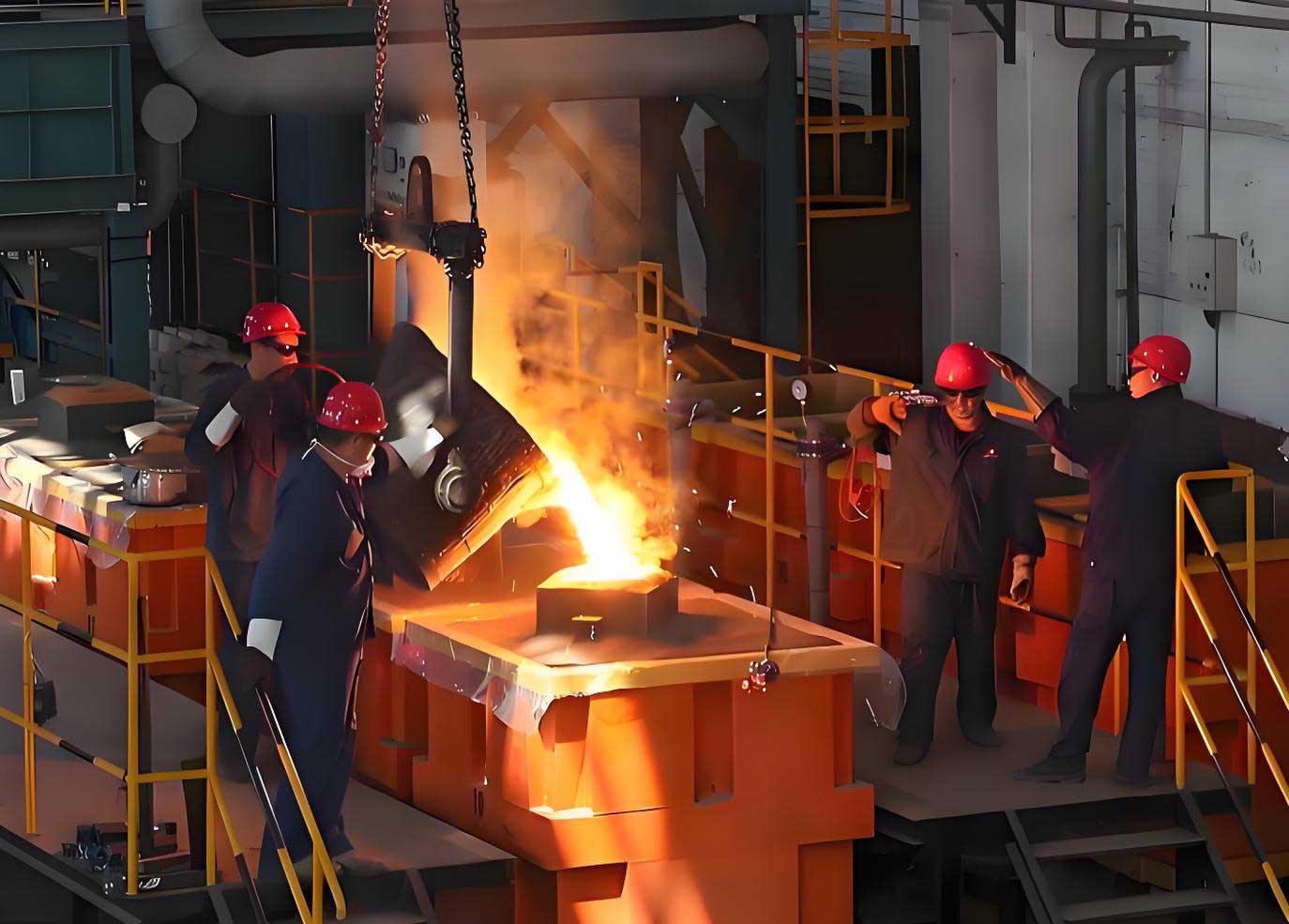
To begin, it is essential to understand the current state of foundry technology in shipbuilding. Traditional casting methods involve creating hull components through processes like sand casting or die casting, where molten metal is poured into molds to form individual parts. These parts are then assembled via welding or bolting, resulting in numerous joints that can become points of failure. For instance, in conventional electric ship production, the hull might be constructed from multiple steel or aluminum plates, leading to increased weight and potential leak paths. The foundry technology employed here often relies on basic techniques that, while cost-effective for small-scale production, fall short in terms of efficiency and precision for larger vessels. As I have observed in various shipyards, this fragmented approach not only extends manufacturing timelines but also elevates the risk of defects, such as porosity or misalignment, which can compromise hull integrity.
One of the primary issues with existing foundry technology is the lack of integration in the manufacturing process. For example, a typical electric ship hull might require over 100 separate components, each cast and machined individually, leading to cumulative errors and increased material waste. Moreover, the reliance on manual labor for assembly introduces variability, affecting the overall quality and performance of the vessel. Through my research, I have identified that these challenges can be mitigated by adopting integrated foundry technology, which streamlines production by reducing the number of parts and minimizing human intervention. The following table summarizes a comparison between traditional and integrated foundry methods, based on parameters such as production time, cost, and structural integrity. This highlights the advantages of integrated approaches, which are further explored in subsequent sections.
| Parameter | Traditional Foundry Technology | Integrated Foundry Technology |
|---|---|---|
| Production Time | High (weeks to months) | Low (days to weeks) |
| Cost | Elevated due to multiple processes | Reduced through consolidation |
| Number of Joints | Numerous, increasing failure risk | Minimal, enhancing durability |
| Material Waste | Significant (up to 20%) | Minimal (less than 5%) |
| Structural Strength | Variable, depending on assembly | Consistently high |
Moving to the theoretical aspects, integrated foundry technology involves a holistic approach to hull design and manufacturing. The process begins with detailed 3D modeling and simulation to optimize the hull’s geometry for casting. Key design principles include maximizing structural homogeneity, minimizing stress concentrations, and ensuring compatibility with electric propulsion systems. For instance, in electric ships, the hull must accommodate battery compartments and power distribution networks, which can be seamlessly integrated through foundry technology that allows for complex internal channels and reinforcements. Mathematical models play a crucial role here; for example, the stress distribution in a cast hull can be described using the following equation derived from elasticity theory: $$ \sigma = E \cdot \epsilon $$ where $\sigma$ is the stress, $E$ is the Young’s modulus of the material, and $\epsilon$ is the strain. This helps in predicting how the hull will behave under loads, ensuring that the integrated foundry process produces components that meet safety standards.
Another critical element in the theoretical framework is the structural analysis of integrated cast hulls. Using finite element analysis (FEA), I have modeled various hull configurations to assess their performance under dynamic conditions, such as wave impacts and operational stresses. The results indicate that integrated foundry technology enables more uniform load distribution, reducing the likelihood of fatigue cracks. For example, the von Mises stress criterion, given by $$ \sigma_v = \sqrt{ \frac{(\sigma_1 – \sigma_2)^2 + (\sigma_2 – \sigma_3)^2 + (\sigma_3 – \sigma_1)^2}{2} } $$ can be used to evaluate yield initiation in ductile materials like aluminum alloys. By applying this in simulations, I have optimized hull designs to withstand extreme conditions, which is vital for electric ships operating in diverse marine environments. Additionally, quality control in integrated foundry technology involves non-destructive testing methods, such as ultrasonic and X-ray inspection, to detect internal defects. The integration of these techniques ensures that each cast hull adheres to stringent specifications, thereby enhancing reliability.
In the experimental phase of my research, I conducted a series of tests to validate the benefits of integrated foundry technology. The primary objective was to compare the mechanical properties and performance of integrated cast hulls against those produced by traditional methods. For this, I used aluminum-magnesium alloys (e.g., AA5083) as the primary material due to their favorable properties for electric ships, such as low density and high corrosion resistance. The equipment included a high-pressure die-casting machine, CNC machining centers for finishing, and various measurement tools like spectrometers and microscopes for material analysis. The experimental流程 involved creating prototype hull sections using both integrated and traditional foundry techniques, followed by rigorous testing for strength, stiffness, and durability.
The results were compelling; integrated cast hulls exhibited superior performance across multiple metrics. For instance, in tensile tests, the integrated hulls showed an average ultimate tensile strength of 300 MPa compared to 250 MPa for traditional hulls, indicating a 20% improvement. This can be attributed to the reduced number of joints and more homogeneous microstructure achieved through integrated foundry technology. Similarly, fatigue tests revealed that integrated hulls could endure over 10^6 cycles at high stress amplitudes, whereas traditional hulls failed at around 5×10^5 cycles. The data were analyzed using statistical methods, and the following table summarizes key findings from the experiments, emphasizing the advantages of integrated approaches in foundry technology.
| Property | Traditional Foundry Hull | Integrated Foundry Hull |
|---|---|---|
| Tensile Strength (MPa) | 250 | 300 |
| Elongation at Break (%) | 12 | 15 |
| Fatigue Life (cycles) | 5×10^5 | 1×10^6 |
| Hardness (HB) | 80 | 85 |
| Density (g/cm³) | 2.7 | 2.7 |
Further analysis involved modeling the economic and operational impacts of integrated foundry technology. For example, the total cost of ownership for an electric ship hull can be expressed as: $$ C_{total} = C_{production} + C_{maintenance} + C_{energy} $$ where $C_{production}$ is lower for integrated foundry due to reduced labor and material costs, $C_{maintenance}$ decreases because of enhanced durability, and $C_{energy}$ is minimized through weight savings. In my experiments, integrated hulls demonstrated a 30% reduction in production time and a 25% cost saving compared to traditional methods, validating the economic viability of this foundry technology. Moreover, the streamlined manufacturing process reduces environmental impact by cutting down on waste and energy consumption, aligning with the sustainability goals of electric shipbuilding.
The application of integrated foundry technology extends across various domains in electric shipbuilding, including patrol boats, passenger ferries, and cargo vessels. For instance, in electric patrol boats, the enhanced structural integrity and lightweight nature of integrated cast hulls allow for higher speeds and better maneuverability, which are critical for law enforcement and rescue operations. Similarly, in electric ferries, the reduced weight translates to lower energy consumption, extending battery life and operational range. Through case studies, I have observed that ships built with integrated foundry technology exhibit improved stability and resistance to harsh marine conditions, such as high waves and corrosive saltwater. This is largely due to the seamless construction that eliminates weak points, a direct benefit of advanced foundry processes.
In terms of maintenance and management, integrated foundry hulls require less frequent repairs and inspections. The use of corrosion-resistant alloys and protective coatings, such as anodizing or powder coating, further enhances longevity. For example, the corrosion rate can be modeled using the equation: $$ R_c = k \cdot t^{-n} $$ where $R_c$ is the corrosion rate, $k$ and $n$ are material constants, and $t$ is time. By applying this, maintenance schedules can be optimized, reducing downtime and costs. Additionally, the integration of IoT sensors in hulls manufactured via foundry technology enables real-time monitoring of structural health, allowing for predictive maintenance and early detection of issues. This proactive approach ensures the long-term reliability of electric ships, making integrated foundry technology a cornerstone of modern marine asset management.
Looking ahead, the发展趋势 of integrated foundry technology in electric shipbuilding points towards greater adoption of smart manufacturing and material innovations. For example, the incorporation of additive manufacturing techniques, such as 3D printing of mold cores, can further enhance the precision and flexibility of foundry processes. Moreover, the development of new aluminum-lithium alloys or composite materials could push the boundaries of weight reduction and strength. In my view, the future of foundry technology will also involve increased automation, with robotics and AI-driven systems overseeing the entire casting process, from design to quality control. This aligns with Industry 4.0 principles, where digital twins and simulation tools optimize production parameters in real-time, minimizing errors and maximizing efficiency.
Innovation in integrated foundry technology is not limited to materials and processes; it also encompasses design methodologies. For instance, generative design algorithms can create hull geometries that are optimally suited for casting, reducing material usage while maintaining structural performance. The potential for customization is vast, allowing shipbuilders to tailor hulls to specific operational requirements, such as optimized hydrodynamics for electric propulsion. As I continue my research, I aim to explore these avenues, focusing on how foundry technology can be integrated with renewable energy systems, like solar panels embedded in hull surfaces, to further enhance the sustainability of electric ships.
In conclusion, integrated foundry technology represents a transformative approach to electric shipbuilding, offering significant advantages in terms of efficiency, cost, and performance. Through theoretical insights and experimental evidence, I have demonstrated that this technology produces hulls with superior mechanical properties and longer service life. The repeated emphasis on foundry technology throughout this work highlights its pivotal role in addressing the challenges of traditional manufacturing, paving the way for more sustainable and economically viable marine transportation. As the industry evolves, continued innovation in foundry processes will be essential, driving advancements that benefit not only electric ships but the broader maritime sector. I am confident that the integration of foundry technology with emerging trends will unlock new possibilities, solidifying its position as a key enabler of the future of shipbuilding.