
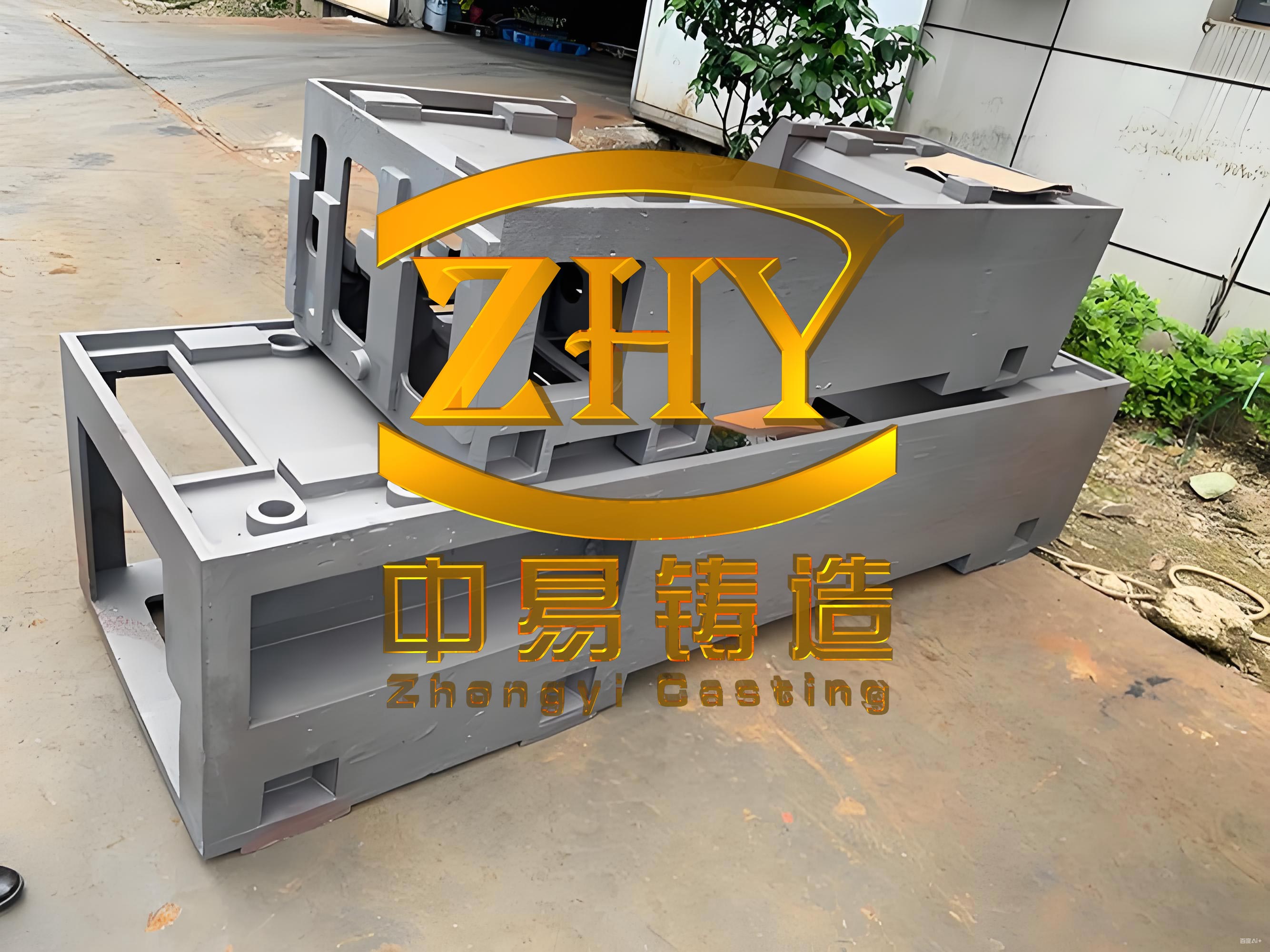
In the field of foundry engineering, the resin sand expanded polystyrene casting (EPC) process has emerged as a highly efficient method for producing large machine tool castings, such as bed frames, columns, and bases. As an engineer deeply involved in casting process research, I have observed that this technique offers distinct advantages, including the elimination of draft angles and parting lines, which significantly reduces costs associated with wooden pattern manufacturing. Moreover, it enhances surface quality, dimensional accuracy, and minimizes machining allowances, while simplifying operations by omitting core-making and drying steps. The adoption of paper gating systems in this process has further revolutionized production, addressing common defects like slag and sand inclusions, and yielding substantial economic benefits for foundries specializing in machine tool castings. This article delves into the practical application of paper gating tubes in resin sand EPC for machine tool castings, incorporating analytical tables and formulas to elucidate key aspects.
Machine tool castings, typically made from grades like HT200 to HT350, exhibit complex internal structures with wall thicknesses ranging from 12 to 30 mm. Traditional sand casting methods, such as resin sand molding, rely on multiple cores to form these internal cavities, leading to challenges like high模具 costs, extended production cycles, and difficulties in controlling dimensional precision. For instance, the assembly of multiple cores can result in gaps that allow molten metal penetration, causing fins and burrs that increase cleaning efforts. In contrast, the resin sand EPC process mitigates these issues by using foam patterns that vaporize upon metal pouring, but it introduces other concerns, such as high pouring temperatures required to decompose the foam, generation of harmful gases and residues, and risks of gas porosity and slag defects. The use of paper gating tubes has proven to be a game-changer in this context, offering a lightweight, flexible alternative to ceramic systems. Paper gating tubes, composed of recycled paper and special materials, are eco-friendly, easy to cut and assemble, and minimize the risk of inclusions due to their combustion and carbonization under high temperatures. This not only streamlines the production of machine tool castings but also aligns with sustainable practices by reducing solid waste and environmental pollution.
The resin sand EPC process for machine tool castings involves a series of steps, starting with the creation of a foam pattern, which is then coated with a refractory coating and dried. Subsequently, the pattern is embedded in resin sand within a mold box, and molten metal is poured, causing the foam to vaporize and be replaced by the metal. The incorporation of paper gating tubes into this流程 enhances efficiency by simplifying the assembly of the gating system, which consists of a pouring cup, sprue, runner, and ingates. For large machine tool castings, a multi-sprue approach is often employed to ensure平稳 and rapid filling. Paper gating tubes, with their承插 connections, allow for easy customization and assembly, reducing labor intensity and time compared to ceramic tubes. A key advantage is their ability to maintain metal temperature due to excellent insulation properties, which is crucial for preventing defects in machine tool castings. The thermal behavior can be modeled using heat transfer equations, such as the Fourier’s law for heat conduction: $$q = -k \nabla T$$ where \(q\) is the heat flux, \(k\) is the thermal conductivity, and \(\nabla T\) is the temperature gradient. This helps in understanding how paper tubes minimize heat loss during pouring, ensuring optimal fluidity for machine tool castings.
| Material | Weight (Relative) | Ease of Cutting | Risk of Inclusions | Environmental Impact | Cost Efficiency |
|---|---|---|---|---|---|
| Paper Gating Tube | 1 (Light) | High | Low | Low (Biodegradable) | High |
| Ceramic Tube | 10 (Heavy) | Low (Requires Special Tools) | Moderate (Erosion Risk) | High (Solid Waste) | Moderate |
| Foam Gating | 0.5 (Very Light) | High | High (Gas and Residue) | Moderate (Harmful Gases) | Low |
In practice, the application of paper gating tubes begins with the preparation of the foam pattern for machine tool castings. The gating system is assembled using承插 (embedded),套入 (socket-type), or adhesive methods, ensuring secure connections that prevent sand intrusion during molding. For example, in承插 connections, the end of a hollow paper tube is inserted into a socket, often with a binder applied to enhance integrity. This method is particularly effective for complex gating layouts required in large machine tool castings, as it allows for quick adjustments using simple tools like handsaws. The assembly process is not only efficient but also reduces the risk of distortions, which is critical for maintaining the dimensional accuracy of machine tool castings. Additionally, the use of filters in the gating system further minimizes slag inclusions, improving the overall quality of machine tool castings. The fluid dynamics of metal flow can be described by Bernoulli’s equation for incompressible flow: $$P + \frac{1}{2}\rho v^2 + \rho gh = \text{constant}$$ where \(P\) is pressure, \(\rho\) is density, \(v\) is velocity, and \(h\) is height. This principle guides the design of gating systems to ensure平稳 filling for machine tool castings.
The benefits of using paper gating tubes in resin sand EPC for machine tool castings are multifaceted. Firstly, their lightweight nature reduces labor intensity, enabling even female workers to handle assembly tasks that previously required male workers for ceramic tubes. This democratization of labor leads to improved workplace ergonomics and efficiency. Secondly, paper tubes exhibit high-temperature strength and refractoriness, resisting冲刷 and minimizing the risk of carbon deposition and wrinkles in machine tool castings. The combustion of paper during pouring results in minimal residue, which is easily removed during shakeout, unlike ceramic fragments that can contaminate sand recycling systems. From an economic perspective, the reduction in defects such as sand inclusions directly lowers scrap rates, enhancing profitability for foundries producing machine tool castings. The overall efficiency can be quantified using a productivity index formula: $$\text{Productivity} = \frac{\text{Number of Defect-Free Castings}}{\text{Total Production Time}}$$ where higher values indicate better performance with paper gating systems for machine tool castings.
| Metric | With Paper Gating Tubes | With Ceramic Tubes | Improvement (%) |
|---|---|---|---|
| Assembly Time (minutes) | 15 | 45 | 66.7 |
| Defect Rate (Slag/Sand Inclusions) | 2% | 8% | 75.0 |
| Labor Intensity (Scale 1-10) | 3 | 8 | 62.5 |
| Environmental Waste (kg per casting) | 0.5 | 2.0 | 75.0 |
Moreover, the thermal insulation properties of paper gating tubes play a crucial role in maintaining metal fluidity, which is essential for producing high-quality machine tool castings. During pouring, the paper tube acts as a barrier to heat loss, allowing the metal to retain its temperature and fill the mold more effectively. This can be analyzed through the heat balance equation: $$Q_{\text{in}} = Q_{\text{out}} + Q_{\text{storage}}$$ where \(Q_{\text{in}}\) is the heat input from the molten metal, \(Q_{\text{out}}\) is the heat loss to the surroundings, and \(Q_{\text{storage}}\) is the heat retained by the system. By minimizing \(Q_{\text{out}}\), paper tubes enhance the overall efficiency of the EPC process for machine tool castings. Additionally, the reduction in harmful gas emissions compared to foam gating systems contributes to a safer working environment, aligning with industrial health standards. As the foundry industry moves towards automation, the adaptability of paper gating tubes to robotic assembly further positions them as a future-proof solution for machine tool castings.
In conclusion, the integration of paper gating tubes into the resin sand EPC process for machine tool castings represents a significant advancement in foundry technology. Its benefits—ranging from ease of use and environmental sustainability to improved product quality and economic gains—make it an attractive alternative to traditional materials. While current cost barriers may hinder widespread adoption, ongoing innovations in manufacturing are expected to drive down prices, paving the way for broader implementation. As we continue to refine this technology, the focus should remain on optimizing design parameters and fostering collaboration between researchers and industry practitioners to unlock the full potential of paper gating systems for machine tool castings. The continued emphasis on machine tool casting production will undoubtedly lead to more efficient and sustainable foundry operations worldwide.