
In my extensive experience within the foundry industry, the pursuit of efficiency, cost-effectiveness, and system-wide value has always been paramount. The lost foam casting process represents a significant advancement in metal casting, offering advantages in design flexibility and surface finish. However, the tooling—specifically the molds used to create the expendable foam patterns—often presents opportunities for improvement. Traditional design approaches can lead to excessive material use, operational inefficiencies, and shortened tool life. It is here that the principles of Performance Technology (PT) have provided a transformative framework for my design philosophy. Performance Technology, while lacking a universally rigid definition, focuses fundamentally on achieving desired human and organizational outcomes through cost-effective and systemic interventions. In engineering contexts, this translates to maximizing the value-to-cost ratio of a system, promoting both individual operator ease and overall production system development. Applying PT theory to the design and manufacture of molds for the lost foam casting process has yielded profound optimizations across various component types, from the main mold body to intricate locating elements. This article details these applications, employing formulas and tables to synthesize the performance gains achieved, always with the overarching goal of enhancing the lost foam casting process.
The core premise of Performance Technology in mechanical design is to analyze every component not just for its functional role, but for its contribution to the entire system’s performance metrics: initial cost, manufacturing time, energy consumption during use, operator ergonomics, maintenance frequency, and ultimate lifespan. A holistic view is essential. For the lost foam casting process, the mold is a critical subsystem. Its performance directly impacts the cycle time for foam pattern production, the quality of the resulting “white mold” or pattern, and the physical burden on foundry personnel. My application of PT begins with a critical assessment of conventional designs, identifying “performance gaps” where resources are wasted or outcomes are suboptimal. The optimization process then involves material science, structural mechanics, and human factors engineering to close these gaps.
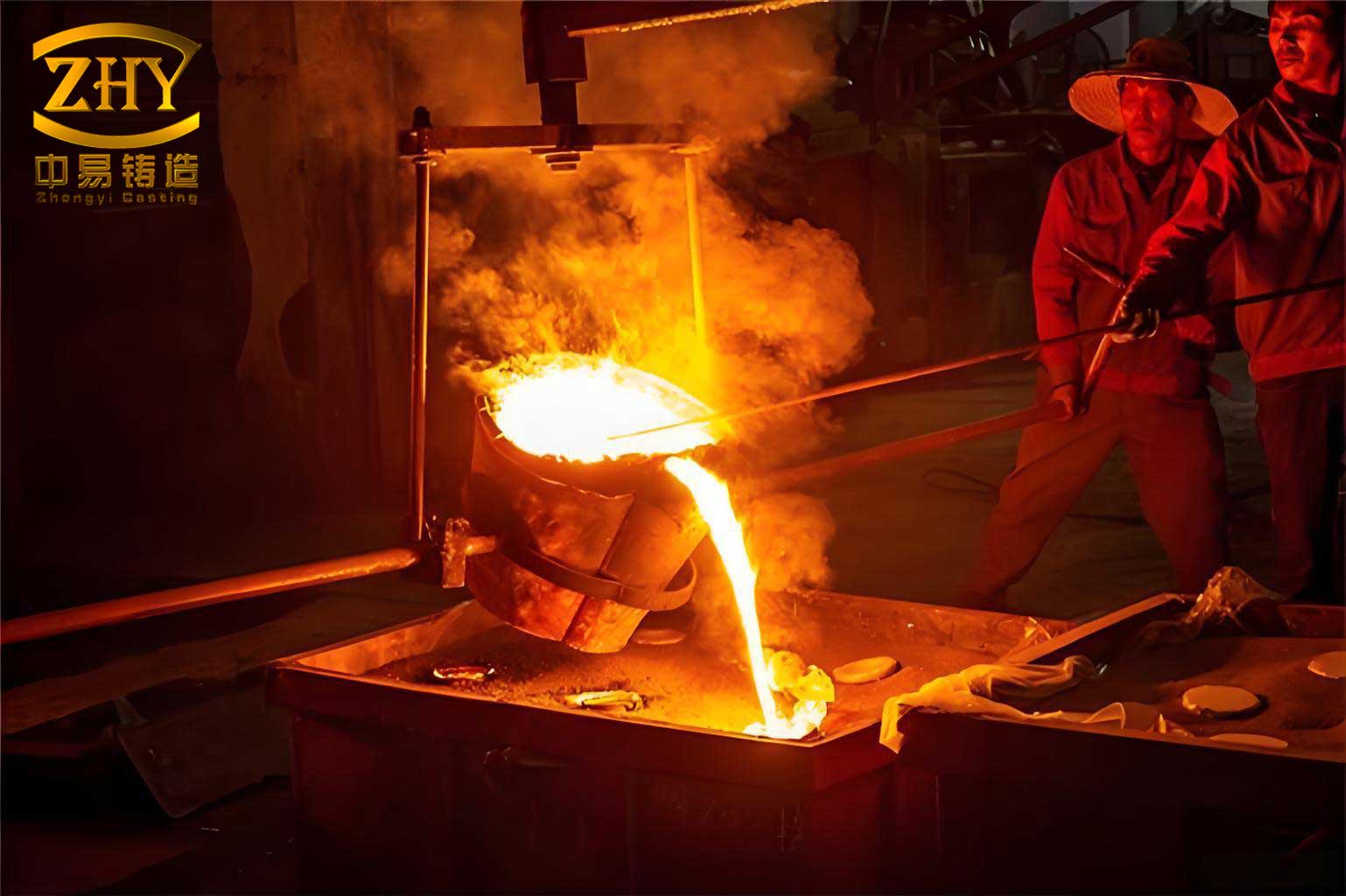
To ground the discussion, let’s formalize a key PT metric for mold evaluation: the Comprehensive Performance Index (CPI). This index attempts to quantify the “goodness” of a design choice. While many factors are involved, a simplified formulation focusing on cost and operational efficiency can be insightful:
$$ CPI = \frac{\alpha \cdot L + \beta \cdot (1/E) + \gamma \cdot (1/C_m)}{\delta \cdot C_i + \epsilon \cdot T_p} $$
Where:
- $L$ represents operational lifespan (in cycles).
- $E$ represents energy consumption per cycle (e.g., for heating).
- $C_m$ represents mass of the component (affecting handling ergonomics).
- $C_i$ represents initial manufacturing cost.
- $T_p$ represents pattern production cycle time influenced by the mold.
- $\alpha, \beta, \gamma, \delta, \epsilon$ are weighting coefficients specific to the foundry’s priorities (e.g., labor cost vs. energy cost).
A higher CPI indicates a more performance-optimized design according to the weighted criteria. This formula will be referenced as we evaluate specific optimizations for the lost foam casting process.
One of the most substantial applications of PT is in the design of the mold body itself—the cavity that forms the foam pattern. In the lost foam casting process, the mold body must be heated to a specific temperature range to allow the polystyrene beads to expand and fuse properly. A common non-optimal practice, observed in many foundries, is the use of excessively thick walls. For a small steel casting mold, a traditional design might specify walls of 14-18 mm. This seems robust, but PT analysis reveals multiple performance deficits. The increased mass ($C_m$) directly leads to higher energy ($E$) requirements for heating, prolonging the预热时间 (pre-heat time). The relationship between heating energy, mass, and specific heat capacity is fundamental:
$$ Q = m \cdot c \cdot \Delta T $$
Where $Q$ is the energy required, $m$ is the mass, $c$ is the specific heat capacity of the mold material (often aluminum alloy), and $\Delta T$ is the temperature rise. Reducing mass linearly reduces the energy input needed per cycle, improving $E$ in the CPI. Furthermore, excessive mass creates ergonomic issues. A mold that could be maneuvered by two operators now requires four, increasing labor strain and potential for injury—a human performance issue central to PT. The optimized design, guided by PT, utilizes finite element analysis to determine the minimum wall thickness (typically 8-10 mm for such applications) that maintains structural integrity under clamping and steam pressure forces. The performance gain is multifaceted: material cost ($C_i$) drops, energy consumption ($E$) drops, handling improves (reducing $C_m$’s negative impact), and the reduced thermal mass can shorten the pattern cycle time ($T_p$), all contributing to a significantly higher CPI for the lost foam casting process.
| Parameter | Traditional Thick-Wall Design (14-18mm) | PT-Optimized Thin-Wall Design (8-10mm) | Performance Improvement |
|---|---|---|---|
| Approximate Mass (kg) | 85 | 48 | Reduction ~43.5% |
| Theoretical Heating Energy (Q) for ΔT=80°C (MJ)* | ~16.15 | ~9.12 | Reduction ~43.5% |
| Estimated Preheat Time (minutes) | 22-25 | 12-15 | Reduction ~40% |
| Operators Required for Manual Handling | 4 | 2 | Reduction 50% |
| Material Cost Index | 100 | ~65 | Reduction ~35% |
| Relative CPI (with sample weights)** | 1.00 (Baseline) | 1.82 | Improvement 82% |
*Assuming aluminum alloy (c ≈ 0.9 kJ/kg·K). **Sample weights: α=0.3, β=0.2, γ=0.2, δ=0.2, ε=0.1. Values simplified for illustration.
Frame-like components, such as the upper and lower mold clamping frames for automated foam molding machines or frames for manual steam boxes, are another area where PT-driven redesign yields remarkable results. Traditional frames, often copied from manual guidelines, are typically fabricated from thick plates with simple welded joints, resembling a heavy rectangular box. This design philosophy prioritizes perceived ruggedness over analyzed performance. The PT critique focuses on the superfluous material, which adds to $C_i$ and $C_m$ without contributing proportionally to rigidity or function. The optimized design employs strategic ribbing and tapered sections, leveraging modern CAD and stress analysis software. The material is redistributed to where it counteracts bending moments most effectively, leading to a lighter, stiffer, and more aesthetically pleasing structure. The weight reduction directly improves ergonomics for manual setups and reduces the inertial load on automated machines, potentially increasing their speed and longevity. For the lost foam casting process, where frames are constantly cycled, this optimization reduces wear on machine guides and actuators. The performance gain can be summarized by comparing the section modulus, a measure of bending strength, against mass. For a rectangular section, the modulus $Z$ is given by:
$$ Z = \frac{b \cdot h^2}{6} $$
where $b$ is width and $h$ is height. A traditional solid plate frame relies on large $b$ and $h$ for $Z$, resulting in high mass. An optimized ribbed frame achieves a comparable or higher $Z$ with a much smaller cross-sectional area, hence lower mass. The CPI improves through lower $C_i$, $C_m$, and improved system reliability.
| Design Feature | Traditional Solid-Frame Design | PT-Optimized Ribbed-Frame Design |
|---|---|---|
| Primary Construction | Thick flat plates welded at corners. | Thinner plates with internal reinforcing ribs and gussets. |
| Weight (for comparable rigidity) | 100% (Baseline) | 60-70% |
| Material Utilization (Strength/Mass) | Low | High |
| Manufacturing Complexity | Low (simple cuts and welds) | Higher (requires precise cutting/forming) |
| Long-term Performance | Prone to distortion from residual weld stress; bulky. | More stable geometry; easier to handle and integrate. |
| Impact on Lost Foam Cycle | Higher energy to move/cycle; slower machine potential. | Faster machine cycling possible; lower energy consumption. |
The positioning and alignment of mold halves and loose pieces (cores or side pulls) are critical for pattern accuracy in the lost foam casting process. Traditional methods heavily rely on dowel pins and bushings or key-and-slot arrangements. While functionally sound in theory, PT analysis of their in-practice performance reveals shortcomings. Dowel pins add parts count ($C_i$), require precise machining of two mating components, and are prone to wear and seizure due to the moist, steamy environment of the lost foam casting process. A seized pin can halt production, drastically affecting $T_p$. Key-and-slot designs share similar issues, often accumulating debris that affects positioning accuracy. The PT-optimized solution exploits the precision of modern CNC machining. For main mold parting lines, an integral tongue-and-groove (or male/female step)定位 is used. This method uses the mold body itself as the aligning feature, eliminating extra parts. The locating accuracy $\Delta_{loc}$ is now a direct function of the machine tool’s capability, which is typically very high and consistent. The performance benefit is in reliability, reduced part count, and simplified maintenance. The relationship for system reliability $R_s$ of a serial system (where failure of any part fails the whole) illustrates this:
$$ R_s = \prod_{i=1}^{n} R_i $$
where $R_i$ is the reliability of each component. Replacing two dowel pins and two bushings (n=4 components, each with R_i < 1) with a single machined feature (n=1, with high R_i) increases the overall system reliability $R_s$ for alignment, reducing downtime in the lost foam casting process.
For loose pieces or core pulls, PT guides the adoption of permanent magnets for positioning. A small neodymium magnet embedded in the mold body and a steel plate on the loose piece provide a secure, quick, and wear-free locating method. The holding force $F_m$ can be calculated based on magnet grade and contact area, ensuring it exceeds any disruptive forces during foam injection. This eliminates the friction and wear associated with mechanical pins in this application. The CPI improves through increased lifespan $L$ (no wear), reduced maintenance, and faster mold assembly/disassembly (positively affecting $T_p$).
Sleeve-type components, such as bead injection nozzles (吹料套) and various guide bushings, are ubiquitous in lost foam molds. A traditional injection nozzle often features a large, flanged cylindrical body machined from a solid bar stock. This design leads to atrocious material utilization, often below 40%. The PT analysis immediately flags this as a major cost inefficiency ($C_i$). Some opt for aluminum castings to improve yield, but this introduces longer lead times and potentially lower mechanical properties, affecting $L$. The PT-optimized design decouples the functions: a slim, high-precision sleeve is made from a high-density aluminum extrusion or precision tube, and a separate, simple clamp plate provides the flange functionality. While part count increases by one, the total material cost and machining time decrease significantly. The material utilization efficiency $\eta_{mat}$ can be expressed as:
$$ \eta_{mat} = \frac{V_{component}}{V_{raw material}} \times 100\% $$
For the traditional solid-bar approach, $\eta_{mat}$ for a nozzle might be 35%. For the optimized two-part design using extruded tube and plate, $\eta_{mat}$ can exceed 85%. Furthermore, using corrosion-resistant aluminum alloys ensures longevity and maintains aesthetic appeal in the harsh environment of the lost foam casting process, directly supporting a higher operational lifespan $L$ in the CPI.
| Aspect | Traditional “Big Flange” Monolithic Design | PT-Optimized “Two-Piece” Design |
|---|---|---|
| Raw Material Form | Large Diameter Aluminum Bar Stock | Aluminum Extruded Tube + Flat Plate |
| Material Utilization (η_mat) | ~35% | ~85% |
| Primary Machining Operations | Extensive turning/boring to remove >60% material. | Light turning/boring on tube; simple milling on plate. |
| Estimated Machining Time | 100% (Baseline) | ~50-60% |
| Component Count | 1 | 2 (Sleeve + Clamp Plate) |
| Assembly Requirement | None | Simple fastening required. |
| Overall Cost Impact (C_i) | High (wasteful material + long machining) | Lower (efficient material + shorter machining) |
| Suitability for Lost Foam Environment | Prone to corrosion if wrong material; bulky. | Can use optimal alloy; compact and serviceable. |
The principles of Performance Technology extend seamlessly to other mold components. For ejector pins or guide rods, PT prompts a review of material and surface treatment. Using standard steel rods might suffice initially, but in the humid, thermally cyclic environment of the lost foam casting process, they rust quickly, increasing friction, wearing bushings, and degrading pattern quality. The PT-optimized specification calls for stainless steel or hardened steel with a protective coating. The incremental increase in $C_i$ is outweighed by a dramatic increase in $L$, reduced downtime for replacement, and consistent pattern quality, yielding a net positive CPI. For large, complex loose pieces (活块), PT analysis might lead to design simplification or the incorporation of conformal cooling channels (if metal molds are used for foam production) to achieve more uniform temperature distribution, directly improving the quality and consistency of the foam pattern in the lost foam casting process. The thermal uniformity can be modeled using the heat conduction equation:
$$ \frac{\partial T}{\partial t} = \kappa \nabla^2 T $$
where $T$ is temperature, $t$ is time, and $\kappa$ is thermal diffusivity. Optimizing the mold geometry and cooling layout helps achieve a more uniform $\nabla^2 T$ (Laplacian of temperature), leading to better foam fusion.
In conclusion, the systematic application of Performance Technology theory to the design and fabrication of tooling for the lost foam casting process moves beyond conventional practice. It instills a mindset of holistic value engineering, where every gram of material, every minute of cycle time, and every ergonomic strain on the operator is considered part of the system’s performance equation. The optimizations discussed—thinner mold bodies, structurally efficient frames, integral and magnetic locating features, and material-conscious sleeve designs—are not isolated improvements. They collectively elevate the efficiency, economy, and reliability of the entire pattern-making stage in the lost foam casting process. The use of formulas like the Comprehensive Performance Index (CPI) and analyses based on fundamental principles of mechanics and thermodynamics provides a quantitative framework for justifying these design choices. As the lost foam casting process continues to evolve for producing complex castings, the role of performance-optimized tooling designed under the PT paradigm will remain crucial for foundries seeking competitive advantage through superior cost control, product quality, and workplace sustainability. The journey involves continuous analysis, but the performance dividends for the lost foam casting process are substantial and clearly measurable.