
The pursuit of enhanced performance and efficiency in automotive engines has led to increasingly demanding requirements for critical components. Among these, the turbocharger housing stands out due to its complex geometry, thin walls, and severe operational environment involving extreme temperatures and pressures. The transition to higher-performance engines, particularly to meet stringent emission standards, has necessitated the use of advanced, high-nickel alloy steels for these casting parts. This material shift, while offering superior high-temperature resistance and durability, introduces significant challenges in the foundry, especially concerning mold material integrity. The production of such alloy steel casting parts demands molding materials capable of withstanding substantially higher pouring temperatures without degrading, which directly impacts the surface quality and dimensional accuracy of the final component.
This article details our first-hand experience and systematic approach in overcoming a critical surface quality defect during the development of a new alloy steel turbocharger housing. The core of the solution lay in the innovative development and application of a pure reclaimed coated sand for producing the intricate shell cores. We will explore the technical journey from initial failure to successful batch production, focusing on the interplay between coated sand properties, process economics, and the final quality of the casting parts.
Structural and Metallurgical Challenges of the Target Casting Part
The turbocharger housing in question presented a formidable casting challenge from the outset. Its complex internal passages and external geometry, characterized by numerous thin sections and sharp re-entrant angles, are typical of performance-oriented casting parts designed for optimal fluid dynamics. The primary wall thickness was specified at 4.5 mm, requiring precise control over metal flow and solidification to avoid misruns or excessive porosity.
The greater challenge, however, stemmed from the material specification: GX40CrNiSi25-20, a high-nickel, high-chromium austenitic alloy steel. The chemical composition of this alloy, crucial for its performance, is summarized below:
| Element | Content (wt.%) |
|---|---|
| C | 0.3 – 0.5 |
| Si | 1.0 – 2.5 |
| Mn | ≤ 2.0 |
| P | ≤ 0.04 |
| S | ≤ 0.03 |
| Cr | 24 – 27 |
| Ni | 19 – 22 |
| Mo | ≤ 0.5 |
This composition grants exceptional heat and corrosion resistance but adversely affects casting characteristics. The alloy has poor fluidity compared to lower-alloy steels, and more critically, requires a very high pouring temperature range of 1630°C to 1650°C to ensure complete filling of the thin sections. This extreme temperature imposes a severe thermal load on any molding material. Conventional green sand molding was immediately deemed unsuitable, as it would lead to gross surface defects, penetration, and poor dimensional stability. Consequently, the process selection converged on using precision shell cores made from coated sand for forming the entire exterior cavity of the casting part. These shell cores would then be assembled and placed within a green sand mold for backing and support during pouring. The success of this approach hinged entirely on the performance of the coated sand under the brutal thermal assault of molten GX40CrNiSi25-20 alloy.
Initial Trial, Defect Manifestation, and Root Cause Analysis
For the initial production trial, we employed a commercially available high-strength coated sand, designated here as Sand Type 1. Its formulation was augmented with expensive additives like chamotte (calcined clay) and chromite sand to boost its refractoriness. The properties of Sand Type 1 were as follows:
| Property | Specification / Value |
|---|---|
| 70/140 Mesh Concentration | ≥ 85% |
| Base Sand Composition (wt.%) | 67% Silica, 25% Chamotte, 8% Chromite |
| Hot Tensile Strength | ≥ 1.8 MPa |
| Cold Tensile Strength | ≥ 4.3 MPa |
| Hot Flexural Strength | ≥ 3.6 MPa |
| Cold Flexural Strength | ≥ 8.0 MPa |
| Gas Evolution | ≤ 15 mL/g |
| Loss on Ignition | ≤ 3.0% |
Ten molds were poured at a controlled temperature of 1642°C. Upon shakeout, cleaning, and shot blasting, a severe defect was immediately apparent on the lateral surfaces of the casting parts. The surface exhibited scabbing or veining-type defects, with a rough, laminated texture. Surface roughness measurements confirmed the failure, yielding values of Ra = 75 – 100 µm, far exceeding the permissible limit of Ra = 20 µm. These casting parts were irreparable and constituted a 100% scrap rate for the trial batch.
A thorough cross-functional analysis identified the root cause. While Sand Type 1 had high refractoriness due to its chamotte and chromite content, its hot strength was insufficient for this specific application. The shell core, when exposed to the intense heat of the molten alloy steel, experienced localized thermal breakdown. The resin binder degraded rapidly, leading to premature sand grain displacement and core surface spalling. This eroded sand then became entrapped in the solidifying metal skin, creating the observed scab defects. The failure could be conceptually modeled by considering the thermal stress on the sand binder at the metal-core interface. The rate of resin degradation is a function of temperature and time:
$$ \frac{d\Psi}{dt} = -k \cdot e^{(-E_a / R T(t))} $$
where $\Psi$ is the effective binder strength, $k$ is a pre-exponential factor, $E_a$ is the activation energy for degradation, $R$ is the gas constant, and $T(t)$ is the interfacial temperature over time. For Sand Type 1, the function $T(t)$ during pouring of 1650°C metal caused $\Psi$ to fall below the critical threshold needed to withstand metallostatic pressure and thermal stress before a stable sintered layer could form.
Furthermore, the cost of Sand Type 1 was prohibitively high at 2100 USD per ton, rendering the production process economically unviable for serial manufacture of these casting parts. Thus, the challenge was twofold: develop a coated sand with significantly superior high-temperature strength and stability, while simultaneously drastically reducing raw material cost.
Coated Sand Reformulation and Development of Pure Reclaimed Sand
The solution pathway was clear: engineer a new coated sand (Sand Type 2) with enhanced high-temperature mechanical properties and improved refractoriness, but based on low-cost, reclaimed materials. The key performance targets were a substantial increase in cold tensile strength (as a proxy for overall binder integrity) and the incorporation of a cost-effective refractory additive.
The strategy centered on two innovations:
1. Utilizing 100% Reclaimed Silica Sand: Instead of premium new silica sand, we implemented a closed-loop system using reclaimed sand from our own foundry processes. The spent sand undergoes a thermal reclamation process: it is heated to approximately 620°C and held for 4 hours. This process combusts residual organic contaminants and coatings, effectively resetting the sand grains to a near-virgin state. After cooling and screening, the sand achieves a SiO2 content >90%, making it a suitable, low-cost base material.
2. Incorporating Iron Oxide (Fe₃O₄) Additive: To enhance the refractory performance without using expensive specialty sands, a controlled addition of iron oxide powder (6-8 wt.%) was introduced. Fe₃O₄ improves the sintering characteristics of the silica sand at high temperatures, promoting the formation of a more stable, self-supporting ceramic layer at the metal-sand interface that protects the underlying core from further thermal erosion.
The production process for the new Sand Type 2 was meticulously defined:
$$ \text{Process Flow: Reclaimed Sand} \xrightarrow{\text{Heat to 150°C}} \xrightarrow{+6.5\% \text{Phenolic Resin}} \xrightarrow{\text{Mix}} \xrightarrow{\text{Cool to 110°C}} \xrightarrow{+\text{Hexamine Solution}} $$
$$ \xrightarrow{+\text{Calcium Stearate} + 7\% \text{Fe}_3\text{O}_4} \xrightarrow{\text{Intensive Mixing/Cooling}} \xrightarrow{\text{Screening}} \text{Sand Type 2} $$
This process ensures an even coating of resin and uniform dispersion of the iron oxide additive. The final properties of the developed Sand Type 2 are summarized below:
| Property | Specification / Value for Sand Type 2 |
|---|---|
| 70/140 Mesh Concentration | ≥ 85% |
| Base Sand | >90% SiO₂ Reclaimed Sand |
| Hot Tensile Strength | ≥ 2.2 MPa |
| Cold Tensile Strength | ≥ 5.5 MPa |
| Hot Flexural Strength | ≥ 5.0 MPa |
| Cold Flexural Strength | ≥ 9.0 MPa |
| Average Fineness (AFS) | 80 – 85 |
| Gas Evolution | ≤ 15.5 mL/g |
| Loss on Ignition | ≤ 3.0% |
The 28% increase in minimum cold tensile strength (from 4.3 to 5.5 MPa) and the inclusion of iron oxide were the critical differentiators. The higher fineness also contributed to better surface finish on the core itself, translating to the final casting part. Economically, the shift to 100% reclaimed base sand and the elimination of chamotte/chromite reduced the material cost by approximately 43%, to around 1200 USD per ton.
Production Validation and Results
The newly developed Sand Type 2 was used to produce the shell cores for the turbocharger housing. The core-making process, core assembly, molding, and pouring parameters (maintaining ~1640°C) remained identical to the initial trial to ensure a direct comparison. Ten new molds were poured and processed.
The results were markedly different. After shakeout and shot blasting, the casting parts exhibited a clean, smooth surface free from scabs, veining, or any other gross surface imperfections. Dimensional inspection confirmed conformity to the drawing. The surface roughness was measured and consistently met the required Ra = 20 µm specification. The casting yield from this batch exceeded 95%, validating the process stability and moving the project from feasibility to reliable production. The successful implementation confirmed that the enhanced hot strength and the promoted sinter layer from the iron oxide additive effectively resisted thermal degradation, maintaining core integrity throughout the pouring and initial solidification phases. The relationship for Sand Type 2 can be thought of as:
$$ \Psi_{Type2}(t) = \Psi_0 \cdot e^{-k_2 \cdot e^{(-E_{a2}/RT(t))}} + S(T(t)) $$
where $S(T(t))$ represents the additional strength contribution from the sintering of the silica sand grains facilitated by the iron oxide additive, which becomes significant at the metal-solid interface temperature. This $S(T)$ component helps maintain $\Psi_{Type2}$ above the critical failure threshold.
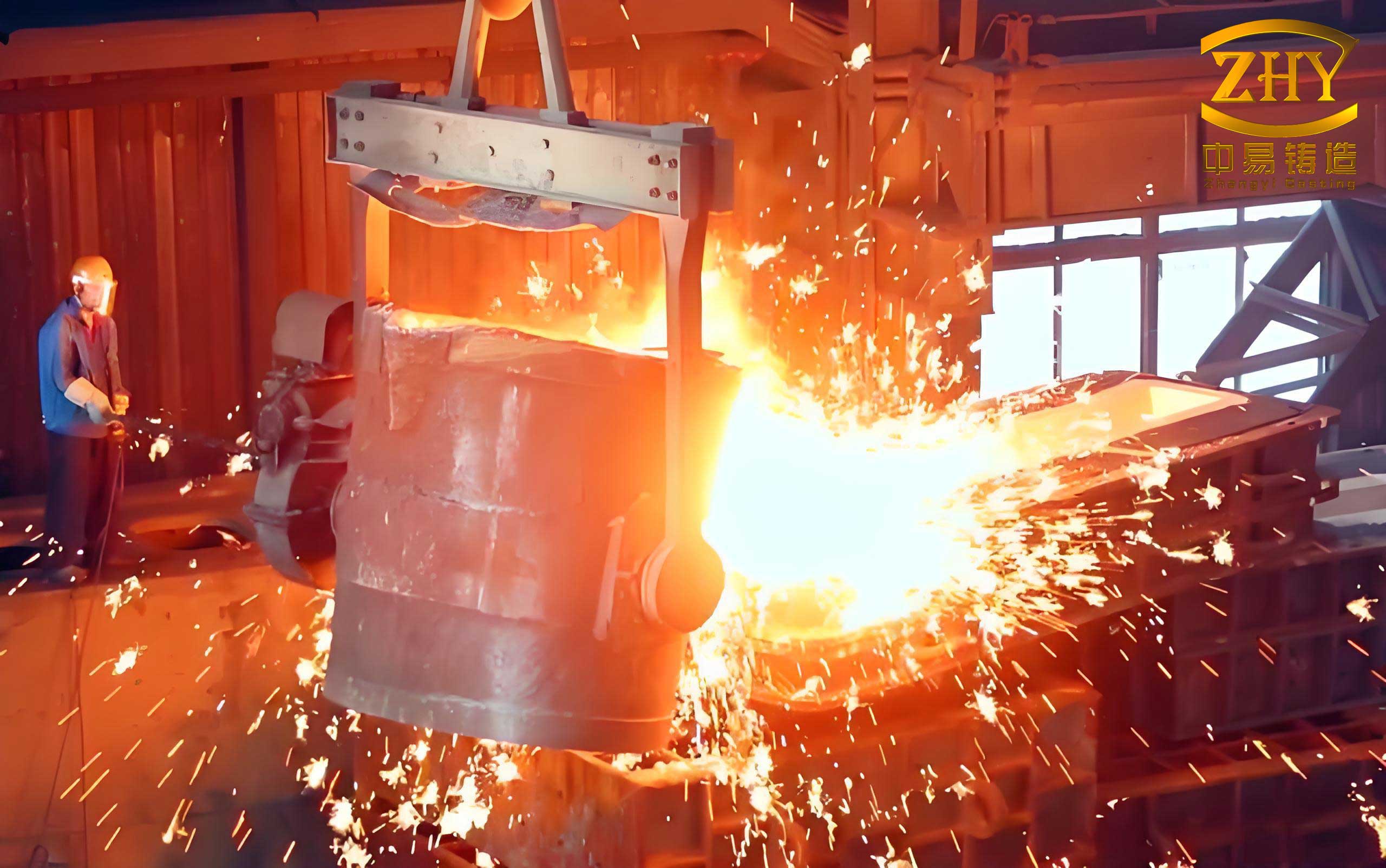
The visual evidence of the final, high-quality alloy steel casting parts underscores the effectiveness of the developed material. This successful validation paved the way for batch production, ensuring on-time delivery to the customer while maintaining stringent quality standards for these high-performance casting parts.
Conclusion and Broader Implications
The development and application of a pure reclaimed coated sand for producing shell cores resolved a critical quality bottleneck in manufacturing high-nickel alloy steel turbocharger housings. By systematically addressing the insufficiency in high-temperature strength of conventional sands and integrating a cost-effective refractory enhancer (Fe₃O₄), we engineered a material solution that directly countered the thermal shock and erosion mechanisms causing surface defects. The shift to a 100% reclaimed silica sand base not only provided a sustainable material loop but was also the principal driver for reducing the core-making cost by nearly half, transforming the economics of producing these complex casting parts.
This case study highlights a fundamental principle in advanced foundry practice: the properties of the molding material must be co-engineered with the metallurgical and geometric demands of the casting part. The successful formula can be generalized as:
$$ \text{Success} = f(\text{High Hot Strength}, \text{Controlled Sintering}, \text{Economic Base Material}) $$
For alloy steel casting parts with high pouring temperatures, this approach demonstrates that superior surface quality and dimensional accuracy are achievable without resorting to exotic, expensive sands. The developed Sand Type 2 has since been successfully deployed in the serial production of various other high-temperature alloy casting parts, proving its robustness and reliability. It stands as a testament to how targeted material science and process innovation within the core-making discipline can unlock the production of challenging, high-value casting parts, ensuring both quality and competitiveness.