
In my experience with foundry operations, particularly in the production of cast iron parts, the challenges associated with sand cores have always been a focal point. Traditionally, for manual molding and small-batch production of cast iron parts, clay sand has been the go-to material for core-making. However, when dealing with complex shapes or large-sized cores, even after drying, clay sand often exhibits low strength, susceptibility to deformation, and difficulties in ensuring the dimensional accuracy of the final cast iron parts. This has historically led to quality issues, such as sand inclusion, deformation, and poor surface finish, which compromise the integrity of cast iron parts. Water glass sand, known for its high strength, dimensional stability, and cost-effectiveness, presents a viable alternative. Yet, its adoption in cast iron parts production has been limited due to concerns like sand burning-on and poor collapsibility. Through extensive trials and adjustments, I have found that by leveraging its strengths and mitigating its weaknesses with appropriate measures, water glass sand can be effectively used for cores in cast iron parts, especially for intricate and large designs.
The core of this approach lies in the precise formulation and processing of water glass sand. The typical composition involves a blend of new sand (often quartz sand), water glass (sodium silicate), and additives like bentonite to enhance properties. A detailed breakdown of the mix ratio is presented in the table below, which has been optimized through iterative testing for cast iron parts production.
| Component | Specification | Percentage by Weight (%) |
|---|---|---|
| New Sand | Quartz sand, AFS 50-70 | 94.0 – 96.0 |
| Water Glass | Modulus (M) = 2.1 – 2.4 | 3.0 – 4.0 |
| Bentonite | Calcium-based, activated | 1.0 – 2.0 |
The mixing and milling process is critical to achieving homogeneity. The sequence involves: first, blending the new sand with bentonite thoroughly; then, adding water glass gradually while continuing to mix. The optimal mixing time, based on my observations, ranges from 3 to 5 minutes, ensuring uniform distribution without over-milling, which can degrade the sand’s properties. The final mixture should have a compactability of around 35-45% for optimal core-making. The hardening mechanism of water glass sand is a key aspect. It primarily relies on the reaction between sodium silicate and carbon dioxide or heat. The process can be described by the following chemical equation, which underpins the strength development:
$$ \text{Na}_2\text{SiO}_3 + \text{CO}_2 \rightarrow \text{SiO}_2\cdot n\text{H}_2\text{O} + \text{Na}_2\text{CO}_3 $$
This reaction forms a silicate gel that binds the sand grains, providing high compressive and tensile strength. In practice, I employ a combined hardening method: initial CO₂ gassing for surface hardening, followed by oven drying at 180-220°C for 1-2 hours to achieve full depth hardening. The CO₂ gassing time is typically 10-20 seconds per core surface, depending on thickness, while the oven drying ensures complete dehydration, enhancing the core’s thermal stability for cast iron parts. The strength after hardening can be modeled using an empirical formula derived from multiple tests:
$$ \sigma_c = k_1 \cdot M^{0.5} \cdot \left( \frac{w}{s} \right)^{-0.3} \cdot e^{-k_2/t} $$
where \(\sigma_c\) is the compressive strength in MPa, \(M\) is the modulus of water glass, \(w/s\) is the water-to-sand ratio, \(t\) is the drying time in hours, and \(k_1\), \(k_2\) are material constants specific to the sand mix. For typical mixes used in cast iron parts, \(k_1 \approx 2.5\) and \(k_2 \approx 0.1\).
To address the issue of sand burning-on, which is common in cast iron parts due to high pouring temperatures, I developed a proprietary alcohol-based fast-drying coating. This coating acts as a barrier between the molten iron and the sand core, preventing metal penetration. The formulation, refined over numerous trials, is detailed in the table below. The ingredients are selected based on their refractory properties and ease of application.
| Coating Component | Type/Specification | Percentage by Weight (%) |
|---|---|---|
| Amorphous Graphite | 200 mesh, fixed carbon ≥85% | 60 – 70 |
| Flake Graphite | 100 mesh, purity ≥90% | 20 – 30 |
| Bentonite | As binder | 5 – 8 |
| Industrial Alcohol | As carrier solvent | Adjustable for viscosity |
The coating is applied by brushing or spraying onto the hardened core surface. The optimal coating thickness, determined through metallographic analysis of cast iron parts, is 0.3-0.5 mm. This range provides sufficient protection without risking peeling or cracking during pouring. The drying time is rapid due to the alcohol base, typically within 10-15 minutes at room temperature, which streamlines the production process for cast iron parts. Additionally, to improve collapsibility—a known weakness of water glass sand—I design cores as “shell cores” by hollowing out the interior from the core print inward. This reduces the sand mass, enhances gas permeability, and facilitates shakeout after casting, crucial for complex cast iron parts. The hollow section also improves thermal decompression, reducing stress on the casting.
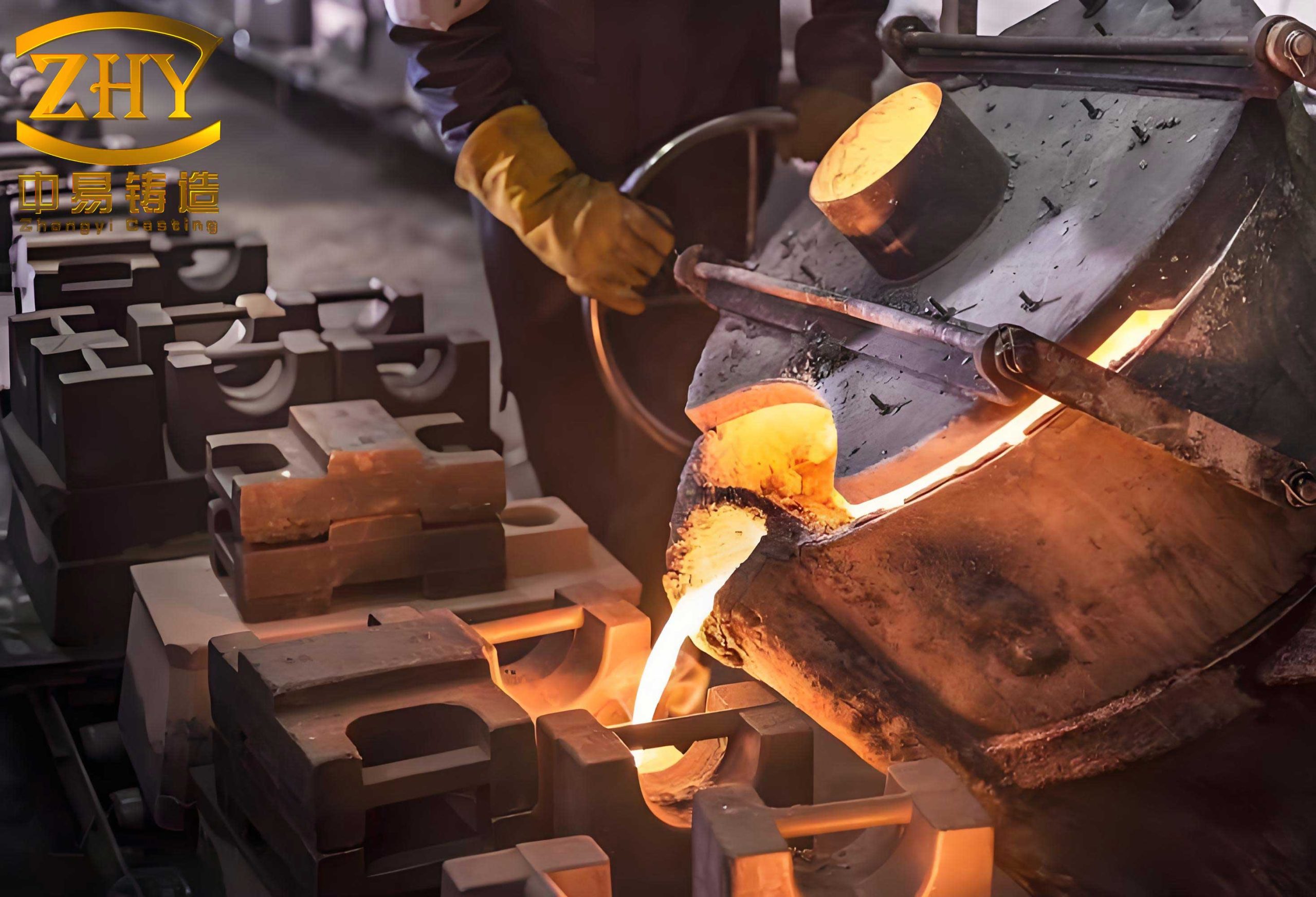
In practical applications, this methodology has proven effective for various cast iron parts. For instance, in producing a large gear component weighing approximately 500 kg, made from grade HT250 cast iron, the core required high dimensional stability to maintain the gear tooth profile. Initially, clay sand cores led to distortions and sand inclusions, resulting in scrap cast iron parts. Switching to water glass sand cores, with the shell design and coating application, eliminated these defects. The core’s strength allowed precise positioning, and the coating prevented burning-on, yielding cast iron parts with smooth surfaces and minimal cleaning effort. Another example involves a pump housing cast iron part, where multiple cores intersected with thin walls. Water glass sand cores provided the necessary rigidity to prevent core shift during pouring, ensuring wall thickness consistency in the final cast iron parts. The collapsibility was adequate due to the hollow design, allowing easy sand removal without damaging the casting.
The advantages extend beyond quality. Economically, water glass sand reduces the need for extensive core reinforcements like chaplets, lowering material costs. The simplified process—fewer drying stages compared to clay sand—cuts energy consumption and cycle times. However, successful implementation requires attention to several factors. First, water glass sand is best suited for cast iron parts with complex cores that demand high strength and minimal deformation, or for large cavities where collapsibility is manageable. Second, the coating must be uniformly applied; deviations in thickness can lead to local defects in cast iron parts. I recommend quality checks using thickness gauges. Third, for “shell cores,” the fit between core prints and mold cavities must be precise to prevent metal penetration into gaps. Tolerance analysis using statistical methods helps: if \(\delta\) is the clearance, it should satisfy \(\delta \leq 0.1 \cdot d\), where \(d\) is the core print diameter in mm. Fourth, due to low green strength, handling water glass sand cores before hardening requires care. Pre-hardening with CO₂ for 5-10 seconds forms a skin that facilitates lifting and transfer to ovens.
From a technical perspective, the performance of water glass sand in cast iron parts production can be quantified through key parameters. The table below summarizes critical properties measured in laboratory and production settings, highlighting its suitability for cast iron parts.
| Property | Test Method | Typical Value for Water Glass Sand | Implication for Cast Iron Parts |
|---|---|---|---|
| Compressive Strength (dry) | ASTM C109 | 3.5 – 5.0 MPa | High resistance to metalostatic pressure |
| Permeability | AFS standard | 80 – 120 | Good gas escape, reducing blowholes |
| Collapsibility (after casting) | Shakeout time test | 30 – 50% easier than clay sand | Faster cleaning, lower labor cost |
| Thermal Stability (at 1200°C) | Dilatometry | Linear expansion <0.8% | Minimizes casting stresses |
| Burning-on Resistance | Visual inspection after pouring | Excellent with coating | Clean surface finish on cast iron parts |
Moreover, the environmental aspect is noteworthy. Water glass sand generates less dust and can be partially reclaimed, though full recyclability remains a challenge. For foundries focusing on sustainability, this aligns with efforts to reduce waste from cast iron parts production. In terms of process optimization, I have derived a formula to estimate the core-making time \(T_c\) for water glass sand compared to clay sand:
$$ T_c = t_m + t_h + t_f = \frac{V}{r_m} + \alpha \cdot \ln(\tau) + \beta \cdot A_c $$
where \(V\) is the core volume, \(r_m\) is the mixing rate, \(t_h\) is hardening time, \(\tau\) is the CO₂ gassing duration, \(A_c\) is the coating area, and \(\alpha\), \(\beta\) are efficiency factors. For typical cast iron parts cores, this model shows a 15-20% reduction in total time due to faster hardening and eliminated secondary drying.
Looking at broader implications, the use of water glass sand supports the trend toward lightweighting and precision in cast iron parts, such as in automotive or machinery components. By enabling more complex geometries without defects, it expands design possibilities. For example, in engine blocks or brake drums—critical cast iron parts—core integrity directly impacts performance and safety. The high-temperature resistance of water glass sand also makes it suitable for alloyed cast iron parts, where pouring temperatures exceed 1400°C. In such cases, the coating formulation may be adjusted by increasing flake graphite content to 35-40% for enhanced refractoriness, as per the relation:
$$ R_c = C_f \cdot \rho_g \cdot \left(1 – e^{-k_3 \cdot T_p}\right) $$
where \(R_c\) is the coating resistance index, \(C_f\) is the flake graphite concentration, \(\rho_g\) is its density, \(T_p\) is the pouring temperature, and \(k_3\) is an empirical constant. This ensures protection for high-grade cast iron parts.
In conclusion, based on my hands-on experience, water glass sand, when paired with tailored measures like optimized mixes, combined hardening, shell core designs, and specialized coatings, offers a robust solution for core-making in cast iron parts production. It addresses the limitations of traditional clay sand, enhancing strength, dimensional accuracy, and cost-efficiency while mitigating issues like burning-on and poor collapsibility. The methodology has been validated across diverse cast iron parts, from heavy gears to intricate housings, consistently yielding defect-free castings with reduced post-processing. I encourage foundries engaged in cast iron parts manufacturing to explore this approach—it not only solves persistent production challenges but also aligns with modern demands for quality and efficiency. By embracing such innovations, the industry can advance the reliability and performance of cast iron parts, underpinning sectors from infrastructure to transportation.