
From my extensive experience in foundry engineering, the pursuit of quality in producing large cast iron parts—those weighing several tons and upwards—presents a unique set of challenges. The financial stakes are incredibly high due to the substantial material costs, lengthy production cycles, and significant machining investments. A single inclusion defect discovered during final machining or, worse, in service, can lead to catastrophic financial loss. It is this high-risk environment that has driven the adoption and refinement of molten metal filtration, a technology now mature in automotive casting but still gaining traction for large-scale cast iron parts. The core rationale is straightforward: prevention is exponentially more cost-effective than repair or scrap. In this discussion, I will share practical insights into the necessity, feasibility, and economic impact of implementing filter technology for large cast iron parts.
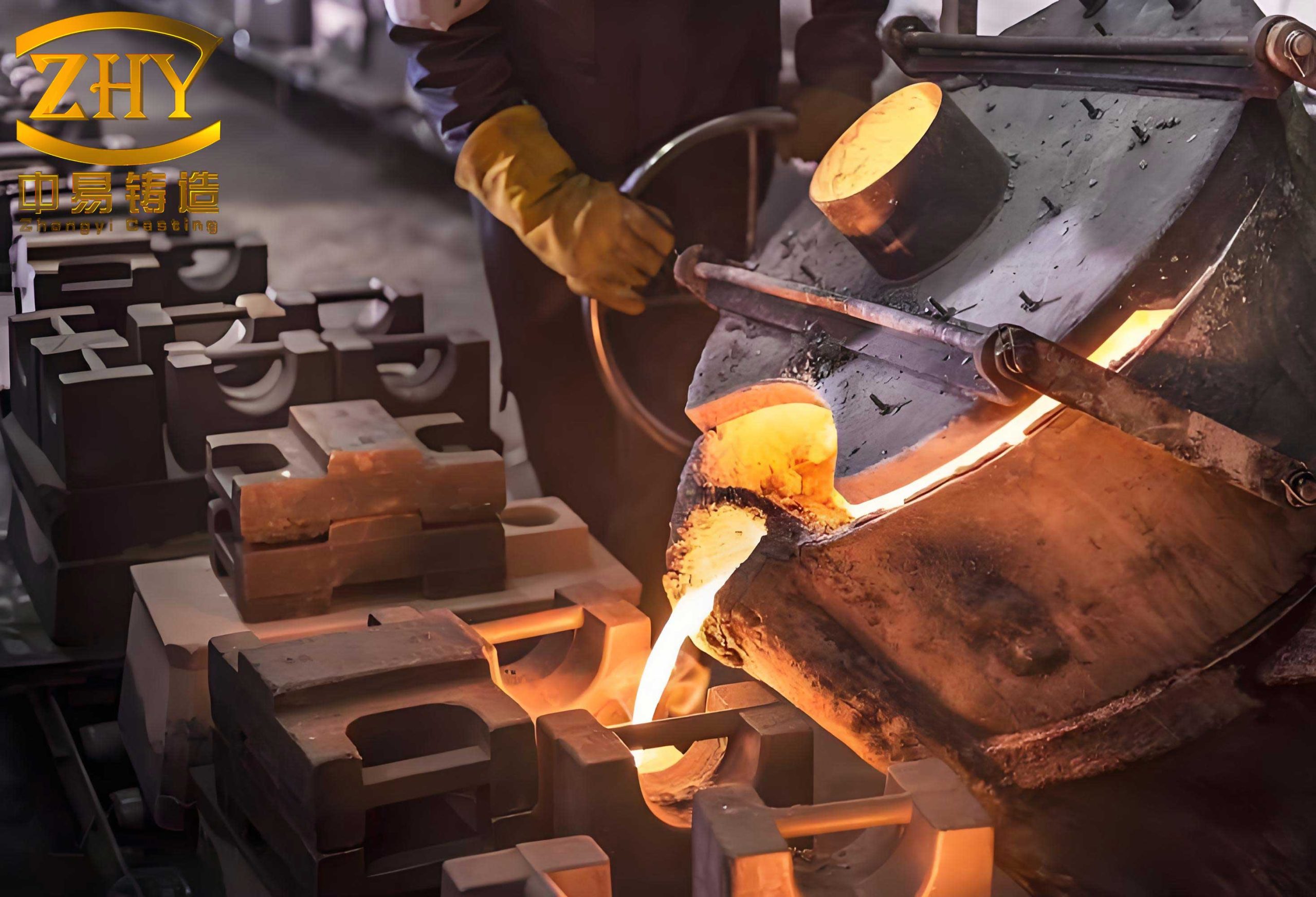
The Imperative for Filtration in Large Cast Iron Parts
The generation of inclusions is an inherent part of the casting process, and for large cast iron parts, their potential for harm is magnified. The necessity for active filtration stems from multiple, concurrent sources of slag and dross:
- Primary Slag from Melting and Treatment: Despite best practices in slag raking and fluxing, not all oxides, sulfides, and reaction products from furnace melting or ladle treatment (like magnesium treatment in ductile iron) are removed. These suspended particles are carried into the mold cavity.
- Erosion Slag from the Gating System: The high thermal and mechanical shock of the initial iron stream can erode sand from the sprue, runner, and gates, especially in resin-bonded sand molds. This sand becomes entrapped in the flow.
- Secondary Oxidation Dross (Reoxidation): Turbulent flow during mold filling exposes fresh metal surfaces to oxygen, forming thin oxide films. In iron alloys, these can agglomerate into macro-inclusions that are light enough to float but often get trapped in complex geometries or heavy sections of large cast iron parts.
- Mold/Core Wash Erosion: The coatings applied to cores and molds to improve surface finish can spall or erode under prolonged contact with hot metal, particularly in long pouring times characteristic of heavy castings.
Without interception, these inclusions become stress concentrators, reduce effective load-bearing areas, and impair pressure tightness. The goal of filtration is to act as a functional, in-line purification unit within the gating system, physically capturing these particulates to deliver cleaner metal to the casting cavity.
Feasibility Analysis and Filter Media Selection
The application of filters to multi-ton pours is not just a theoretical concept but a proven practice. I have been involved in projects filtering iron for cast iron parts weighing up to 60 tons, such as wind turbine hubs, injection molding machine frames, and large machine tool beds. Success hinges on selecting the appropriate filter type and correctly engineering its placement within the gating system.
The primary filter types suitable for large cast iron parts are:
- Silicon Carbide (SiC) Foam Ceramic Filters: The most commonly used type, offering a good balance of refractoriness, thermal shock resistance, and cost-effectiveness.
- Alumina (Al2O3) Cellular (Cellular) or Direct-Pour Filters: Often used for their higher mechanical strength at temperature, sometimes in combination with foam filters for support.
- Carbon-Bonded Silica (Carbonaceous) Foam Filters: Notable for their low thermal mass, which prevents premature metal freezing, and high chemical stability.
- Zirconia (ZrO2) Foam Ceramic Filters: The premium choice for the most demanding applications, offering the highest refractoriness and thermal strength.
The critical engineering parameters are filter thickness and the safe specific flow rate, which is the mass of iron a unit area of filter can reliably handle. Long pouring times and large metal heads in big castings impose significant thermal and mechanical stress on the filter. The following table summarizes the key selection criteria based on my field data:
| Filter Material | Typical Composition | Max Service Temp. (°C) | Recommended Thickness (mm) | Pore Size (ppi) | Safe Specific Flow Rate (kg/cm²) | Key Characteristics & Considerations |
|---|---|---|---|---|---|---|
| Silicon Carbide Foam | SiC, Al2O3, binders | ~1550 | 30 – 40 | 10 | 2.5 – 3.5 | Excellent balance, widely available. Often used in thick, single-layer configurations. |
| Alumina Direct-Pour | High-purity Al2O3 | ~1700 | 20 – 25 | N/A (cellular) | 4.0 – 5.0* | High strength, minimal filtration/adhesion. Best used as a support layer under a foam filter. |
| Carbon-Bonded Foam | SiO2, Carbon | ~1650 | 25 – 35 | 10 | 5.0 – 6.0 | Low thermal mass, no preheating needed. Verify oxidation resistance in your specific gating design. |
| Zirconia Foam | ZrO2, stabilizers | >1700 | 25 – 30 | 10 | 6.0 – 8.0 | Superior high-temperature strength and chemical inertness. Highest safe flow rate, premium cost. |
*Note: Flow rate for direct-pour filters is higher due to open structure, but they are less effective at trapping fine inclusions.
The total required filter area $A_{filter}$ (in cm²) for a casting can be calculated based on the pouring weight $W$ (in kg) and the selected filter’s safe specific flow rate $q$ (in kg/cm²):
$$ A_{filter} = \frac{W}{q} $$
This area is then achieved by using multiple filter tiles. It is crucial to ensure even flow distribution across all tiles to avoid overloading any single unit. The pressure drop $\Delta P$ across a foam ceramic filter, a key factor in maintaining proper fill time, can be approximated using a modified Darcy’s law for flow through porous media:
$$ \Delta P = \frac{\mu \cdot v \cdot L}{\kappa} $$
where $\mu$ is the dynamic viscosity of the molten iron, $v$ is the superficial velocity (flow rate/area), $L$ is the filter thickness, and $\kappa$ is the permeability of the foam structure, which is a function of its pore size and porosity.
Practical Application Schemes and Gating Design
The placement and gating design are as critical as the filter selection itself. Based on numerous successful implementations, I recommend several robust schemes for large cast iron parts.
Scheme 1: Horizontal Placement in the Runner (Baseline Scheme)
This is the most reliable and commonly used method for heavy-section cast iron parts. The filter tiles are laid horizontally in a widened section of the runner. The key advantages are:
- Slag Buoyancy: Allows inclusions to float up in the runner before reaching the filter plane, preventing premature clogging.
- Flow Stabilization: The filter acts as a flow diffuser, calming the metal stream and reducing turbulence after the filter, which minimizes reoxidation.
- Even Distribution: With proper runner design, metal flow can be distributed evenly across multiple filter tiles placed in parallel.
A supporting shelf of 10-12mm in the mold is essential. For very large filters (e.g., 200x200mm), using ceramic support tiles underneath the foam filter is a wise safety measure to prevent breakage under the metal head pressure.
Scheme 2: Integrated Filter Units (For Flexibility and Space Saving)
Pre-fabricated ceramic units with a filter cartridge pre-installed inside offer great operational flexibility. These “integrated filter throws” or “filter pods” can be placed strategically, even away from the main pattern plate, and connected to the gating system via ceramic tubes. This is particularly beneficial for:
- Reducing the mold size (sand-to-metal ratio).
- Simplifying mold assembly.
- Using high-performance filters like zirconia in a secure, easy-to-handle housing.
Scheme 3: Multi-Level or Combination Filtration (A Cautionary Approach)
Some designs employ a dual-layer system: a direct-pour filter on top for mechanical strength and coarse filtration, backed by a foam filter for fine filtration and flow rectification. While this seems robust, my experience has shown a critical weakness: if the primary direct-pour filter deforms or collapses under thermal stress, the foam filter beneath often lacks the independent strength to hold. This can lead to a catastrophic failure. Therefore, I now strongly favor using a single, thicker-grade foam ceramic filter (e.g., 40mm thick SiC) which provides integrated strength and filtration in one monolithic piece, offering greater reliability for critical large cast iron parts.
Gating Design Principles with Filters
Incorporating a filter necessitates a re-evaluation of the entire gating system. The goal is a non-pressurized (open) system to maintain a consistent flow rate despite the pressure drop from the filter. I recommend the following ratios for large cast iron parts:
$$ \text{Sprue Base Area} : \text{Total Runner Area (before filter)} : \text{Total Ingate Area} = 1 : (1.1 \text{ to } 1.3) : (1.4 \text{ to } 1.6) $$
The ingates should be designed to achieve a fill velocity into the mold cavity, $v_{cavity}$, below the critical threshold for reoxidation. For most large cast iron parts, this is:
$$ v_{cavity} \leq 0.5 \text{ to } 0.7 \, \text{m/s} $$
Simulation software is an invaluable tool for verifying flow distribution, filter loading, and fill velocity before committing to expensive tooling and production.
Quantifying the Economic Benefit: A Cost-Benefit Analysis
The decision to adopt filtration must be justified economically. While the filters and their installation add direct cost, the return on investment comes from dramatic reductions in indirect and failure costs. Let’s analyze the key economic factors for producing large cast iron parts.
| Cost Factor | Scenario Without Filter | Scenario With Filter | Economic Impact & Notes |
|---|---|---|---|
| Direct Material Cost | Lower (no filter cost) | Higher (adds filter unit cost) | Direct increase. Cost per ton of casting rises slightly. |
| Scrap Rate Due to Inclusions | High (e.g., 3-8% for critical parts) | Very Low (e.g., <1%) | Major saving. Eliminates loss of full value of metal, energy, and labor for scrapped castings. |
| Machining Cost & Rejection | High risk of tool damage and part rejection during machining. | Significantly reduced risk. | Saves machining hours, tooling costs, and prevents the even greater loss of a fully machined part. |
| Weld Repair Operations | Frequent, costly, and can affect material properties. | Minimal to none. | Eliminates cost of skilled welders, heat treatment for stress relief, and re-inspection. |
| Dimensional Allowance (Machining Stock) | Larger stock required to “machine out” near-surface defects. | Can be reduced. | Saves metal weight and reduces machining time per part. |
| Process Yield (Pouring Yield) | Dictated by traditional gating. | Often increased by 2-5%. | Optimized, smaller gating with filters can be used. More of the poured metal goes into the casting itself. |
| Customer Quality & Warranty | Higher risk of field failure. | Enhanced reliability and reputation. | Difficult to quantify but crucial for long-term contracts and premium markets. |
The net economic benefit $B_{net}$ can be modeled as:
$$
B_{net} = (R_s \cdot V_c) + (C_m \cdot \Delta T) + (C_r \cdot N_r) + (Y \cdot W \cdot C_{iron}) – (C_f + C_i)
$$
Where:
$R_s$ = Reduction in scrap rate (decimal)
$V_c$ = Total cost of a scrapped casting (metal, energy, labor, overhead)
$C_m$ = Machining cost per hour
$\Delta T$ = Reduction in machining time per part (hours)
$C_r$ = Average cost per weld repair
$N_r$ = Reduction in number of repairs per part
$Y$ = Increase in pouring yield (decimal)
$W$ = Casting weight (kg)
$C_{iron}$ = Cost of molten iron per kg
$C_f$ = Cost of filters per part
$C_i$ = Additional tooling/installation cost
In virtually every sustained production run for high-value large cast iron parts, the sum of the positive terms far outweighs $C_f + C_i$, resulting in a significant positive $B_{net}$.
Conclusion and Best Practices
The application of ceramic filter technology in the production of large cast iron parts is a proven and economically sound strategy for achieving superior metallurgical quality and financial performance. It transitions quality control from a reactive inspection-based activity to a proactive process-embedded one. Based on the accumulated experience, I advocate for the following best practices:
- Validate Before Scaling: Always conduct a pilot run—from simulation to physical pour and full NDT—for a new part design or filter scheme before committing to series production.
- Design for Even Flow: Engineer the gating to ensure balanced metal flow through all filter tiles. Avoid designs where one tile carries a disproportionate share of the load.
- Prioritize Monolithic Strength: For critical applications, choose a single, thicker foam ceramic filter over complex multi-layer systems to ensure mechanical integrity throughout the pour.
- Embrace Open Gating & Controlled Velocity: Use an open, non-pressurized gating system designed around the filter’s pressure drop. The final goal is a calm fill of the mold cavity at a velocity below 0.7 m/s.
- View it as an Investment, Not a Cost: Perform a detailed total-cost analysis specific to your operation. The true value of filtration is realized in the savings from reduced scrap, machining, repair, and liability, solidifying its role as an essential technology for manufacturing premium large cast iron parts.