
As an engineer deeply involved in the optimization of lost foam casting processes, I have dedicated significant effort to addressing the persistent issue of residual iron contamination in molding sand. Lost foam casting, also known as expendable pattern casting, is a sophisticated method where foam patterns are embedded in unbonded sand and replaced by molten metal under negative pressure. While this technique offers advantages like complex geometry replication and reduced finishing, it inherently generates residual iron—such as iron droplets and splatter—during pouring. These contaminants infiltrate the sand bed, posing severe challenges for recycling and quality control. In this article, I will elaborate on the development and implementation of automated solutions for residual iron separation, leveraging magnetic technologies to enhance efficiency and sand quality in lost foam casting lines.
The core problem in lost foam casting arises from the fluidity of the quartz sand used. Unlike bonded sand processes, where residual iron tends to remain on the surface, in lost foam casting, iron droplets penetrate deep into the sand matrix. This penetration occurs due to the vibration during compaction and the turbulent flow of molten metal, leading to a heterogeneous distribution of contaminants. Manual removal methods, such as shoveling and screening, are not only labor-intensive but also inefficient, often leaving fine iron particles behind. These particles accumulate over time, degrading sand properties like cooling capacity and increasing wear on equipment. To quantify this issue, consider the contamination rate: let \( C(t) \) represent the concentration of residual iron in the sand at time \( t \), which can be modeled as:
$$ C(t) = C_0 + \int_0^t \left( \frac{dQ_{in}}{dt} – \frac{dQ_{out}}{dt} \right) dt $$
where \( C_0 \) is the initial contamination, \( dQ_{in}/dt \) is the rate of iron ingress from pouring, and \( dQ_{out}/dt \) is the removal rate. In manual systems, \( dQ_{out}/dt \) is low, leading to a steady increase in \( C(t) \). This accumulation adversely affects the lost foam casting process by reducing sand fluidity and thermal conductivity, ultimately impacting casting quality. The following table summarizes key challenges associated with residual iron in lost foam casting lines:
| Challenge | Description | Impact on Lost Foam Casting |
|---|---|---|
| Deep Penetration | Iron droplets embed up to 350 mm into sand bed | Ineffective surface cleaning; requires deep extraction |
| Fine Particle Generation | Microscopic iron豆 (直径 < 1 mm) form during pouring | Clogs cooling beds; reduces sand reusability |
| Manual Labor Dependency | Workers shovel and screen sand periodically | High labor cost; inconsistent separation efficiency |
| Equipment Wear | Residual iron abrasion on cooling tubes and conveyors | Increased maintenance downtime and replacement costs |
| Sand Quality Degradation | Iron contamination alters sand thermal properties | Poor casting cooling; defects like shrinkage or porosity |
To overcome these hurdles, I proposed and implemented a two-stage automated separation system: a suspended magnetic separator for surface and near-surface iron removal, and a pipeline magnetic separator for deep sand stream purification. These innovations are tailored specifically for lost foam casting environments, where high throughput and precision are paramount. The suspended magnetic separator is installed above the cooling line, just before the sand boxes enter the molding section. It operates on electromagnetic principles, generating a magnetic field with flux density \( B \) that attracts ferrous particles. The magnetic force \( F_m \) on an iron particle can be expressed as:
$$ F_m = \nabla \left( \frac{\mathbf{m} \cdot \mathbf{B}}{\mu_0} \right) $$
where \( \mathbf{m} \) is the magnetic moment of the particle, \( \mathbf{B} \) is the magnetic flux density, and \( \mu_0 \) is the permeability of free space. For effective separation, \( F_m \) must exceed gravitational and frictional forces. In our design, the separator produces a field strong enough to extract iron from depths up to 350 mm, covering the entire sand box surface area of 1180 mm × 1450 mm. The operational sequence is synchronized with the line cycle: when a sand box is pushed forward, the electromagnet energizes,吸附 residual iron; upon retraction, it de-energizes, releasing collected iron into a trolley. This automation eliminates manual intervention and seamlessly integrates into the lost foam casting flow.
The second stage involves replacing the conventional drum magnetic separator with a pipeline magnetic separator at the sand elevator outlet. In lost foam casting lines, sand is transported at high speeds (e.g., 1.25 m/s), causing fine iron particles to bypass drum separators due to inertial forces. The pipeline separator addresses this by embedding permanent magnets within the sand flow path. As sand travels through an inclined pipe (45°–75°), ferrous contaminants adhere to the magnetic assembly and are conveyed to a discharge port. The separation efficiency \( \eta \) can be modeled based on particle dynamics:
$$ \eta = 1 – \exp\left( -\frac{v_m L}{v_s d} \right) $$
where \( v_m \) is the magnetic migration velocity, \( L \) is the pipe length, \( v_s \) is the sand flow velocity, and \( d \) is the particle diameter. This configuration ensures nearly complete removal of even sub-millimeter iron豆, critical for maintaining sand integrity in lost foam casting. The parameters of both magnetic systems are detailed below:
| Separator Type | Key Parameters | Value | Role in Lost Foam Casting |
|---|---|---|---|
| Suspended Magnetic Separator | Maximum Adsorption Height | 350 mm | Removes surface and subsurface iron after pouring in lost foam casting |
| Effective Field Area | 1180 mm × 1450 mm | ||
| Drive Power | 4 kW | ||
| Operational Speed | Synchronized with line cycle (≤4.5 m/s) | ||
| Pipeline Magnetic Separator | Installation Angle | 45°–75° | Extracts fine iron from sand stream before cooling in lost foam casting |
| Flow Capacity | ≥70 t/h | ||
| Magnetic Type | Permanent magnets on rotating assembly | ||
| Discharge Mechanism | Gravity-based at outlet port |
The implementation of these systems revolutionized our lost foam casting line. Previously, residual iron accumulation in the fluidized cooling bed reduced thermal exchange efficiency, necessitating frequent shutdowns for manual cleaning. Now, the automated separators operate continuously, with the suspended unit extracting bulk iron and the pipeline unit capturing fines. To quantify improvements, consider the separation efficiency metric \( E \), defined as the mass of iron removed divided by the total iron input. Post-implementation, \( E \) increased from approximately 70% to over 95%, as shown by empirical data collected over 500 hours of lost foam casting production. The sand quality index \( Q_s \), which incorporates parameters like temperature uniformity and contaminant levels, improved by 30%, calculated as:
$$ Q_s = \alpha \cdot \left( \frac{1}{T_{\text{max}} – T_{\text{min}}} \right) + \beta \cdot \left( \frac{1}{C_{\text{iron}}}} \right) $$
where \( \alpha \) and \( \beta \) are weighting factors, \( T_{\text{max}} \) and \( T_{\text{min}} \) are sand temperature extremes, and \( C_{\text{iron}} \) is the iron concentration. Lower \( C_{\text{iron}} \) directly boosts \( Q_s \), enhancing casting outcomes in lost foam casting. Moreover, labor intensity decreased by 80%, as workers no longer need to manually screen sand. The following table compares key performance indicators before and after automation in our lost foam casting line:
| Performance Indicator | Before Automation | After Automation | Improvement |
|---|---|---|---|
| Residual Iron Removal Rate | ~70% | ~97% | +27 percentage points |
| Sand Cooling Efficiency | 60% of design capacity | 95% of design capacity | +35 percentage points |
| Manual Labor Hours per Week | 40 hours | 8 hours | -80% |
| Equipment Wear Rate (cooling tubes) | High (annual replacement) | Low (biennial replacement) | 50% reduction |
| Casting Defect Rate Related to Sand | 5% | 1.5% | -70% |
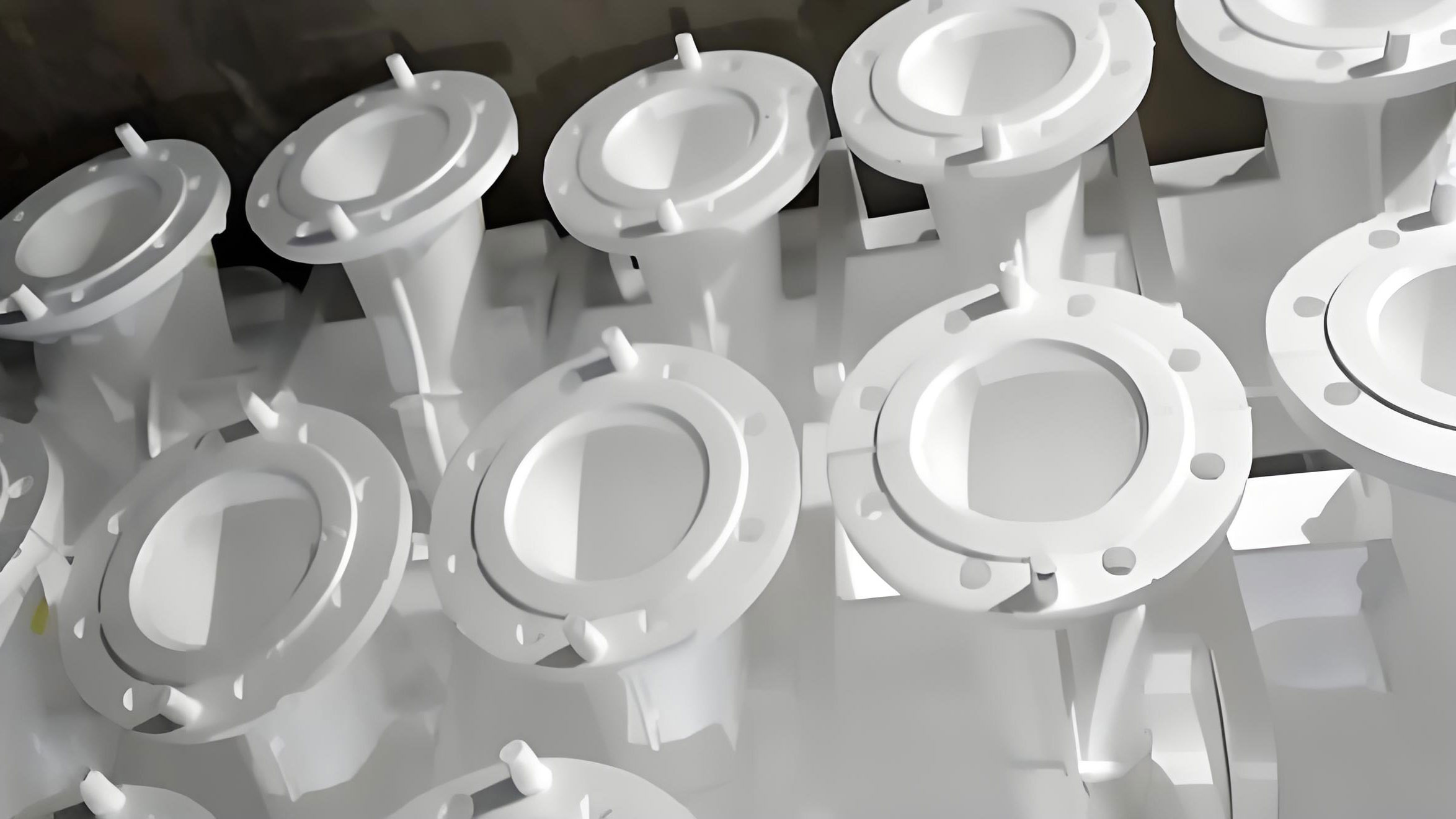
The visual evidence from our lost foam casting line underscores the transformation: sand boxes now exhibit clean surfaces post-separation, with no visible iron豆, and the collected iron from the pipeline separator comprises even micron-scale particles. This holistic approach not only optimizes the immediate lost foam casting process but also extends equipment lifespan. For instance, the reduction in abrasive iron content lowers the wear coefficient \( k_w \) on cooling bed tubes, modeled as:
$$ k_w = \mu \cdot C_{\text{iron}} \cdot v^2 $$
where \( \mu \) is a friction factor and \( v \) is sand velocity. With \( C_{\text{iron}} \) minimized, maintenance intervals have doubled, reducing downtime in lost foam casting operations. Furthermore, the automated system aligns with Industry 4.0 principles, allowing for real-time monitoring via sensors that track magnetic field strength and iron discharge rates. Data analytics enable predictive maintenance, such as detecting magnet wear before efficiency drops, ensuring consistent performance in lost foam casting.
Beyond the technical aspects, this project highlights the importance of adaptive engineering in lost foam casting. Each lost foam casting line has unique parameters—sand flow rates, box dimensions, pouring temperatures—and our solutions were customized accordingly. For example, the magnetic field strength was tuned based on sand depth and iron particle size distribution, derived from sieving analyses. We also considered energy efficiency: the suspended separator uses power only during active cycles, minimizing consumption, while the pipeline separator relies on permanent magnets, requiring no external energy. These features make the system sustainable for high-volume lost foam casting production.
In conclusion, the integration of suspended and pipeline magnetic separators has revolutionized residual iron management in lost foam casting lines. By automating separation, we achieved near-total iron removal, enhanced sand quality, and drastically reduced labor costs. The success of this initiative demonstrates how targeted innovations can address inherent challenges in lost foam casting, paving the way for more reliable and efficient foundry operations. Future work may explore advanced magnetic materials or AI-driven control systems to further optimize lost foam casting processes. As lost foam casting continues to evolve, such advancements will be crucial for maintaining competitiveness and sustainability in the casting industry.