
In the realm of casting forming and processing technology, one of the pivotal research directions revolves around the critical casting techniques for extra-large castings, precision forming technologies, and computer simulation and optimization technologies. Our organization upgraded its casting CAE software in 2020, and since then, it has been extensively applied in the development of new products and the resolution of on-site quality issues. This article delves into a specific case where CAE simulation was effectively utilized to address slag porosity defects in the cooler chamber area of a 13L engine block, a prominent example of high-integrity casting parts. The focus is on leveraging advanced simulation tools to enhance the quality and reliability of such critical casting parts, which are fundamental components in commercial vehicle engines.
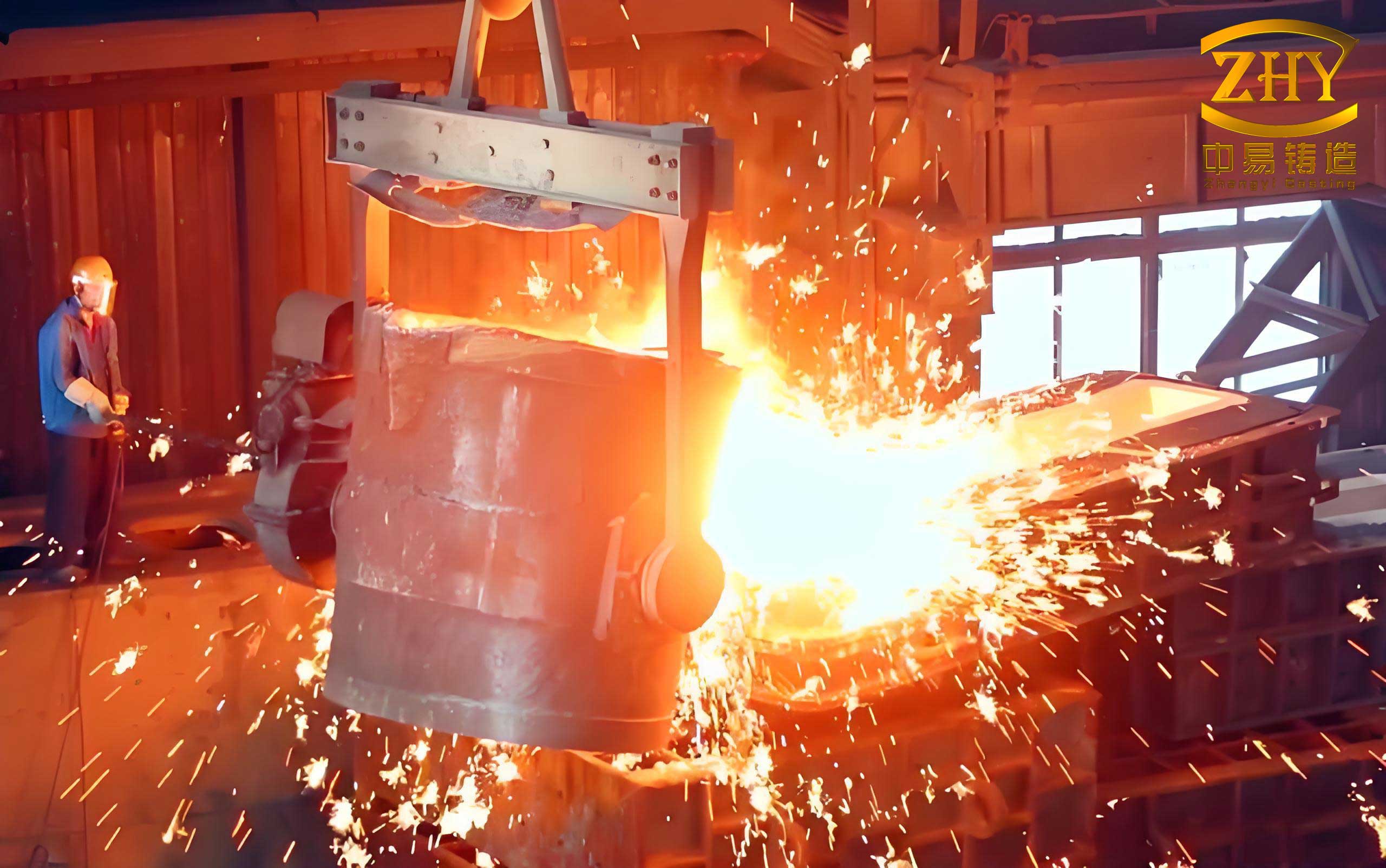
The casting part under investigation is a 13L inline six-cylinder engine block, which serves as a core structural element in heavy-duty engines. These casting parts are typically produced using gray iron with a specified material grade of HT250, ensuring adequate strength and durability for demanding applications. The overall mass of the casting part is approximately 325 kg, and it is manufactured via horizontal pouring in a single-cavity mold. The production process employs green sand molding with HWS high-pressure squeeze molding systems, which provide consistent mold hardness and dimensional stability. The melting is carried out in medium-frequency induction furnaces, and the molten metal is held and poured using an 8-ton channel-type holding furnace to maintain temperature consistency. The pouring temperature is tightly controlled at 1420°C ± 10°C, with a pouring rate ranging from 20 to 25 kg/s to ensure proper filling and solidification dynamics for these intricate casting parts.
The initial gating system design for these casting parts featured a step-like horizontal runner with seven separate vertical runners. The ingates were positioned at the crankshaft bearing caps, arranged in two layers, as illustrated in the accompanying figure. This configuration was intended to facilitate a balanced fill and minimize turbulence. However, since the commencement of production, a persistent issue of slag porosity defects has been observed in these casting parts, particularly concentrated around the cooler chamber face. The defects manifest as clusters of spherical or oval cavities with smooth walls, often containing embedded solid particles and slag inclusions. In severe cases, these defects lead to wall penetration and leakage, resulting in scrap casting parts and significant economic losses.
To systematically analyze the root cause of these defects in our casting parts, we conducted a comprehensive CAE filling simulation using the upgraded software. The simulation incorporated various boundary conditions that mirror the actual production environment, as summarized in the table below:
| Parameter | Value | Remarks |
|---|---|---|
| Material | HT250 (Gray Iron) | Standard for engine block casting parts |
| Pouring Temperature | 1420 °C | Initial condition for simulation |
| Mold Sand Temperature | 30 °C | Ambient condition |
| Core Sand Temperature | 25 °C | Pre-heat condition |
| Pouring Cup State | 70% Full (Maintained) | To simulate realistic pouring practice |
| Pouring Height | 150 mm | Height from pouring cup to sprue |
| Filling Type | Automatic Filling Control | Software-determined based on geometry |
The CAE simulation models the fluid flow and heat transfer during the filling process. The governing equations for fluid flow include the Navier-Stokes equations for incompressible flow, which can be expressed as:
$$ \rho \left( \frac{\partial \mathbf{u}}{\partial t} + \mathbf{u} \cdot \nabla \mathbf{u} \right) = -\nabla p + \mu \nabla^2 \mathbf{u} + \mathbf{f} $$
where \( \rho \) is the density of the molten iron, \( \mathbf{u} \) is the velocity vector, \( t \) is time, \( p \) is pressure, \( \mu \) is the dynamic viscosity, and \( \mathbf{f} \) represents body forces such as gravity. For heat transfer, the energy equation is solved:
$$ \rho c_p \left( \frac{\partial T}{\partial t} + \mathbf{u} \cdot \nabla T \right) = k \nabla^2 T + Q $$
where \( c_p \) is the specific heat capacity, \( T \) is temperature, \( k \) is thermal conductivity, and \( Q \) represents any heat source terms. These equations are discretized and solved numerically to predict the filling patterns and temperature distributions in the casting parts.
The simulation results for the original gating system revealed several critical issues contributing to slag porosity in these casting parts. The analysis of the flow field and temperature field at different filling times is summarized below:
| Filling Time (s) | Flow Field Observation | Temperature Field Observation | Implication for Casting Parts |
|---|---|---|---|
| 2 | Molten metal first reaches the central area of the crankcase, with more flow at both ends. | Initial temperature distribution shows localized heating. | Unequal metal distribution from ingates leads to non-sequential filling. |
| 4 | Metal flows around the cooler chamber from the sealing face and rear face, encircling the area. | The cooler chamber region becomes surrounded by hotter metal. | Encircling flow traps air and prevents slag from escaping in casting parts. |
| 5.4 | Metal from all sides converges onto the cooler chamber斜面, creating a confined space. | Rapid temperature drop is observed on the cooler chamber face. | Trapped air and slag from the first metal wave form slag porosity in casting parts. |
| 16 | Filling completes, but the cooler chamber area solidifies early. | Significant temperature gradient exists, with the cooler face being coldest. | Premature solidification exacerbates defect formation in casting parts. |
The simulation clearly indicated that the original gating system caused unfavorable flow conditions: the molten metal did not fill the mold cavity sequentially from bottom to top; instead, it encircled the cooler chamber, trapping air and slag. This, combined with a non-uniform temperature field that led to rapid cooling in the critical area, directly contributed to the formation of slag porosity defects in these casting parts. The entrapped air and slag, rich in Mn and S as confirmed by energy-dispersive spectroscopy, resulted in the characteristic spherical pores.
To address these issues and improve the quality of our casting parts, we proposed a modification to the gating system. The key change involved adding an additional bottom-feeding ingate at the base of the vertical runner, positioned on the oil pan flange of the casting part. This design alteration aimed to promote bottom-up filling, ensuring that molten metal enters from the lower part of the casting part first and progresses upward in a more controlled manner. The modified gating system layout is shown conceptually, emphasizing the new bottom ingate that works in conjunction with the existing ingates on the crankshaft caps.
We then performed a new CAE simulation with the improved gating system to validate its effectiveness. The same boundary conditions were applied to ensure a consistent comparison. The simulation results for the modified system are summarized in the following table:
| Filling Time (s) | Flow Field Observation | Temperature Field Observation | Implication for Casting Parts |
|---|---|---|---|
| 2.8 | Metal spreads uniformly across the lower and central sections of the crankcase; bottom and side ingates act simultaneously. | Temperature distribution is more even in the lower regions. | Balanced metal entry promotes sequential filling in casting parts. |
| 4.5 | Metal flows from the crankcase center toward the cooler chamber斜面 without encircling it. | The cooler chamber area is gradually filled from within, not surrounded. | Avoids air entrapment and slag accumulation in casting parts. |
| 5 | Metal fills the cooler chamber斜面 uniformly from the center, no convergence from sides. | Temperature on the cooler face is consistent with surroundings. | Eliminates confined spaces and allows slag to float up in casting parts. |
| 5.4 | Lower mold half is completely filled; no metal convergence on cooler chamber. | Uniform temperature field prevents rapid local cooling. | Reduces risk of slag porosity formation in casting parts. |
The improved flow and temperature fields can be quantitatively assessed using metrics such as the filling sequence index \( S_f \) and temperature uniformity index \( U_T \). For instance, \( S_f \) can be defined as the ratio of the volume filled from the bottom ingate to the total volume filled up to a given time, aiming for a value close to 1 initially:
$$ S_f(t) = \frac{V_{\text{bottom}}(t)}{V_{\text{total}}(t)} $$
In the modified system, \( S_f \) is higher at early times, indicating better bottom-up filling. Similarly, \( U_T \) can be expressed as the standard deviation of temperature across the cooler chamber face, with lower values denoting better uniformity:
$$ U_T = \sqrt{ \frac{1}{N} \sum_{i=1}^{N} (T_i – \bar{T})^2 } $$
where \( N \) is the number of nodes on the cooler face, \( T_i \) is the temperature at node \( i \), and \( \bar{T} \) is the average temperature. The simulation showed that \( U_T \) decreased significantly in the modified system, contributing to fewer defects in the casting parts.
Following the positive simulation predictions, we implemented the gating system modification in actual production. The design changes were incorporated into the mold, and batch production was carried out under the same process parameters as before. The results were meticulously tracked to evaluate the impact on defect rates in these casting parts. The comparative data before and after the improvement are presented below:
| Phase | Gating System Design | Slag Porosity Defect Rate in Cooler Chamber | Remarks on Casting Parts Quality |
|---|---|---|---|
| Before Improvement | Original design with two-layer ingates at crankshaft caps only. | Approximately 12% | High scrap rate; many casting parts required repair or were rejected. |
| After Improvement | Modified design with added bottom ingate at oil pan flange. | Less than 0.1% | Dramatic reduction in defects; casting parts meet quality standards consistently. |
The implementation of the bottom ingate effectively enabled a more sequential filling pattern, allowing the first wave of molten metal, which often carries slag and entrapped gases, to be directed away from the critical cooler chamber area. As the filling progressed, slag particles could float upward into the overflow risers, and air could escape through vent pins designed in the mold. Consequently, the formation of slag porosity in these casting parts was minimized. The temperature field during solidification also became more uniform, reducing thermal stresses and further enhancing the integrity of the casting parts.
This case study underscores the profound value of CAE filling simulation in diagnosing and resolving defects in complex casting parts. By leveraging computational tools, we were able to identify subtle flaws in the gating system design that were not apparent through traditional trial-and-error methods. The simulation provided insights into the fluid dynamics and thermal behavior that directly impact the quality of casting parts. The successful reduction of slag porosity from 12% to below 0.1% not only improved the yield and reliability of these engine block casting parts but also resulted in substantial cost savings by reducing scrap, rework, and associated downtime.
In conclusion, the integration of CAE simulation into the design and optimization process for casting parts is indispensable for modern foundries aiming to produce high-quality components efficiently. The ability to visualize and analyze filling patterns and temperature distributions allows for proactive improvements, minimizing defects and enhancing performance. For critical casting parts like engine blocks, where integrity is paramount, such technological advancements ensure that manufacturing processes are robust and reliable. Future work may involve further refining simulation models to account for more complex phenomena, such as slag formation kinetics and gas dissolution, to continue pushing the boundaries of quality in casting parts production.