
In my extensive experience in the foundry industry, I have observed that any casting defect directly impacts both economic efficiency and social benefits. These imperfections can lead to increased scrap rates, higher production costs, and compromised product reliability. Therefore, understanding and addressing casting defects is paramount. Here, I will analyze several primary and common casting defects, such as gas holes, shrinkage cavities, slag inclusions, and poor spheroidization, discussing their causes and proposing elimination measures. Throughout this discussion, the term ‘casting defect’ will be emphasized repeatedly to underscore its significance. My goal is to provide a comprehensive guide that foundries can reference to improve their processes and minimize these issues.
To begin, let’s consider the fundamental nature of casting processes. Metal casting involves pouring molten metal into a mold, where it solidifies into the desired shape. However, numerous factors can introduce defects during this process. A casting defect can manifest in various forms, each with unique characteristics and root causes. By systematically examining these defects, we can develop targeted strategies to mitigate them. I will use tables and mathematical formulas where applicable to summarize key points, enhancing clarity and practicality. Additionally, to illustrate a typical casting where defects might occur, I will include a reference image later in the text.
Gas Holes: Formation and Solutions
Gas holes are a prevalent casting defect characterized by smooth, often pear-shaped cavities within the casting. They arise when gases are trapped during solidification. Based on my observations, gas holes can be classified into two main types: precipitated gas holes and invasive gas holes.
The primary cause of gas holes is the presence of gases in the molten metal or the mold cavity. For precipitated gas holes, gases originate from the metal itself due to factors such as inferior charge materials containing sand, oil, rust, and moisture. During melting, these contaminants generate gases like oxygen (O), hydrogen (H), and nitrogen (N), along with slag. Low melting temperatures, insufficient refining, low pouring temperatures, prolonged pouring times, slow pouring speeds, and damp ladles contribute to early formation of an oxide film on the metal surface. This film prevents gas escape, leading to upward-oriented “pear-shaped” bubbles with the stem pointing inward. The solubility of gases in molten metal can be described by Sieverts’ law: $$ C = k \sqrt{P} $$ where \( C \) is the gas concentration, \( k \) is a constant dependent on temperature and metal composition, and \( P \) is the partial pressure of the gas. When the metal cools, solubility decreases, causing gas precipitation and defect formation.
Invasive gas holes result from gases in the mold cavity entering the molten metal. This occurs when the sand mold has high moisture content (≥4.5%), high ash content (>12%), or poor permeability. Other contributors include inadequately dried sodium silicate sand (mere CO2 blowing is insufficient), excessive resin (>1.8%) or hardener in resin sand, thick and dense lost foam patterns that are not fully dried, coating layers >2 mm that are undried, overly compacted sand cores without vents, and long waiting times after mold assembly (>8 hours or overnight) causing moisture regain. Poor gating system design, such as oversized sprue leading to air entrainment or turbulence from ingates, exacerbates the issue. These gases, under high mold pressure, invade the metal, forming pear-shaped holes with stems pointing outward.
To eliminate gas holes, I recommend a multi-faceted approach focused on removing gas sources and facilitating escape. First, use high-quality, clean, and dry charge materials. Increase melting temperatures (e.g., 1520°C for gray iron, 1650°C for steel, 1680°C for stainless steel) to enhance gas removal. Employ thorough refining, degassing, and holding periods to allow gas release. Pour at high temperatures and rapid rates—for lost foam casting, increase pouring temperature by 50°C due to endothermic foam decomposition. Ensure molds and cores are thoroughly dried and minimize organic content. Design gating systems with tapered sprues for quick filling, tall runners to promote slag floating, and multiple dispersed ingates with flared shapes for radial flow. Use top gating or ingates placed upper sections to break the oxide film and delay surface solidification. Incorporate ample vents in the cope mold to expel gases, crucial for large castings. Preheat ladles above 500°C and inoculants. The table below summarizes key causes and elimination methods for gas holes.
| Type of Gas Hole | Primary Causes | Elimination Methods |
|---|---|---|
| Precipitated Gas Holes | Poor charge materials, low melting temperature, insufficient refining, low pouring temperature, slow pouring | Use优质炉料, high melting temps, degassing, rapid pouring, preheated ladles |
| Invasive Gas Holes | High mold moisture, poor permeability, undried molds/cores, improper gating design | Dry molds thoroughly, improve permeability, design tapered sprues, add vents, top gating |
Moreover, the critical velocity for metal flow should be maintained below 0.5 m/s to avoid disrupting the metal surface tension. Implementing these measures can significantly reduce this casting defect.
Shrinkage Cavities and Porosity: Analysis and Remedies
Shrinkage cavities and porosity are another common casting defect resulting from inadequate feeding during solidification. Shrinkage cavities appear as large, irregular voids with dendritic surfaces, often dark-colored, while porosity consists of fine, dispersed pores or surface looseness. Both typically occur at hot spots—sections of the casting that solidify last.
The causes are multifaceted. Structurally, hot spots form where geometry promotes late solidification without sufficient feeding. Poor gating design, such as a single ingate at a thick section, creates artificial hot spots with shrinkage around it. Bottom gating leads to a temperature gradient with cooler metal at the top solidifying first, hindering feeding to lower, hotter regions. Inadequate riser design—small cold risers on hot spots or oversized necks for ductile iron—fails to compensate for shrinkage. High pouring temperatures and slow pouring prolong solidification, worsening feeding issues. For ductile iron, low mold hardness (<90 HB) or weak flask rigidity allows mold wall movement due to expansion during eutectic solidification, exacerbating shrinkage. Chemically, low carbon equivalent (CE < 4.3%) and high sulfur/phosphorus content form low-melting compounds that create voids. Over-inoculation or inoculation decay also promotes porosity.
To eliminate shrinkage defects, I advocate for strategies that promote directional solidification or uniform cooling. Use chills (external or internal) at hot spots—external chills should have dimensions 0.6–0.7 times the section size, while internal chills (e.g., welded nets) can weigh about 5% of the cooled section. Place ingates at thin sections to balance temperatures; for uniform wall thickness, chill the ingate area. Modify gating positions: for instance, moving ingates to mid-height in box-shaped castings can transform late-solidifying areas into early-solidifying ones, improving hardness and reducing “quasi-porosity.” Add cores to shift ingates to thin walls. Increase riser effectiveness by placing them near but not on hot spots, with small necks. For heavy sections, use hot risers with chills. Enhance mold high-temperature strength to resist metal pressure; ensure clamping force is applied directly on the mold, not flask handles. Optimum carbon equivalent (CE ≥ 4.3%) minimizes shrinkage; alloying and reducing harmful elements like S, P, Al help. Low-temperature, fast pouring is highly effective. The solidification shrinkage can be quantified as: $$ V_s = \beta V_0 $$ where \( V_s \) is the shrinkage volume, \( \beta \) is the shrinkage coefficient (material-dependent), and \( V_0 \) is the initial volume. Proper feeding must compensate for \( V_s \).
| Aspect | Causes of Shrinkage | Elimination Methods |
|---|---|---|
| Geometric | Hot spots, poor gating, bottom pouring | Use chills, place ingates at thin sections, modify gating design |
| Thermal | High pouring temp, slow pouring | Low-temp fast pouring, control solidification |
| Mold Related | Low mold hardness, weak rigidity | Increase mold strength, proper clamping |
| Chemical | Low CE, high S/P, over-inoculation | Adjust composition, optimize inoculation |
Additionally, incorporating ample venting on upper surfaces with small diameters (<6 mm) or wedge-shaped vents prevents shrinkage at vent roots. Addressing this casting defect requires a holistic view of geometry, thermal management, and chemistry.
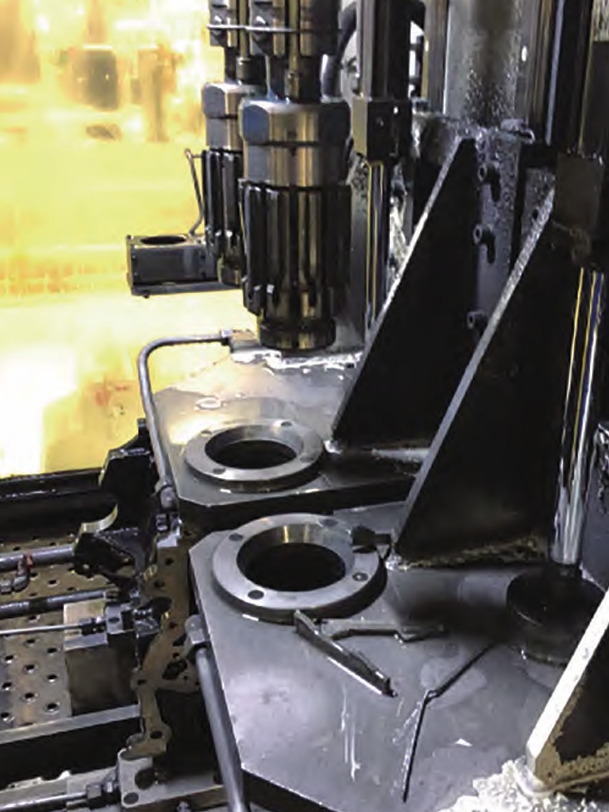
As shown in the image above, a complex casting like an engine cylinder block is prone to various defects, including shrinkage and gas holes, underscoring the need for rigorous process control.
Slag and Sand Inclusions: Origins and Prevention
Slag and sand inclusions are casting defects that appear as visible impurities on casting surfaces or within the material. Primary inclusions involve slag or sand entrained during pouring, while secondary inclusions form from in-situ reactions, creating fine oxide streaks or spots resembling micro-shrinkage but distinct in origin.
Causes stem from multiple sources. Inferior charge materials introduce contaminants. Chemical incompatibility between molten metal and mold materials (e.g., refractory linings, core sands, coatings) leads to reactive compounds, causing both inclusions and chemical burn-on. Gating design flaws—oversized sprue causing air entrainment, or damaged coatings in lost foam patterns allowing sand ingress—promote inclusion. Inverted trumpet-shaped ingates cause metal jetting, breaking surface tension and enabling oxidation, forming isolated defects. Low mold strength or refractoriness fails to withstand erosion. Human factors like uncleaned mold cavities or poor slag skimming during pouring add to the problem.
Elimination focuses on cleanliness and controlled flow. Use优质炉料, high melting temperatures, thorough refining, and slag removal. Match mold material properties to the metal—e.g., alkaline binders for acidic slags. Design gating as semi-open/semi-closed: tapered sprue, tall runner, multiple flared ingates for平稳 flow. Metal velocity should remain below the critical 0.5 m/s. For tall castings, stepped gating without bottom pouring facilitates layered solidification. Implement mold tilting (8–10°) with overflow to discharge initial metal flow containing slag. For large castings, use pouring basins with ceramic filters; for smaller ones, place filter screens at ingates. In lost foam, ensure pattern surface quality and intact coatings. Strictly clean molds before closing, cover openings, and employ slag-trapping practices like teapot ladles. The probability of inclusion formation can be modeled as: $$ P_i = k_d \cdot C_{imp} \cdot v^2 $$ where \( P_i \) is the inclusion probability, \( k_d \) is a constant, \( C_{imp} \) is impurity concentration, and \( v \) is flow velocity. Reducing \( v \) and \( C_{imp} \) lowers this casting defect risk.
| Inclusion Type | Key Causes | Prevention Measures |
|---|---|---|
| Primary (Slag/Sand) | Poor charge, chemical mismatch, gating issues, human error | 优质炉料, compatible materials, proper gating, filters, cleanliness |
| Secondary (Oxides) | Metal jetting, oxidation during flow | Control flow velocity, use flared ingates, avoid turbulence |
Every step in the casting process must adhere to high standards to achieve zero defects, emphasizing that combating this casting defect requires meticulous attention to detail.
Poor Spheroidization in Ductile Iron: Causes and Corrective Actions
Poor spheroidization is a specific casting defect in ductile iron where graphite morphology deviates from the desired spherical form, ranging from flake-like to exploded or fragmented shapes. It results from over-spheroidization, spheroidization decay, or inoculation decay, severely affecting mechanical properties.
Causes are often linked to material and process shortcomings. Substandard charge materials, excessive returns (>30%) causing “hereditary” issues, and high levels of trace elements like Pb, Bi, Sb interfere with graphite formation. Incorrect or low-quality nodularizers (e.g., oxidized, wrong rare-earth content), improper inoculants (single-type, inefficient), and suboptimal treatment temperatures (<1420°C or >1520°C) lead to poor nodulation. The ideal temperature is around 1460°C. Ladle design with height less than 1.3 times diameter reduces treatment efficiency. Delays after treatment (>10 minutes) cause fading of spheroidizing and inoculating effects. The kinetics of graphite spheroidization can be expressed as: $$ \frac{dN}{dt} = -k N $$ where \( N \) is the number of effective graphite nuclei, and \( k \) is a decay constant dependent on time and temperature. Rapid processing is crucial to maintain \( N \).
To prevent poor spheroidization, employ high-purity pig iron with high carbon, low silicon, low sulfur/phosphorus, and minimal trace elements. Note that sulfur should not be too low (<0.01%) to allow rare-earth elements to neutralize impurities. Limit returns to avoid hereditary effects. Select优质 nodularizers (light/heavy rare-earth based) and高效复合 inoculants for multiple or late inoculation. Use pretreatment agents like SiBa or SiC (~0.3%) to form high-melting nuclei. Implement covered ladle treatment to reduce oxidation. For补救 of already poor metal, quickly transfer to a preheated ladle with additional nodularizer/inoculant, or add fresh treatment agents to the original ladle with high-temperature metal. Monitor using wedge tests or flame characteristics (candle-like flame indicates good spheroidization).
| Factor | Causes of Poor Spheroidization | Corrective Measures |
|---|---|---|
| Charge Materials | Low-purity pig iron, high returns, harmful elements | Use high-purity materials, limit returns, control chemistry |
| Treatment Materials | Poor nodularizer/inoculant quality, incorrect type | Select优质 materials, use复合 inoculants, pretreatment |
| Process Parameters | Temperature extremes, delays, poor ladle design | Maintain ~1460°C, rapid processing, proper ladle design |
Addressing this casting defect demands precise control over metallurgy and timing, as even minor deviations can lead to significant quality issues.
Other Casting Defects and Concluding Remarks
Beyond the defects discussed, numerous other imperfections can arise, such as cracks, wall thickness variations, burn-on, mold collapse, shrinkage sinking, hard spots, discoloration, carbon pick-up, graphite flotation, mistruns, wrinkles, core breakage, and fins. Each casting defect has unique triggers, often interrelated with the factors already mentioned. For instance, cracks may stem from residual stresses due to uneven cooling, while burn-on results from metal-mold reactions. A comprehensive approach involving simulation software for solidification analysis, statistical process control, and continuous operator training is essential to mitigate these issues.
In conclusion, resolving casting defects requires deep theoretical knowledge and practical experience. Each casting defect must be analyzed contextually, considering the specific casting geometry, material, and process conditions. The strategies I’ve outlined—focusing on gas removal, controlled solidification, cleanliness, and precise metallurgical treatment—form a foundation for improvement. Foundries should adopt a holistic view, integrating design, material selection, process optimization, and quality assurance. By persistently addressing these challenges, we can enhance casting quality, reduce waste, and boost profitability. Remember, every step in casting production is a critical battle against defects; winning it demands unwavering commitment to excellence and zero-tolerance for errors.
To further aid understanding, I summarize key formulas related to casting defects below:
1. Gas solubility (Sieverts’ Law): $$ C = k \sqrt{P} $$
2. Solidification shrinkage volume: $$ V_s = \beta V_0 $$
3. Inclusion probability: $$ P_i = k_d \cdot C_{imp} \cdot v^2 $$
4. Graphite nuclei decay: $$ \frac{dN}{dt} = -k N $$
These mathematical models help quantify defect mechanisms, guiding preventive actions. Ultimately, the goal is to minimize every casting defect through science-driven practices, ensuring that castings meet the highest standards of integrity and performance.