
In the production of high-performance diesel engines, cylinder heads stand as critical casting parts that endure extreme operational conditions. These casting parts must withstand thermal cycles reaching approximately 2,000 K (around 1,700 °C) and high-pressure cyclic loads within the combustion chamber. Consequently, the internal and external quality requirements for these casting parts are exceptionally stringent, with no tolerance for defects in areas such as the high-pressure side and valve seat holes. The internal structures, including oil and fuel injection passages, demand dense microstructures to ensure reliability in harsh environments. As a key casting part, the cylinder head’s complex geometry—featuring numerous internal curves and thin walls as narrow as 6–8 mm—necessitates precise casting processes to achieve dimensional accuracy within CT10–CT11 grades. In our foundry, we produce cylinder heads using RuT300 material, known for its excellent mechanical properties, thermal fatigue resistance, and air tightness. However, during the manufacturing of 16V190 cylinder heads, we frequently encountered defects such as sand holes, misruns, internal burrs, and porosity, which compromised the integrity of these casting parts. This article, from my first-hand perspective, delves into the root causes of these issues and outlines the improvement strategies we implemented to enhance the quality of our casting parts.
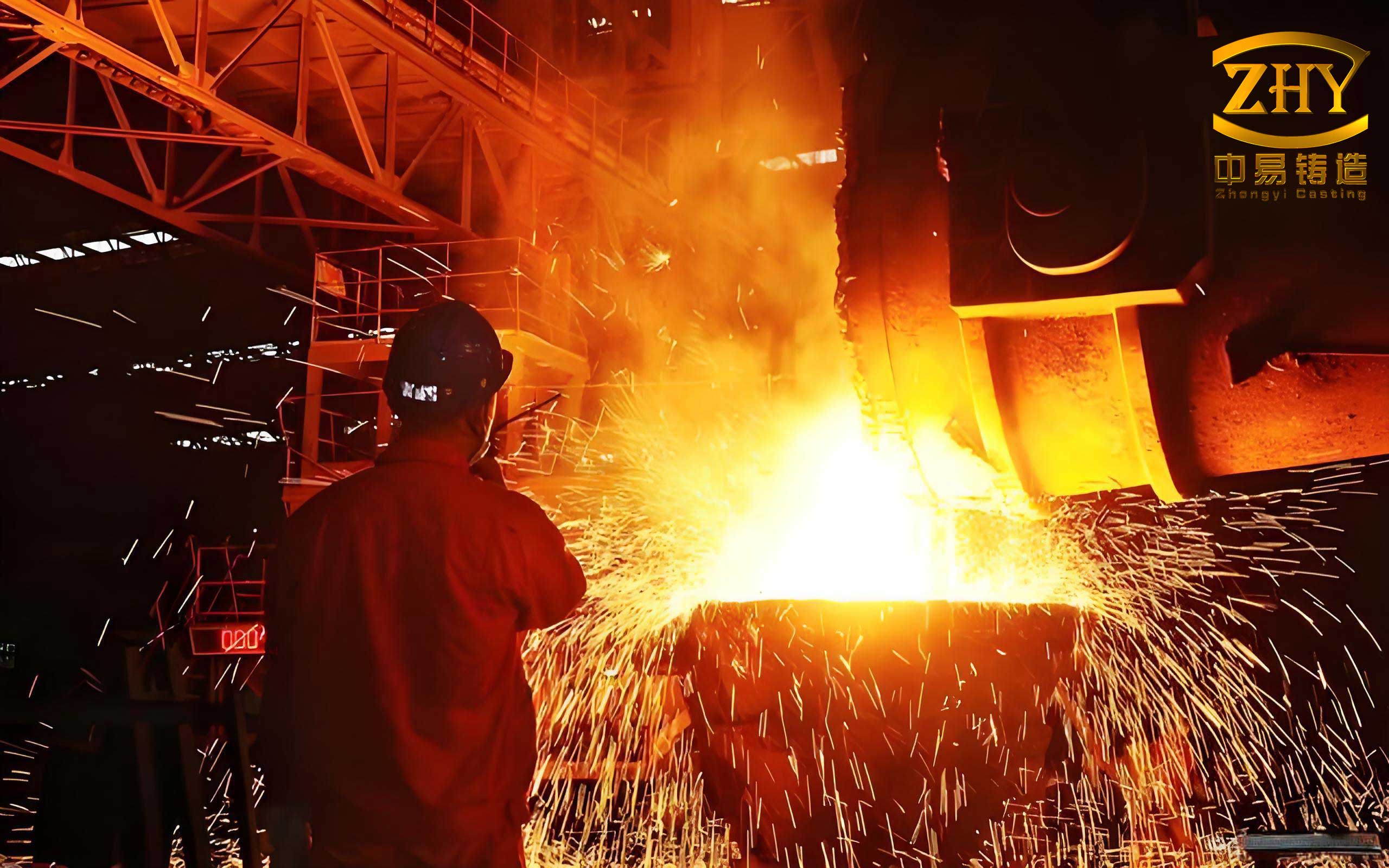
The casting process for these cylinder heads involves resin sand molding with machine shaping, designed for two casting parts per mold. We utilize a combination of resin sand for manual core-making and hot-box coated sand for cores like the water jacket and bolt holes, totaling 22 cores per casting part. To ensure smooth internal surfaces and proper cooling flow, we apply water-based coatings via spraying, followed by drying at 170 °C ± 10 °C for 3.5–4 hours. For cores, we employ a composite coating process with alcohol-based quartz and water-based graphite coatings. During assembly, cores are stacked layer by layer, with sealing adhesive applied to joint surfaces to prevent metal penetration. Each casting part weighs 89 kg, and given the thin sections, we use a stepped gating system to facilitate rapid and stable mold filling. The pouring temperature is maintained at 1,380–1,390 °C, with a pouring time controlled within 15–20 seconds. Despite these precautions, defects persisted, prompting a detailed analysis to safeguard the quality of our casting parts.
One of the most common issues was sand holes, which manifest as unwanted cavities on or within the casting parts. These defects primarily arose from operational errors during mold assembly. For instance, improper installation of bolt hole cores—such as misalignment or non-vertical positioning—led to breakage when the upper mold was lowered, causing sand fragments to fall into the cavity undetected. Similarly, the assembly of split water jacket cores and fuel injector cores, bonded with adhesive, introduced cumulative tolerances that sometimes resulted in poor fits. If residual sand or coating accumulations were present in core seats, cores might not seat fully, making them susceptible to fracture during closing. These incidents underscore the sensitivity of casting parts to handling precision, as even minor discrepancies can lead to rejections.
Internal burrs, resembling irregular “thin iron skins” in passages like water and air channels, posed another challenge for our casting parts. Two main factors contributed to this defect. First, the water jacket cores, produced via hot-box shooting with coated sand, were prone to shell thinning and capillary cracking due to thermal softening and shrinkage during cooling. When exposed to high-temperature molten metal, these cracks allowed iron infiltration, forming burrs. Second, the complex internal structure required splitting the water jacket core into two segments for assembly, which were later bonded. Inadequate bonding tightness at the interface increased the risk of metal penetration, compromising the internal smoothness essential for cooling efficiency in casting parts. This highlighted the need for improved core quality and assembly techniques.
Misruns, where casting parts are incomplete due to insufficient mold filling, often resulted from mold leakage at the parting line. Factors such as improper mold clamping, impurities in the molten metal, incorrect placement of ceramic filters, or blocked vents contributed to this issue. For example, if filters were oriented wrongly or vents became clogged with metal, the flow was disrupted, leading to premature solidification. Additionally, maintaining the pouring temperature at the upper limit of 1,390 °C was crucial; any drop could hinder fluidity, especially in thin-walled sections of casting parts. We observed that leakage not only wasted material but also increased scrap rates, emphasizing the importance of process control.
Porosity, particularly invasive gas holes, frequently appeared in our casting parts due to gas entrapment during pouring. The resin sand used for molds and cores generates substantial gas—from resins and hardeners—under the heat of molten metal. If the gating system or venting was inadequate, this gas could not escape, forming pores within the solidified casting parts. The entrapped gases degrade the mechanical integrity, making casting parts unsuitable for high-stress applications. Thus, optimizing venting and gating design became a priority to mitigate this defect.
To address these issues, we implemented a series of countermeasures focused on process optimization and operational standardization. For sand holes, we introduced alignment gauges and thickness checkers to ensure precise core placement. A dedicated gauge verified core heights, minimizing cumulative errors, while flexible wires and calipers ensured minimum wall thicknesses in curved sections. Regular training enhanced operators’ quality awareness, emphasizing cleaning of core seats and checking core perpendicularity before mold closing. These steps reduced core breakage incidents, directly benefiting the consistency of casting parts.
For internal burrs, we improved core quality by adjusting hot-box parameters—such as shooting temperature and hold time—to achieve a shell thickness greater than 5 mm. We also adopted a double-coating process with alcohol-based zirconium powder to enhance surface density and refractoriness. In assembly, we refined the bonding procedure: cores were trial-fitted, gaps were minimized, and adhesive was applied uniformly, avoiding vent slots. Excess adhesive was removed, and patches were applied where needed, ensuring tight interfaces. This meticulous approach significantly lowered the incidence of burrs in casting parts.
To prevent misruns, we reinforced mold sealing by placing ϕ4 mm sealing ropes along the parting line and ensuring even clamping with diagonal tightening. We also optimized molten metal treatment, including slag removal and controlled pouring to maintain a steady flow. Ceramic filters were positioned correctly, with inlet holes facing the pouring cup, to facilitate smooth metal passage. Venting was enhanced by clearing all core and mold vents, extending them to thick sections, and sealing around vents to prevent metal ingress. Maintaining pouring temperature at 1,390 °C initially, with proper ladle insulation, ensured adequate fluidity throughout the process, crucial for complete filling of casting parts.
For porosity, we redesigned the gating system to promote laminar flow and gas escape, with optimally placed risers and vents. We ensured all core vents were open and connected to external vents, using adhesive to seal gaps without blocking airways. This allowed gases to exit freely during pouring, reducing entrapment. The improvements are summarized in the table below, which categorizes defects, causes, and countermeasures for casting parts.
| Defect Type | Primary Causes | Improvement Measures |
|---|---|---|
| Sand Holes | Core misalignment, breakage during assembly, residual sand in seats | Use of alignment gauges, thickness checkers, operator training, thorough cleaning |
| Internal Burrs | Core shell thinning, capillary cracks, poor bonding of split cores | Optimized hot-box parameters, double-coating, refined bonding procedures |
| Misruns | Mold leakage, low pouring temperature, incorrect filter placement, blocked vents | Enhanced mold sealing, proper filter orientation, vent management, temperature control |
| Porosity | Gas generation from resin sand, inadequate venting | Redesigned gating and venting systems, ensured open airways, used sealing adhesive |
The effectiveness of these measures can be quantified through process parameters. For instance, the pouring time \( t \) is critical for mold filling and can be expressed as:
$$ t = \frac{V}{A \cdot v} $$
where \( V \) is the volume of the casting part, \( A \) is the cross-sectional area of the gating system, and \( v \) is the flow velocity. By optimizing \( A \) and \( v \), we reduced \( t \) to within 15–20 seconds, minimizing cold shuts and misruns. Similarly, the thermal behavior during cooling affects defect formation. The heat transfer rate \( Q \) through the mold wall can be modeled as:
$$ Q = k \cdot A \cdot \frac{\Delta T}{d} $$
where \( k \) is the thermal conductivity of the sand, \( A \) is the surface area, \( \Delta T \) is the temperature difference between the molten metal and mold, and \( d \) is the wall thickness. For thin-walled sections of casting parts (e.g., 6 mm), ensuring adequate \( k \) and controlling \( \Delta T \) helped prevent premature solidification and gas entrapment.
We also implemented a quality monitoring system, tracking key metrics like pouring temperature, coating thickness, and core integrity. The table below outlines the optimized process parameters for producing high-quality casting parts.
| Process Parameter | Target Value | Tolerance |
|---|---|---|
| Pouring Temperature | 1,390 °C | ±10 °C |
| Pouring Time | 17.5 seconds | 15–20 seconds |
| Mold Drying Temperature | 170 °C | ±10 °C |
| Core Shell Thickness | >5 mm | Minimum 5 mm |
| Wall Thickness (Internal) | 7 mm | 6–8 mm |
Through these efforts, the rejection rate for casting parts dropped from 3.8% to 0.8%, demonstrating significant quality enhancement. The reduction in defects not only improved the reliability of casting parts but also lowered production costs and increased efficiency. In my experience, attention to detail in every step—from core making to mold assembly—is paramount for casting parts used in critical applications like cylinder heads.
In conclusion, the journey to perfecting casting parts involves continuous analysis and adaptation. By systematically addressing sand holes, internal burrs, misruns, and porosity, we have elevated the standard of our cylinder heads. The integration of precise gauges, improved coatings, and rigorous process controls has proven effective. As casting technology evolves, we remain committed to refining our methods, ensuring that every casting part meets the highest performance criteria. The lessons learned here extend beyond cylinder heads, offering insights for other complex casting parts in the automotive and industrial sectors. Ultimately, the synergy of sound engineering and meticulous execution is key to producing defect-free casting parts that endure the toughest operational demands.