
In the realm of injection molding machinery, the front plate stands as a pivotal component, directly influencing the efficiency of injection, operational stability, and the provision of rated clamping force. Its performance is crucial for ensuring the成形 quality of molded parts. This article delves into the intricate process design for manufacturing a high-pressure ductile iron casting for the front plate, addressing technical challenges, detailing工艺 parameters, and presenting验证 results. The focus is on achieving a defect-free casting, particularly in critical areas like oil cylinder holes, which demand high machining precision and must withstand hydraulic pressures up to 20 MPa. The entire discussion is grounded in a first-person perspective as an engineer involved in this project, emphasizing the systematic approach taken to optimize the casting process for ductile iron casting.
The front plate casting, as the subject of this study, is a substantial component with a毛坯 weight of 1,700 kg and a pouring weight of 1,850 kg. Its overall dimensions are 1,330 mm × 620 mm × 850 mm, featuring a maximum wall thickness of 360 mm and a minimum of 40 mm. Post-casting machining allowances are specified: 12 mm for the upper surface, and 8 mm for holes, lower, and side surfaces. The material specified is QT450-10A, a ductile iron grade requiring a combination of strength and ductility. The technical requirements are stringent:附铸试块 must exhibit tensile strength ≥ 390 MPa, yield strength ≥ 260 MPa, elongation ≥ 8%, with a microstructure showing nodularity ≥ 85% and graphite size of 4-7. Most critically, the two oil cylinder holes must be free from shrinkage porosity, shrinkage cavities, and other defects, with a machined surface roughness of Ra 0.4–0.8 μm and the ability to endure 20 MPa hydraulic pressure. These demands present significant challenges in the production of this ductile iron casting.
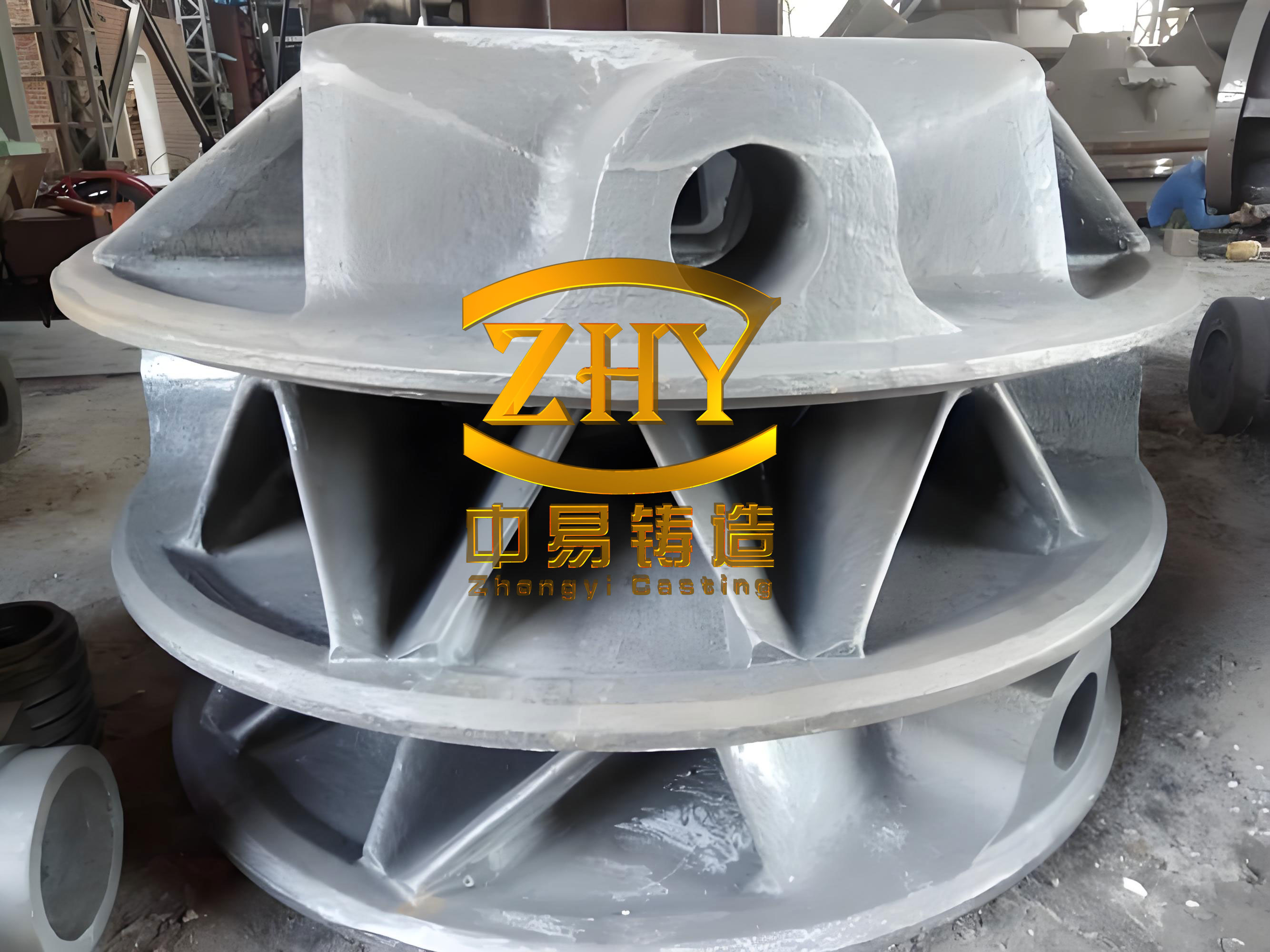
The core of the manufacturing strategy lies in a meticulously designed casting process. For any ductile iron casting, the gating and risering system is paramount to ensure smooth filling, effective slag trapping, and adequate feeding to counteract solidification shrinkage. Given the structural characteristics of the front plate—a relatively complex shape with thick and thin sections—a bottom-gating, semi-open system was adopted. This design promotes a “large flow rate, low velocity,平稳 and clean filling” principle. It aims to maintain uniform temperature distribution within the mold cavity, minimize turbulence, and reduce the likelihood of缺陷 formation, such as shrinkage and porosity, common concerns in ductile iron casting.
The gating system employs ceramic pipes for the sprue and ingates to prevent冲砂 defects. The choke is set at the sprue, with a filter incorporated in the runner. The area ratios of the gating system are carefully calculated as ΣFsprue : ΣFrunner : ΣFingate = 1 : 1.25 : 1.10. The pouring time is controlled within 120–150 seconds. The critical sprue area is determined based on the large-hole outflow theory, expressed by the formula:
$$F_{\text{sprue}} = \frac{G}{0.31 \times \mu \times t \times \sqrt{H_p}}$$
Where:
- $G$ is the pouring weight (1,850 kg),
- $\mu$ is the flow coefficient (0.35),
- $t$ is the pouring time (taken as 140 s),
- $H_p$ is the average pressure head (10.02 mm).
Substituting the values yields $F_{\text{sprue}} = 38.48 \, \text{cm}^2$, which corresponds to one ceramic pipe with an internal diameter of 70 mm. Consequently, the runner and ingates are sized accordingly: the runner has dimensions of 30/40 mm height by 70 mm width, and six ingates, each with a 30 mm internal diameter ceramic pipe, are used.
Risers are strategically placed above the two oil cylinder holes. These serve as safety risers, providing a limited source of liquid metal to compensate for contraction during cooling and solidification. They also facilitate the escape of gases generated during pouring, reducing the risk of gas entrapment in the critical油缸 areas. Furthermore, they leverage the graphitization expansion inherent to ductile iron casting to promote a denser matrix. The overall gating and risering layout is designed for造型 convenience, effective slag floatation, and cost efficiency. A three-part molding box is utilized to accommodate the complex surface geometry of the front plate.
The cooling system is another vital aspect of the process design for this ductile iron casting. To address potential hot spots and prevent associated shrinkage defects, chill irons are employed. Analysis identified four凸台 areas as prone to forming thermal nodes. For these, four chill irons, each measuring 100 mm × 100 mm × 80 mm, are applied to accelerate cooling and minimize the effective thermal section. However, for the highly demanding oil cylinder holes, a more sophisticated approach is required. Simply using chills might only relocate defects rather than eliminate them, unless directional solidification with adequate feeding channels is achieved. Moreover, chills can risk causing chill (white iron) defects if inoculation is inadequate or pouring temperature is too low.
Therefore, for the oil cylinder holes, a composite sand core design is implemented. The core consists of a铸铁砂芯骨架 enveloped by a layer of specially formulated molding sand. The outer sand layer is a mixture of 30% chromite sand and 70%普通硅砂, with a thickness of 20–30 mm. After core making, the strength of this sand layer is controlled between 0.9–1.1 MPa. This design ensures uniform cooling, minimizes the risk of core collapse or sand inclusion, and helps achieve a dense, defect-free microstructure on the油压 working surfaces of the ductile iron casting. Numerical simulation对比 between this composite core and a conventional sand core clearly shows a reduction in the size of thermal nodes and a significant decrease in predicted shrinkage porosity and cavity defects when the composite core is used, particularly shifting potential defects away from the critical油缸 areas towards the risers.
The successful production of high-integrity ductile iron casting heavily relies on precise control of chemical composition and melt treatment. The selected composition for the as-cast QT450-10A front plate is a平衡 designed to promote graphite nodularization, ensure mechanical properties, and minimize harmful elements. The roles and controlled ranges of key elements are summarized below:
| Element | Function | Control Range (wt.%) |
|---|---|---|
| Carbon (C) | Promotes graphite precipitation, provides graphitization expansion for self-feeding, improves fluidity. | 3.45 – 3.65 |
| Silicon (Si) | Strong graphitizer, increases ferrite content, improves ductility, solid solution strengthens ferrite. | 2.3 – 2.6 |
| Manganese (Mn) | Stabilizes carbides, promotes pearlite formation; kept low to avoid segregation and embrittlement. | < 0.40 (0.25–0.40 typical) |
| Phosphorus (P) | Harmful; forms brittle phosphide eutectic, reduces toughness. | < 0.02 |
| Sulfur (S) | Harmful;消耗球化元素,反石墨化. | < 0.015 |
| Magnesium (Mg) (Residual) |
Essential for spheroidization of graphite. | 0.03 – 0.05 |
| Rare Earth (RE) (Residual) |
Aids nodularization, neutralizes tramp elements. | 0.01 – 0.03 |
| Carbon Equivalent (CE) | CE = %C + (%Si + %P)/3. Critical for fluidity and graphitization potential. | 4.30 – 4.45 |
The melt treatment process is meticulously controlled. The spheroidizing agent addition is maintained at 1.10–1.20% to achieve the target residual Mg and RE levels. Spheroidization is performed by冲入 a large stream of molten iron into the treatment ladle to enhance reagent recovery and desulfurization. After treatment, slag is thoroughly skimmed, and the melt is covered with珍珠岩 to prevent air contact and sulfur reversion. Inoculation is critical for enhancing nodule count, refining graphite, and improving the overall properties of the ductile iron casting. A multiple inoculation practice is adopted, including a final随流孕育 during pouring with about 0.10% inoculant. This step is crucial for counteracting fading and ensuring a fine, stable graphite structure throughout the casting section.
Pouring parameters are strictly regulated. A philosophy of “low temperature, fast pouring” is followed, with the pouring temperature controlled between 1,290–1,320 °C. This range avoids excessive residual stress from too high a temperature and prevents mistuns from too low a temperature. The entire process from spheroidization to the end of pouring is completed within 20 minutes to preserve effective nodularization.
The designed process was put into practice for the trial production of three front plate castings. The resulting ductile iron castings were subjected to rigorous inspection and testing. Visual and penetrant testing (PT) of the casting bodies was conducted according to EN 1371 standard, with all critical areas, especially the oil cylinder holes, achieving Quality Level I—indicating no detectable surface defects. The附铸试块 were machined for mechanical testing and metallographic examination. The results are tabulated below:
| Property | Standard Requirement | Measured Value |
|---|---|---|
| Tensile Strength (MPa) | ≥ 390 | 480 |
| Yield Strength (MPa) | ≥ 260 | 340 |
| Elongation (%) | ≥ 8 | 11 |
| Hardness (HB) | 160 – 210 | 162 |
| Nodularity (%) | ≥ 85 | 90 |
| Graphite Size | 4 – 7 | 6 |
The metallographic structure revealed well-dispersed, spherical graphite nodules in a predominantly ferritic matrix, confirming successful processing. The oil cylinder hole surfaces, after machining, met the Ra 0.4–0.8 μm roughness specification and successfully passed the 20 MPa hydraulic pressure test without leakage or failure. This validates the effectiveness of the comprehensive process design for this demanding ductile iron casting.
In conclusion, the production of high-pressure-resistant ductile iron casting for injection molding machine front plates requires an integrated approach encompassing optimized gating and risering, innovative cooling strategies, precise chemical composition, and stringent melt process control. Key takeaways from this project are:
- Chemical Composition: A balance of C (3.45–3.65%), Si (2.3–2.6%), low Mn (<0.4%), and minimal P (<0.02%) and S (<0.015%), with controlled residuals of Mg (0.03–0.05%) and RE (0.01–0.03%), is fundamental for achieving the desired as-cast QT450-10A properties in this ductile iron casting.
- Gating and Feeding: A bottom-gating, semi-open system with calculated area ratios, combined with strategically placed safety risers, ensures平稳 filling and provides必要的补缩, leveraging graphitization expansion for densification.
- Advanced Cooling: The use of conventional chill irons at local凸台s, coupled with the composite sand core (chromite-silica sand over a铸铁骨架) for oil cylinder holes, effectively manages solidification, minimizes hot spots, and relocates potential shrinkage away from critical areas, which is crucial for the performance of this ductile iron casting.
- Melt Treatment: Controlled spheroidization and multiple-stage inoculation, including随流孕育, are essential for achieving high nodularity, fine graphite, and consistent mechanical properties throughout the ductile iron casting.
This systematic methodology not only met all technical specifications but also demonstrated robustness in trial production. The lessons learned contribute to the broader knowledge base for manufacturing high-integrity, thick-section ductile iron castings for demanding hydraulic applications. Future work could explore further optimization of the chilling design and the use of simulation tools for predictive analysis of distortion and residual stresses in such large ductile iron castings.