
In our foundry, we recently undertook the development of a large-scale engine block for a marine diesel engine, which posed significant challenges due to its complex internal structure and high-quality requirements. This engine block, made from high-grade gray cast iron, represents one of the most substantial projects in our portfolio. The use of gray cast iron is critical for achieving the desired mechanical properties, such as high strength and good machinability, which are essential for heavy-duty applications. In this article, I will detail the comprehensive casting process design we implemented, focusing on key aspects like gating system optimization, core stability, and defect prevention. Throughout this discussion, the term “gray cast iron” will be emphasized repeatedly, as it is the foundational material that dictates many of our工艺 decisions.
The engine block in question is designed for an 8-cylinder marine diesel engine, with overall dimensions of approximately 4,060 mm in length, 1,672 mm in width, and 1,250 mm in height. The rough casting weight is around 12 tons, making it the largest high-grade gray cast iron component we have produced to date. The material specification is HT300, a common grade of gray cast iron known for its tensile strength of 300 MPa. This gray cast iron composition is selected for its excellent castability, damping capacity, and wear resistance, which are vital for engine components subjected to dynamic loads. The wall thickness varies significantly, from a minimum of 15 mm to a maximum of 170 mm, creating challenges in achieving uniform solidification and minimizing defects like shrinkage porosity. The internal structure includes intricate features such as water jackets, air chambers, intercooler cavities, oil passages, camshaft bores, cylinder liners, and crankshaft housings, all of which require precise core assembly and careful thermal management during casting.
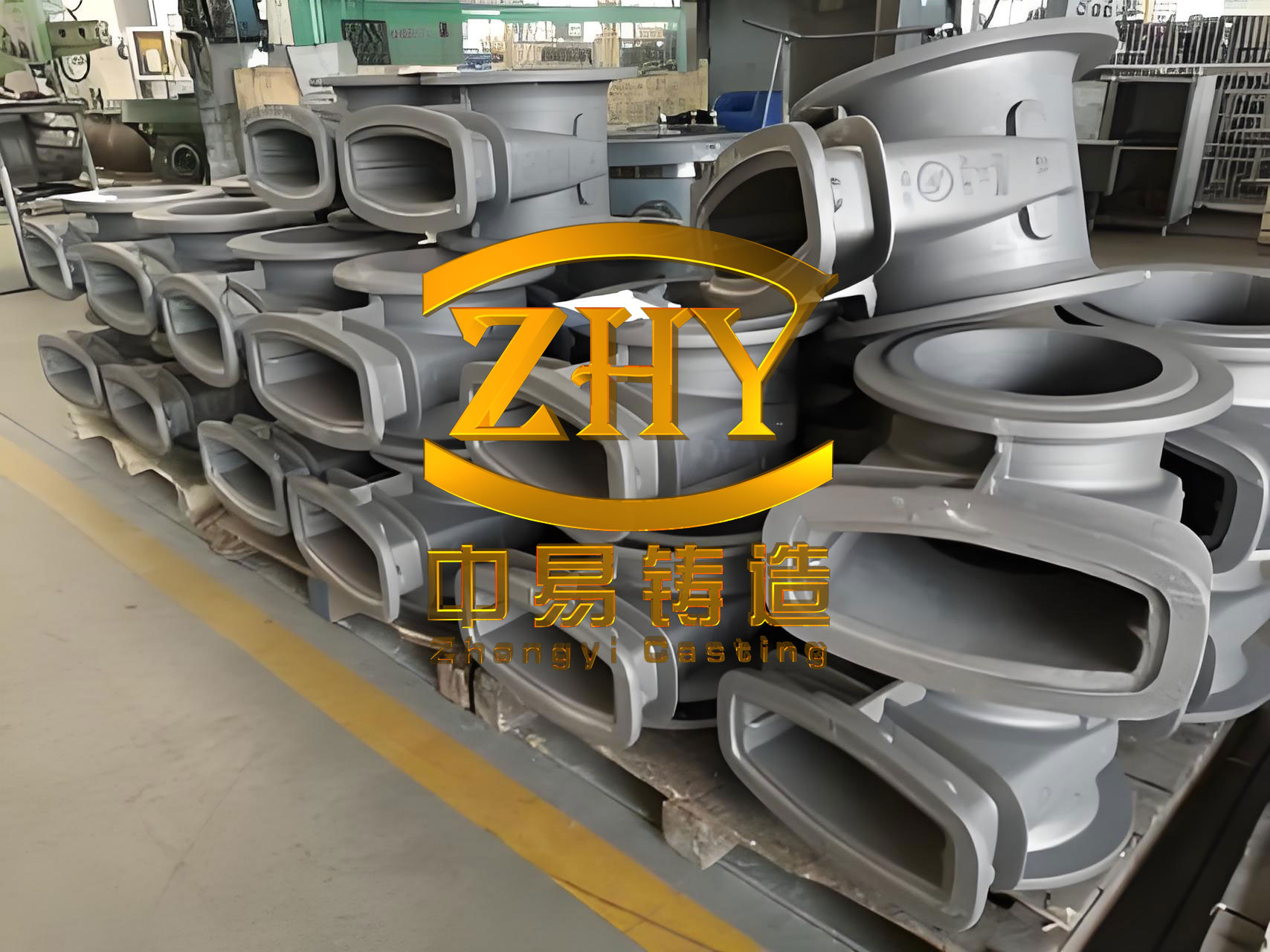
Given the structural constraints, we opted for a horizontal pouring position instead of vertical pouring. In vertical pouring, cores such as the intercooler core and gear housing core would have inadequate positioning stability, as they rely on limited core prints for support. Horizontal pouring allows for better core fixation through bottom core prints, reducing the risk of displacement during mold filling. The machining allowances were set as follows: 15 mm for the top surface (corresponding to the pouring position), 8 mm for all machined holes, and 10 mm for the side surfaces and bottom surface. Based on our experience with similar gray cast iron castings and data from 3D scanning analysis, we determined the key casting process parameters, which are summarized in Table 1.
| Parameter | Value | Notes |
|---|---|---|
| Casting Shrinkage (Length) | 1.0% | Applied to the longitudinal direction |
| Casting Shrinkage (Width & Height) | 0.6% | Applied to transverse and vertical directions |
| Coating Thickness | 0.6 mm | Uniform coating on core surfaces |
| Core Gap Allowance | 1.5–2.0 mm | For major core assemblies to accommodate expansion |
| Material | HT300 Gray Cast Iron | Chemical composition tailored for high strength |
The gating system is a crucial element in ensuring defect-free castings, especially for large gray cast iron components. We designed a bottom-gated open-type gating system with ceramic pipes, utilizing a reverse rain gating approach to promote calm mold filling. This system minimizes turbulence, reduces air entrainment, and lowers the risk of slag inclusion and sand erosion. The cross-sectional areas of the gating components were carefully calculated to achieve a specific ratio. The sprue diameter is 110 mm, with two horizontal runners each of 110 mm diameter, and 18 ingates each of 40 mm diameter. The cross-sectional area ratio is given by:
$$ F_{\text{sprue}} : F_{\text{runner}} : F_{\text{ingate}} = 1 : 2 : 2.38 $$
where \( F_{\text{sprue}} = \pi \times (110/2)^2 \), \( F_{\text{runner}} = 2 \times \pi \times (110/2)^2 \), and \( F_{\text{ingate}} = 18 \times \pi \times (40/2)^2 \). This open system ensures a low metal velocity at the ingates, typically below 0.5 m/s, which can be derived from the flow rate equation:
$$ v = \frac{Q}{A} $$
where \( v \) is the velocity, \( Q \) is the volumetric flow rate of molten gray cast iron, and \( A \) is the cross-sectional area. By maintaining a large total ingate area, we reduce \( v \), thereby promoting laminar flow. The filling time \( t_f \) for such a large casting can be estimated using empirical formulas for gray cast iron:
$$ t_f = k \cdot \frac{W}{\rho \cdot A_{\text{ingate}} \cdot v} $$
where \( W \) is the casting weight, \( \rho \) is the density of gray cast iron (approximately 7,200 kg/m³), \( A_{\text{ingate}} \) is the total ingate area, \( v \) is the average velocity, and \( k \) is a correction factor (typically 1.2–1.5 for complex shapes). For our block, \( t_f \) was optimized to around 60–90 seconds to ensure proper thermal gradients.
For the main oil passage, we adopted a non-cored solid design, meaning the passage is not cast but machined afterward. This decision was based on previous issues with pre-embedded steel tubes (which caused fusion defects and distortion) and sand cores (which led to core deformation and difficult cleaning). For gray cast iron, machining is relatively straightforward due to its graphite flakes that act as chip breakers. This approach eliminated risks associated with core assembly and reduced post-casting labor significantly. However, it required careful consideration of material integrity and stress concentrations, which we addressed through optimized cooling and stress relief annealing.
To counteract the shrinkage tendency of high-grade gray cast iron, we implemented an extensive chilling strategy. Chills were placed at critical locations such as crankshaft bearing caps, cylinder head bolt bosses, main bolt bosses, and other thick sections. The chill design follows heat transfer principles, where the chill extracts heat rapidly to promote directional solidification. The effectiveness of a chill can be modeled using Fourier’s law of heat conduction:
$$ q = -k \cdot \frac{dT}{dx} $$
where \( q \) is the heat flux, \( k \) is the thermal conductivity of the chill material (typically iron or copper), and \( \frac{dT}{dx} \) is the temperature gradient. For gray cast iron, the solidification time \( t_s \) of a section with thickness \( d \) can be approximated by Chvorinov’s rule:
$$ t_s = C \cdot \left( \frac{V}{A} \right)^2 $$
where \( V \) is the volume, \( A \) is the surface area, and \( C \) is a constant dependent on mold material and metal properties. By attaching chills, we effectively increase the cooling surface area \( A \), reducing \( t_s \) and preventing shrinkage porosity. Table 2 summarizes the chill placements and their dimensions.
| Location | Chill Type | Dimensions (mm) | Purpose |
|---|---|---|---|
| Crankshaft Bearing Areas | Rectangular Iron Chills | 150 × 100 × 20 | Accelerate cooling in high-stress zones |
| Cylinder Head Bolt Bosses | Circular Copper Chills | Diameter 50, Thickness 15 | Prevent micro-shrinkage |
| Main Oil Passage (Solid) | Contoured Iron Chills | Custom-fit to oil passage shape | Enhance solidification sequence |
| Thick Wall Sections | Various Sizes | As per thermal analysis | Uniformize cooling rates |
Venting is another critical aspect, as gray cast iron pouring generates substantial gases from core binders and coatings. We designed a comprehensive venting network to ensure all gases escape to the atmosphere. Cores like the air chamber core and intercooler core were reinforced with pre-embedded steel core rods that had drilled holes for gas escape. The venting paths were connected to external vents via core prints and upper mold sections. The gas generation rate \( G \) during pouring can be estimated by:
$$ G = \alpha \cdot e^{-\beta / T} $$
where \( \alpha \) and \( \beta \) are constants related to the core sand composition, and \( T \) is the temperature. By providing adequate vent areas \( A_v \), we ensure the gas pressure \( P_g \) remains below the metallostatic pressure \( P_m \) of the gray cast iron melt:
$$ P_g = \frac{G \cdot t}{V_g} < P_m = \rho \cdot g \cdot h $$
where \( t \) is time, \( V_g \) is the gas volume, \( \rho \) is melt density, \( g \) is gravity, and \( h \) is the melt height. Our vent design maintained \( P_g \) under 0.1 atm to prevent gas entrapment.
Core stability was addressed through innovative tooling. For instance, the long, slender water-jacket hole cores were pre-assembled with the cylinder liner cores using dedicated fixtures. This ensured accurate positioning and prevented deformation during handling and pouring. The fixture design accounted for thermal expansion mismatches between the gray cast iron and core sand, using clearance fits based on the coefficient of thermal expansion \( \alpha \):
$$ \Delta L = L_0 \cdot \alpha \cdot \Delta T $$
where \( \Delta L \) is the length change, \( L_0 \) is initial length, and \( \Delta T \) is the temperature change. For gray cast iron, \( \alpha \approx 11 \times 10^{-6} \, \text{K}^{-1} \), while for silica sand cores, \( \alpha \approx 12 \times 10^{-6} \, \text{K}^{-1} \). The slight difference was accommodated by the core gap allowance listed in Table 1.
Production validation involved pouring several trial castings and conducting rigorous inspections. The attached test bars were analyzed for mechanical properties and microstructure. The results confirmed that the gray cast iron met HT300 specifications, with tensile strengths exceeding 300 MPa and Brinell hardness values between 200–250 HB. Microstructural analysis revealed a pearlitic matrix with well-distributed Type A graphite flakes, which is typical for high-quality gray cast iron. Non-destructive testing, including ultrasonic and magnetic particle inspection, showed no major defects like shrinkage cavities, gas pores, or inclusions. The dimensional accuracy was verified via 3D scanning, with all critical features within tolerance. Table 3 summarizes the mechanical property data from the test bars.
| Property | Average Value | Standard Deviation | Specification Requirement |
|---|---|---|---|
| Tensile Strength (MPa) | 315 | 12 | >300 MPa |
| Hardness (HB) | 225 | 15 | 180–250 HB |
| Elongation (%) | 1.2 | 0.3 | N/A for gray cast iron |
| Graphite Flake Type | Type A, Size 4–5 | – | As per ASTM A247 |
The successful implementation of this casting process demonstrates that large, complex engine blocks can be produced reliably from high-grade gray cast iron. Key factors include the open gating system with balanced ratios, strategic use of chills to control solidification, robust venting for gas escape, and stable core assemblies. This approach minimizes defects common in gray cast iron castings, such as gas holes, slag inclusions, and sand burns. Moreover, the non-cored oil passage simplified the process and reduced costs. The experience gained from this project provides a foundation for future developments in gray cast iron casting technology, particularly for heavy-duty applications where material performance is paramount.
In conclusion, the design and production of large gray cast iron components require a holistic approach that integrates fluid dynamics, heat transfer, and material science. Our work on this engine block highlights the importance of meticulous process planning and validation. The consistent use of gray cast iron as the material of choice underscores its versatility and reliability in demanding engineering contexts. As foundry technologies advance, further optimizations in gating design, cooling techniques, and core materials will continue to enhance the quality and efficiency of gray cast iron castings, paving the way for even larger and more intricate components in the future.