
In the production of planetary gear transmission systems, the planetary carrier plays a pivotal role in bearing loads, transmitting torque, and distributing forces. As the component subjected to the highest external moments in the mechanism, it demands lightweight construction, high rigidity, and must be free from shrinkage porosity and cavities. Our company manufactures a double-sided plate integrated planetary carrier using spheroidal graphite cast iron, specifically grade QT500-7. The casting has a maximum outer轮廓尺寸 of φ245 mm × 98 mm, wall thickness ranging from 13 to 22 mm, and a rough weight of 9.8 kg. The structure comprises two annular side plates and four evenly spaced支撑 pillars forming a spatial framework, with a distance of approximately 60 mm between the side plates, resulting in complex internal geometry. This article details the casting process design for producing this spheroidal graphite cast iron planetary carrier on a DISA vertical molding line, employing green sand molds, 20L cold box core making, medium-frequency electric furnace melting, and DISA vertical造型 automation.
Product Structure and Hot Spot Analysis
When designing the casting process for spheroidal graphite cast iron components, the primary consideration is the prevention of shrinkage defects. Therefore, identifying hot spots—locations where metal accumulates and solidifies slowly—is crucial. Hot spots are categorized into structural hot spots, arising from the geometric design of the casting, and process hot spots, induced by工艺 elements like risers, gates, and vents. For the planetary carrier, structural hot spots are concentrated at the junctions between the side plates and the支撑 pillars, totaling eight locations: four on the larger端面 and four on the smaller端面. These areas, due to their higher volume-to-surface area ratio, solidify last and are prone to shrinkage if not properly fed.
To quantitatively assess these hot spots, the modulus method is commonly employed. The modulus \( M \) is defined as the ratio of volume to cooling surface area:
$$ M = \frac{V}{A} $$
where \( V \) is the volume of the section and \( A \) is its surface area through which heat is dissipated. A higher modulus indicates slower solidification. For the planetary carrier, approximate moduli were calculated for critical sections. The results are summarized in Table 1.
| Section Description | Volume, V (cm³) | Surface Area, A (cm²) | Modulus, M (cm) |
|---|---|---|---|
| Junction of large side plate and支撑 pillar | ~85 | ~65 | ~1.31 |
| Junction of small side plate and支撑 pillar | ~78 | ~72 | ~1.08 |
| 支撑 pillar mid-section | ~42 | ~50 | ~0.84 |
| Side plate wall (average) | ~35 | ~45 | ~0.78 |
The modulus values confirm that the junctions are indeed thermal centers. Furthermore, Computer-Aided Engineering (CAE) analysis using AnyCasting software was performed to simulate solidification and defect formation. The initial casting temperature was set to 1385°C. The simulation revealed that the smaller side plate solidified first, becoming isolated into four液相 regions by 107 seconds, while the larger side plate retained significant isolated液相 until 183 seconds. The defect probability analysis indicated over 30% of potential shrinkage cavities集中在 these eight structural hot spots. This underscored the need for differential feeding strategies: the smaller端面, with better cooling conditions, could potentially rely on self-feeding via石墨 expansion of the spheroidal graphite cast iron, while the larger端面 required explicit riser design for effective feeding.
Casting Process Design
The process design was tailored for the DISA vertical flaskless挤压 molding line, which utilizes a vertical parting plane. Key aspects included parting surface selection, core design, gating system, and riser design.
Parting Surface Selection
Two parting surface options were evaluated, as illustrated conceptually. Option 1 placed the parting through the center of the支撑 pillars, resulting in a simpler core but making riser placement for the large side plate hot spots inefficient due to distance (~45 mm). Option 2 positioned the parting at the large side plate’s outer edge, allowing gates and risers to be placed directly adjacent to the critical hot spots. Although this complicated the core design and led to uneven machining allowances, it was chosen for superior feeding capability. The small side plate, facing outward in this configuration, benefits from enhanced cooling in the mold, promoting faster solidification and facilitating self-feeding through the expansion characteristics of spheroidal graphite cast iron.
Core Design
The core, producing the internal cavity between the side plates, was designed for automatic placement on the DISA line. Following DISA manual guidelines, the core print on the positive mold plate included定位夹紧 surfaces with an interference fit of -0.1 to -0.3 mm to secure the core during automatic setting. Other clearances were set between 0 and 0.5 mm. The core was produced using a 20L cold box process with amine gas curing. The design ensured proper venting and minimization of core-generated defects.
Gating and Riser System Design
The gating system was designed to achieve controlled filling, temperature distribution conducive to directional solidification, and effective feeding. Each mold on the 600 mm × 480 mm pattern plate accommodated two castings. The key design principles and calculations are outlined below.
Gating Design: The ingate location is critical. Placing it directly on a hot spot increases its thermal modulus and complicates feeding. Therefore, ingates were positioned between two支撑 pillars on the large side plate, aiming for one riser to feed two adjacent hot spots. The ingate dimensions were 60 mm × 12 mm (width × thickness), creating a wide, thin通道 that spreads the flow and allows it to approach the hot zones from the side. A foam ceramic filter (82 mm × 82 mm × 12.5 mm, 10 PPI) was incorporated in the gating system to trap inclusions and moderate flow. The total gating ratio (sprue area : runner area : ingate area) was designed approximately as 1 : 1.5 : 1.2 to ensure a non-turbulent fill. The filling time \( t_f \) can be estimated using Bernoulli’s equation and continuity:
$$ Q = A_g \cdot v_g $$
$$ v_g = \mu \sqrt{2gh} $$
where \( Q \) is the volumetric flow rate, \( A_g \) is the total ingate area, \( v_g \) is the flow velocity at the ingates, \( \mu \) is the discharge coefficient (≈0.6 for green sand), \( g \) is gravity, and \( h \) is the effective metallostatic head. For a pouring weight of ~20 kg (2 castings) and a designed fill time of ~8 seconds, the required \( A_g \) was calculated to be around 7.2 cm², matching the chosen ingate area (60mm×12mm = 7.2 cm²).
Riser Design: The primary goal was to feed the four hot spots on the large side plate. Two cylindrical risers of φ70 mm were employed, each intended to feed two hot spots. The riser modulus \( M_r \) must be greater than the casting modulus \( M_c \) at the hot spot to ensure it solidifies last. For \( M_c \approx 1.31 \) cm, a riser with diameter D=70 mm and height H=105 mm (H=1.5D) has a modulus calculated for a cylindrical riser considering side and top散热:
$$ M_r = \frac{V_r}{A_r} = \frac{\pi D^2 H / 4}{\pi D H + \pi D^2 / 4} = \frac{D H}{4H + D} $$
Substituting D=7 cm, H=10.5 cm gives \( M_r \approx 1.54 \) cm, which is > \( M_c \), satisfying the criterion. A connecting bridge of 30 mm × 8 mm was placed between the two risers to prevent the upper riser from feeding the lower one, thereby improving the feeding efficiency of the upper riser. Exothermic riser sleeves could be considered but were not used in this initial design. For the small side plate, no risers were used; reliance was placed on the self-feeding capability of spheroidal graphite cast iron. The石墨 expansion pressure during eutectic solidification can compensate for shrinkage in isolated液相 regions if the mold rigidity is sufficient. The expansion pressure \( P_{exp} \) can be approximated as a function of graphite volume fraction and constraint, though it is complex to quantify precisely.
Venting and overflow passages (18 mm × 3 mm) were added at strategic locations to reduce cavity backpressure, improve feeding, and prevent core burns.
CAE Simulation and Solidification Analysis
The preliminary process design was modeled in 3D and analyzed using AnyCasting simulation software. The simulation parameters included thermophysical properties for spheroidal graphite cast iron, boundary conditions for green sand, and an initial temperature of 1385°C. The results vividly illustrated the solidification sequence and feeding dynamics.
The solidification process followed the pattern predicted by modulus calculations. The smaller side plate and支撑 pillars began solidifying first. By 80 seconds, the small side plate was largely solid except for the four junction hot spots. By 124 seconds, these hot spots on the small side plate were isolated液相 pools. Crucially, the simulation showed that these pools solidified under pressure from the expanding graphite nodules in the surrounding solidified matrix, indicating a high probability of self-feeding成功. The larger side plate hot spots remained液态 much longer, with significant液相 pools present until 224 seconds. The two φ70 mm risers remained液态 throughout this period, demonstrating effective feeding paths. By 335 seconds, solidification was complete with the risers solidifying last. The shrinkage porosity prediction module showed a very low probability of defects in the large side plate hot spots and acceptable risk for the small side plate, validating the riser design and the exploitation of graphite expansion in spheroidal graphite cast iron.
The solidification time \( t_s \) for a section can be approximated by Chvorinov’s rule:
$$ t_s = k \cdot M^n $$
where \( k \) is the solidification constant (dependent on mold material and casting metal) and \( n \) is an exponent typically close to 2. For green sand molds and iron castings, \( k \) is often in the range of 0.8 to 1.2 min/cm². Using \( M_c = 1.31 \) cm for the hot spot, \( t_s \) is estimated as \( 1.0 \times (1.31)^2 \approx 1.72 \) minutes (103 seconds), which aligns with the CAE simulation results showing these spots solidifying between 100-180 seconds.
Melting and Metallurgy for Spheroidal Graphite Cast Iron
The production of high-quality spheroidal graphite cast iron requires precise control over chemical composition, melting, and treatment processes. The铁液 was prepared in a medium-frequency coreless induction furnace. The base iron was carefully charged to achieve the target chemistry. Post-melting, the铁液 was subjected to a magnesium-treatment via wire feeding inoculation for spheroidization, followed by inoculation to promote graphite nucleation. A final随流孕育 was performed during pouring to enhance graphite count and prevent chilling.
The target chemical composition for QT500-7 spheroidal graphite cast iron is critical for achieving the desired microstructure and mechanical properties. The typical composition range used in this process is detailed in Table 2.
| Element | Carbon (C) | Silicon (Si) | Manganese (Mn) | Phosphorus (P) | Sulfur (S) | Magnesium (Mg) | Tin (Sn) | Other Trace |
|---|---|---|---|---|---|---|---|---|
| Content (%) | 3.6–3.8 | 2.5–2.8 | 0.1–0.4 | < 0.06 | < 0.02 | 0.03–0.05 | 0.02–0.04 | Bal. Fe |
The carbon equivalent (CE) is a vital parameter for cast iron, calculated as:
$$ CE = \%C + \frac{\%Si + \%P}{3} $$
For our composition, CE ranges approximately from 4.3 to 4.5, placing it in a hypereutectic region favorable for graphite formation. The magnesium content ensures spheroidization of graphite, while锡 is added as a pearlite stabilizer to achieve the required strength and hardness for QT500-7. The pouring temperature was tightly controlled between 1370°C and 1390°C to ensure adequate fluidity while minimizing gas dissolution and shrinkage tendency.
Trial Production and Quality Verification
The designed process was implemented on the DISA垂直造型 line for trial production. Multiple molds were poured and allowed to cool. The castings were then shaken out, cleaned, and subjected to rigorous inspection.
Visual and Dimensional Inspection: The castings were free from visible surface defects like misruns, cold shuts, or severe sand inclusions. Dimensional checks against the CAD model confirmed that the castings were within specified tolerances, validating the core and mold design.
Non-Destructive Testing (NDT): All castings were inspected using dye penetrant testing to detect surface cracks and porosity. No significant indications were found at the critical hot spot junctions. Additionally, ultrasonic testing was performed on sample castings to check for internal shrinkage; the results were satisfactory.
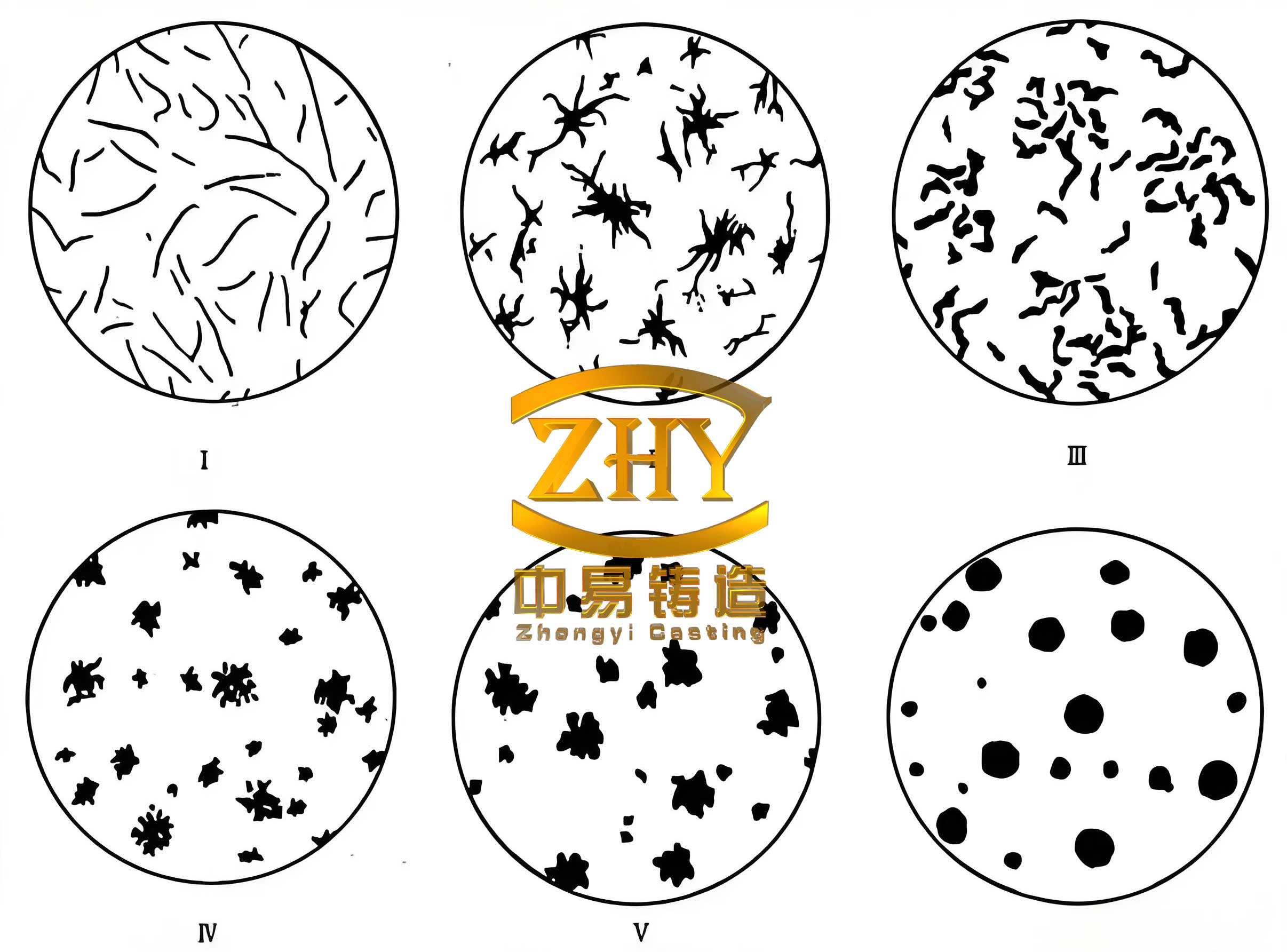
Destructive Testing and Metallographic Analysis: Sample castings were sectioned through the hot spot locations for macroscopic and microscopic examination. The sections revealed sound metal without macroscopic shrinkage cavities or porosity. Metallographic samples were prepared, etched, and analyzed under an optical microscope. The microstructure exhibited well-formed, spheroidal graphite nodules uniformly distributed in a matrix of ferrite and pearlite. Quantitative image analysis yielded the following results,符合 QT500-7 specifications:
- Graphite nodularity: >85% (typically 85-90%)
- Graphite nodule count: >120 nodules/mm²
- Nodule size: Maximum diameter ≤ 6 μm
- Matrix structure: Approximately 45-50% pearlite, balance ferrite
Mechanical Property Testing: Tensile test coupons machined from separately cast keel blocks (poured from the same ladle as the castings) and from the castings themselves were tested. The average results met and exceeded the QT500-7 grade requirements:
| Property | Result | QT500-7 Requirement |
|---|---|---|
| Tensile Strength, Rm | 527 MPa | > 500 MPa |
| Yield Strength, Rp0.2 | 320 MPa | > 320 MPa |
| Elongation, A | 11% | > 7% |
| Hardness, HBW | 187 | 170-230 |
The successful trial production confirms the efficacy of the casting process design. The strategic placement of risers for the large side plate, combined with leveraging the inherent self-feeding characteristics of spheroidal graphite cast iron for the small side plate, effectively eliminated shrinkage defects. The DISA vertical line’s capabilities were fully utilized, achieving high productivity and consistent quality.
Conclusion and Process Insights
The development of a reliable casting process for a double-sided plate planetary carrier in spheroidal graphite cast iron on a DISA vertical molding line involved a systematic approach integrating product analysis, modulus calculations, CAE simulation, and practical foundry knowledge. The key conclusions and insights gained are summarized below:
- Comprehensive Analysis is Foundational: A thorough understanding of the casting geometry, identification of structural hot spots via modulus calculations (\( M = V/A \)), and preliminary CAE analysis are indispensable first steps. This guides all subsequent工艺 decisions.
- Strategic Parting and Feeding is Critical: The choice of parting surface (Option 2) directly enabled efficient riser placement. Differentiating the feeding strategy based on local solidification conditions—using risers for slower-solidifying sections and relying on graphite expansion for faster-cooling sections—is a powerful technique for spheroidal graphite cast iron. The self-feeding capacity stems from the volumetric expansion associated with graphite precipitation during the eutectic reaction, which can compensate for shrinkage if the mold is rigid. The pressure generated \( P_{exp} \) helps suppress microporosity.
- Gating and Riser Design Requires Balance: The gating system must fill the mold quietly and establish a favorable temperature gradient. The riser design must obey modulus principles (\( M_r > M_c \)) and consider practicalities like interference between multiple risers. The use of a thin connecting bridge improved individual riser efficiency.
- CAE Simulation is a Vital Validation Tool: The solidification simulation accurately predicted the sequence and isolated液相 regions. It provided confidence that the small side plate hot spots, while showing isolated液相 in simulation, would likely be sound due to the self-feeding mechanism of spheroidal graphite cast iron, a nuance that pure thermal analysis might miss.
- Material Consistency is Paramount: Strict control over the chemical composition of the spheroidal graphite cast iron, particularly carbon, silicon, and magnesium, along with effective inoculation practices, ensures the desired graphite morphology and matrix structure, which directly influence both mechanical properties and feeding behavior.
This successful project demonstrates that complex, high-integrity castings like the planetary carrier can be produced efficiently on high-speed vertical molding lines by employing a scientifically grounded and simulation-verified process design. The unique properties of spheroidal graphite cast iron, when properly harnessed, contribute significantly to achieving defect-free castings with excellent performance characteristics.