
In the field of railway infrastructure, the production of high manganese steel casting components, such as frogs, is critical for ensuring durability and performance under heavy loads. This article details my experience in developing a casting process for super-long high manganese steel frogs that comply with EN standards, utilizing VRH (Vacuum Replace Hardening) combined molding technology. The VRH process integrates vacuum treatment with traditional sand casting, offering significant advantages in product quality, cost-effectiveness, and environmental sustainability. By adopting this approach, we have expanded the production capabilities of existing equipment to manufacture frogs exceeding standard lengths, which is essential for specialized railway applications. The focus here is on the design of process equipment, casting methodology, and validation through numerical simulation, all aimed at achieving the stringent internal quality requirements set by EN 15689.
The VRH process involves creating a vacuum environment to harden sand molds, which enhances the dimensional accuracy and reduces defects in high manganese steel casting. For super-long frogs, which can extend up to 9,160 mm, conventional VRH systems with limited vacuum box sizes (typically up to 6,000 mm) posed a challenge. To overcome this, we implemented a segmented molding strategy where the sand mold is divided into sections, assembled post-hardening, and then used for casting. This method required precise design of molds and support structures to ensure stability and minimize deformation during handling. The overall workflow for VRH combined molding includes segment preparation, surface finishing, assembly on a dedicated frame platform, and final adjustments to seams, as summarized in the following table outlining key steps and considerations.
| Step | Description | Key Parameters |
|---|---|---|
| 1. Segment Preparation | Divide the mold into two segments, avoiding areas with risers. | Segment length: ~4,580 mm each |
| 2. Surface Finishing | Flatten the joining surfaces of each segment for precise alignment. | Surface tolerance: ≤1 mm |
| 3. Assembly | Combine segments on a frame platform using定位销 and bolts. | Total assembled length: 12,630 mm |
| 4. Final Adjustments | Repair seams and ensure integrity before casting. | Deformation limit: ≤2 mm |
The design of process equipment was crucial for successful high manganese steel casting. We developed a split-pattern model divided near the center, with sandboxes featuring main frames, auxiliary ends, and joining surface mechanisms. The sandboxes, made from Q345R steel plates, were engineered to withstand the loads during molding and assembly. For instance, the upper sandbox included connection frames to enhance rigidity, and finite element analysis was used to verify that maximum deformation under uniform load did not exceed 0.96 mm. Similarly, the lower sandbox, fixed on a frame platform, showed a deformation of 0.58 mm, meeting the design criteria. The assembly relationship is illustrated by the equation for deformation under load: $$ \delta = \frac{q L^4}{8 E I} $$ where \( \delta \) is the deformation, \( q \) is the distributed load, \( L \) is the length, \( E \) is the modulus of elasticity, and \( I \) is the moment of inertia. This ensured that the sand molds remained intact during handling, preventing cracks or misalignment that could compromise the high manganese steel casting quality.
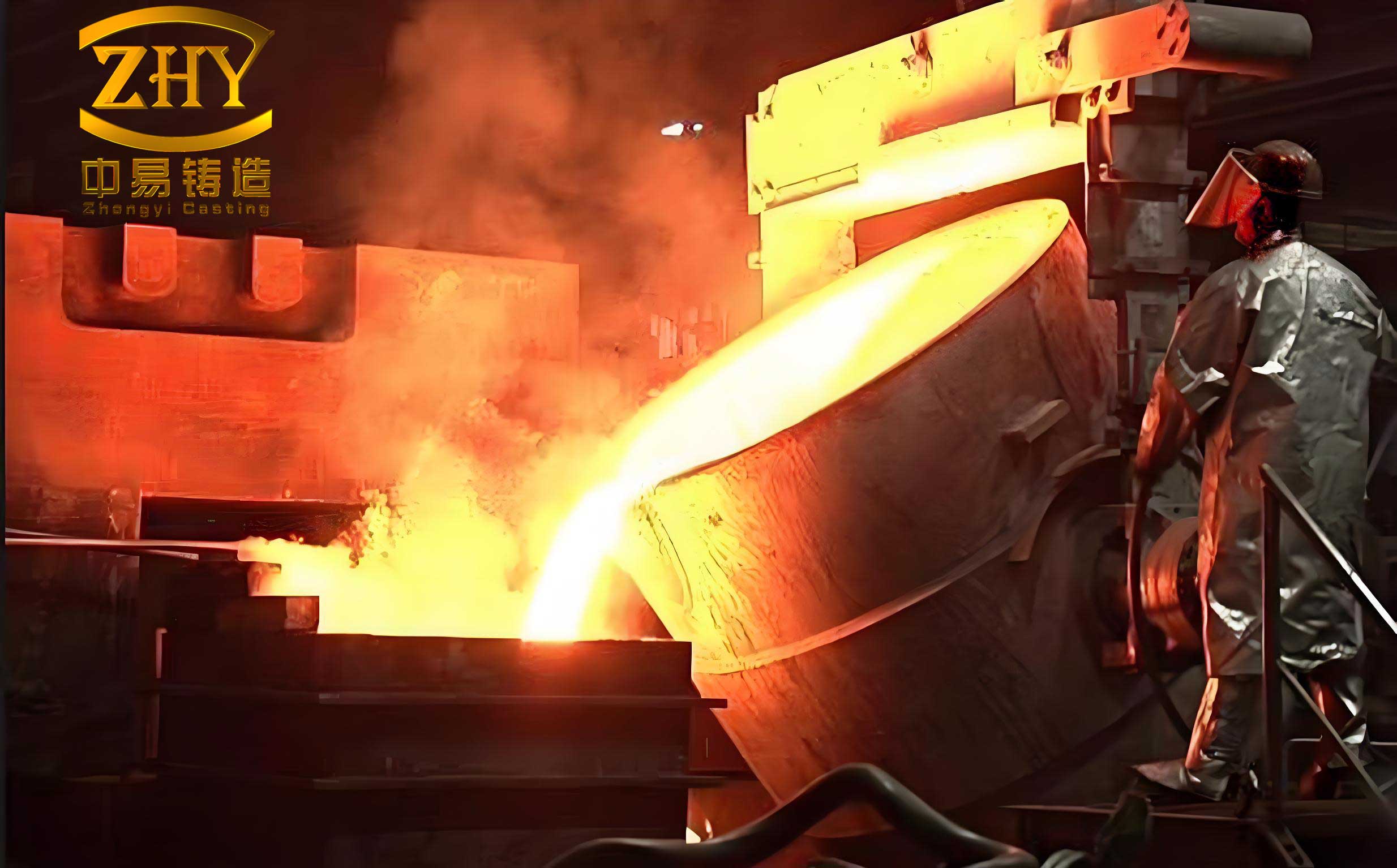
Moving to the casting process design, the high manganese steel casting for the frog had a contour size of 9,180 mm × 580 mm × 190 mm and a mass of approximately 2,100 kg. The material, ZGMn13, exhibits high toughness and wear resistance, but its long, shell-like structure with varying thicknesses (25–30 mm main walls and thicker sections up to 60 mm) posed risks of shrinkage and cold shuts. According to EN 15689, the internal quality must achieve Level 1 (no visible defects in radiography) for the top surface down to 25 mm and Level 3 (minor defects allowed) for other areas. To address this, we oriented the casting with the top surface downward during pouring to improve internal quality, and used a combination of risers and chills for effective feeding. The gating system was designed with ingates at the heel end to avoid defects at the thinner toe end, and the pouring temperature was set at 1,460–1,480°C with a tilt angle of 6° to ensure a metal rise speed of 30–36 mm/s. The total pouring weight was 2,900 kg over 35–45 seconds, and the following table summarizes the key casting parameters.
| Parameter | Value | Rationale |
|---|---|---|
| Pouring Temperature | 1,460–1,480°C | Optimizes fluidity and reduces shrinkage |
| Tilt Angle | 6° | Balances metal rise speed and safety |
| Pouring Time | 35–45 s | Ensures complete filling without cold shuts |
| Riser and Chill Arrangement | Multiple risers with insulation and chills | Prevents porosity in thick sections |
Numerical simulation played a vital role in optimizing the high manganese steel casting process. Using ProCAST software, we modeled the geometry with a mesh size of 10 mm for the casting and 30 mm for the sand mold, resulting in 9.229 million elements. The simulation accounted for material properties and boundary conditions, and multiple runs were conducted to evaluate different tilt angles. The results confirmed that a tilt angle greater than 5° prevented defects like misruns, and the chosen 6° angle yielded a sound casting with all shrinkage defects confined to the risers and gating system. The solidification process can be described by the Chvorinov’s rule: $$ t_s = k \left( \frac{V}{A} \right)^2 $$ where \( t_s \) is the solidification time, \( k \) is a constant, and \( V/A \) is the volume-to-surface area ratio. This helped in identifying critical sections requiring additional cooling or feeding, ensuring the high manganese steel casting met the EN standards. The simulation output showed no defects in the frog body, validating the工艺 design.
During product trial, the high manganese steel casting was produced without issues such as cracks or cold shuts, and the appearance was satisfactory. After machining, X-ray inspection revealed that the internal quality complied with EN 15689: Level 1 in specified zones and Level 3 elsewhere. This success demonstrates the effectiveness of the VRH combined molding approach for super-long components. The process not only leverages existing equipment but also enhances productivity for high manganese steel casting applications in railways. In conclusion, this methodology offers a reproducible framework for similar projects, emphasizing the importance of integrated design and simulation in achieving high-quality outcomes. Future work could focus on refining the segmentation technique for even longer castings or adapting it to other alloys, further advancing the field of high manganese steel casting.
The development of this high manganese steel casting process underscores the value of innovation in manufacturing. By addressing equipment limitations through creative engineering, we have enabled the production of critical railway components that meet international standards. The use of VRH technology, combined with rigorous simulation and testing, ensures that the high manganese steel casting achieves the necessary mechanical properties and longevity. As railways continue to evolve, such advancements will play a pivotal role in supporting infrastructure demands, making high manganese steel casting a cornerstone of durable and efficient transport systems.