
In my extensive experience with investment casting, particularly for aluminum alloys like ZL101A, I have observed that defects such as porosity in casting and slag inclusions are among the most critical challenges affecting product quality and performance. Investment casting, known for its ability to produce complex, high-precision components with excellent surface finish, is widely used in aerospace, military, and other high-value industries. However, the slow cooling rates associated with hot-shell pouring often lead to coarse microstructures and increased susceptibility to defects. Among these, porosity in casting—primarily due to hydrogen entrapment—and slag inclusions—resulting from oxide formation—are pervasive issues that can compromise mechanical properties and structural integrity. This article delves into the underlying mechanisms of these defects, based on practical production insights and metallurgical analysis, and presents effective mitigation strategies. I will explore the oxidation behavior of ZL101A alloy at high temperatures, the formation of gas bubbles and slag particles, and the efficacy of methods like argon purging and ceramic filtration. Throughout, I emphasize the importance of controlling porosity in casting to enhance cast quality, and I incorporate tables and formulas to summarize key data and theoretical frameworks.
The ZL101A alloy, a hypoeutectic Al-Si-Mg system, is favored for its good castability and mechanical properties. Its typical chemical composition, as per standard specifications, includes silicon (6.5–7.5%), magnesium (0.30–0.45%), titanium (0.08–0.20%), and iron (limited to 0.15%), with aluminum as the balance. In practice, maintaining this composition is crucial, as deviations can influence fluidity, shrinkage, and defect formation. For instance, silicon content affects eutectic formation, while magnesium contributes to strength through precipitation hardening. However, during melting and pouring, interactions with the environment—especially oxygen and moisture—lead to oxidation and hydrogen absorption, which are primary sources of defects. The following table summarizes the target and analyzed composition of ZL101A used in my investigations, highlighting the close adherence to specifications.
| Element | Standard Range (GB/T 8733-2007) | Measured Composition |
|---|---|---|
| Si | 6.5–7.5 | 6.542 |
| Cu | – | 0.0457 |
| Fe | ≤0.15 | 0.1539 |
| Mn | – | 0.0108 |
| Mg | 0.30–0.45 | 0.3608 |
| Zn | – | 0.0101 |
| Ti | 0.08–0.20 | 0.1270 |
| Al | Balance | Balance |
Melting and casting processes play a pivotal role in defect generation. In many foundries, medium-frequency induction furnaces are employed for their rapid melting and electromagnetic stirring capabilities, which ensure homogeneity. However, this intense agitation continuously disrupts the protective oxide layer on the melt surface, exacerbating oxidation and hydrogen pickup. The oxidation mechanism of aluminum at high temperatures involves the formation of alumina (Al2O3) films, which, under stagnant conditions, act as barriers. But when disturbed, these films fracture and become entrained in the melt, leading to slag inclusions. Simultaneously, hydrogen from moisture or atmosphere dissolves into the liquid aluminum, and upon solidification, its decreased solubility results in bubble formation, contributing to porosity in casting. The relationship between temperature and hydrogen solubility can be expressed using Sieverts’ law:
$$ C_H = k_H \cdot \sqrt{P_{H_2}} \cdot e^{-\frac{\Delta H_s}{RT}} $$
where \( C_H \) is the hydrogen concentration in the melt, \( k_H \) is a constant, \( P_{H_2} \) is the partial pressure of hydrogen, \( \Delta H_s \) is the enthalpy of solution, \( R \) is the universal gas constant, and \( T \) is the temperature in Kelvin. This formula underscores how higher temperatures increase hydrogen uptake, making control during melting critical to minimize porosity in casting.
To understand the defect morphology, I conducted metallographic examinations using optical microscopy. Untreated castings exhibited numerous gas pores and slag particles, often concentrated in interdendritic regions or near surfaces. The porosity in casting appeared as spherical or elongated voids, ranging from micrometers to millimeters in size, while slag inclusions manifested as irregular, dark phases within the matrix. These defects not only reduce effective load-bearing areas but also act as stress concentrators, degrading fatigue life and tensile strength. The following table quantifies the typical volume fractions of slag inclusions in ZL101A melts under different processing conditions, derived from multiple production batches.
| Treatment Method | Slag Volume Fraction Range (%) | Removal Efficiency (%) |
|---|---|---|
| Untreated (Baseline) | 0.005–0.020 | – |
| Argon Purging Only | 0.0015–0.0060 | 70 |
| Ceramic Filtration Only (20 ppi) | 0.0001–0.0040 | 80 |
| Argon Purging + Ceramic Filtration | 0.00005–0.0020 | 90 |
The data highlight that combined approaches yield superior results. For porosity in casting, hydrogen content is a key metric. In untreated melts, hydrogen levels typically range from 0.30 to 0.60 mL per 100 g of aluminum. After argon purging, this drops to 0.08–0.16 mL/100g, corresponding to a reduction in porosity incidence by approximately 73%. This improvement is crucial because porosity in casting often originates from hydrogen supersaturation during solidification. The solubility gap between liquid and solid aluminum drives gas rejection, forming bubbles that become trapped in the casting. The critical hydrogen concentration for pore formation can be estimated using:
$$ C_{crit} = C_0 \cdot \left(1 + \frac{\Delta T}{T_s}\right) $$
where \( C_0 \) is the hydrogen solubility at the solidus temperature \( T_s \), and \( \Delta T \) is the undercooling. By reducing \( C_0 \) through degassing, porosity in casting is effectively mitigated.
Focusing on slag inclusions, the primary culprit is aluminum oxide (Al2O3), which forms via the reaction:
$$ 4Al_{(l)} + 3O_{2(g)} \rightarrow 2Al_2O_{3(s)} $$
This oxide has a melting point exceeding 2050°C, so once incorporated into the melt, it remains solid and disperses as fine particles. In induction furnaces, the stirring action increases the surface area exposed to oxygen, accelerating oxidation. To combat this, I implemented argon purging during melting. Argon, being inert, forms a protective blanket over the melt surface, isolating it from atmospheric oxygen. The effectiveness depends on flow rate and duration; in my trials, purging at 740°C for 10 minutes with high-purity argon (99.99%) significantly reduced oxide formation. Additionally, ceramic filters—specifically foam filters with 20 pores per inch (ppi)—were used during pouring to physically trap suspended slag. The filtration mechanism involves interception and adsorption, with efficiency modeled by:
$$ \eta = 1 – e^{-\alpha L} $$
where \( \eta \) is the filtration efficiency, \( \alpha \) is a capture coefficient dependent on particle size and filter morphology, and \( L \) is the filter thickness. This approach alone achieved 80% slag removal, but when combined with argon purging, efficiency reached 90%, drastically minimizing inclusions that could otherwise nucleate porosity in casting.
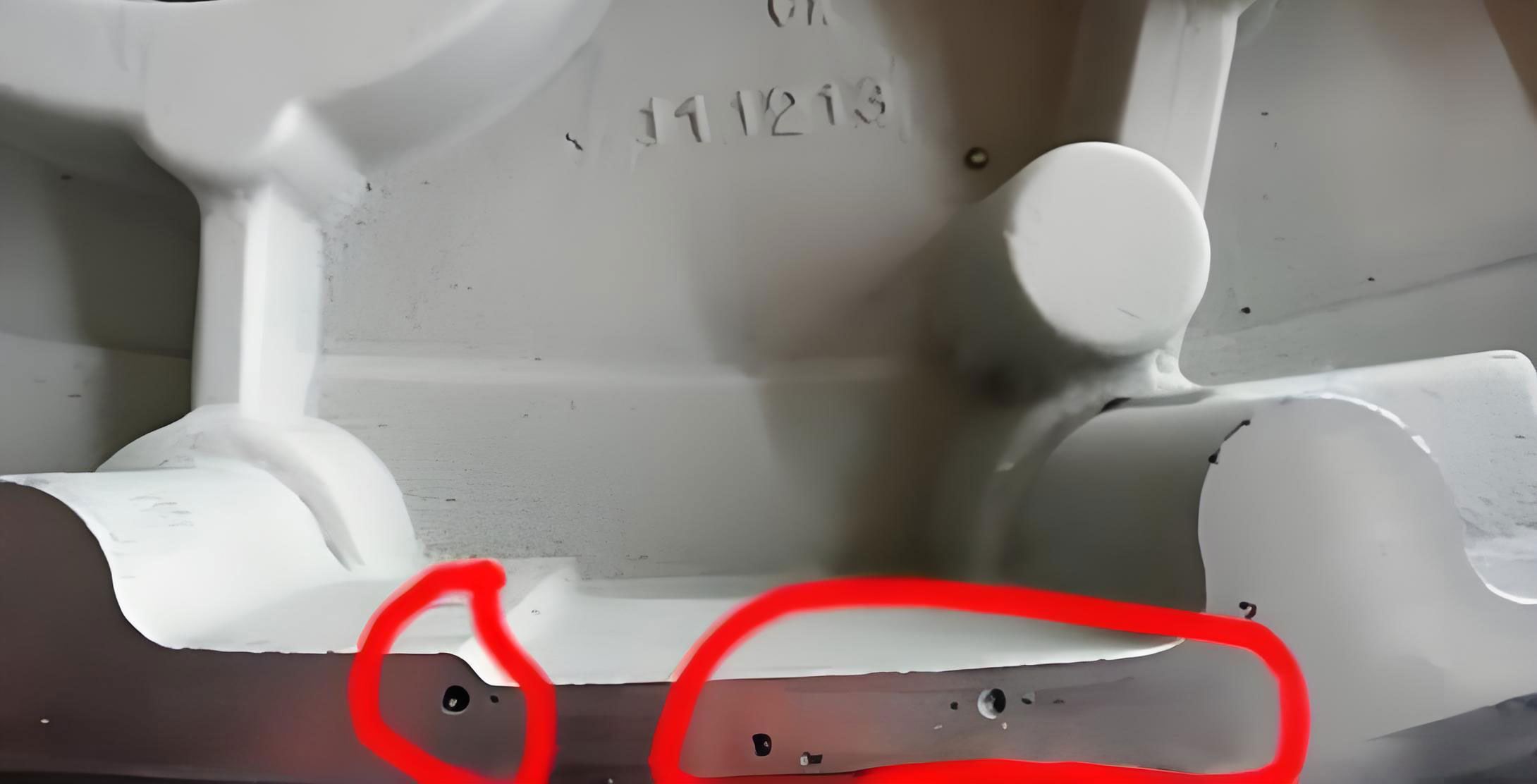
The image above illustrates typical porosity in casting, showcasing the detrimental voids that form due to hydrogen entrapment. Such visual evidence underscores the importance of process control. In my experiments, castings were produced via gravity pouring into preheated ceramic shells at 400°C, with alloy temperatures maintained at 720°C to balance fluidity and gas solubility. Each casting weighed approximately 5 kg, with pouring times of 8–10 seconds to minimize turbulence. After treatment, microstructural analysis revealed a stark contrast: untreated samples showed dense populations of gas pores and slag clusters, while treated ones exhibited clean matrices with minimal defects. This aligns with the quantitative data in Table 2 and supports the efficacy of the methods.
To further elaborate on porosity in casting, it is essential to consider the kinetics of hydrogen diffusion and bubble growth. The rate of hydrogen diffusion in liquid aluminum can be described by Fick’s second law:
$$ \frac{\partial C}{\partial t} = D \nabla^2 C $$
where \( D \) is the diffusion coefficient (approximately \( 10^{-8} \) m²/s for hydrogen in aluminum near melting point), and \( C \) is concentration. During solidification, hydrogen redistributes, leading to local supersaturation and bubble nucleation. The critical radius for a stable bubble is given by:
$$ r_c = \frac{2\gamma}{\Delta P} $$
where \( \gamma \) is the surface tension of aluminum (about 0.9 N/m), and \( \Delta P \) is the pressure difference between the bubble and surrounding liquid. Argon purging aids by introducing exogenous bubbles that serve as nucleation sites for hydrogen, facilitating its removal via flotation. The buoyancy-driven rise velocity of an argon bubble follows Stokes’ law:
$$ v = \frac{2 (\rho_m – \rho_g) g r^2}{9 \eta} $$
where \( \rho_m \) and \( \rho_g \) are densities of melt and gas, \( g \) is gravity, \( r \) is bubble radius, and \( \eta \) is melt viscosity. This process not only degasses but also promotes oxide flotation, reducing both porosity in casting and slag.
Regarding slag inclusions, their impact extends beyond mere presence; they can act as stress raisers and initiate cracks. The size distribution of oxide particles influences filter performance. Assuming a log-normal distribution, the number density \( n(d) \) of particles with diameter \( d \) is:
$$ n(d) = \frac{N_0}{\sqrt{2\pi} \sigma d} \exp\left(-\frac{(\ln d – \mu)^2}{2\sigma^2}\right) $$
where \( N_0 \) is total particle count, and \( \mu \) and \( \sigma \) are mean and standard deviation of the log-transformed diameters. Ceramic filters with 20 ppi pore size effectively capture particles above ~50 μm, but finer particles may require deeper filtration beds. In practice, I found that pre-filtration melt cleanliness—enhanced by argon purging—reduces the load on filters, prolonging their life and improving overall economy. This synergy is vital for controlling porosity in casting, as slag particles can entrap gas bubbles, forming combined defects.
The role of alloy composition cannot be overlooked. Elements like magnesium and titanium affect oxide formation. Magnesium, for instance, can form spinel (MgAl2O4), which alters slag characteristics. Titanium additions refine grains, potentially reducing interdendritic porosity in casting by providing more solidification paths for gas escape. However, excessive titanium may form hard inclusions. Thus, balancing composition is part of a holistic defect prevention strategy. The table below summarizes key processing parameters and their effects on porosity and slag.
| Parameter | Typical Value | Effect on Porosity in Casting | Effect on Slag Inclusions |
|---|---|---|---|
| Melting Temperature | 740°C | Higher temperature increases hydrogen solubility, raising porosity risk. | Accelerates oxidation, increasing slag formation. |
| Argon Purging Time | 10 min | Reduces hydrogen content by ~73%, decreasing porosity. | Suppresses oxide formation by isolating melt surface. |
| Filter Pore Size | 20 ppi | Indirectly reduces porosity by removing slag that can trap gas. | Directly removes ~80% of slag particles. |
| Pouring Temperature | 720°C | Lower temperature reduces gas solubility, but must maintain fluidity. | Minimizes turbulence-induced oxide entrainment. |
| Mold Temperature | 400°C | Affects solidification rate; slower cooling may exacerbate porosity. | Less influence on slag, but hot molds reduce thermal shock. |
In discussion, the interplay between porosity in casting and slag inclusions is evident. Slag particles often serve as nuclei for gas bubbles, leading to compounded defects. Therefore, addressing one issue frequently alleviates the other. For example, argon purging reduces both hydrogen and oxides, while ceramic filtration removes slag that could otherwise harbor gas. The economic aspect is also important: though argon and filters add cost, they reduce scrap rates and improve mechanical properties, justifying their use in high-value castings. Moreover, monitoring melt quality through techniques like reduced pressure test (RPT) for hydrogen or LiMCA for inclusions can provide real-time data for process adjustment, further minimizing porosity in casting.
From a theoretical perspective, the prevention of porosity in casting hinges on controlling hydrogen sources and providing escape routes. Hydrogen originates from moisture in charge materials, furnace atmosphere, or refractories. Using dry tools and preheated ingots helps, but degassing is indispensable. Argon purging works by partial pressure dilution: as argon bubbles rise, hydrogen diffuses into them due to the concentration gradient, described by:
$$ J = -D \frac{dC}{dx} $$
where \( J \) is flux, and \( \frac{dC}{dx} \) is the concentration gradient. Over time, this reduces bulk hydrogen to safe levels. Similarly, for slag, the goal is to minimize melt exposure to air. Induction furnaces, despite their advantages, require careful management; I recommend covering the melt with argon during non-stirring periods and using fluxes sparingly to avoid chloride-induced corrosion that could exacerbate porosity in casting.
In conclusion, my investigations into ZL101A investment casting reveal that porosity in casting and slag inclusions are primarily driven by oxidation and hydrogen absorption during melting. The use of medium-frequency induction furnaces, while efficient, necessitates complementary treatments to counter their stirring-induced drawbacks. Argon purging effectively reduces hydrogen content by approximately 73% and oxide formation by 70%, directly addressing porosity in casting. Ceramic filtration with 20 ppi foam filters further removes up to 80% of slag particles, and when combined with argon purging, overall slag removal reaches 90%. These methods synergize to produce castings with minimal defects, enhancing mechanical performance and reliability. Future work could explore optimizing purge parameters or developing advanced filter materials to tackle sub-micron inclusions. Ultimately, a thorough understanding of melt dynamics and solidification behavior is key to mastering porosity in casting, ensuring high-quality components for demanding applications.
To reiterate, porosity in casting remains a focal point in aluminum casting research, and continuous improvement in degassing and filtration technologies is essential. By integrating theoretical models with practical solutions, foundries can achieve consistent defect control, pushing the boundaries of what investment casting can offer. I hope this detailed account provides valuable insights for practitioners and researchers alike, emphasizing that combating porosity in casting is not just a technical challenge but a cornerstone of casting excellence.