
The pursuit of high-integrity aluminum alloy castings with minimal shrinkage porosity and a dense microstructure remains a primary focus in foundry research. Among various advanced forming techniques, squeeze casting, also known as liquid forging, has garnered significant industrial attention due to its advantages in producing high-quality parts efficiently and with energy savings. The defining characteristic of squeeze casting is the filling of the mold cavity with molten alloy under high pressure but low flow velocity, which profoundly promotes a denser casting structure. This inherent capability grants squeeze casting a broad application spectrum. Semi-solid squeeze casting represents a synergistic hybrid technology, merging the principles of semi-solid forming with squeeze casting. Components produced via this route exhibit excellent surface finish, significantly reduced shrinkage defects, and mechanical properties rivaling those of forgings. Compared to conventional forging, the process is more energy-efficient. When contrasted with liquid squeeze casting, the semi-solid variant offers smoother mold filling, enhanced casting density, reduced thermal shock on the die, and superior mechanical performance.
Unlike steel, aluminum lacks allotropic transformation, leading to fundamentally different heat treatment strengthening mechanisms. For aluminum alloys, strengthening is typically achieved through a sequence of solution heat treatment followed by aging. The solution treatment aims to dissolve alloying elements and secondary phases into the aluminum matrix to form a supersaturated solid solution. Subsequent aging facilitates the uniform precipitation of fine, coherent strengthening phases, thereby enhancing strength. Conventional high-pressure die-cast (HPDC) aluminum alloys are generally not suitable for such strengthening heat treatments. This limitation stems from the prevalence of entrapped gas porosity within HPDC parts. Upon reheating for solution treatment, these internal gases expand, often causing surface blistering—a classic and detrimental example of **heat treatment defects**. In contrast, semi-solid squeeze cast A356 alloy components, characterized by their dense, nearly pore-free microstructure, are fully amenable to T6-type heat treatment. This article delves into the systematic investigation of how solution and aging parameters govern the final microstructure and mechanical properties of squeeze cast semi-solid A356 aluminum alloy, with particular attention to optimizing processes to avoid **heat treatment defects**.
Experimental Methodology: Material, Processing, and Analysis
The base material was semi-solid A356 aluminum alloy slurry, prepared using a low-temperature pouring technique at 630°C into an iron mold cooled with water. This process promotes the formation of a non-dendritic, globular primary α-Al phase. Chemical composition analysis of the resulting billet confirmed it as a standard A356 alloy. Differential Scanning Calorimetry (DSC) was employed to determine the critical solidus and liquidus temperatures, which are essential for defining semi-solid processing windows. The DSC analysis yielded a solidus temperature of approximately 556.4°C and a liquidus temperature of about 617.3°C.
The prepared semi-solid billets were reheated to 610°C and held for 120 minutes to achieve a uniform semi-solid state with a solid fraction of roughly 50% (corresponding to a slurry temperature of ~582°C). This reheated slurry was then transferred into a preheated mold (300°C) and formed under pressure using squeeze casting. The key process parameters were set at a specific pressure of 48.7 MPa and a holding time of 3 seconds.
To rigorously evaluate the effect of heat treatment, a designed L9(3^4) orthogonal experiment was conducted. This statistically efficient approach allows for the study of four key factors—solution temperature, solution time, aging temperature, and aging time—each at three different levels, as summarized in Table 1.
| Level | A: Solution Temp. (°C) | B: Solution Time (h) | C: Aging Temp. (°C) | D: Aging Time (h) |
|---|---|---|---|---|
| 1 | 530 | 2 | 195 | 3 |
| 2 | 535 | 4 | 200 | 4 |
| 3 | 540 | 6 | 205 | 5 |
The experimental layout following the orthogonal array is presented in Table 2. Castings from each condition were sectioned to prepare specimens for microstructural examination using optical microscopy and for tensile testing. The mechanical properties evaluated include ultimate tensile strength (UTS), yield strength (YS), and elongation (El%).
| Exp. No. | A: Sol. Temp. | B: Sol. Time | C: Aging Temp. | D: Aging Time | UTS (MPa) | YS (MPa) | El. (%) |
|---|---|---|---|---|---|---|---|
| 1 | 530 (1) | 2 (1) | 195 (1) | 3 (1) | 305 | 295 | 4.42 |
| 2 | 530 (1) | 4 (2) | 200 (2) | 4 (2) | 320 | 295 | 9.40 |
| 3 | 530 (1) | 6 (3) | 205 (3) | 5 (3) | 295 | 270 | 5.68 |
| 4 | 535 (2) | 2 (1) | 200 (2) | 5 (3) | 330 | 310 | 9.68 |
| 5 | 535 (2) | 4 (2) | 205 (3) | 3 (1) | 310 | 295 | 6.84 |
| 6 | 535 (2) | 6 (3) | 195 (1) | 4 (2) | 340 | 325 | 9.56 |
| 7 | 540 (3) | 2 (1) | 205 (3) | 4 (2) | 340 | 325 | 8.32 |
| 8 | 540 (3) | 4 (2) | 195 (1) | 5 (3) | 300 | 290 | 4.48 |
| 9 | 540 (3) | 6 (3) | 200 (2) | 3 (1) | 310 | 305 | 4.28 |
Analysis of Microstructural Evolution
The microstructure of the as-cast semi-solid billet showed a uniform distribution of fine, globular α-Al grains surrounded by a eutectic (α-Al + Si) network. After squeeze casting and heat treatment, significant microstructural changes were observed, directly linked to the processing parameters. For instance, under conditions of relatively low solution temperature and short solution time (e.g., Exp. 1), dissolution of Mg and Si into the α-Al matrix was incomplete. This leads to a lower supersaturation level, subsequently resulting in a reduced volume fraction of Mg₂Si precipitates during aging. The resulting microstructure may show undissolved, coarse eutectic Si particles, which can act as stress concentrators.
Conversely, excessively high solution temperatures or prolonged solution times (e.g., Exp. 3, 9) can lead to incipient melting at grain boundaries or excessive grain coarsening. Grain growth can be described by the classical grain growth equation:
$$ D^n – D_0^n = K t $$
where \(D\) is the final grain size, \(D_0\) is the initial grain size, \(n\) is the grain growth exponent, \(K\) is a temperature-dependent rate constant (following an Arrhenius relationship), and \(t\) is time. Excessive grain growth diminishes the beneficial Hall-Petch strengthening effect, where strength is inversely proportional to the square root of the grain size:
$$ \sigma_y = \sigma_0 + k_y D^{-1/2} $$
Both incipient melting and grain coarsening are severe **heat treatment defects** that degrade mechanical properties, particularly ductility and toughness.
The optimal condition identified in this study (Exp. 6: 535°C/6h solution + 195°C/4h aging) produced a microstructure where solution treatment was sufficient to dissolve most of the Mg and Si. The subsequent aging at a moderate temperature and time promoted the precipitation of a high density of fine, coherent Mg₂Si particles (GP zones or β” phases) uniformly distributed within the grains and along boundaries. This microstructure is ideal for maximizing strength through precipitation hardening while retaining good ductility.
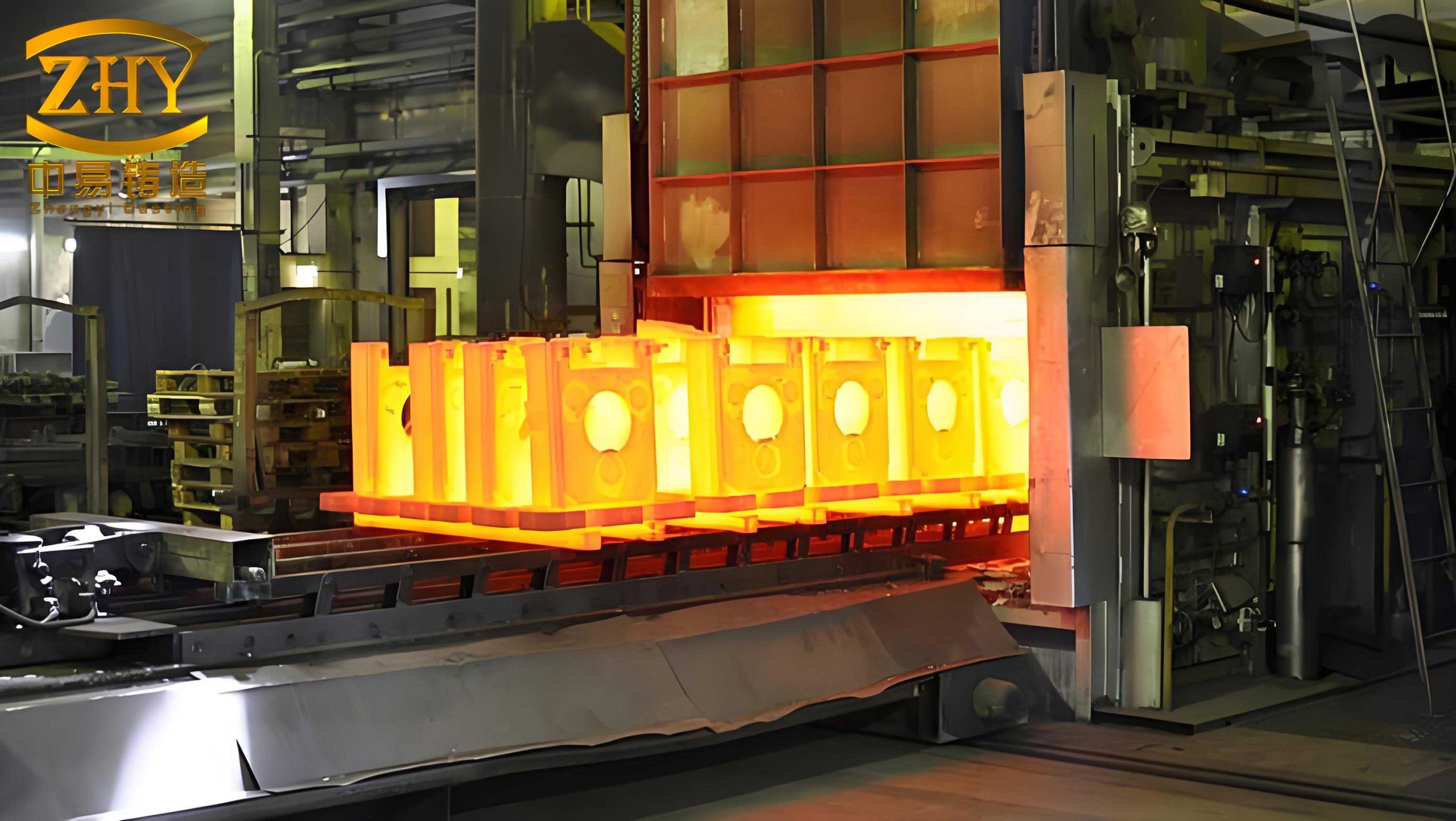
The image above conceptually illustrates various **heat treatment defects**, such as distortion, cracking, and inhomogeneous microstructure, which the controlled parameters in semi-solid squeeze casting aim to avoid. The dense starting structure of these castings is inherently less susceptible to defects like blistering, allowing focus on optimizing precipitation for strength.
Mechanical Performance and Statistical Evaluation
The tensile test results, as compiled in Table 2, show a notable variation in properties based on the heat treatment parameters. To quantify the influence of each factor, a range analysis (R-value) was performed on the data. The R-value represents the difference between the highest and lowest average response for a given factor across its levels; a larger R-value indicates a greater influence on the property. The results of this analysis are summarized in Table 3.
| Factor | R-value for UTS | R-value for YS | R-value for Elongation |
|---|---|---|---|
| A: Solution Temperature | 20.0 | 23.3 | 8.99 |
| B: Solution Time | 15.0 | 16.7 | 2.90 |
| C: Aging Temperature | 5.0 | 6.7 | 4.90 | D: Aging Time | 25.0 | 25.0 | 11.74 |
The analysis clearly reveals that aging time (Factor D) has the most pronounced influence on all three mechanical properties—UTS, YS, and elongation. This is followed by solution temperature (Factor A). The effect of aging time exhibits a predictable trend: properties first increase with aging time, reaching a peak (peak-aged condition), and then decrease with further aging (over-aged condition). This behavior is classic for precipitation-hardening alloys and is described by the interaction of dislocations with precipitates.
At the peak-aged condition (found at 4 hours for this alloy under the tested parameters), a critical dispersion of coherent precipitates exists. The strengthening mechanism is primarily governed by dislocations shearing through the precipitates. The increase in strength, \(\Delta \tau\), due to this mechanism can be approximated by:
$$ \Delta \tau \propto f^{m} r^{n} $$
where \(f\) is the volume fraction of precipitates, \(r\) is their average radius, and \(m\) and \(n\) are positive exponents. At peak age, the product \(f^{m} r^{n}\) is optimized. The stress required for dislocation shear is high, maximizing strength. However, shearing damages the precipitate structure and creates planar slip bands, which can reduce ductility somewhat compared to the under-aged state.
With over-aging (5 hours in this study), precipitates coarsen (increasing \(r\)) and lose coherency. The dominant mechanism shifts to Orowan bypassing, where dislocations loop around the larger, non-shearable particles. The corresponding strengthening increment is given by:
$$ \Delta \tau_{Orowan} \approx \frac{Gb}{L} $$
where \(G\) is the shear modulus, \(b\) is the Burgers vector, and \(L\) is the inter-precipitate spacing. As precipitates coarsen, \(L\) increases, causing \(\Delta \tau\) to decrease, leading to a drop in strength. Furthermore, coarse, incoherent precipitates, especially when continuously distributed along grain boundaries, can severely impair ductility and fracture toughness—another critical manifestation of **heat treatment defects** stemming from improper aging.
Solution temperature’s significant influence stems from its control over solute uptake. Higher temperatures increase solid solubility and diffusion rates, described by the Arrhenius equation for diffusion coefficient \(D\):
$$ D = D_0 \exp\left(-\frac{Q}{RT}\right) $$
where \(D_0\) is a pre-exponential factor, \(Q\) is the activation energy for diffusion, \(R\) is the gas constant, and \(T\) is absolute temperature. This allows more complete dissolution of Mg₂Si particles, increasing the supersaturation and thus the potential volume fraction of strengthening precipitates during aging. However, as noted, an excessively high temperature risks creating **heat treatment defects** like grain growth or incipient melting.
The optimal combination identified, Experiment 6 (A2B3C1D2: Solution at 535°C for 6h, Aging at 195°C for 4h), successfully balanced these factors. It provided sufficient solution treatment without microstructural degradation, followed by aging to a near-peak condition. This resulted in an excellent combination of high strength and good ductility: UTS of 340 MPa, YS of 325 MPa, and elongation of 9.56%.
Conclusions: Synergy of Process and Treatment
This investigation underscores the critical interplay between the semi-solid squeeze casting process and subsequent T6 heat treatment in defining the performance of A356 aluminum alloy components. The intrinsic density of the squeeze castings, free from the gas porosity that plagues conventional die castings, provides a flawless canvas for heat treatment, effectively eliminating one major category of **heat treatment defects** from the outset.
1. The statistical analysis of the orthogonal experiment definitively shows that aging time is the most influential parameter on the ultimate tensile strength, yield strength, and elongation of heat-treated semi-solid squeeze cast A356 alloy. All three properties follow a parabolic trend with aging time, increasing to a maximum before decreasing due to over-aging.
2. Solution temperature is the second most critical factor, primarily governing the degree of solute supersaturation achievable, which sets the ceiling for potential precipitation strengthening. Its optimization is crucial to avoid the opposing **heat treatment defects** of incomplete dissolution on one hand and grain coarsening or incipient melting on the other.
3. The identified optimum heat treatment parameters (Solution: 535°C/6h; Aging: 195°C/4h) for this specific semi-solid squeeze cast material produce a fine, uniform dispersion of strengthening precipitates. This microstructure yields an outstanding balance of strength and ductility, with properties reaching 340 MPa UTS, 325 MPa YS, and 9.56% elongation.
The success of this integrated approach lies in the sequential mitigation of defects: the squeeze casting process minimizes macro- and micro-porosity, while a meticulously designed heat treatment cycle maximizes precipitation strengthening while avoiding the microstructural **heat treatment defects** associated with over-aging or excessive grain growth. This synergy enables the production of lightweight, high-integrity aluminum components capable of performing in demanding structural applications.