
In my extensive experience working with gray iron castings, cold cracking stands out as a particularly insidious defect that can compromise the integrity and performance of critical components. For gray iron castings used in applications such as turbine housings or machine tools, cold cracks often manifest in areas of high stress concentration, like the junctions between ribs and walls, leading to significant quality challenges. Unlike other defects that might be remedied through simple repairs, cold cracks in gray iron castings, especially those requiring airtightness, can be nearly fatal to the product’s functionality. This article delves into the mechanisms behind cold cracking in gray iron castings, analyzes contributing factors, and proposes practical prevention strategies. My goal is to share insights that can enhance the reliability and lifespan of gray iron castings in industrial settings.
Cold cracking in gray iron castings occurs when the casting is in its elastic state, and the internal casting stress surpasses the tensile strength of the material. These cracks typically appear in regions under tension, often where stress concentrators exist, such as sharp corners or intersections of structural elements. In gray iron castings, the fracture surface of a cold crack is usually straight or smoothly curved, with a clean, metallic shine or slight oxidation, indicating a transgranular fracture pattern rather than intergranular. This is a direct result of excessive casting stress. To understand cold cracking in gray iron castings, one must first grasp the origins of casting stress, which I categorize into three primary types: thermal stress, transformation stress, and contraction stress.
Thermal stress arises due to differential cooling rates across a casting. In gray iron castings, variations in wall thickness cause some sections to cool and contract faster than others. This non-uniform contraction generates internal forces because the faster-cooling regions constrain the slower-cooling ones. The stress magnitude can be approximated by the formula: $$\sigma_{th} = E \cdot \alpha \cdot \Delta T$$ where $\sigma_{th}$ is the thermal stress, $E$ is the elastic modulus of the gray iron, $\alpha$ is the coefficient of thermal expansion, and $\Delta T$ is the temperature difference between different parts of the casting. For gray iron castings, the graphite flakes provide some stress relief via micro-yielding, but in complex geometries, thermal stress can still accumulate to critical levels.
Transformation stress, specific to ferrous alloys like gray iron castings, results from phase changes during cooling. As gray iron castings cool through the eutectoid transformation temperature, austenite decomposes into ferrite and graphite. If this transformation occurs non-uniformly due to temperature gradients, the associated volume changes (expansion during graphite precipitation) can induce stress. In some cases, if cooling is rapid enough to form martensite, additional transformation stress arises. The stress from phase transformation can be modeled as: $$\sigma_{tr} = K \cdot \Delta V$$ where $\sigma_{tr}$ is the transformation stress, $K$ is a constraint factor dependent on casting geometry, and $\Delta V$ is the volume change per unit volume during phase transformation. For gray iron castings, the graphite expansion can partially offset shrinkage, but imbalance leads to stress.
Contraction stress, also known as mechanical stress, occurs when the solidifying casting’s linear shrinkage is hindered by external obstacles, such as rigid sand cores or molds. In gray iron castings, this stress is always tensile and can directly initiate cracks if the mold’s resistance is high. Improving the collapsibility of molds and cores is a key strategy to minimize contraction stress in gray iron castings.
To summarize these stress types and their impacts on gray iron castings, I have compiled the following table:
| Stress Type | Cause | Effect on Gray Iron Castings | Typical Prevention |
|---|---|---|---|
| Thermal Stress | Non-uniform cooling due to section thickness variations | Builds up internal tension in faster-cooling regions; can lead to cracks in thick-thin junctions | Design uniform wall thickness; use chills to control cooling |
| Transformation Stress | Differential phase transformation (e.g., eutectoid reaction) | Adds stress from volume changes; exacerbated by rapid cooling | Control cooling rate; ensure proper inoculation |
| Contraction Stress | External restraint from molds/cores during solid shrinkage | Direct tensile stress on casting surface; often causes cracks at hot spots | Use high-venting molds; optimize core sand composition |
The formation of cold cracks in gray iron castings is not merely a stress phenomenon; it is influenced by a multitude of factors related to melting, processing, and composition. From my observations, the following elements play critical roles in predisposing gray iron castings to cold cracking.
First, superheating temperature and holding time of the molten iron are crucial. While superheating helps purify the melt and refine grains, excessive temperatures or prolonged holding can degrade heterogeneous nucleation sites. This reduces the nucleation potential, leading to increased shrinkage during solidification and higher thermal stress. For gray iron castings, I recommend limiting superheating to 50-100°C above the liquidus temperature and holding for no more than 30 minutes to preserve nucleation capacity.
Second, inoculation practices are vital. Inoculation introduces foreign nuclei that promote simultaneous solidification, reducing transformation stress. Inadequate or uneven inoculation, or inoculation fade, can weaken this effect. Using long-lasting inoculants, such as those containing strontium or rare earth elements, can maintain efficacy in gray iron castings. The effectiveness of inoculation can be quantified by the change in eutectic cell count: $$N = N_0 \cdot e^{-kt}$$ where $N$ is the number of eutectic cells after time $t$, $N_0$ is the initial cell count post-inoculation, and $k$ is a fade constant dependent on the inoculant type.
Third, chemical composition significantly affects cold cracking in gray iron castings. Carbon content is a double-edged sword: higher carbon increases liquid contraction but also boosts graphite expansion, which can compensate for shrinkage. Phosphorus is particularly harmful; levels above 0.03% promote brittle phosphide networks that act as stress concentrators. The table below expands on key elements:
| Element | Role in Gray Iron Castings | Optimal Range (wt.%) | Impact on Cold Cracking |
|---|---|---|---|
| Carbon (C) | Promotes graphite formation; affects shrinkage | 3.1–3.4 | Lower C increases tensile strength but raises shrinkage risk; balance is key |
| Silicon (Si) | Graphitizer; influences matrix structure | 1.8–2.4 | Higher Si enhances graphitization, reducing stress |
| Phosphorus (P) | Forms hard phosphides | < 0.03 | Elevated P drastically increases brittleness and crack susceptibility |
| Manganese (Mn) | Neutralizes sulfur; strengthens matrix | 0.5–0.8 | Moderate Mn improves toughness but excess can segregate |
| Sulfur (S) | Combines with Mn to form inclusions | < 0.12 | High S reduces fluidity and promotes inclusions that initiate cracks |
Liquid contraction values for gray iron castings vary with carbon content, as shown in this derived table (based on typical data):
| Carbon Content (wt.%) | Liquid Contraction Volume (%) | Notes for Gray Iron Castings |
|---|---|---|
| 3.0 | 4.0–4.5 | Higher contraction, but graphite expansion may offset |
| 3.2 | 3.5–4.0 | Often optimal for balancing strength and shrinkage |
| 3.4 | 3.0–3.5 | Lower contraction, but risk of reduced mechanical properties |
The relationship between carbon content and liquid shrinkage can be expressed as: $$V_{sh} = a \cdot C + b$$ where $V_{sh}$ is the volumetric shrinkage percentage, $C$ is the carbon content in weight percent, and $a$ and $b$ are constants dependent on other alloying elements. For typical gray iron castings, $a \approx -0.5$ and $b \approx 5.5$ within the carbon range of 3.0–3.5%.
Fourth, pouring temperature directly influences stress development. Higher pouring temperatures increase the total heat that must be dissipated, leading to greater thermal gradients and stress. For most gray iron castings, I advocate for a controlled pouring temperature range of 1280–1320°C, tailored to section thickness. The thermal gradient $\nabla T$ can be estimated as: $$\nabla T = \frac{T_{pour} – T_{solidus}}{L^2}$$ where $L$ is a characteristic length related to casting geometry. Lower $\nabla T$ reduces thermal stress in gray iron castings.
Fifth, charge makeup, particularly the scrap steel ratio, affects crack propensity. High steel scrap additions elevate the melting point and reduce graphitization, increasing shrinkage and stress. In gray iron castings, limiting steel scrap to 20–30% of the charge, with the rest being foundry returns and pig iron, can improve crack resistance.
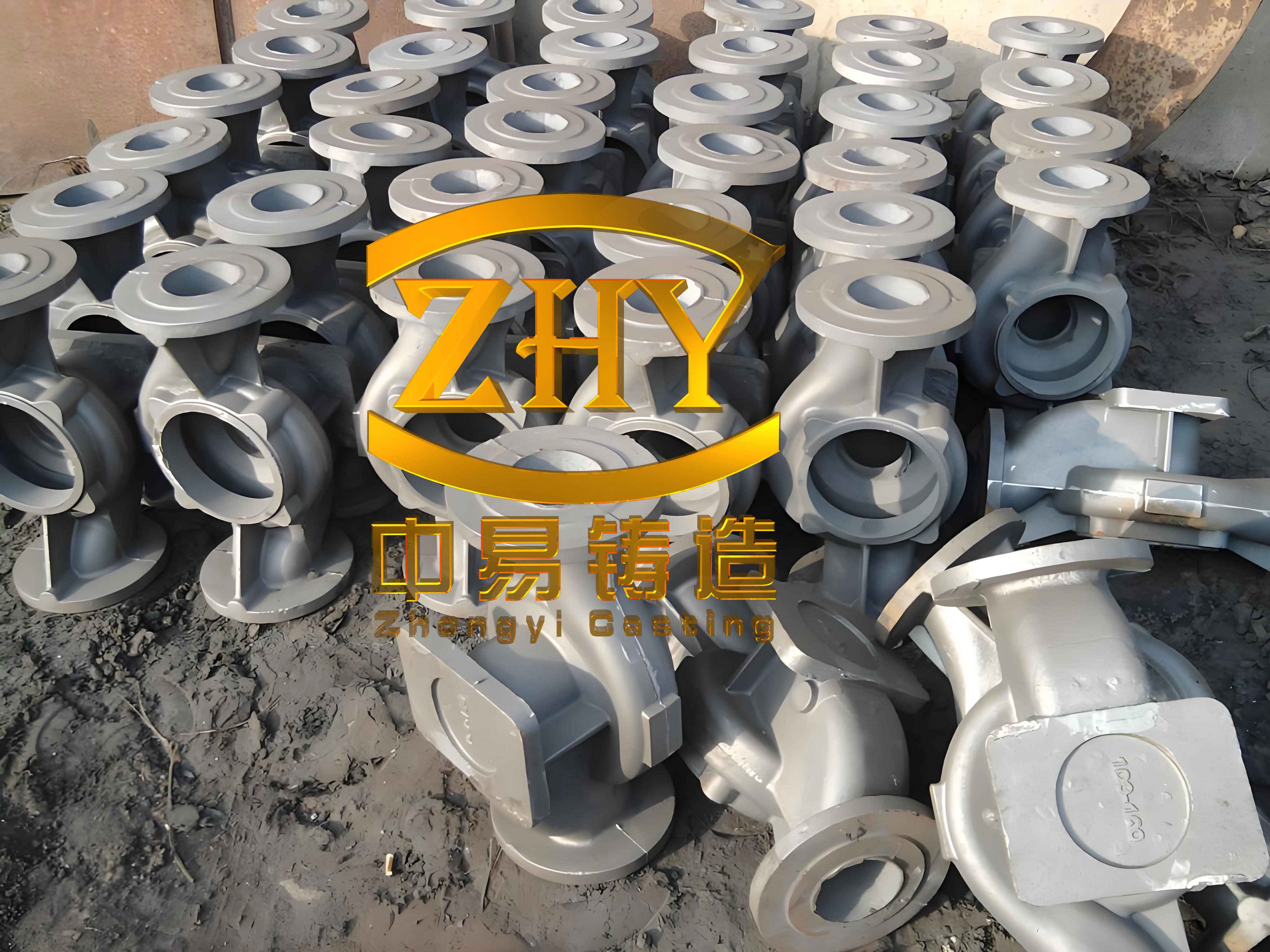
Having identified these factors, I have developed and implemented preventive measures for gray iron castings in production environments. The approach is multifaceted, targeting both casting and melting processes. For instance, in a case involving a large turbine rear cylinder—a complex gray iron casting weighing 20 tons with intersecting ribs and thick-thin transitions—cold cracks were observed originating from flash lines and propagating into the cylinder walls. This was attributed to stress concentration at the flash, compounded by high internal stress.
The corrective actions for these gray iron castings included: (1) Tightening carbon control to 3.10–3.20% and phosphorus to below 0.04%; (2) Implementing a two-stage inoculation process with a trough feeder to ensure uniformity, plus floating silicon in the ladle to counteract fade; (3) Setting pouring temperature at 1290–1310°C; (4) Applying chills at hot spots where ribs meet walls to equalize cooling; (5) Adding reinforcement ribs (tie bars) to strengthen vulnerable areas; (6) Extending mold shakeout time from 120 to 168 hours to allow slower cooling in the mold; and (7) Optimizing stress-relief annealing cycles, typically heating to 500–550°C for 2–4 hours followed by slow cooling. These measures collectively reduced thermal and transformation stresses in the gray iron castings, eliminating cold cracks.
To generalize, preventing cold cracking in gray iron castings requires a holistic strategy. From the casting process perspective, design modifications are essential. This includes using generous fillet radii at intersections, incorporating compensating pads or ribs, and optimizing gating and risering to promote directional solidification where needed. In gray iron castings, it is also beneficial to employ mathematical modeling to simulate stress distribution. The total casting stress $\sigma_{total}$ can be expressed as a superposition: $$\sigma_{total} = \sigma_{th} + \sigma_{tr} + \sigma_{c}$$ where $\sigma_{c}$ is the contraction stress. Minimizing $\sigma_{total}$ below the ultimate tensile strength (UTS) of the gray iron is key. The UTS for gray iron castings typically ranges from 150 to 350 MPa, depending on grade.
From the melting standpoint, consistency is paramount. Maintaining a stable carbon equivalent (CE) is critical for gray iron castings, calculated as: $$CE = C + \frac{Si + P}{3}$$ For most gray iron castings, a CE between 3.8 and 4.2 ensures good fluidity and graphitization without excessive shrinkage. Additionally, using high-quality raw materials and monitoring trace elements like lead and tin (which should be kept below 0.005% each) can prevent embrittlement.
Annealing treatments specifically for gray iron castings involve heating to temperatures below the eutectoid to relieve residual stresses without affecting microstructure. The stress relief $\Delta \sigma$ over time $t$ at temperature $T$ follows an exponential decay: $$\Delta \sigma = \sigma_0 \cdot e^{-Q/RT}$$ where $\sigma_0$ is the initial stress, $Q$ is an activation energy, and $R$ is the gas constant. For gray iron castings, a typical cycle is 550°C for 1 hour per inch of thickness.
In conclusion, cold cracking in gray iron castings is a multifaceted issue rooted in casting stress interplay with material properties. Through my work, I have found that a proactive approach—combining optimized chemistry, careful process control, and intelligent design—can significantly mitigate risks. Gray iron castings are indispensable in many industries, and their reliability hinges on understanding and addressing cold crack mechanisms. By sharing these insights, I hope to contribute to improved manufacturing practices for gray iron castings worldwide. Remember, prevention is always more economical than repair when it comes to gray iron castings, and continuous monitoring and adaptation are key to success in producing high-integrity gray iron castings.