
In my extensive experience as a welding engineer, I have consistently faced the daunting task of repairing large cast iron parts, which are ubiquitous in industrial machinery, agricultural equipment, and infrastructure. These cast iron parts, particularly gray cast iron, constitute up to 50-60% of the total weight in many machines due to their excellent castability, vibration damping, and wear resistance. However, their inherent brittleness, low tensile strength, and poor plasticity make them highly susceptible to cracking under thermal or mechanical stress, rendering welding a critical yet challenging endeavor. For decades, the welding community has grappled with the weldability issues of cast iron parts, often resorting to expensive specialty electrodes. Through practical experimentation and theoretical analysis, I have explored and refined the cold welding process using low-cost structural steel electrodes for large cast iron parts, achieving significant economic savings while maintaining functional integrity. This article synthesizes my firsthand insights, supported by metallurgical principles, empirical data, and procedural details, to elucidate a viable methodology for welding cast iron parts.
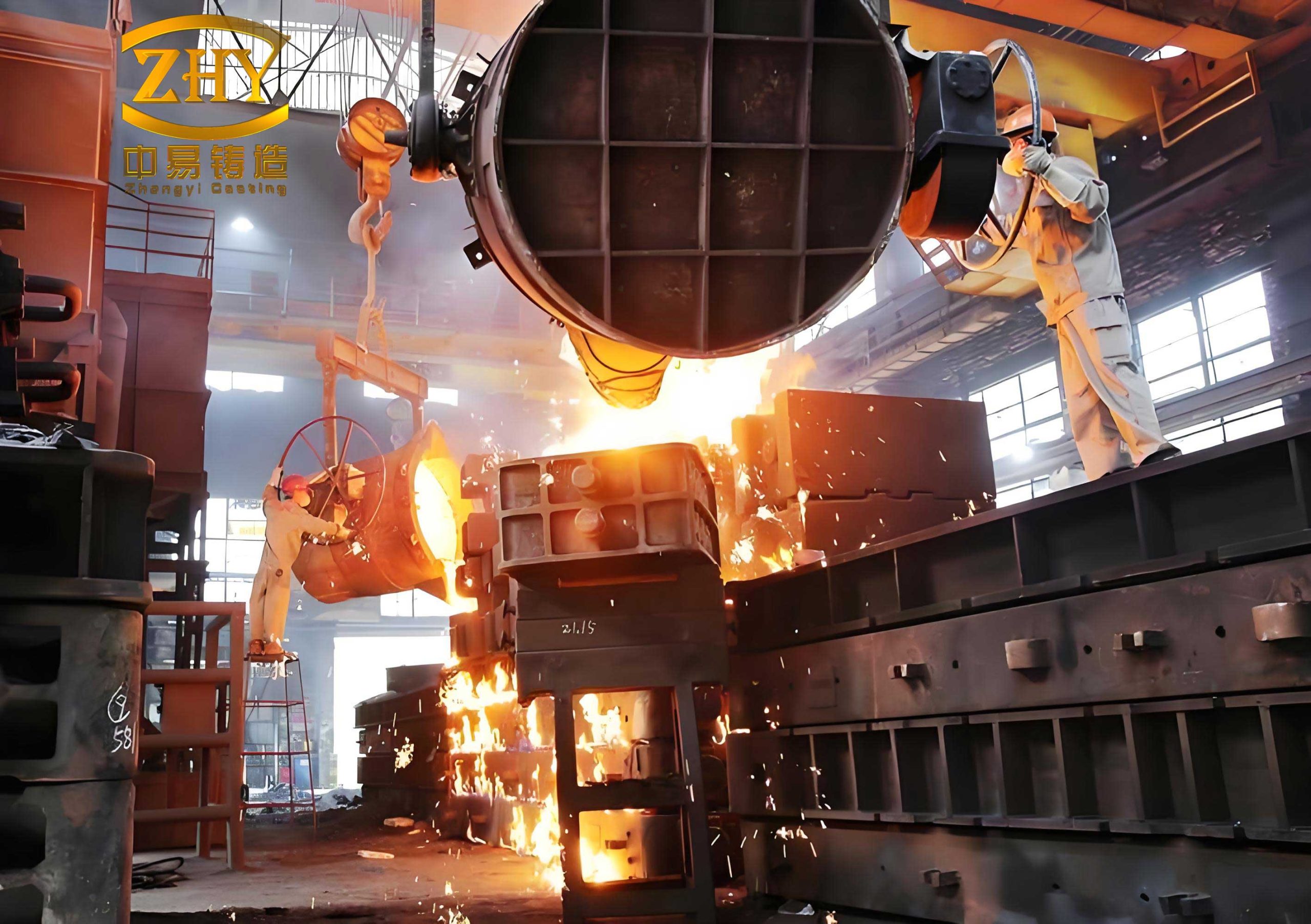
The fundamental challenge in welding cast iron parts stems from their unique microstructure and composition. Gray cast iron contains graphite flakes embedded in a ferritic or pearlitic matrix, which introduce stress concentrators and reduce ductility. During welding, the rapid thermal cycles induce several detrimental phenomena: the formation of hard and brittle white iron (chilled) layers in the heat-affected zone (HAZ), the development of cracks due to thermal stresses and martensitic transformation, and the occurrence of porosity and slag inclusions from impurities. These defects are exacerbated in cold welding, where preheating is minimized or omitted to avoid distortion and reduce costs. My analysis begins with a detailed examination of these issues, using mathematical models to quantify the risks. For instance, the cooling rate $R$ in the weld zone, a critical factor for white iron formation, can be approximated by:
$$R = \frac{2\pi k (T – T_0)^2}{Q/v}$$
where $k$ is the thermal conductivity, $T$ is the peak temperature, $T_0$ is the ambient temperature, $Q$ is the heat input, and $v$ is the welding speed. High $R$ values promote metastable cementite (Fe$_3$C) formation instead of graphite, leading to white iron. The thickness of the white iron layer $d_w$ correlates with the carbon diffusion length:
$$d_w \approx \sqrt{D_c \cdot t_c}$$
where $D_c$ is the carbon diffusion coefficient and $t_c$ is the time in the critical temperature range (approximately 1150°C to 750°C). To mitigate this, reducing heat input and using intermittent welding are essential, as I have validated in practice.
Cracking in cast iron parts during welding primarily arises from tensile stresses exceeding the material’s low fracture toughness. The residual stress $\sigma_{res}$ after welding can be modeled using thermo-elasto-plastic theory:
$$\sigma_{res} = E \left[ \alpha \Delta T – \epsilon_p \right]$$
where $E$ is Young’s modulus, $\alpha$ is the coefficient of thermal expansion, $\Delta T$ is the temperature drop, and $\epsilon_p$ is the plastic strain. For cast iron, $\alpha \approx 12 \times 10^{-6}$ /°C and $E \approx 110$ GPa, but the low ductility limits $\epsilon_p$, causing stress accumulation. Additionally, hydrogen-induced cracking can occur if moisture is present, with the critical stress intensity factor $K_{IH}$ for cast iron being relatively low. To address these, I emphasize stress relief techniques such as peening and controlled deposition sequences.
In selecting electrodes for welding cast iron parts, a comparison between specialty cast iron electrodes and structural steel electrodes reveals stark trade-offs. The table below summarizes key properties based on my evaluations:
| Electrode Type | Typical Composition | Advantages for Cast Iron Parts | Disadvantages for Cast Iron Parts | Relative Cost Index |
|---|---|---|---|---|
| Nickel-based (e.g., ENi-CI) | High Ni (90-95%), low C | Excellent machinability, minimal white iron layer (0.1-0.3 mm), good crack resistance | Very high cost, poor wetting and fluidity, limited diameter variety | 10.0 |
| Nickel-iron (e.g., ENiFe-CI) | Ni (40-50%), Fe balance | Good strength, reduced white iron, moderate machinability | High cost, potential for hot cracking | 7.5 |
| Structural steel (e.g., E7018, E6013) | Low C steel (0.1% C), basic or rutile coating | Low cost, excellent availability, wide diameter range, good fusion with cast iron parts | Promotes white iron and martensite, high risk of cracking, poor machinability | 1.0 |
As shown, structural steel electrodes are economically attractive but technically inferior due to their lack of graphitizing elements (e.g., C, Si). This leads to carbon migration from the cast iron parts into the weld metal, increasing hardness. The carbon content in the weld $C_w$ can be estimated from the dilution ratio:
$$C_w = \frac{C_m \cdot A_m + C_e \cdot A_e}{A_m + A_e}$$
where $C_m$ and $C_e$ are carbon contents of the base metal and electrode, and $A_m$ and $A_e$ are the cross-sectional areas melted. For typical gray cast iron (3-4% C) and mild steel electrode (0.1% C), even with 20% dilution, $C_w$ exceeds 0.6%, leading to martensite upon rapid cooling. The hardness $H$ of such a microstructure follows a relationship with carbon content and cooling rate:
$$H \approx 1667 \cdot C_w + 50 \cdot \log(R)$$
where $H$ is in Vickers hardness. Values above 400 HV are common, exacerbating cracking susceptibility. Therefore, my approach focuses on process modifications to compensate for these material deficiencies.
The core of my methodology for welding cast iron parts with structural steel electrodes revolves around precise control of thermal cycles and stress management. I have codified this into a set of principles: “short, intermittent, and dispersed welds; low current with shallow penetration; post-weld peening for stress relief; and annealing passes to soften layers.” Each principle targets a specific defect mechanism. For example, short welds (20-30 mm length) limit heat accumulation, reducing the HAZ width and white iron thickness. The interpass temperature is kept below 60°C to minimize overall heat input. To quantify, I often use a parameter $P$ combining heat input and deposition rate:
$$P = \frac{Q}{L_d} = \frac{VI}{v \cdot L_d}$$
where $V$ is voltage, $I$ is current, $v$ is travel speed, and $L_d$ is deposit length per segment. For cast iron parts, I maintain $P < 500$ J/mm² to avoid excessive dilution. Peening after each pass induces compressive surface stresses, offsetting tensile stresses. The peening efficacy $\eta_p$ can be expressed as:
$$\eta_p = 1 – \frac{\sigma_{after}}{\sigma_{before}}$$
where $\sigma_{before}$ and $\sigma_{after}$ are residual stresses measured via strain gauges or simulation. In my trials, $\eta_p$ ranges from 0.3 to 0.6, significantly lowering crack risk.
For large cast iron parts with thick sections, I employ a multi-layer technique with strategic sequencing. The table below outlines a typical procedure for a 20 mm thick cast iron part crack repair:
| Welding Step | Electrode Specification | Current (DCEN or DCEP) | Key Technique | Purpose |
|---|---|---|---|---|
| Surface cleaning | N/A | N/A | Grinding, degreasing, preheating to 40°C max | Remove oil, graphite, and oxides |
| Groove preparation | N/A | N/A | U-groove, 60° included angle, 1 mm root face | Minimize weld volume |
| Root pass | E7018, 2.5 mm diameter | 80-100 A (DCEN for E7018) | Short beads (10-15 mm), skip welding, immediate peening | Minimize dilution, control white iron |
| Intermediate passes | E7018, 3.2 mm diameter | 100-120 A | Staggered deposition, peening each layer | Build up thickness, anneal underlying layers |
| Cover passes | E6013, 4.0 mm diameter | 120-140 A (DCEP) | Slow travel speed, weave pattern | Provide soft overlay, reduce stress concentration |
| Post-weld | N/A | N/A | Insulated cooling, final peening, inspection | Prevent thermal shocks, verify integrity |
This procedure emphasizes low heat input in initial passes to restrict carbon pickup, followed by higher heat in later passes to temper earlier deposits. The annealing effect from subsequent layers modifies the microstructure, as described by the tempering parameter $M$:
$$M = T \cdot (\log t + 20)$$
where $T$ is temperature in Kelvin and $t$ is time in hours. For martensite in the weld, $M$ values above 15,000 promote softening to ferrite and cementite. In practice, I observe hardness reductions from 500 HV to 300 HV after three layers, improving toughness.
To illustrate, I recall a project involving the repair of a massive gearbox housing, a critical cast iron part weighing over 2 tons, with a complex network of cracks totaling 3 meters in length. The housing operated in an oily environment, presenting challenges of contamination and previous failed weld attempts. Using structural steel electrodes (E7018 for most passes, E6013 for cover), I applied the above methodology meticulously. First, I mechanically gouged the cracks to create a U-groove, then used oxy-fuel torches to burn off embedded oil—a step crucial for preventing porosity. For the root passes, I employed 2.5 mm electrodes at 90 A, depositing 20 mm segments at a time, with intervals to keep the temperature low. Each segment was peened using a needle scaler while still warm. The welding sequence was designed to maximize freedom of contraction: I started from the ends of each crack, working inward, and avoided continuous runs across constraints. To enhance strength, I integrated reinforcement bars (threaded studs) into the design, drilling and tapping holes along the groove edges, then welding them in place to act as bridging elements. The stress distribution around such studs can be modeled as:
$$\sigma_r = \frac{F}{A_s} \left(1 + \frac{r^2}{R^2}\right)$$
where $F$ is the load, $A_s$ is the stud cross-section, $r$ is the radial distance, and $R$ is the effective radius of the repaired zone. This approach distributed stresses away from the fusion line, reducing crack propagation risk. After completing the weld, I performed dye penetrant testing and pressure testing at 0.5 MPa to ensure leak tightness—the housing successfully returned to service with no failures over two years of operation.
Quality assurance when welding cast iron parts with structural steel electrodes hinges on rigorous inspection and adaptation. I recommend non-destructive testing (NDT) methods like ultrasonic testing to detect subsurface flaws, especially in thick sections. For critical cast iron parts, mechanical properties can be estimated using empirical correlations. For instance, the approximate tensile strength $\sigma_t$ of the weld metal correlates with hardness:
$$\sigma_t \text{ (MPa)} \approx 3.15 \times H_V$$
where $H_V$ is Vickers hardness. Achieving $H_V$ below 350 in the weld zone is desirable for some applications, though machinability remains limited due to the persistent white iron layer. In my experience, the white iron thickness $d_w$ can be kept under 0.5 mm with proper technique, which may be acceptable for non-machined surfaces. The following table summarizes defect control measures based on my observations:
| Defect Type | Root Cause in Cast Iron Parts | Preventive Measure | Corrective Action if Occurred |
|---|---|---|---|
| White iron layer | High cooling rate, low graphitizers | Minimize heat input, use small electrodes, preheat slightly (40-60°C) | Grinding removal, or overlay with nickel electrode |
| Cracks (hot or cold) | Thermal stresses, martensite, hydrogen | Peening, intermittent welding, low-hydrogen electrodes (E7018), dry electrodes | Gouge out crack, re-weld with tighter parameters |
| Porosity | Oil, moisture, gas entrapment | Thorough cleaning, baking electrodes, proper arc length | Drill out pores, weld fill with care |
| Slag inclusions | Poor fusion, improper technique | Correct angle, adequate current, slag removal between passes | Remove via grinding, re-weld |
Economic analysis further underscores the value of this approach. For large cast iron parts, the cost savings from using structural steel electrodes versus nickel-based electrodes can exceed 80%, as material costs dominate repair budgets. The total cost $C_{total}$ for welding cast iron parts includes electrode cost $C_e$, labor $C_l$, and overhead $C_o$:
$$C_{total} = N_e \cdot p_e + t_w \cdot r_l + C_o$$
where $N_e$ is the number of electrodes, $p_e$ is price per electrode, $t_w$ is welding time, and $r_l$ is labor rate. Structural steel electrodes reduce $N_e \cdot p_e$ significantly, though $t_w$ may increase due to careful procedures. Overall, the benefit is substantial, making repair feasible for many otherwise scrapped cast iron parts.
In conclusion, cold welding of large cast iron parts using structural steel electrodes is a viable and economically compelling technique when executed with meticulous process control. My firsthand experience demonstrates that by understanding the metallurgical pitfalls—such as white iron formation and stress cracking—and compensating through optimized welding parameters, sequence design, and stress-relief practices, acceptable weld quality can be achieved for many industrial applications. While not suitable for highly machined or critically stressed cast iron parts without post-weld heat treatment, this method extends the service life of costly components with minimal investment. The key lies in respecting the material’s limitations, adapting techniques to each specific cast iron part, and rigorously validating outcomes. As industries seek cost-effective maintenance solutions, mastering this approach can yield significant dividends, preserving valuable assets and reducing downtime. Future advancements in electrode coatings or hybrid processes may further bridge the performance gap, but even with current technology, structural steel electrodes offer a pragmatic solution for welding cast iron parts.