
In my years of experience at a foundry specializing in pressure filtration equipment, one of the most persistent and costly challenges we faced was the issue of porosity in casting. Specifically, our production of large filter plates made from HSi80-3 silicon brass was plagued by gas-related defects, leading to alarming scrap rates and failed pressure tests. This article is a comprehensive account of our investigative journey and the systematic measures we implemented to understand and ultimately control porosity in casting. The fight against porosity in casting is not merely a technical adjustment; it is a fundamental re-evaluation of the entire process chain, from furnace to finished mold.
The filter plate castings, critical components for beer filtration machines, have substantial dimensions and require extensive machining. Their non-porous integrity is paramount, as they must withstand rigorous hydrostatic testing. For a long period, our scrap rate hovered at unacceptable levels, with porosity in casting accounting for the dominant share of defects. This prompted a deep-rooted analysis to identify the dual sources of gas that lead to porosity in casting: intrinsic gas within the molten alloy and gases generated through violent metal-mold interactions.
The phenomenon of porosity in casting in silicon brass is particularly insidious due to the alloy’s composition. The primary gases dissolved in the melt are hydrogen, oxygen, and carbon monoxide. Hydrogen, with its high solubility in liquid copper and drastically reduced solubility upon solidification, is a prime culprit. The solubility relationship can be approximated by Sieverts’ law: $$ C_H = K_H \sqrt{P_{H_2}} $$ where $C_H$ is the concentration of dissolved hydrogen, $K_H$ is the equilibrium constant (temperature-dependent), and $P_{H_2}$ is the partial pressure of hydrogen in the atmosphere. During solidification, the sudden drop in solubility causes hydrogen to precipitate out, forming pinholes or subsurface porosity in casting.
Furthermore, the highly reactive elements in silicon brass, namely zinc and silicon, engage in a redox reaction with moisture present in the green sand mold. This metal-mold reaction is a prolific generator of hydrogen gas right at the casting interface, directly contributing to surface and subsurface porosity in casting. The principal chemical reactions are as follows:
$$ \text{Zn (l)} + \text{H}_2\text{O (g)} \rightarrow \text{ZnO (s)} + \text{H}_2 (g) $$
$$ \text{Si (in melt)} + 2\text{H}_2\text{O (g)} \rightarrow \text{SiO}_2 (s) + 2\text{H}_2 (g) $$
The generated hydrogen can either immediately form bubbles or dissolve into the liquid metal skin, only to be rejected later during solidification, exacerbating the problem of porosity in casting. The intensity of this reaction is a function of several variables, which we will explore in detail.
To systematically break down the contributors to porosity in casting, we can categorize them into process stages. The following table summarizes the key sources and mechanisms that lead to gas entrapment and pore formation.
| Process Stage | Gas Source | Mechanism | Resulting Porosity Type |
|---|---|---|---|
| Melting & Holding | Atmosphere, Wet Charge, Refractory, Tools | Dissolution of H2, O2, CO in superheated melt. | Distributed micro-porosity, pinholes. |
| Metal-Mold Interaction | Mold Moisture (H2O) | Redox reactions with Zn and Si, releasing H2. | Subsurface blowholes, surface pitting, slag inclusions. |
| Solidification | Precipitated Dissolved Gases | Reduced gas solubility during phase change causing bubble nucleation and growth. | Shrinkage-gas combined porosity, interdendritic pores. |
Our strategy to eliminate porosity in casting was therefore bifurcated, targeting both the reduction of the melt’s initial gas content and the strict control of the metal-mold reaction environment. These are not independent strategies but are deeply interconnected; a melt with high inherent gas content is far more susceptible to triggering severe porosity from even minor mold reactions.
Reducing the Initial Gas Content of the Alloy
The battle against porosity in casting begins at the furnace. We use medium-frequency induction furnaces, which, while efficient, require meticulous practice to prevent gas pickup. Every material that contacts the molten metal is a potential source of gas. We instituted a rigorous protocol: all charge materials (ingots, returns) must be clean and preheated to above 150°C to drive off surface moisture and adsorbed gases. Crucibles and ladles are subjected to a prolonged baking cycle until they achieve a uniform, deep red heat, ensuring no residual moisture exists in the refractory lining. Covering fluxes, essential for protecting the melt from oxidation, are now dried in an oven at 250°C for at least two hours before use.
The melting sequence was critically revised. Zinc’s role is dual: it is an alloying element and a powerful deoxidizer. Its high vapor pressure creates a protective blanket. Our previous practice of adding the majority of zinc in the ladle was wasteful of this property. We now maintain a minimum zinc content of 20% in the furnace melt. This ensures a sufficient zinc vapor pressure during melting, which helps sweep hydrogen from the melt and reduces oxidation. The remaining zinc is added in the ladle just before pouring. The temperature control is paramount. We strictly enforce a maximum pouring temperature of 1180°C, measured with a calibrated thermocouple. Superheating above this temperature exponentially increases the solubility of gases, directly feeding the problem of porosity in casting. If a delay in pouring is unavoidable, we allow the melt to cool and solidify in the furnace, remelting it shortly before casting, rather than holding it in a superheated state for extended periods.
Controlling the Metal-Mold Reaction
Even with a optimally degassed melt, porosity in casting can be introduced at the final moment—during pouring and solidification within the mold. The three pillars of controlling the metal-mold reaction are: pouring temperature, mold moisture/dryness, and mold/core permeability. Their interplay is complex, but mastering it is the key to sound castings.
Pouring Temperature: This is the most sensitive lever. A high pouring temperature increases the kinetics of the Zn/Si-H2O reaction, raises the water vapor pressure in the mold, and increases the metal’s capacity to absorb the generated hydrogen. We conducted a series of experiments tracking riser behavior, a reliable indicator of gas content. A casting poured at 1200°C consistently showed a swollen, rising riser, while one from the same ladle poured at 1120°C showed normal shrinkage. The thermal gradient can be modeled to show how higher temperature increases the reaction zone depth: $$ \delta \propto \sqrt{\alpha t} $$ where $\delta$ is the penetration depth of the reaction, $\alpha$ is the thermal diffusivity of the mold, and $t$ is the time the interface is above the reaction threshold temperature. Higher pouring temperature extends $t$ and increases $\delta$, allowing more mold moisture to be accessed and react. Our optimal range is now firmly set at 1100-1130°C.
Mold Dryness and Moisture Control: Silicon brass is notoriously sensitive to mold moisture. We transitioned to using dry sand molds, but the drying process itself must be flawless. A mold must have a adequately thick dried skin. We specify a minimum dried layer thickness of 15mm, verified by penetration tests. Furthermore, we enforce a strict “same-day pouring” rule for molds. A mold left overnight, even in a controlled environment, can re-absorb enough atmospheric moisture to cause porosity in casting. The following table contrasts the conditions that promote or suppress mold-related porosity in casting.
| Factor | Condition Promoting Porosity | Condition Suppressing Porosity | Control Standard |
|---|---|---|---|
| Mold Moisture | High green strength moisture (>5%), insufficient drying, re-humidification. | Thorough, deep drying; moisture content <0.8% in dried layer. | Dry skin >15mm; pour within 8 hrs of molding. |
| Permeability | Low permeability sand, compacted cores, blocked vents. | High permeability sand, vented cores, porous coatings. | Green permeability >120; ample venting channels. |
| Mold Coatings | None, or coating applied to wet mold. | Refractory coating (e.g., graphite-based) applied to fully dry mold. | Uniform coating layer 0.2-0.5mm thick. |
Mold and Core Permeability: This is the escape route for generated gases. Inadequate permeability traps gases, forcing them into the metal. We reformulated our facing sand to guarantee a green permeability number greater than 120. For cores, which are often the bottleneck for gas escape, we ensure they are highly permeable and that core prints are designed to provide an unimpeded path to the atmosphere. A common pitfall is when molten metal seals the core print, turning the core into a pressure vessel. We now use larger print areas and sometimes incorporate wax vent threads that burn out during pouring.
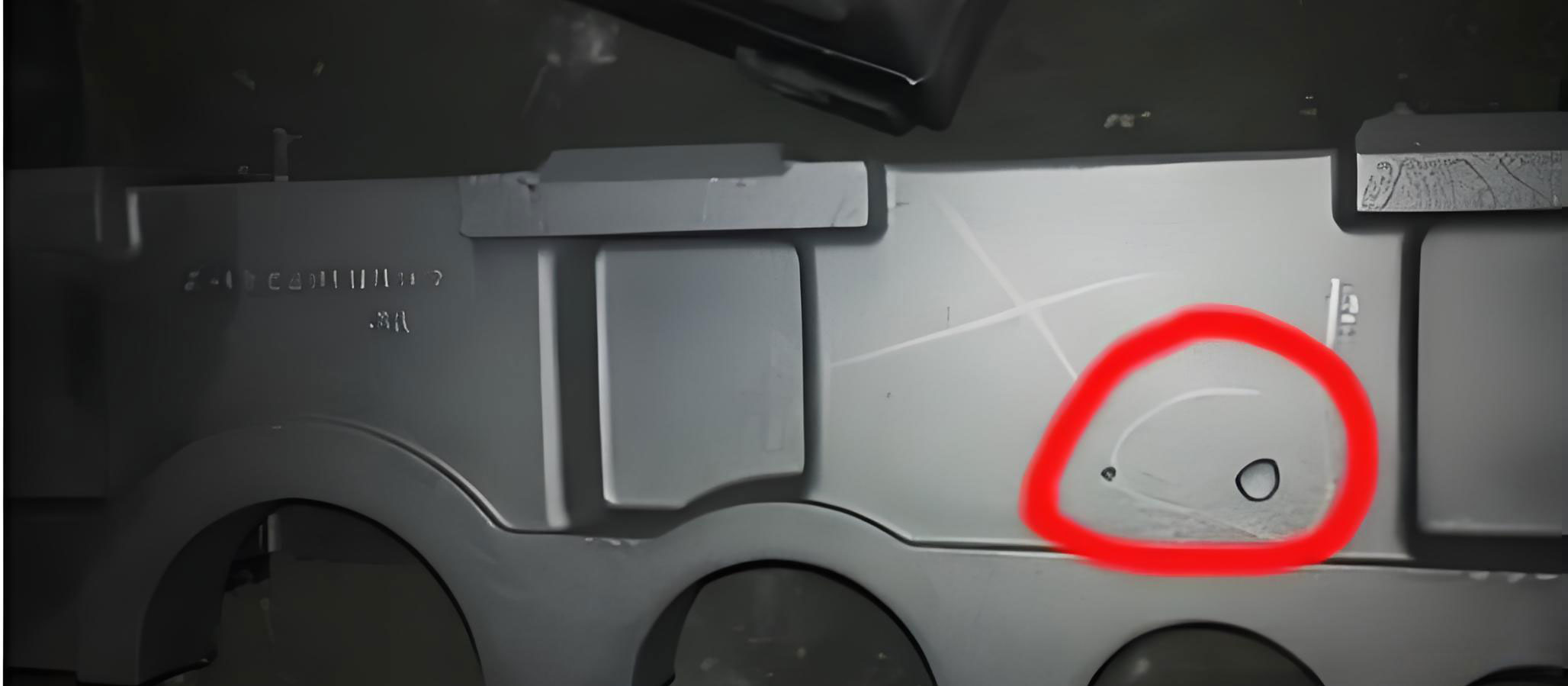
The image above provides a visual reference for the types of defects we combat—a stark reminder of the pervasive nature of porosity in casting. It underscores the importance of visual inspection and cross-sectional analysis in diagnosing the root cause, whether it’s from dissolved gases or mold reactions.
The implementation of these integrated measures transformed our production outcomes. The scrap rate due to porosity in casting, which once peaked over 30%, was systematically reduced and stabilized below 5%. The rate of plates failing pressure tests due to leakage fell from over 10% to less than 2%. This represented not just a saving in material and re-melting costs, but also a massive reduction in wasted machining hours and a significant boost in product reliability and customer confidence. The economic impact was profound, but the greater achievement was the development of a robust, repeatable process immune to the vagaries of porosity in casting.
In conclusion, the conquest of porosity in casting for silicon brass components is a holistic endeavor. It requires a steadfast commitment to melt hygiene—controlling charge materials, furnace atmosphere, and pouring temperature—coupled with an almost surgical precision in mold preparation and control. The two pillars of attack, reducing initial gas content and suppressing metal-mold reactions, are synergistic. A clean melt tolerates minor mold imperfections, and a dry, permeable mold protects even a moderately gassy melt. The key equations governing gas solubility and reaction kinetics provide the theoretical framework, but it is the relentless application of practical controls, as summarized in our process tables, that turns theory into defect-free castings. The lesson is clear: porosity in casting is not an inevitable defect; it is a process variable that can be measured, understood, and effectively eliminated.
Future work may involve more advanced degassing techniques like rotary degassing with inert gases or real-time hydrogen analysis using reduced pressure test (RPT) or Telegas methods for even tighter control. However, the fundamentals outlined here—scrupulous attention to detail in every step from the scrap bin to the shakeout—remain the indispensable foundation for preventing porosity in casting. This systematic approach has not only solved a critical production issue but has also established a culture of process excellence that extends to all our casting operations, ensuring that the challenge of porosity in casting is met with knowledge, discipline, and consistent success.