
In the realm of high-voltage power transmission and distribution, aluminum alloys have become indispensable due to their exceptional combination of lightweight properties, high strength, excellent corrosion resistance, and good formability. Within Gas Insulated Switchgear (GIS) systems, the three-position shell is a critical component, historically manufactured using conventional casting processes. As an engineer deeply involved in the development of manufacturing technologies for electrical enclosures, I have observed that these traditional methods, while established, present significant challenges in terms of production efficiency, environmental impact, and structural optimization. The pursuit of greener manufacturing and the global imperative for carbon neutrality have catalyzed innovation. This article presents a detailed, first-person analysis of a novel cast-modified-welding (cast-to-weld) process for three-position shell castings, contrasting it rigorously with the long-standing traditional casting approach. The term ‘shell castings’ will be frequently referenced to underscore the core component under discussion.
The traditional manufacturing paradigm for these shell castings predominantly utilizes ZL101 cast aluminum-silicon alloy. To understand its limitations, we must first examine its inherent material characteristics. The chemical composition of ZL101, as per common standards, is outlined below.
| Element | Si | Mg | Fe | Cu | Mn | Zn | Ti | Others (Total) | Al |
|---|---|---|---|---|---|---|---|---|---|
| Content | 6.5-7.5 | 0.25-0.45 | ≤0.5 | ≤0.2 | ≤0.35 | ≤0.3 | ≤0.25 | ≤1.1 | Balance |
This composition grants ZL101 good castability but also dictates its mechanical behavior, which varies significantly with heat treatment. The mechanical properties under different conditions can be summarized as follows.
| Casting Method | Heat Treatment State | Tensile Strength, $$R_m$$ (MPa) | Elongation, $$A$$ (%) | Hardness (HBW) |
|---|---|---|---|---|
| Sand, Permanent Mold | As-Cast (F) | ≥155 | ≥2 | ≥50 |
| Sand, Permanent Mold | T4 (Solutionized) | ≥175 | ≥4 | ≥50 |
| Permanent Mold | T5 (Artificially Aged) | ≥195 | ≥2 | ≥60 |
| Premium Quality | T6 (Solutionized & Aged) | ≥225 | ≥1 | ≥70 |
The traditional production of shell castings from ZL101 involves a complex, multi-step sequence: raw material preparation, melting, composition adjustment, refining, modification, pouring, heat treatment (like T6), and extensive post-casting machining. From my perspective, each stage is a potential source of defects that compromise the integrity of the final shell castings. The flaws are not merely superficial; they are rooted in the physics of solidification and thermal gradients. Common defects include segregation, porosity, shrinkage cavities, inclusions, and cracks. For instance, micro-segregation leads to non-uniform chemical composition, described by the non-equilibrium solidification where the solute redistribution follows the Scheil equation approximation:
$$ C_s = k C_0 (1 – f_s)^{k-1} $$
where $$C_s$$ is the solute concentration in the solid, $$C_0$$ is the initial alloy composition, $$k$$ is the partition coefficient, and $$f_s$$ is the solid fraction. This inhomogeneity directly impacts mechanical performance. Shrinkage porosity forms because the volumetric shrinkage during solidification, often around 4-6% for aluminum alloys, is not adequately fed by liquid metal. The susceptibility to hot tearing is related to the strain accumulation in the mushy zone, which can be expressed as a function of coherency temperature range and thermal stress. Furthermore, the very nature of casting often necessitates thick sections and abrupt geometric transitions to ensure mold fill and structural feasibility, leading to inherent stress concentrations. In a critical area like the perpendicular junction of two cylindrical sections in a three-position shell casting, the local stress state is complex. The stress concentration factor $$K_t$$ at such a notch can be empirically high, exacerbating the risk of failure under cyclic pressure loads. The design of these traditional shell castings is thus a compromise between castability and structural efficiency.
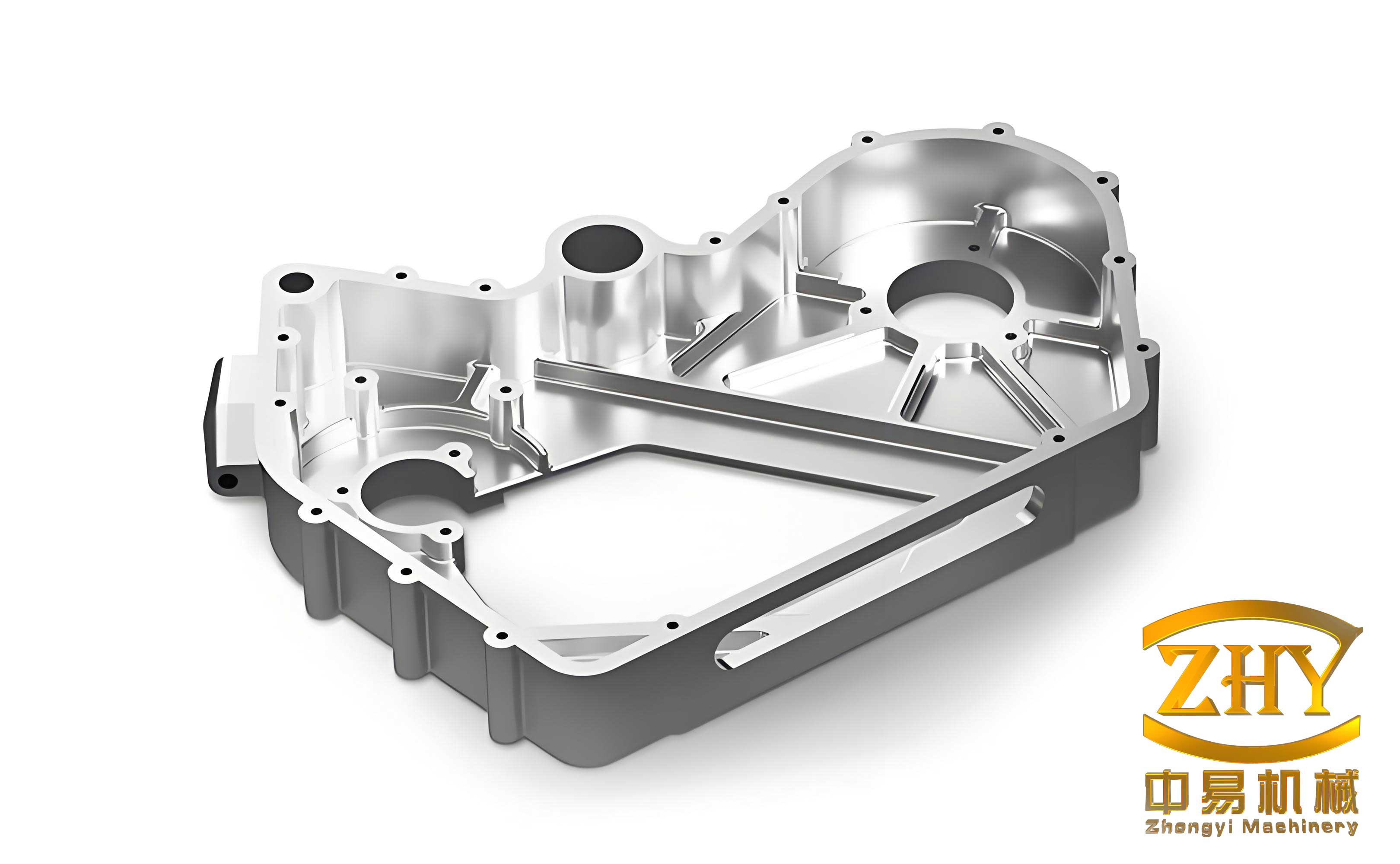
Driven by the need for a more efficient, environmentally friendly, and structurally superior solution, we have developed and implemented a cast-modified-welding process. This method abandons the monolithic casting of shell castings in favor of fabricating them from wrought aluminum alloy plates, specifically the 5XXX series Al-Mg alloys. These alloys, such as 5083 or 5052, offer a superior property profile for this application. They are non-heat-treatable and derive strength from solid solution hardening by magnesium and work hardening. Their typical yield strength ($$R_{p0.2}$$) ranges from 125 to 280 MPa, with elongation ($$A$$) often exceeding 10-15%, providing excellent toughness and plastic reserve. The key advantage lies in their superb weldability and corrosion resistance. The core of our new process is the press-forming of sheet metal into semi-shells using dedicated dies, followed by welding. The manufacturing flowchart is significantly streamlined: material certification, blanking, edge preparation (machining weld grooves), press-forming, longitudinal seam welding, flange assembly and welding, and finally testing. The press-forming stage is critical. We employ Finite Element Analysis (FEA) to simulate the deep drawing process and optimize die design to ensure uniform material flow and thickness distribution. The strain during forming can be analyzed using the theory of plasticity. For a simple axisymmetric cup drawing, the radial stress $$\sigma_r$$ and hoop stress $$\sigma_\theta$$ can be related by the yield criterion. For a material obeying von Mises yield criterion under plane stress conditions:
$$ \sigma_r^2 – \sigma_r \sigma_\theta + \sigma_\theta^2 = \bar{\sigma}^2 $$
where $$\bar{\sigma}$$ is the equivalent flow stress. Our simulations, as shown in thickness distribution contours, ensure that the thinnest areas after pressing remain well above the design minimum, eliminating the unpredictability of wall thickness in sand cast shell castings. The welding of these formed parts is performed using automated or robotic Gas Tungsten Arc Welding (GTAW) with precisely controlled heat input to minimize distortion. The primary joint is a single-V or double-V butt weld. The quality of these welds is paramount. Defects like porosity, lack of fusion, or cracks are mitigated through stringent procedure qualification and real-time monitoring. The resultant structure is a fabricated shell casting with homogeneous, wrought material properties in its body and localized, high-integrity welded joints.
To substantiate the advantages of this new approach for shell castings, a systematic comparison with traditional casting is essential. The evaluation spans multiple dimensions, which I have quantified where possible.
| Aspect | Traditional Casting Process (ZL101) | Cast-Modified-Welding Process (5XXX Al-Mg) |
|---|---|---|
| Number of Major Process Steps | ~10-12 (Melting, Pouring, Heat Treatment, Extensive Machining) | ~6-7 (Blanking, Pressing, Welding, Limited Machining) |
| Typical Production Lead Time | Long (Weeks, due to pattern making, solidification, lengthy T6 cycle) | Short (Days, rapid pressing and welding cycles) |
| Energy Consumption (Relative) | High (Melting ~660°C, Homogenization ~540°C, Aging ~150-200°C) | Lower (Heating for pressing ~300-400°C, localized welding energy) |
| CO2 & Pollutant Emissions | Substantial (Furnace emissions, sand disposal, quench waste) | Significantly Reduced (Minimal furnace use, no sand, less waste) |
| Material Utilization (Yield) | Low (60-70%, significant machining allowance required) | High (85-90%, near-net-shape forming) |
| Design Flexibility & Complexity | Limited by casting constraints (draft angles, uniform thickness) | High (Allows optimized, smooth contours and variable thickness) |
The structural superiority of the welded shell castings is perhaps the most significant technical advancement. In traditional cast shell castings, stress concentrations at sharp internal corners or abrupt section changes are inevitable. The stress concentration factor $$K_t$$ for a rectangular corner is theoretically infinite. In our fabricated design, we replace these sharp junctions with smooth, optimized transitions. For a curved transition of radius $$R$$ between two sections of thickness $$t$$, the stress concentration factor can be approximated for tension by a formula such as:
$$ K_t \approx 1 + \alpha \sqrt{\frac{t}{R}} $$
where $$\alpha$$ is a geometric constant. By increasing $$R$$, we dramatically reduce $$K_t$$, leading to a more favorable and predictable stress distribution. This is directly linked to enhanced fatigue life, which often governs the lifespan of pressure-containing shell castings. The fatigue strength improvement can be related to the reduction in local stress amplitude $$\Delta \sigma_{local}$$:
$$ \Delta \sigma_{local} = K_t \cdot \Delta \sigma_{nominal} $$
A lower $$K_t$$ directly reduces $$\Delta \sigma_{local}$$, shifting the operating condition to a safer region on the S-N curve. Furthermore, the base material itself offers better performance. Let’s compare key mechanical properties at the component level. For a traditionally cast ZL101-T6 shell casting, the tensile strength might be 225 MPa with 1% elongation. For a fabricated shell using 5083-H116 alloy, the base metal offers $$R_m$$ ~ 300 MPa and $$A$$ ~ 12%. Even considering the welded joint efficiency (often 85-95% for GTAW on 5XXX alloys), the overall component has higher toughness and damage tolerance. The superiority in corrosion resistance is also notable. The 5XXX series alloys form a more stable, protective oxide film, especially in marine or industrial atmospheres, compared to cast Al-Si alloys which can have active cathodic phases like Si or intermetallics.
The economic and environmental calculus further reinforces the value proposition of this new method for producing shell castings. The reduction in process steps translates to lower labor costs and less floor space. The shorter lead time improves responsiveness to market demands. Most importantly, aligning with global sustainability goals, the cast-modified-welding process embodies green manufacturing principles. The reduction in energy consumption per unit shell casting is substantial. If we model the total embodied energy $$E_{total}$$ as the sum of melting energy $$E_{melt}$$, thermal processing energy $$E_{therm}$$, and machining energy $$E_{machine}$$, the contrast is stark:
$$ E_{total, cast} = E_{melt} + E_{T6} + E_{heavy machine} $$
$$ E_{total, weld} = E_{press-heat} + E_{weld} + E_{light machine} $$
Given that melting aluminum is extremely energy-intensive (~13 kWh/kg), eliminating this bulk melting step for each shell casting results in dramatic primary energy savings. Furthermore, the near-net-shape forming minimizes aluminum scrap, contributing to a circular economy. The process also virtually eliminates hazardous waste associated with sand casting binders or chemical heat treatment baths. From my firsthand experience in transitioning production, the improvement in working conditions—from a hot, dusty foundry environment to a cleaner, automated press and welding shop—is equally transformative.
In conclusion, the evolution from traditional casting to the cast-modified-welding process for manufacturing three-position shell castings represents a paradigm shift. This analysis, grounded in material science, process engineering, and structural mechanics, demonstrates that the new method is not merely an alternative but a superior solution across multiple metrics. It delivers shell castings with enhanced mechanical performance, superior structural efficiency through optimized geometry, and remarkable gains in production agility. Most compellingly, it offers a tangible path for the electrical equipment industry to reduce its carbon footprint and environmental impact, directly supporting global carbon neutrality ambitions. The successful implementation of this technology for critical shell castings is indeed a milestone, paving the way for wider adoption of high-performance, sustainable fabrication techniques in heavy electrical engineering. Future work will focus on further automating the welding cell and exploring advanced non-destructive evaluation techniques to ensure the utmost reliability of every fabricated shell casting.