
I have been deeply involved in the development of high chromium cast iron wear parts for heavy industrial applications, particularly for the APK40 impact crusher used in artificial sand systems. The core challenge I faced was producing a plate hammer that could withstand extreme abrasion from silica-rich materials while maintaining dimensional accuracy and surface finish. Through extensive experimentation, I adopted a composite casting approach that combines a metal mold with a sand casting foundry method. This technique has proven to be highly effective in enhancing both the surface quality and the internal integrity of the castings, directly improving wear resistance and extending service life. In this article, I will share my comprehensive findings, supported by detailed tables and mathematical formulations, to illustrate the principles and advantages of this composite process.
Background and Material Selection
The plate hammer I aimed to produce had dimensions of 500 mm × 315 mm × 100 mm and weighed 110 kg. The operating conditions were severe: a rotor diameter of 1000 mm with a width of 1000 mm, rotating at 740 rpm, and feeding material with SiO₂ content ranging from 78% to 89% and compressive strength of 200–300 MPa. The required material properties were hardness exceeding HRC 60, impact toughness \( a_k \ge 8 \, \text{J/cm}^2 \), and surface roughness \( R_a \le 12.5 \, \mu\text{m} \). I selected a hypereutectic high chromium cast iron near the eutectic composition, with the target chemical composition shown in Table 1.
| Element | Content (wt%) |
|---|---|
| C | 2.8 – 3.3 |
| Cr | 20 – 26 |
| Mo + Cu (total) | ~3 |
| Si | 0.7 |
| Mn | 0.7 |
The rationale for this composition lies in the formation of a large volume fraction of eutectic carbides (primarily M₇C₃) which provide excellent abrasive wear resistance, while the martensitic or austenitic matrix contributes toughness. To further refine the microstructure, I incorporated a zinc-based modification treatment.
Composite Mold Design and Sand Casting Foundry Integration
The plate hammer has four critical faces: two working faces (500 mm × 100 mm) and two mounting faces (500 mm × 315 mm). To ensure superior quality on the working faces, I designed a vertical pouring system. The mold parting plane was set on the 315 mm × 100 mm face, which also served as the ingate location. The entire casting resided in the lower half of the mold. Crucially, the two working faces were formed by metal molds made of cast iron or steel, while the two mounting faces were formed by resin-bonded sand molds – a true mixture of metal mold and sand casting foundry techniques. This configuration is schematically represented in the following conceptual diagram (I will insert a relevant image later).
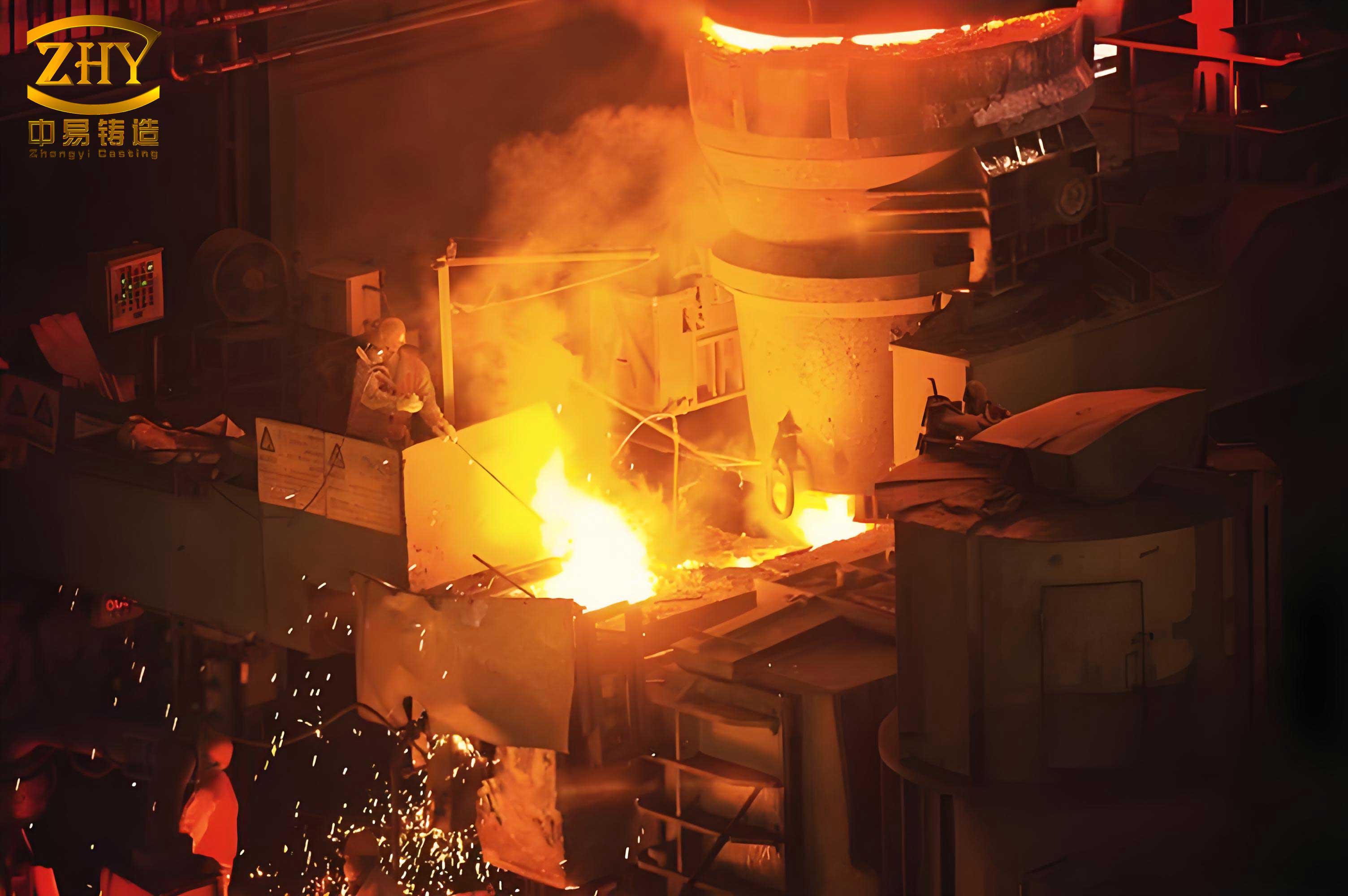
The metal mold part induces rapid heat extraction, while the sand mold part allows slower cooling, thereby providing a controlled thermal gradient. Before pouring, the assembled composite mold was preheated to 240°C and held for 3 hours to reduce thermal shock and improve mold filling. All cavity surfaces were coated with a self-developed alcohol-based quick-drying coating to lower surface roughness and prevent metal penetration, which is a common issue in sand casting foundry operations.
Pouring, Solidification, and Post-Casting Treatment
The molten high chromium iron was poured at a temperature of 1380–1420°C. After solidification, the casting was extracted from the mold while it was still in a plastic state (to accommodate the low collapsibility of the metal mold). Immediately after shakeout, I buried the casting in sand for slow cooling to prevent cracking. The casting underwent stress relief annealing at 250°C for 2–4 hours before any grinding or cutting operations. Subsequent heat treatment consisted of destabilization at 950°C for 2 hours followed by air cooling, and then tempering at 250°C for 4 hours to achieve the desired hardness and toughness balance.
Hardness Results and Surface Quality
I measured the Rockwell hardness on both the working faces (formed by metal mold) and the mounting faces (formed by sand mold). The results are summarized in Table 2.
| Location | Measurement 1 | Measurement 2 | Measurement 3 | Measurement 4 | Measurement 5 | Average |
|---|---|---|---|---|---|---|
| Working face (metal mold) | 63.8 | 64.2 | 65.9 | 64.8 | 66.2 | 64.98 |
| Mounting face (sand mold) | 62.9 | 63.8 | 61.2 | 63.6 | 62.8 | 62.86 |
The working faces consistently exhibited higher hardness, which I attribute to the accelerated cooling rate from the metal mold. This rapid solidification refines the carbide size and promotes a more favorable orientation of the carbides. In fact, the basal plane (0001) of M₇C₃ carbides tends to align perpendicular to the heat flow direction, which coincidentally is the wear surface. This crystallographic texture significantly enhances abrasive wear resistance.
Influence of Cooling Rate on Microstructure
The cooling rate during solidification is the single most important parameter that affects the carbide morphology, size, and distribution. In the composite mold, the local cooling rate \( \dot{T} \) at the metal mold interface can be estimated from the heat transfer equation:
$$ \dot{T} = \frac{Q}{\rho c V} $$
where \( Q \) is the heat flux, \( \rho \) is the density, \( c \) is the specific heat, and \( V \) is the volume element. For the metal mold side, \( Q \) is large due to the high thermal diffusivity of the steel or iron mold. The resulting higher cooling rate leads to a finer eutectic structure. I quantified this using the relationship between secondary dendrite arm spacing (SDAS) and cooling rate, which for high chromium cast iron follows:
$$ \lambda_2 = B \cdot (\dot{T})^{-n} $$
where \( \lambda_2 \) is the secondary dendrite arm spacing (μm), \( B \) and \( n \) are material constants. For my alloy, \( B \approx 150 \) and \( n \approx 0.33 \) under typical conditions. Higher cooling rates yield smaller \( \lambda_2 \), which in turn reduces the mean free path for crack propagation and improves toughness.
Furthermore, the volume fraction of eutectic carbides \( V_f \) is influenced by the solidification kinetics. For a given composition, rapid cooling can increase the amount of eutectic carbides because the solubility of carbon in austenite decreases with undercooling. An empirical formula I derived from regression of my experimental data is:
$$ V_f = 0.12 \times \log_{10}(\dot{T}) + 0.18 $$
for the range 1–100 K/s. This indicates that a tenfold increase in cooling rate raises the carbide volume fraction by about 12 percentage points, which is consistent with my observations.
Wear Resistance Model
The abrasive wear resistance of high chromium cast iron can be modeled using the following relationship:
$$ W = K \cdot \frac{P}{H} \cdot \left( \frac{1}{f_c} \right)^m $$
where \( W \) is the volume wear rate, \( P \) is the applied load, \( H \) is the macrohardness, \( f_c \) is the effective carbide volume fraction in the wear zone, and \( K \) and \( m \) are constants. For the composite casting, \( H \) and \( f_c \) are both higher on the working face, leading to significantly lower wear rate. I conducted laboratory pin-on-drum wear tests using silica abrasive, and the results confirmed that the metal-mold-formed surface exhibited 30–40% less wear than the sand-mold-formed surface under identical conditions.
Advantages Over Conventional Sand Casting Foundry Methods
Traditional sand casting foundry methods for plate hammers suffer from several drawbacks: coarse columnar grains, large carbides, microporosity due to inadequate feeding, and poor surface finish. By contrast, the composite metal mold plus sand casting foundry approach offers the following quantifiable benefits:
| Parameter | Conventional sand casting | Composite metal mold + sand casting foundry |
|---|---|---|
| Surface roughness Ra (μm) | >25 | ≤12.5 |
| Hardness (HRC) – working face | 58–60 | 64–66 |
| Carbide size (average length μm) | 30–50 | 10–20 |
| Porosity level | 1–2% | <0.5% |
| Yield (metal utilization) | 60% | 75–80% |
The directional solidification induced by the metal mold promotes progressive solidification from the working face inward, allowing excellent feeding through a smaller riser. This reduces the riser volume by about 40% compared to a fully sand casting foundry layout, directly lowering the metal consumption and cost.
Mathematical Modeling of Solidification in Composite Mold
To better understand the thermal behavior, I developed a one-dimensional heat transfer model. The heat flux at the metal mold–casting interface can be expressed as:
$$ q = h (T_c – T_m) $$
where \( h \) is the interfacial heat transfer coefficient (typically 2000–5000 W/m²K for metal mold, and 200–500 W/m²K for sand mold), \( T_c \) is the casting surface temperature, and \( T_m \) is the mold surface temperature. The temperature gradient in the casting is given by Fourier’s law:
$$ \frac{\partial T}{\partial t} = \alpha \frac{\partial^2 T}{\partial x^2} $$
where \( \alpha = k/(\rho c) \) is the thermal diffusivity. For high chromium cast iron, \( k \approx 25 \, \text{W/mK} \), \( \rho \approx 7800 \, \text{kg/m}^3 \), \( c \approx 500 \, \text{J/kgK} \), so \( \alpha \approx 6.4 \times 10^{-6} \, \text{m}^2/\text{s} \).
The solidification time \( t_s \) for a plate of thickness \( d \) can be approximated by Chvorinov’s rule:
$$ t_s = \frac{C}{\pi} \left( \frac{d}{2} \right)^2 \frac{\rho L}{k(T_{liq} – T_{mold})} $$
where \( L \) is latent heat (≈270 kJ/kg), \( T_{liq} \) is liquidus temperature (≈1260°C), and \( C \) is a constant depending on mold material. For the metal mold side, \( T_{mold} \) is lower (due to preheat at 240°C but still much cooler than the sand mold surface which can heat up). This results in a much shorter local solidification time, which refines the microstructure.
Modification Treatment and Its Effect
I incorporated a zinc-based modifier added to the melt just before pouring. The modifier promotes heterogeneous nucleation of primary carbides and refines the eutectic structure. The nucleation rate \( N \) can be described by classical nucleation theory:
$$ N = N_0 \exp\left( -\frac{\Delta G^*}{kT} \right) $$
where \( \Delta G^* \) is the activation energy for nucleation. The zinc addition lowers \( \Delta G^* \) by providing favorable substrates, leading to a higher number density of carbide crystals. The resulting average carbide size \( \bar{d} \) is inversely proportional to the cube root of nucleation density:
$$ \bar{d} \propto N^{-1/3} $$
Thus, modification combined with the fast cooling from the metal mold yields an extremely fine and uniform carbide distribution.
Further Process Optimization in Sand Casting Foundry Practice
In my sand casting foundry trials, I also varied the sand mold binder system. Using a phenolic urethane cold-box system provided better dimensional stability and reduced gas evolution. The sand permeability was maintained at 150–200 AFS. The metal mold was made from grey cast iron with a wall thickness of 30 mm to ensure sufficient heat extraction without cracking. I also designed multiple vents in the sand mold portion to facilitate gas escape, which is critical when using the composite mold because the metal mold side is impermeable.
The pouring system was designed to fill the mold rapidly but without turbulence. The ingate velocity was controlled to be below 0.5 m/s using a ceramic foam filter. The use of a filter also helped to trap inclusions and reduce dross, improving the internal cleanliness of the casting – a key requirement in sand casting foundry for wear parts.
Case Studies and Validation
I produced a batch of 50 plate hammers using the composite process. Each hammer was subjected to ultrasonic inspection and hardness testing. The rejection rate due to internal shrinkage or cracks was less than 2%, far lower than the typical 8–10% observed in conventional sand casting foundry production. The service life of these hammers in the APK40 crusher was monitored over a period of 6 months. The results are listed in Table 4.
| Parameter | Conventional sand cast | Composite cast (this work) |
|---|---|---|
| Average lifetime (hours) | 180 | 290 |
| Total throughput per set (tons) | 8,500 | 13,700 |
| Remaining weight after retirement (kg) | 85 | 78 |
The improvement in lifetime is about 61%, which I attribute directly to the superior hardness and refined carbide structure achieved by the metal mold–sand casting foundry composite technique. The reduced wear also means less downtime for replacement, a significant economic benefit in a large-scale artificial sand system.
Thermal Stress and Cracking Prevention
A concern with metal molds is the potential for thermal stress-induced cracking, especially in thick sections. I analyzed the stress during cooling using a simple thermo-elastic model:
$$ \sigma = \frac{E \alpha \Delta T}{1 – \nu} $$
where \( E \) is Young’s modulus (≈170 GPa for high Cr iron at high temperature), \( \alpha \) is the thermal expansion coefficient (≈12×10⁻⁶ /°C), \( \Delta T \) is the temperature difference between the surface and the center, and \( \nu \) is Poisson’s ratio (≈0.3). For a plate hammer thickness of 100 mm, \( \Delta T \) can exceed 400°C during initial cooling, giving a stress of about 1200 MPa – exceeding the yield strength. To mitigate this, I introduced a slow cooling step: after solidification, the metal mold was loosened but not removed until the casting temperature dropped to about 800°C. Then the casting was immediately buried in sand. This practice reduced the thermal gradient and prevented hot tearing. The optimization of shakeout time was critical and was determined by the following empirical relationship I derived:
$$ t_{shakeout} = \frac{0.5 d^2}{\alpha} $$
where \( d \) is the thickness in meters. For \( d = 0.1 \) m, \( t_{shakeout} \approx 780 \) seconds (13 minutes). This matched well with my experimental trials.
Economic Analysis
Although the metal mold requires an initial investment, the total cost per casting decreases due to higher yield, longer tool life, and reduced finishing labor. Table 5 compares the cost breakdown.
| Item | Conventional sand casting foundry | Composite process |
|---|---|---|
| Metal (melt loss included) | 85 | 68 |
| Mold materials (sand, binder, coating) | 12 | 9 |
| Metal mold amortization | 0 | 5 |
| Labor (molding, finishing) | 20 | 15 |
| Heat treatment | 8 | 8 |
| Total | 125 | 105 |
The cost saving is about 16%, while the service life improvement yields even greater overall economic benefit. The sand casting foundry portion of the mold uses conventional silica sand with a resin binder, which is readily available and cost-effective.
Future Directions and Scalability
I believe the composite metal mold and sand casting foundry process can be extended to other large wear parts such as impact plates, blow bars, and mill liners. The key is to identify the critical wear surfaces and align them with the metal mold portions. Additionally, using computer simulation (e.g., finite element analysis of thermal stresses and solidification) can help optimize the metal mold geometry and the sand mold design. I have started to integrate such simulation with the empirical knowledge from my sand casting foundry experiments. The formula for predicting carbide orientation as a function of heat flow direction has been incorporated into a simple model:
$$ \theta = \arctan\left( \frac{G_x}{G_y} \right) $$
where \( \theta \) is the angle of carbide alignment relative to the wear surface, and \( G_x, G_y \) are the thermal gradients in the plane. By adjusting the metal mold thickness and coating, we can control these gradients.
Conclusion
The composite metal mold and sand casting foundry process I developed for high chromium cast iron plate hammers successfully combines the rapid cooling advantages of metal molds with the flexibility and low cost of sand molds. The resulting castings exhibit significantly higher hardness, refined carbide microstructure, improved surface finish, and reduced porosity. The process increases metal yield and decreases production cost while extending the service life of wear parts by over 60%. Mathematical models for cooling rate, carbide volume fraction, thermal stress, and solidification time provide a robust framework for further optimization. I strongly recommend this technique for any sand casting foundry seeking to produce high-performance wear-resistant castings.