
The production of high-integrity, complex thin-walled shell castings, such as clutch housings or engine blocks, represents a significant challenge in foundry engineering. These components are characterized by intricate internal geometries, varying wall thicknesses, and stringent quality requirements including pressure tightness and high mechanical properties. The inherent complexity of their molds and cores, coupled with the demand for dense microstructure free from defects like gas holes, sand inclusions, and core fractures, necessitates a meticulously designed and controlled casting process. This article presents a first-person, in-depth analysis and systematic methodology developed to address persistent defect issues encountered in the high-volume production of a specific clutch housing shell casting, drawing upon fundamental principles of foundry science.
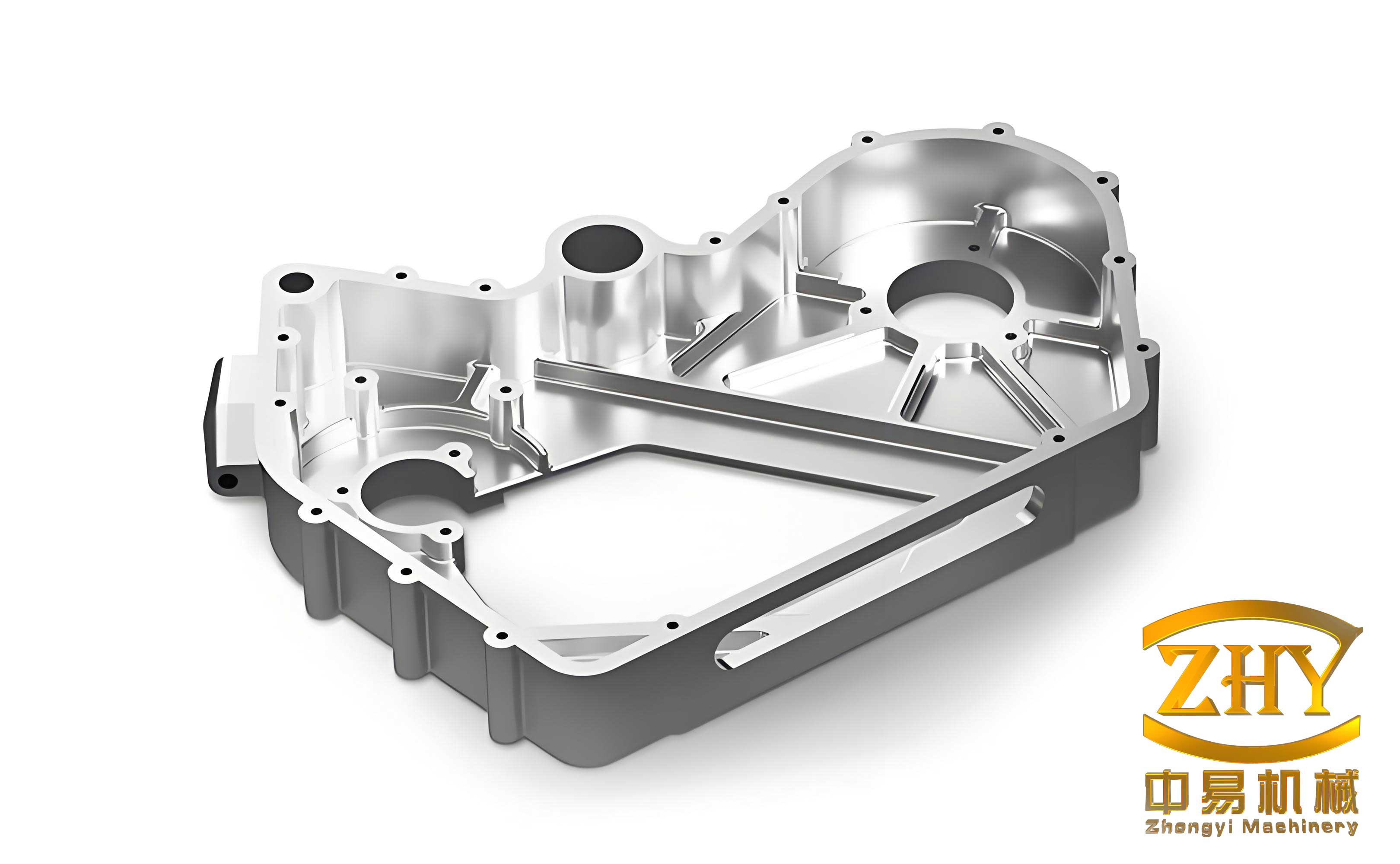
The subject shell casting had a maximum envelope dimension of 363 mm × 384 mm × 220 mm, a weight of 18 kg, and was made from Grade HT250 gray iron. The most critical feature was a minimum wall thickness of 5 mm, classifying it firmly as a complex thin-walled casting. The requirement for pressure tightness mandated an exceptionally sound casting with no leakage paths from shrinkage porosity or other defects. The initial production utilized high-pressure green sand molding with a flask size of 1200 mm × 800 mm. To optimize productivity, a pattern layout of four castings per mold was adopted. The gating system was a bottom-running design with horizontal gates along the parting line, chosen for its smooth filling characteristics which minimize turbulence, slag entrainment, and erosion of sand cores—a crucial factor for shell castings with large core assemblies. Each casting was fed by three ingates. Given that all internal cavities were formed using resin-coated sand (shell) cores, which have higher gas generation rates, the initial process included venting channels in the core prints and overhead vent pins in the cope.
Despite the seemingly sound initial design, mass production revealed a high scrap rate due to three predominant defects: gas porosity localized at the top of certain vertical walls, sand inclusions on the upper flange faces, and fractures at the connecting points between large core segments. A statistical process control analysis confirmed these defects were systematic and location-specific.
| Defect Type | Location on Casting | Hypothesized Primary Cause |
|---|---|---|
| Gas Porosity (Blowholes) | Upper sections of vertical walls, near vent points. | Insufficient venting capacity for core gases. |
| Sand Inclusions/Scabs | Cope-side flange surfaces, near flask walls. | Low sand compaction in deep, vertical mold pockets. |
| Core Fracture | Junction points of large interlocking cores. | Inadequate mechanical strength of slender core prints. |
Theoretical Analysis of Defect Formation Mechanisms
A rigorous root-cause analysis was undertaken, moving from observation to the underlying physical principles governing the formation of these defects in shell castings.
1. Analysis of Gas Porosity Defects
The gas porosity was identified as primarily invasive, originating from the decomposition of the resin binder in the shell cores. Upon contact with molten iron, the core surface heats rapidly, causing pyrolysis of the phenolic resin. The generated gases (mainly hydrocarbons, CO, CO₂) create a pressure layer at the metal-core interface. For the gas to invade the solidifying metal, the local gas pressure \( P_{gas} \) must exceed the sum of the metallostatic pressure \( P_{metal} \) and the pressure required to nucleate a bubble in the liquid \( P_{nuc} \), often approximated by:
$$P_{gas} > P_{metal} + P_{nuc} = \rho g h + \frac{2\gamma}{r}$$
Where \( \rho \) is the metal density, \( g \) is gravity, \( h \) is the height of metal above the point, \( \gamma \) is the surface tension, and \( r \) is the pore radius.
In the initial design, two large cores shared a common, undersized vent path. This created a bottleneck, allowing \( P_{gas} \) to build up to critical levels, especially in the upper sections of the mold where \( P_{metal} \) is lowest (h is small). The vents and riser pins were unable to evacuate the gas volume quickly enough. While increasing pour temperature can extend the time available for gas escape, it was deemed unsuitable for these thin-walled shell castings as it increases the risk of core erosion and penetration defects. Therefore, the solution space was focused on drastically improving the venting efficiency to reduce \( P_{gas} \) below the invasion threshold.
2. Analysis of Sand Inclusion Defects
The sand washes occurred exclusively on vertical faces formed by the mold sand in the cope, adjacent to the flask wall. In high-pressure molding, achieving uniform compaction in deep, narrow recesses of the pattern is challenging. An “arching” or “bridging” effect occurs, leaving an area of lower green strength. The hardness of the sand in these areas was measured to be 50-60 on a standard scale, compared to a requirement of >70 for erosion resistance.
The hydrodynamic force exerted by the flowing metal can dislodge weakly bonded sand grains. The tendency for erosion can be modeled by considering the shear stress \( \tau \) at the mold wall:
$$ \tau \propto \frac{\mu V}{d} $$
Where \( \mu \) is the dynamic viscosity of the metal, \( V \) is the local flow velocity, and \( d \) is the hydraulic diameter of the flow channel. While reducing \( V \) via gating design is beneficial, the fundamental weakness was the low sand strength. Re-engineering the pattern to improve compaction was impractical. The most robust solution was to eliminate the problem entirely by re-designing the core assembly to form these problematic vertical surfaces, transferring the task from the variable-strength mold sand to the consistently high-strength shell core material.
3. Analysis of Core Fracture Defects
The core assembly consisted of two major segments interlocked via three small cylindrical print features. This created a cantilevered structure where the core weight and metallostatic lift force created a significant bending moment \( M \) at the base of the prints.
$$ M = F \cdot L $$
Where \( F \) is the resultant force (weight + buoyancy) and \( L \) is the cantilever length. The stress \( \sigma \) in the slender print is:
$$ \sigma = \frac{M \cdot c}{I} $$
Where \( c \) is the distance from the neutral axis and \( I \) is the area moment of inertia. For a cylindrical print of diameter \( d \), \( I = \frac{\pi d^4}{64} \). The stress is therefore inversely proportional to \( d^3 \). The original print diameter was below the critical threshold where the bending stress exceeded the core’s tensile strength, leading to fracture during handling or metal pouring. Using a higher-resin, higher-strength shell sand would increase gas generation and cost. External chaplets risked causing leaks if not fused completely. The optimal solution was to internally reinforce the high-stress points without altering the core sand formulation.
Systematic Process Modifications and Implementation
Based on the above analysis, three targeted modifications were implemented to the production process for these shell castings.
Modification 1: Independent, Optimized Venting for Each Core
The shared vent path was eliminated. Each major shell core was given its dedicated, generously sized vent channel routed directly from the core’s highest point to the exterior of the mold. This effectively paralleled the venting resistance, drastically increasing the total venting capacity. The governing principle for vent sizing is to ensure the volumetric flow rate of gas \( Q_{gas} \) can be accommodated without significant pressure build-up. The required total vent area \( A_{vent} \) can be estimated from the gas generation rate \( G \) and the permissible pressure drop \( \Delta P \), using a simplified flow analogy:
$$ A_{vent} \propto \frac{G}{\sqrt{\Delta P}} $$
By providing separate, large vents for each core, \( \Delta P \) was minimized, keeping \( P_{gas} \) well below the invasion pressure throughout the pouring and solidification sequence for all four shell castings in the mold.
Modification 2: Core Re-design to Eliminate Mold Wall Erosion
The 2# core was re-designed to extend its print, thereby enveloping the vertical flange face that was previously formed by the mold sand. This is illustrated in the table below comparing the mold make-up before and after the change.
| Condition | Flange Vertical Surface Formed By | Material Hardness (Typical) | Erosion Risk |
|---|---|---|---|
| Original Design | Green Sand Mold (Cope) | 50-60 units | High |
| Modified Design | Shell Core (#2 Core) | >90 units | Very Low |
This change transferred the formation of the critical surface from a variable, lower-strength material to a consistent, high-strength material. The shear stress from the metal flow was now acting on a shell core surface with an order-of-magnitude higher resistance to erosion, effectively eliminating sand wash defects at their root cause.
Modification 3: Structural Reinforcement of Core Prints
To address the cantilever fracture failure, a steel wire rod (core rod) was integrated into the small connecting prints of the 2# core during the shell core shooting process. The rod, acting as an internal reinforcement, significantly increases the bending strength of the composite print. The enhanced moment of inertia \( I_{composite} \) of the reinforced print is much greater than that of the sand alone. Furthermore, during core assembly, this rod was designed to protrude and be glued into a matching socket in the 1# core, transforming the joint from a simple butt connection into a pinned and bonded structural connection. This greatly increased the overall rigidity of the core assembly, preventing fracture under operational loads. The failure criterion shifted from the tensile strength of the shell sand to the yield strength of the steel rod, providing a large safety factor.
Results and Validation
The implementation of these three integrated modifications yielded transformative results in the production of these complex shell castings. The core fracture defect was completely eliminated, providing immediate stability to the core assembly process. The scrap rate due to sand inclusions on the flange face dropped to near zero, confirming the effectiveness of using the core itself to form erosion-prone surfaces. The incidence of gas porosity was dramatically reduced. While not every gas-related defect can be eliminated due to the inherent gas generation of shell cores, the independent venting strategy reduced the pressure build-up sufficiently to push the process well within the acceptable quality limits. The table below summarizes the quantitative improvement.
| Defect Category | Initial Scrap Rate (%) | Scrap Rate After Modification (%) | Improvement |
|---|---|---|---|
| Core Fracture | ~8% | 0% | 100% Elimination |
| Sand Inclusions (Flange) | ~5% | <0.5% | >90% Reduction |
| Gas Porosity | ~7% | ~1.5% | >75% Reduction |
| Total Related Scrap | ~20% | ~2% | ~90% Reduction |
The success of this project underscored that producing high-quality, complex shell castings in dense molding patterns requires a holistic engineering approach. It is not sufficient to address symptoms; one must model and address the root physical causes—gas dynamics, fluid shear stresses, and structural mechanics—within the constraints of production foundry practice.
Conclusion and General Principles for Shell Castings
The methodology developed and proven in this case study provides a general framework for troubleshooting and designing robust processes for complex thin-walled shell castings. The key principles derived are:
- Venting Strategy: For shell cores with high gas generation, assume shared vent paths are insufficient. Design dedicated, low-resistance venting for each core or core segment, sized using gas generation estimates and aimed at minimizing interfacial gas pressure \( P_{gas} \).
- Erosion Management: In high-productivity molding lines where perfect sand compaction cannot be guaranteed in complex patterns, the process design should favor core-formed surfaces over mold-formed surfaces for critical vertical or ceiling faces, especially in areas prone to high metal velocity. This leverages the superior and consistent strength of shell core materials.
- Core Assembly Mechanics: Treat large, multi-part core assemblies as mechanical structures. Analyze cantilevers and joints for stress concentrations. Integrate metallic reinforcements (core rods/armatures) during the core-making process to carry tensile and bending loads, transforming weak sand sections into composite structures. Use adhesives at key joints to enhance overall rigidity.
- Systems Approach: Changes in one area (e.g., adding vents) affect others (gas flow, temperature gradients). All modifications must be evaluated as part of an integrated system to ensure synergistic improvement without introducing new failure modes.
By applying these principles—rooted in fluid dynamics, solid mechanics, and materials science—foundries can reliably produce high-integrity, complex shell castings with high dimensional accuracy, pressure tightness, and minimal defect scrap rates, even in challenging high-volume production environments with multi-cavity molds. The successful resolution of these defects in a one-mold-four-casting configuration demonstrates that productivity and quality in shell castings manufacture are not mutually exclusive when supported by rigorous engineering analysis and targeted process innovation.