
In my extensive experience within the foundry industry, particularly focusing on heavy-section castings for wind turbine applications, I have encountered significant challenges related to internal quality defects in nodular cast iron components. The material specification, often designated as QT400-18L or equivalent to EN-GJS-400-18U-LT, demands stringent mechanical properties and flawless internal integrity as per European standards such as DIN EN 1563. These wind power castings, including front and rear gland covers, are critical structural elements where defects like shrinkage porosity and micro-shrinkage can lead to high rejection rates during non-destructive testing like penetration, magnetic particle, and ultrasonic inspection. This article details the comprehensive process improvements I implemented to enhance the yield and reliability of these nodular cast iron castings, leveraging principles of metallurgy and foundry engineering. The core objective was to transform the solidification behavior of nodular cast iron from a pasty mode to a more directional one, thereby mitigating shrinkage-related defects.
The inherent nature of nodular cast iron solidification is key to understanding defect formation. Unlike gray iron or steel, nodular cast iron undergoes a pasty or mushy solidification. During this process, graphite nodules precipitate and grow throughout the entire volume of the liquid metal while it is cooling. The solid and liquid phases coexist in a slurry-like state. This is represented by a wide solidification range. The expansion associated with graphite precipitation (graphitization expansion) is a fundamental characteristic. If the mold wall cannot resist this expansion, it leads to mold wall movement, increasing the casting volume and potentially creating internal voids or shrinkage porosity. The net volume change during solidification is a balance between the contraction of the liquid metal and austenite, and the expansion from graphite formation. The overall volume change, $V_{total}$, can be conceptualized as:
$$ V_{total} = V_{liquid\_contraction} + V_{austenite\_contraction} – V_{graphite\_expansion} $$
In many cases for thick-section nodular cast iron, if the graphite expansion is not harnessed to compensate for shrinkage, the result is internal porosity. The goal of process improvement is to create conditions where the mold rigidity is high enough to utilize this expansion for self-feeding, and to promote sequential solidification to channel remaining liquid to feed shrinkage.
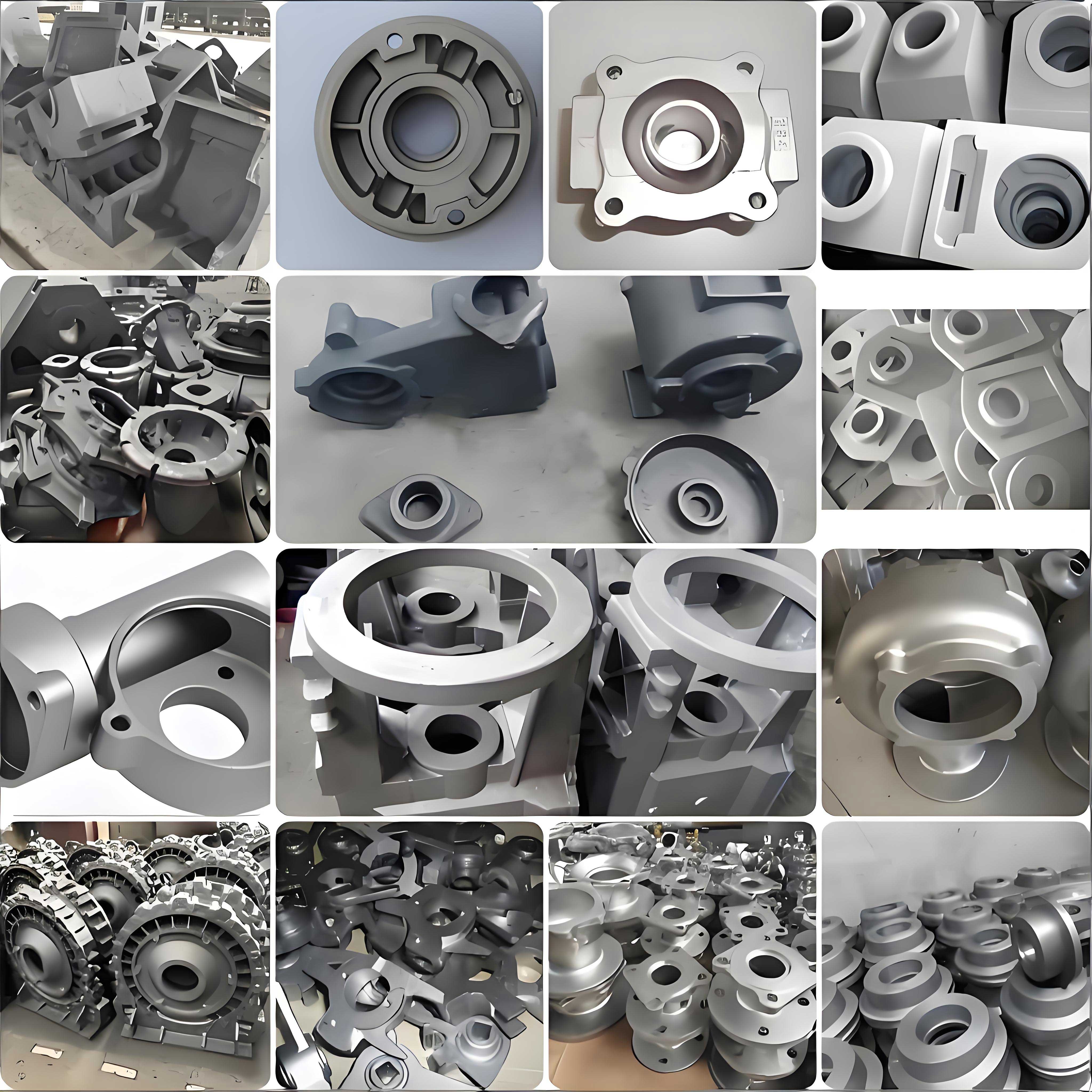
The primary casting defects we addressed were shrinkage cavities and dispersed micro-shrinkage in the heavy-walled, ring-shaped nodular cast iron components. The initial process, using resin sand molds, resulted in an unacceptable rejection rate. The improvement strategy was multi-faceted, targeting mold design, sand properties, melting practice, and pouring control, all tailored to the unique behavior of nodular cast iron.
Strategic Placement of Chills to Control Solidification
The fundamental shift was to promote directional solidification in these thick sections. This was achieved by strategically placing external chills. Chills act as heat sinks, extracting heat rapidly from specific areas, thus narrowing the mushy zone and encouraging a more progressive front-like solidification. For the ring-shaped gland covers, three sets of contoured chills were designed and positioned uniformly. The chill material was HT200 gray iron to ensure good thermal conductivity and durability. The placement was critical: at the bottom of the casting, around the inner ring, and around the outer ring. This arrangement created a thermal gradient, driving solidification from the chilled surfaces towards the feeding risers (not explicitly used here, but the chills act as thermal triggers). The effectiveness of a chill can be approximated by its chilling power, related to its volume, surface area, and thermal diffusivity. The heat extraction rate $q$ can be described by:
$$ q = h \cdot A \cdot (T_{melt} – T_{chill}) $$
where $h$ is the heat transfer coefficient, $A$ is the contact area, and $T$ are temperatures. By increasing $A$ through multiple chills and ensuring good contact, we significantly increased the chilling capacity of the mold. The details of the chill sets are summarized in Table 1.
| Chill Designation | Dimensions (Length x Width x Thickness in mm) | Quantity | Primary Placement Location | Function |
|---|---|---|---|---|
| Chill Set 1 | 350 x 80 x 30 | 8 | Bottom region of the casting | Initiate bottom-up solidification, reduce isolated hot spots. |
| Chill Set 2 | 250 x 150 x 40 | 4 | Inner ring circumference | Extract heat from the internal thick section, promote radial solidification. |
| Chill Set 3 | 250 x 60 x 25 | 4 | Outer ring circumference | Extract heat from the external thick section, complement inner chills. |
This configuration effectively reduced the size of the simultaneous solidification zone, accelerated the cooling rate, and contributed to a finer graphite microstructure in the chilled regions, which is desirable for mechanical properties in nodular cast iron.
Design of a Specialized Pouring Basin
To improve the quality of metal entering the mold, a dedicated pouring cup or basin was designed. The primary functions were to minimize turbulence, reduce air entrainment, and act as an effective slag trap. The design featured a large, deep well that allowed it to be filled quickly, maintaining a constant metallostatic head. This reduces the velocity of the metal stream and its exposure to air, thereby decreasing the oxidation and gas pickup tendency. The principle is to maintain a positive pressure and minimize the vortex formation. The basin design also incorporated a dam or weir to further promote slag separation. The effectiveness can be related to the Bernoulli principle; by increasing the cross-sectional area at the entry, the velocity decreases:
$$ v_1 A_1 = v_2 A_2 $$
where $v_1$ and $A_1$ are the velocity and area at the pouring spout, and $v_2$ and $A_2$ are in the basin. A larger $A_2$ results in a much smaller $v_2$, leading to a quiescent filling of the gating system. This is crucial for resin sand molds, which can be eroded by high-velocity streams, potentially causing sand inclusions. For nodular cast iron, which is prone to dross formation, an effective slag-trapping basin is essential.
Control of Sand Mold and Core Hardness
The rigidity of the mold is paramount for exploiting the graphite expansion in nodular cast iron. A soft mold will yield to the expansion, leading to wall movement and shrinkage porosity. Therefore, strict control over sand mold and core hardness was implemented. We used a resin-bonded sand system (likely furan or phenolic urethane). The molding process was optimized to achieve uniform and high compaction. Hardness was measured using a mold hardness tester and maintained within a stringent range of 85 to 90 units. This high hardness ensures that the mold cavity retains its dimensions against the pressures generated during graphite expansion. The resistance pressure $P_{mold}$ exerted by the mold can be considered a function of its compressive strength, which correlates with hardness. A rigid mold allows the internal graphite expansion pressure $P_{graphite}$ to counteract the shrinkage pressure $P_{shrinkage}$, ideally leading to a net positive pressure that feeds shrinkage:
$$ P_{net} = P_{graphite} – P_{shrinkage} $$
If $P_{mold} > P_{net}$, the mold remains stable, and the expansion is used internally to densify the casting. This is a critical aspect of producing sound heavy-section nodular cast iron castings.
Optimization of Coating and Drying Procedures
To prevent metal penetration and improve surface finish, the coating system was upgraded. Initially, a graphite-based alcohol coating (FQ506) was used. This was changed to a high-alumina alcohol-based coating (FQ580) with higher refractoriness, better suited for the high pouring temperatures and chemical environment of nodular cast iron. The coating parameters were standardized: a slurry density of 1.5 to 1.6 g/cm³, a target coating thickness of 0.2 to 0.3 mm after a single application by flow coating. The coating layer also influences the heat transfer at the metal-mold interface, though its primary role is anti-penetration. Furthermore, a critical step introduced was the pre-drying or baking of the molds, specifically focusing on the chill areas. Two methods were validated:
- Using a gasoline torch to pre-heat the chills and surrounding sand to drive off moisture and any volatiles (this “sweating” of chills eliminates a potential source of gas). After core setting and closing, the entire mold was baked using a hot air blower at approximately 200°C for 1.5 to 2 hours, followed by natural cooling before pouring.
- Allowing molds to air-dry naturally for over 24 hours, followed by torch heating only the chills for about 20 minutes per mold before closing and pouring.
Both methods aim to reduce the moisture content in the mold cavity, thereby lowering the tendency for gas hole formation according to the reaction: $ \text{H}_2\text{O} + \text{Fe} \rightarrow \text{FeO} + \text{H}_2 \uparrow $. The released hydrogen can cause pinholing or gross porosity if not vented properly.
Comprehensive Adjustment of Melting and Treatment Practice for Nodular Cast Iron
The melting and metallurgical treatment process was thoroughly reviewed and optimized to achieve a high graphite nodule count, small nodule size, and a dense matrix structure in the final nodular cast iron casting. The charge composition was altered significantly. To promote graphite formation and increase the carbon equivalent, the use of steel scrap was eliminated from the charge. A higher carbon equivalent (CE) favors a larger fraction of graphite and can enhance the graphitization expansion. The carbon equivalent for cast iron is given by:
$$ CE = \%C + \frac{1}{3}(\%Si + \%P) $$
Aiming for a slightly hypereutectic composition can be beneficial for feeding characteristics. The detailed charge makeup and alloy addition practice are summarized in Table 2.
| Material | Quantity (kg per 1000 kg base iron) | Particle Size (mm) | Purpose and Notes |
|---|---|---|---|
| South African Pig Iron (Cleaned) | 1075 | <330 | Primary source of low-tramp element iron and carbon. Surface rust removed. |
| 75% Ferrosilicon (FeSi75) | 13 | ~40 | Added during melting to adjust final silicon content and carbon equivalent. |
| Nodularizing Agent (ND-1Z MgFeSi) | 13.5 | 5 – 25 | Added in the ladle for magnesium treatment to spheroidize graphite. Pre-heated. |
| Primary Inoculant (FeSi based) | 9 | 5 – 8 | Placed over nodularizer in the ladle to promote nodule count and prevent chilling. |
| Silicon Steel Laminations | 10 | – | Small pieces added with inoculant; provide silicon and act as a mild chill initiator. |
| Secondary Inoculant (FeSi based, fine) | 2.5 | 1 – 3 | Added during late stream pouring (post-inoculation) for fade resistance. |
| Covering Flux / Slag Agglomerator | 10 | – | Used to cover the ladle after treatment to protect from oxidation. |
| Slag Remover (Pearlite) | 10 | – | Used repeatedly to clean slag from the metal surface before and after treatment. |
The melting sequence was meticulously controlled. The pig iron was melted in a medium-frequency induction furnace. Near the end of melting, the FeSi75 was added. After complete melting, the temperature was raised to 1500°C, and the iron was tapped into a preheated, well-lined ladle for slag removal and preheating. The metal was then returned to the furnace for superheating and holding at 1530-1550°C for 4-5 minutes for temperature homogenization and composition adjustment based on a quick chemistry analysis. This superheating also aids in dissolution of nuclei and can improve graphite morphology later. The treatment ladle was a tundish cover or sandwich-type ladle. The nodularizing agent (MgFeSi) was placed at the bottom, compacted, covered with the primary inoculant and silicon steel pieces, and then sealed with a steel plate and some slag remover. The treatment temperature was crucial. The furnace was turned off to allow cooling to 1460-1480°C before tapping. About two-thirds of the iron was tapped quickly onto the treatment alloy, initiating a vigorous reaction lasting about 90 seconds. After the reaction subsided, the remaining third was tapped, and during this stream, the fine secondary inoculant was added for stream inoculation. This two-stage inoculation is vital for achieving a high nodule count in thick-section nodular cast iron, which refines the structure and improves feeding. The treated metal was then thoroughly skimmed. A wedge test sample was poured to visually assess nodularity—a silvery-white fracture with slight shrinkage depression and a narrow chill edge indicated successful treatment. The entire process from treatment end to pour completion was strictly limited to under 15 minutes to prevent nodularizer fade and graphite degradation.
Precise Pouring Process Control
The final step was controlled pouring. The metal was poured using the specialized basin. The pouring temperature was tightly controlled between 1330°C and 1350°C, measured by an infrared pyrometer. A lower temperature could lead to mistuns, while a higher temperature increases shrinkage and gas solubility. The pouring time for these large castings was kept under 45 seconds to ensure a rapid, smooth fill without excessive temperature loss in the gating system. The fast fill also helps maintain thermal gradients favorable for directional solidification initiated by the chills. The relationship between pouring time $t_p$, casting weight $W$, and effective gating area $A_g$ can be approximated by the basic flow equation, but in practice, it was optimized through experience to balance turbulence control and thermal management for nodular cast iron.
Results, Discussion, and Quantitative Analysis
The implementation of this integrated set of improvements led to a dramatic reduction in shrinkage cavity and porosity defects in the 4.2 MW front and rear gland cover castings made from QT400-18L nodular cast iron. The yield rate increased significantly, reducing costs and enabling reliable production. The microstructural quality improved, with a higher nodule count and finer graphite dispersion, contributing to the required mechanical properties (400 MPa tensile strength, 18% elongation at low temperatures). The effectiveness of chills can be analyzed through the concept of Chvorinov’s Rule, where the solidification time $t$ for a simple shape is proportional to the square of the volume-to-surface area ratio $(V/A)^2$:
$$ t = B \cdot \left( \frac{V}{A} \right)^2 $$
where $B$ is the mold constant. By attaching chills, we effectively increase the cooling surface area $A$ for that local region, drastically reducing its local solidification time $t$ and forcing it to solidify before adjacent heavier sections, thereby creating a natural feeding path. The combined effect of rigid mold and controlled solidification allowed the graphite expansion to effectively compensate for shrinkage. The metallurgical adjustments ensured a high graphitization potential, maximizing this expansion. Table 3 summarizes the key controlled parameters before and after improvement.
| Process Parameter | Previous State / Range | Optimized State / Range | Impact on Nodular Cast Iron Quality |
|---|---|---|---|
| Mold Hardness (Resin Sand) | Variable, often below 80 | 85 – 90 (uniform) | Increased mold rigidity to harness graphite expansion, reduce wall movement. |
| Chill Usage | Limited or none | Extensive, strategic placement (See Table 1) | Promoted directional solidification, reduced mushy zone, refined structure. |
| Charge Carbon Source | Included steel scrap | 100% pig iron, no steel scrap | Increased carbon equivalent, enhanced graphitization and feeding. |
| Pouring Temperature | Wider range | 1330 – 1350°C | Optimal fluidity with controlled shrinkage tendency. | Inoculation Practice | Single stage | Two-stage (ladle + stream) | High nodule count, small nodule size, improved microstructure uniformity. |
| Mold Drying | Minimal or inconsistent | Systematic (torch + hot air or natural + torch) | Reduced moisture-related gas defects. |
| Time from Treatment to Pour | Sometimes >20 min | Strictly <15 min | Prevented nodularizer fade and graphite degeneration. |
The success of this project underscores the importance of a holistic approach to casting nodular cast iron, especially for demanding applications like wind power components. Each factor—mold design, sand properties, metallurgy, and pouring—interacts synergistically. The knowledge gained has been successfully applied to other large, thick-walled nodular cast iron components such as bearing housings and brake discs for wind turbines. The principles of utilizing chills for directional solidification, maintaining high mold hardness, optimizing carbon equivalent and inoculation, and implementing rigorous process controls are universally applicable for improving the internal soundness of heavy-section nodular cast iron castings. Future work could involve more sophisticated simulation modeling to optimize chill design and placement further, but the empirical results from this comprehensive process improvement are unequivocal: a significant enhancement in quality and yield for complex nodular cast iron castings was achieved.