
In the realm of internal combustion engine manufacturing, gray iron casting serves as a cornerstone for producing critical components like engine blocks or cylinder bodies. The performance, durability, and reliability of an engine are intrinsically linked to the quality of these castings. Among various defects, cracks pose a significant threat, particularly in high-grade gray iron castings such as HT300, where they can severely compromise mechanical properties and structural integrity. Through my extensive experience in foundry engineering, I have encountered and addressed numerous challenges related to crack formation. This article delves deep into the root causes of crack defects in large, high-grade gray iron castings, particularly focusing on engine blocks, and presents a multifaceted approach to prevention and resolution. The insights shared here are based on practical investigations and technological refinements aimed at enhancing the yield and quality of gray iron casting processes.
The inherent complexity of engine block geometries—characterized by varying wall thicknesses, intricate internal cavities, and substantial dimensions—makes gray iron casting particularly susceptible to stress-induced defects. A typical high-power marine diesel engine block, for instance, can have dimensions exceeding 4000 mm in length and a weight of around 12 tons, with wall thicknesses ranging from 15 mm to as much as 170 mm. Such disparities in section size create non-uniform cooling rates during solidification and subsequent cooling, leading to thermal stresses that, if not managed, manifest as cracks. My analysis begins with understanding the fundamental mechanisms behind these defects. Cracks in gray iron casting generally fall into two categories: hot tears and cold cracks. Hot tears occur at elevated temperatures near the solidus, where the material has low strength and ductility, often due to restricted contraction during the final stages of solidification. In contrast, cold cracks form at lower temperatures, in the elastic range, when residual stresses exceed the material’s tensile strength. Distinguishing between these is crucial for implementing correct countermeasures.
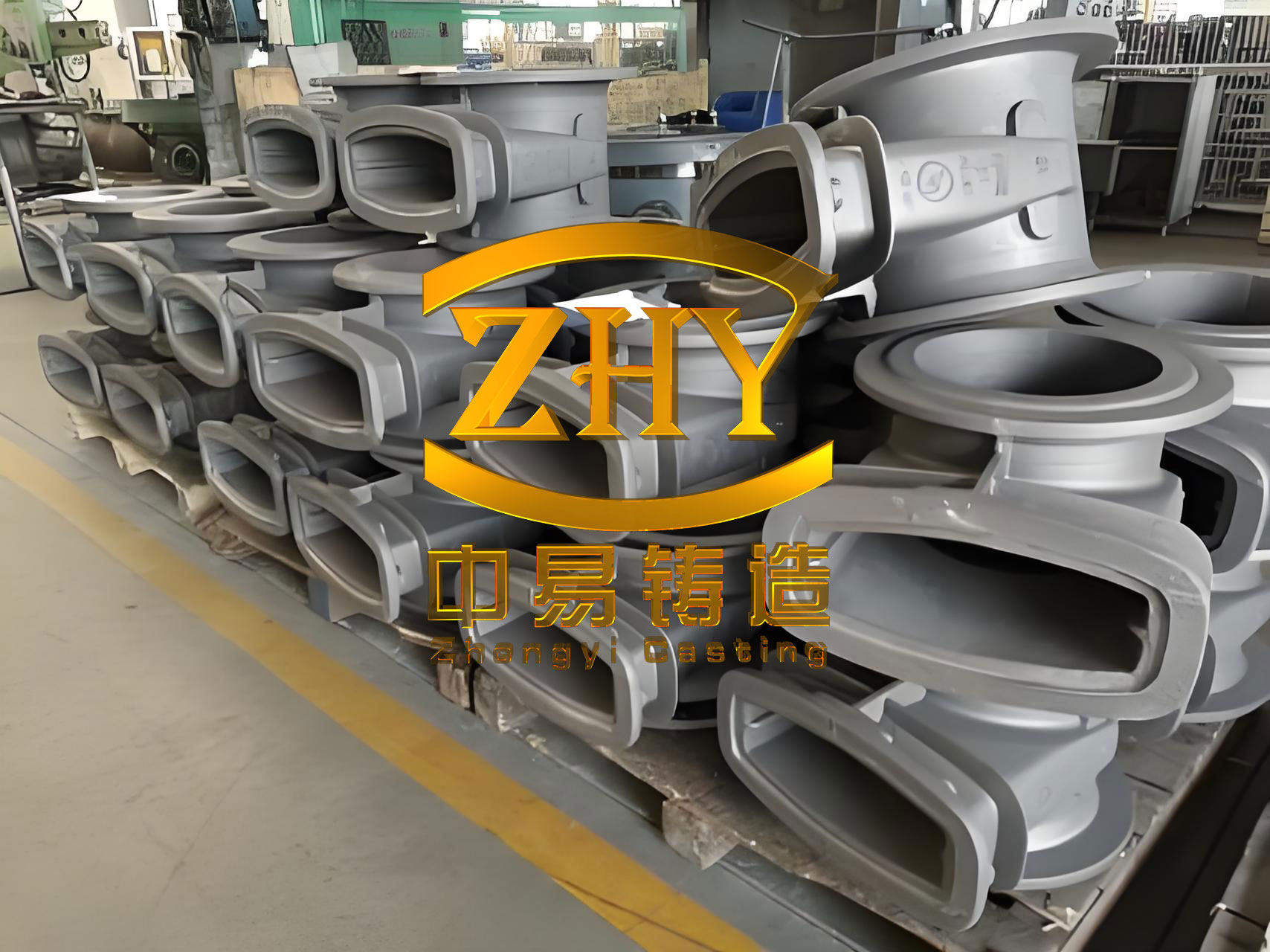
In a specific case involving a large HT300 gray iron casting for an engine block, cold cracks were identified as the predominant issue. These cracks typically originated at sharp re-entrant corners, such as those around inspection windows, and propagated inward in a jagged pattern. The fracture surfaces appeared relatively smooth or slightly oxidized, indicative of cold cracking. The primary driver was identified as tensile stress concentration due to differential cooling: thinner sections like inspection windows solidified and cooled first, while thicker sections like main oil galleries, supplemented by exothermic risers, remained hotter longer. This created a scenario where the early-solidifying regions were subjected to pulling forces as the slower-cooling regions contracted. The stress concentration factor at sharp corners can be approximated using theoretical formulas. For instance, the stress concentration factor \( K_t \) for a notch or fillet can be expressed as: $$ K_t = 1 + \sqrt{\frac{a}{\rho}} $$ where \( a \) is a geometric parameter and \( \rho \) is the radius of the fillet. A smaller \( \rho \) (sharper corner) leads to a higher \( K_t \), dramatically increasing local stress. In the original design, fillet radii were as small as R20, creating hotspots for crack initiation. The resultant stress \( \sigma_{local} \) at such features can be modeled as: $$ \sigma_{local} = K_t \cdot \sigma_{nominal} $$ where \( \sigma_{nominal} \) is the nominal tensile stress from thermal contraction. When \( \sigma_{local} \) surpasses the temperature-dependent tensile strength \( \sigma_{TS}(T) \) of the gray iron casting, cracking ensues. The tensile strength of gray iron, especially high-grade varieties like HT300, is influenced by microstructure (graphite flake morphology, matrix) and cooling rates, but it generally decreases at elevated temperatures and exhibits limited plasticity.
To systematically address these issues, a holistic strategy encompassing product design optimization, process refinement, and thermal management was developed. The following table summarizes the key improvement measures implemented to combat cracks in high-grade gray iron castings:
| Measure Category | Specific Action | Mechanism & Impact | Expected Outcome |
|---|---|---|---|
| Product Design Optimization | Increase fillet radii at critical corners (e.g., from R20 to R80). | Reduces stress concentration factor \( K_t \), distributing stress more evenly. Formula: \( \Delta K_t \propto 1/\sqrt{\rho} \). | Lower peak stresses below the tensile strength of the gray iron casting. |
| Structural Reinforcement | Connect internal ribs and add reinforcing ties (with pre-designed break notches) near crack-prone zones. | Provides additional load path, alters stress distribution. The notch acts as a stress reliever by localizing plastic deformation or crack initiation at a non-critical location. | Prevents crack propagation into the main casting body; allows controlled stress relief. |
| Solidification Control | Modify gating/risering to promote more uniform temperature fields. Link hot spots (risered sections) to thinner sections via added material channels. | Approaches “directional” or “balanced” solidification locally. Enhances feedability to thinner sections, reducing thermal gradients. The thermal gradient \( \nabla T \) is a key driver of stress: \( \sigma_{thermal} \approx E \cdot \alpha \cdot \Delta T \), where \( E \) is Young’s modulus, \( \alpha \) is thermal expansion coefficient, and \( \Delta T \) is temperature difference. | Minimizes differential contraction stresses during cooling. |
| Cooling Process Adjustment | Extend in-mold cooling time (e.g., from 4 to 5 days) and reduce shakeout temperature. | Allows more complete stress relaxation within the mold, lowers residual stresses. The rate of stress relaxation can be modeled with time-temperature superposition principles. | Decreases residual thermal stresses and susceptibility to handling-induced cracks. |
| Mold/Core Material Consideration | Ensure adequate collapsibility of resin-bonded sand cores to minimize mechanical restraint during contraction. | Reduces external resistance to shrinkage. The restraining force \( F_{restraint} \) contributes to stress: \( \sigma = F_{restraint} / A \). | Lowers contraction stresses, particularly in complex internal cavities of the gray iron casting. |
Beyond these specific measures, a deeper understanding of the material science behind gray iron casting is essential. High-grade gray irons like HT300 have a tensile strength typically ranging from 300 MPa to 350 MPa, but their strength at elevated temperatures (e.g., above 500°C) can be significantly lower. The cooling curve and the resulting microstructure play a pivotal role. The solidification of gray iron involves the precipitation of graphite flakes, which can accommodate some strain due to their morphology, but excessive stress can still cause matrix cracking. The susceptibility to cold cracking can be assessed using a cracking susceptibility index \( S \), which might be empirically derived as: $$ S = C \cdot \frac{E \cdot \alpha \cdot \Delta T_{crit}}{\sigma_{TS}} $$ where \( C \) is a geometry factor, \( E \) is Young’s modulus (≈100-140 GPa for gray iron), \( \alpha \) is the thermal expansion coefficient (≈10-12 × 10⁻⁶ /K), \( \Delta T_{crit} \) is the critical temperature range over which high stress develops, and \( \sigma_{TS} \) is the tensile strength at the cracking temperature. Minimizing \( S \) involves reducing \( \Delta T_{crit} \) through uniform cooling and increasing \( \sigma_{TS} \) via proper alloying and inoculation, but for a given grade, process control is paramount.
The implementation of the aforementioned measures required careful validation. After modifying the product design to incorporate larger fillets and additional ribs, and adjusting the process to include strategic reinforcing ties with break notches, the production of over 50 engine blocks was monitored. Non-destructive testing methods like dye penetrant inspection were employed post-cleaning. The results were conclusive: no crack defects were detected in any of the castings. This marked a significant improvement from a previous scrap rate of 35% due to cracking. The success underscores the importance of a integrated approach. For instance, the added reinforcing ties with notches served as “sacrificial” elements; the stress concentration at the notch tip caused localized yielding or micro-cracking, thereby dissipating energy that would otherwise drive a crack through the critical section of the gray iron casting. These ties were removed after stress relief heat treatment, leaving the main structure intact.
Further analysis into the cooling dynamics revealed the importance of time-temperature-transformation (TTT) considerations. Extending the in-mold cooling time allowed the gray iron casting to pass through the pearlitic transformation range more uniformly, reducing transformation stresses. The stress relief due to extended cooling can be qualitatively described by viscoelastic models. While gray iron is not typically considered a viscoelastic material at low temperatures, at elevated temperatures (above ~500°C), some stress relaxation occurs. The extended cooling essentially provides a natural stress relief cycle. The relationship between cooling rate \( \dot{T} \) and residual stress \( \sigma_{res} \) can be complex, but a simplified linear thermal stress model during elastic cooling gives: $$ \sigma_{res} \approx \int_{T_{shakeout}}^{T_{room}} E(T) \cdot \alpha(T) \cdot \dot{T}(t) \cdot \Phi \, dt $$ where \( \Phi \) is a constraint factor accounting for mold restraint. Lowering \( T_{shakeout} \) (shakeout temperature) reduces the integral’s upper limit, thereby reducing \( \sigma_{res} \).
Another critical aspect is the role of inoculation and chemistry in high-grade gray iron casting. While the primary focus here is on geometric and process factors, the base material properties set the foundation. HT300 gray iron typically has a carbon equivalent (CE) in the range of 3.9-4.1, with careful balance of silicon, manganese, and alloying elements like copper or tin to ensure pearlitic matrix and fine graphite. The graphite morphology influences both thermal conductivity and crack propagation resistance. Flake graphite can act as stress concentrators themselves, but a uniform, type A graphite distribution is desirable. The modulus of elasticity \( E \) for gray iron is not constant; it depends on the graphite structure and temperature. At room temperature, \( E \) might be around 120 GPa, but it decreases with temperature. This temperature dependence must be considered in thermal stress calculations. For example, the thermal stress in a constrained bar during cooling is: $$ \sigma_{thermal} = E(T) \cdot \alpha \cdot (T_0 – T) $$ where \( T_0 \) is the stress-free temperature (often near the solidus or a lower transformation temperature). In a complex gray iron casting like an engine block, this simple formula is insufficient, and finite element analysis (FEA) simulations are invaluable for predicting stress fields. However, practical measures like adding ribs and optimizing fillets directly address the stress concentrations identified by such analyses or empirical evidence.
The economic and qualitative implications of solving crack defects in gray iron casting are substantial. Scrap reduction directly lowers manufacturing costs, but more importantly, it enhances the reliability of the final engine. A crack-free gray iron casting ensures better pressure tightness (for water jackets or oil galleries), improved fatigue life, and overall structural soundness. The table below compares key parameters before and after implementing the comprehensive improvements for the engine block gray iron casting:
| Parameter | Before Improvements | After Improvements | Remarks |
|---|---|---|---|
| Crack Incidence Rate | 35% (High) | 0% (in sampled lots) | Based on dye penetrant inspection. |
| Fillet Radius at Critical Corner | R20 mm | R80 mm | Reduced stress concentration factor significantly. |
| In-Mold Cooling Time | 4 days | 5 days | Lowered residual stresses. |
| Presence of Reinforcing Ties | None | Added with break notches | Provided stress relief and structural bridging. |
| Solidification Uniformity | Low (hot spots isolated) | Improved (channels added) | Better thermal balance, reduced ΔT. |
| Shakeout Temperature | Relatively High | Reduced | Minimized handling-induced stress. |
In conclusion, preventing cracks in high-grade gray iron castings, especially for large and complex components like engine blocks, demands a multifaceted strategy rooted in a deep understanding of thermal stresses, material behavior, and geometric design. My experience confirms that no single measure is sufficient; rather, a combination of product design optimization (enlarging fillets, adding strategic ribs), process adjustments (controlled cooling, improved feeding), and attention to mold/core behavior is essential. The gray iron casting process, while mature, continually presents challenges that require innovative solutions. By applying principles of stress concentration reduction, balanced solidification, and controlled cooling, foundries can significantly enhance the quality and yield of high-grade gray iron castings. Future work may involve advanced simulation tools to predict crack susceptibility more accurately and explore the effects of novel inoculants or alloying elements on the crack resistance of gray iron casting. Nonetheless, the practical measures outlined here provide a robust framework for addressing one of the most persistent defects in the production of high-performance gray iron castings for heavy-duty applications.
The journey from a high scrap rate to zero defects in these gray iron castings underscores the importance of persistent investigation and holistic problem-solving. Each gray iron casting project carries unique geometries and requirements, but the fundamental principles of managing thermal gradients, minimizing restraint, and avoiding stress raisers remain universally applicable. As the demand for more powerful and efficient engines grows, the role of high-integrity gray iron casting becomes ever more critical, driving continuous improvement in foundry technologies and methodologies.