
In my extensive experience within the foundry industry, the adoption and refinement of the lost foam casting process has been a significant technological evolution. This process, which utilizes expandable polystyrene (EPS) foam patterns that vaporize upon contact with molten metal, offers distinct advantages for producing complex, near-net-shape components like flywheel housings. However, achieving consistent quality presents considerable challenges, as defects often arise from a cumulative effect of minor inconsistencies across multiple production stages. This article details my firsthand analysis and the systematic measures developed to combat prevalent defects such as distortion, slag inclusion, iron-sand scab, and cold laps in gray iron (HT250) flywheel housings. The primary goal was to enhance process yield and qualification rates through rigorous control and optimization of every step in the lost foam casting process.
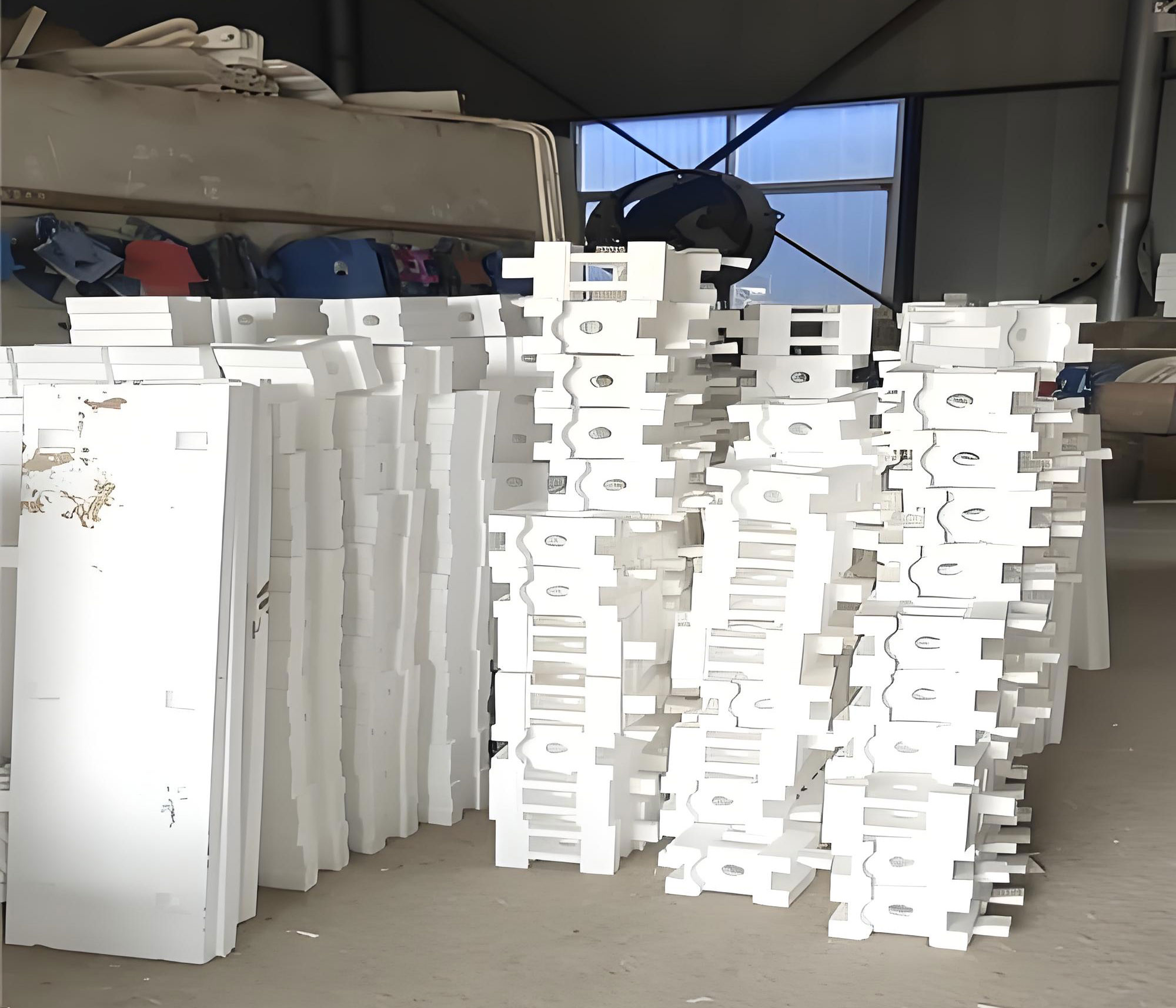
The flywheel housing is a critical thin-walled shell component, typically with a primary wall thickness of around 6 mm. Its structure features large internal cavities and discontinuous geometries, making it inherently susceptible to deformation during the lost foam casting process. The production sequence—encompassing pattern molding, drying, assembly, coating, and mold filling with vibration compaction—must be meticulously controlled. Initial production trials revealed unacceptably high rejection rates, primarily due to the defects mentioned. My approach involved deconstructing each defect’s root cause and implementing targeted, data-driven countermeasures, fundamentally realigning the production protocol for the lost foam casting process.
1. In-Depth Analysis and Control of Distortion Defects
Distortion, manifesting as deviations of 3-8 mm in elliptical window sections, was initially responsible for approximately 35% of scrap. In the lost foam casting process, the foam pattern acts as the geometric precursor to the final casting. Therefore, any distortion in the pattern directly translates to the metal component. The causes are multifaceted, stemming from mechanical stresses during pattern demolding, improper support during drying and storage, the hydraulic pressure of coating slurry during dipping, and asymmetric forces during sand vibration and compaction.
My investigation concluded that the pattern’s mechanical integrity is paramount. The key control measures implemented were threefold. First, we strictly controlled the pre-expansion density of the EPS beads. While a lower density reduces the mass of gaseous decomposition products, it can compromise surface finish and pattern strength. Through iterative testing, an optimal pre-expansion density range was established. Second, the coating formulation was modified to increase its adhesive strength and rigidity upon drying, effectively creating a supportive shell around the foam pattern. The most effective intervention, however, was the strategic addition of support ribs to the pattern’s upper flange. These ribs provide internal reinforcement, counteracting the external pressures from coating and sand during mold filling. The effectiveness of these combined measures can be summarized by a simple relationship for stabilizing force:
$$ F_{stable} = k_1 \cdot \sigma_{coating} + k_2 \cdot N_{rib} \cdot E_{foam} $$
Where \( F_{stable} \) is the stabilizing force against distortion, \( \sigma_{coating} \) is the dried coating’s compressive strength, \( N_{rib} \) is the number of support ribs, \( E_{foam} \) is the effective modulus of the foam pattern, and \( k_1 \), \( k_2 \) are process constants. The results were dramatic, reducing distortion-related scrap to below 3%.
| Root Cause | Control Measure | Key Parameter | Target Value/Outcome |
|---|---|---|---|
| Low pattern strength | Optimize EPS bead pre-expansion | Pre-expansion Density | 26-28 g/L |
| Coating-induced stress | Reformulate coating for higher strength | Coating Adhesive Strength | Increased by ~40% |
| Sand vibration forces | Add internal support ribs to pattern | Number of Ribs | 4-6, pattern-specific |
| Overall Result | Distortion scrap reduced from 35% to <3% | ||
2. Systematic Elimination of Slag Inclusion Defects
Slag inclusion, appearing as black blocky discontinuities on or within the casting, was the most prolific defect, causing up to 45% scrap initially. In the lost foam casting process, slag originates from two primary sources: the decomposition products of the EPS pattern and entrained coating material. During pouring, the foam thermally degrades into gaseous, liquid, and solid pyrolysis products. If the gaseous products are not vented efficiently or if liquid/solid residues are trapped by advancing metal, slag forms. Furthermore, if the coating layer is breached or has penetrated the foam, it can be eroded into the metal stream.
My strategy focused on minimizing the volume of decomposition residues and ensuring their rapid evacuation. This involved optimizing pattern density, redesigning the gating system, and refining pouring practice. As established for distortion, a pattern density that balances strength and low mass is crucial. The gating system, traditionally handmade from cut EPS sheets, was a significant contributor. Its rough surface and high density (~20 g/L) promoted coating penetration and increased turbulence. I spearheaded a redesign to use hollow, cylindrical sprue patterns molded with the same controlled-density beads as the main pattern. This change offered multiple benefits: a smoother surface, reduced EPS mass (less residue), and better thermal dynamics, allowing metal to reach the mold bottom faster with less temperature loss. The gating design principles for the lost foam casting process can be guided by the following relationships for flow and pyrolysis:
$$ Q = A \cdot v = \frac{\pi d^2}{4} \cdot \sqrt{2gh} $$
$$ m_{residue} \propto \rho_{foam} \cdot V_{foam} \cdot (1 – \eta_{vapor}) $$
Where \( Q \) is the volumetric flow rate, \( A \) and \( d \) are the sprue’s cross-sectional area and diameter, \( v \) is flow velocity, \( h \) is effective metallostatic head, \( m_{residue} \) is the mass of liquid/solid pyrolysis residue, \( \rho_{foam} \) is foam density, \( V_{foam} \) is foam volume in the gating, and \( \eta_{vapor} \) is the vaporization efficiency. By implementing the hollow cylindrical sprue and maintaining pattern density at 26-28 g/L, slag inclusion rates plummeted to around 5%.
| Parameter | Old Design (Sheet Cut) | New Design (Molded Hollow Cylinder) | Impact on Slag Formation |
|---|---|---|---|
| Sprue Shape | Solid Square Prism | Hollow Cylinder | Reduced surface area & turbulence |
| Surface Roughness | High (wire-cut) | Low (molded) | Minimized coating penetration |
| Foam Density | ~20 g/L | 26-28 g/L | Balanced strength & lower residue |
| Thermal Mass | High | Lower (hollow) | Faster pouring, less metal cooling |
| Flow Path | Indirect | Direct to base | Improved pyrolysis gas evacuation |
3. Resolving Iron-Sand Scab (Penetration) Defects
Iron-sand scab, or metal penetration, occurs when molten iron breaches the refractory coating and infiltrates the sand matrix, creating a fused metal-sand layer on the casting surface. This defect is particularly prone in deep recesses and “dead zones” of the pattern where dry sand compaction during vibration is inadequate. Without densely packed sand supporting the coating, the combined thermal and dynamic pressure of the metal front can cause coating failure.
My solution centered on achieving uniform and high compaction density throughout the mold, especially in problematic areas. This required optimizing the parameters of the three-dimensional vibration table and introducing manual auxiliary sand-filling techniques. The vibration process is critical in the lost foam casting process for achieving a self-supporting mold. Through extensive experimentation, I determined the optimal vibration parameters for our flywheel housing patterns. The relationship between vibration parameters and sand compactability can be complex, but a simplified effective compaction energy model can be considered:
$$ E_{comp} \approx \int_0^T A \cdot f \cdot \sin(2\pi f t) \, dt $$
Where \( E_{comp} \) is the effective compaction energy per cycle, \( A \) is amplitude, \( f \) is frequency, and \( T \) is vibration time. Practically, we found a frequency of 45-50 Hz, an amplitude of 1-1.5 mm, and a controlled vibration time of 20 seconds per cycle to be optimal. The mold-filling sequence was also standardized: after placing a base layer of sand and vibrating, the pattern cluster is positioned. Sand is then added in two stages. The first fill, leveled with the pattern’s top, is thoroughly vibrated. For intricate cavities, fine-grained resin-coated sand is manually tamped into place before vibration to ensure no voids. A second covering fill with sufficient sand thickness (adequate “sand jacket”) follows. This method ensures the coating is uniformly backed by high-density sand, increasing its resistance to metal pressure. The application of resin sand in dead zones was a game-changer, drastically reducing penetration defects to a stable 1-2%.
| Process Step | Key Action | Parameter/Technique | Rationale |
|---|---|---|---|
| Base Sand Preparation | Add and pre-vibrate sand in flask | Depth: ~100 mm | Creates a consistent foundation |
| Primary Filling | Add sand after placing pattern, then vibrate | Vibration: 45-50 Hz, 1-1.5 mm, 20s | Achieves bulk compaction |
| Dead Zone Treatment | Manual filling with resin-coated sand | Sand Type: Fine-grade resin sand | Ensures high local density where vibration is ineffective |
| Final Covering | Add top sand layer and final vibration | Sand Jacket Thickness: Min. 100 mm above pattern | Provides sufficient metallostatic pressure resistance |
4. Overcoming Cold Lap Defects
Cold laps, characterized by visible seams or folds on the casting surface where metal streams failed to fuse, are primarily a thermal issue. In thin-walled castings like flywheel housings produced via the lost foam casting process, the metal front has a large surface-area-to-volume ratio, leading to rapid heat loss. If the metal temperature drops below the critical fluidity point before the mold cavity is completely filled, incomplete fusion occurs.
The root cause was identified as insufficient superheat in the metal delivered to the mold. Initial pouring temperatures of 1380-1420°C, while common, were inadequate for the extended flow path and cooling effect of foam decomposition in this specific geometry. My corrective action was straightforward but required adjustments in melting and pouring operations: significantly increase both the tap temperature and the pouring temperature. The required pouring temperature \( T_{pour} \) can be estimated by accounting for heat losses:
$$ T_{pour} \geq T_{liquidus} + \Delta T_{superheat} + \Delta T_{loss\_foam} + \Delta T_{loss\_flow} $$
Where \( T_{liquidus} \) is the liquidus temperature of HT250 iron (~1150-1200°C), \( \Delta T_{superheat} \) is the necessary superheat for fluidity, \( \Delta T_{loss\_foam} \) is the heat absorbed by foam decomposition (endothermic), and \( \Delta T_{loss\_flow} \) is heat lost to the coating and sand during flow. We increased the furnace tap temperature to 1560°C and mandated a minimum pouring temperature of 1420°C. Furthermore, we enforced a “fast-pour” principle, minimizing any hesitation during pouring to reduce total filling time. This ensured the metal retained enough thermal energy to remain fluid until the entire cavity was filled and fusion was complete. This thermal management approach successfully reduced cold lap scrap from 15% to about 1%.
| Thermal Parameter | Initial Practice | Optimized Practice | Physiological Effect |
|---|---|---|---|
| Furnace Tap Temperature | ~1500°C | 1560°C | Provides higher initial superheat |
| Pouring Temperature | 1380-1420°C | ≥1420°C (strict minimum) | Compensates for foam decomposition cooling |
| Pouring Speed | Standard/Moderate | Fast, Continuous Pour | Minimizes heat loss during cavity fill |
| Effective Fluid Life | Short | Extended | Allows complete fusion of metal fronts |
5. Holistic Process Integration and Quality Management
The successful mitigation of these defects was not merely the sum of individual fixes but the result of integrating them into a cohesive, controlled lost foam casting process. Each modification had interdependencies. For instance, increasing pouring temperature to eliminate cold laps could potentially aggravate penetration defects if the sand compaction and coating were not already optimized. Therefore, a systematic implementation plan was vital. We established standard operating procedures (SOPs) for every stage, from EPS bead storage and pre-expansion to final shakeout. Key process variables were continuously monitored using statistical process control (SPC) charts. For example, the density of pre-expanded beads was checked hourly, and coating viscosity was measured per batch. The health of the vibration table was regularly calibrated to maintain the defined acceleration (1-2g). This holistic approach transformed the production line from a trial-and-error operation to a predictable, engineering-driven system. The overall improvement in the lost foam casting process for flywheel housings can be quantified by the dramatic increase in overall casting yield and the significant reduction in total scrap cost.
Furthermore, the principles developed here—controlling pattern properties, designing gating for efficient decomposition product removal, ensuring mold uniformity, and managing thermal parameters—are broadly applicable to other complex thin-walled castings made via the lost foam casting process. The process has proven its maturity for high-quality component manufacturing when underpinned by rigorous analysis and control.
6. Concluding Synthesis and Formulae for Process Design
In conclusion, the journey to master the lost foam casting process for flywheel housings involved tackling four major defect categories through targeted interventions. Support ribs and controlled foam density solved distortion. A molded, hollow sprue combined with optimal foam density virtually eliminated slag. Optimized vibration and manual sand packing defeated iron-sand scab. Elevated pouring temperatures and speed eradicated cold laps. The success of these measures underscores that the lost foam casting process is highly controllable when approached with scientific methodology. For engineers designing a lost foam casting process, the following consolidated formulae and relationships can serve as a valuable starting point for key parameter estimation:
Pattern Density-Fluidity Relationship:
$$ \rho_{opt} = C \cdot \frac{\tau_{wall}}{SA/V} $$
Where \( \rho_{opt} \) is the optimal pre-expansion foam density (g/L), \( \tau_{wall} \) is the nominal wall thickness (mm), \( SA/V \) is the surface-area-to-volume ratio of the pattern, and \( C \) is a material-constant (approximately 4-5 for gray iron).
Gating Design for Minimum Residue:
$$ A_{choke} \geq \frac{W}{\rho_{metal} \cdot t_{pour} \cdot \sqrt{2gH_{eff}}} \cdot \left(1 + \alpha \cdot \frac{\rho_{foam,gate}}{\rho_{metal}}\right) $$
Where \( A_{choke} \) is the choke area, \( W \) is casting weight, \( t_{pour} \) is desired pour time, \( H_{eff} \) is effective sprue height, \( \alpha \) is a foam decomposition factor (0.1-0.3), and \( \rho_{foam,gate} \) is the foam density in the gating.
Thermal Requirement for Thin Sections:
$$ T_{pour, min} = T_{liq} + \beta \cdot L_{flow} + \gamma $$
Where \( T_{pour, min} \) is the minimum safe pouring temperature, \( L_{flow} \) is the maximum flow length for the metal in the cavity, and \( \beta \), \( \gamma \) are coefficients derived from coating properties and foam type.
The continuous refinement of the lost foam casting process remains an engaging challenge. Future work may focus on advanced coating technologies with higher refractoriness and permeability, automated sand-filling systems for complex geometries, and real-time thermal monitoring during pouring. The foundational work described here, however, provides a robust framework for producing high-integrity flywheel housings and similar components efficiently and reliably using the lost foam casting process.