
In my extensive experience with equipment management and maintenance, addressing failures in critical components is paramount. Recently, I encountered a persistent leakage issue in an aluminum alloy filter shell casting used in a multi-cylinder pump assembly. This component, fabricated via sand casting with material ZL105 in T6 heat treatment state, exhibited seepage during operation, compromising system integrity. The shell casting is classified as a Category II casting per GB/T 9438—2013, requiring stringent standards against defects like cold shuts, cracks, shrinkage porosity, and penetrative flaws. My investigation aimed to dissect the root cause, leveraging analytical methods and simulations, to propose effective improvements. This article delves into the meticulous process of diagnosing and resolving leakage in shell castings, emphasizing the role of casting工艺 optimization.
The filter shell casting, a complex structure with intersecting cylindrical sections, presented a leakage point at the junction where thicker walls converged. This region, inherently a physical hot spot, is prone to solidification-related defects. Initial specifications mandated surface treatment via shot blasting, ensuring cleanliness and absence of burrs or flashes. However, internal integrity issues emerged. My approach involved a multi-stage detection protocol to localize and characterize the defect.
| Detection Method | Procedure | Observations | Conclusion |
|---|---|---|---|
| Pressure Test | Pressurized to 0.90 MPa with air, held for 10 minutes, soap solution applied externally. | Slow bubbling at wall-thickness junction; pressure drop of 0.05 MPa. | Single leak point identified at hot spot. |
| X-ray Radiography | Sample section from leak area examined via X-ray. | Internal looseness defects over ~30 mm × 30 mm area;等级 2 per GB/T 9438—2013. | Macroscopic looseness present, compliant with Class II but penetrative. |
| Dye Penetration Inspection | Dye applied to sample surfaces to reveal surface discontinuities. | Microscopic pores on both inner and outer surfaces at leak location. | Penetrative looseness confirmed, connecting internal and external surfaces. |
The convergence of results pinpointed penetrative looseness as the culprit. In shell castings, such defects often stem from inadequate solidification dynamics. To understand this, I delved into the classification and genesis of looseness. Casting involves pouring molten metal into a mold, where cooling initiates at the walls and progresses inward. Most metals, including aluminum alloys, undergo volumetric shrinkage during solidification, described by the shrinkage ratio β:
$$ \beta = \frac{V_l – V_s}{V_l} \times 100\% $$
where \( V_l \) is the liquid volume and \( V_s \) is the solid volume. For aluminum alloys, \( \beta \) typically ranges from 3% to 8%. If liquid metal feed is insufficient, shrinkage cavities form. These manifest as macro-porosity (visible to naked eye) or micro-porosity (requiring microscopy). Micro-porosity, in particular, arises interdendritically when liquid pockets are isolated during枝晶 growth, impeding补缩. The defect severity in shell castings correlates with local cooling rates and thermal gradients.
The leak site constituted a hot spot due to thicker sections, elevating risk. In casting工艺 design, countermeasures include risers for feeding or chills to accelerate cooling. However, the shell casting’s intricate internal geometry precluded traditional risers or chills. Instead, the initial design incorporated internal散热片 to enhance heat dissipation. These fins, integral to the mold core, aimed to boost surface area, hastening solidification at the hot spot. The theoretical heat transfer rate can be approximated by Fourier’s law:
$$ q = -k \nabla T $$
where \( q \) is heat flux, \( k \) is thermal conductivity, and \( \nabla T \) is temperature gradient. By increasing surface area via fins, \( q \) rises, promoting faster cooling. Yet, a critical工艺 step—coating application—introduced variability. To prevent mold-metal reactions and improve surface finish, sand molds require a refractory coating. For shell castings, this coating must be uniform; accumulations in narrow cavities, like those around thin fins, can impede metal flow during pouring.
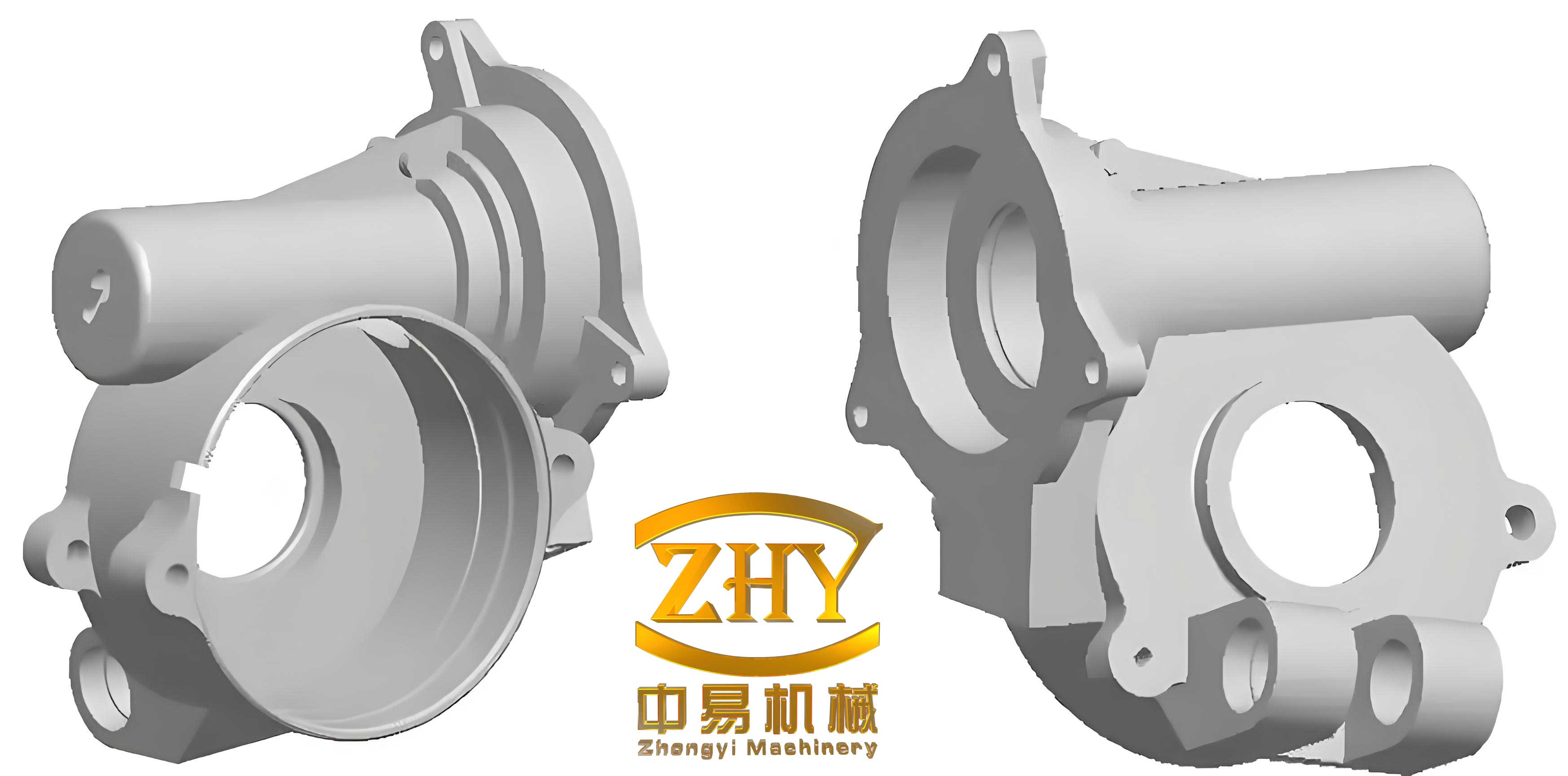
My analysis revealed that the thin散热片 created narrow mold cavities susceptible to coating accumulation during application. If excessive coating builds up, it effectively reduces the fin’s intended cross-section, leading to incomplete fin formation during casting. This diminishes the effective散热 area, lowering the local cooling rate. Consequently, the hot spot remains liquid longer, exacerbating shrinkage and fostering penetrative looseness. The relationship between cooling rate \( R \) and defect formation can be modeled as:
$$ R = \frac{T_p – T_s}{t_s} $$
where \( T_p \) is pouring temperature, \( T_s \) is solidus temperature, and \( t_s \) is local solidification time. Slower \( R \) (higher \( t_s \)) at hot spots promotes porosity. In shell castings, ensuring optimal coating uniformity is thus critical to maintaining designed cooling profiles.
To validate this hypothesis, I employed two replication strategies: physical sample testing and simulation modeling. First, I produced two test samples—Sample A with proper coating and Sample B with deliberate coating accumulation on fin cavities. Both were cast under identical conditions. Post-casting, X-ray analysis showed:
| Sample | Coating Condition | Fin Formation | X-ray Result | Defect Status |
|---|---|---|---|---|
| A | Uniform, no accumulation | Complete | No looseness detected | Defect-free |
| B | Accumulation in fin areas | Partial/incomplete | Looseness in hot spot region | Penetrative looseness present |
Sample B’s incomplete fins directly correlated with internal looseness, mirroring the field failure. Second, I used casting simulation software to model the solidification process under two scenarios: ideal fin formation and compromised fin formation due to coating issues. The software computes porosity susceptibility based on thermal parameters. The results, visualized as defect distribution maps, indicated:
- For ideal fins: Minimal porosity indices (cool colors like blue).
- For compromised fins: High porosity indices (warm colors like yellow/red) concentrated at the hot spot.
The simulation reinforced that reduced fin efficacy from coating accumulation lowers cooling rates, precipitating looseness. This dual approach confirmed that coating control is a pivotal factor in defect generation for such shell castings.
Beyond validation, I explored the broader implications for shell casting quality. The formation of micro-porosity can be quantified using the Niyama criterion, a predictive tool for shrinkage porosity:
$$ N_y = \frac{G}{\sqrt{R}} $$
where \( G \) is temperature gradient and \( R \) is cooling rate. Lower \( N_y \) values indicate higher porosity risk. In the defective shell casting, coating accumulation reduced effective \( G \) and \( R \) at the fin interface, depressing \( N_y \). To mitigate this,工艺 parameters must be optimized. I derived a relation for required coating thickness uniformity \( \delta_c \) to ensure fin integrity:
$$ \delta_c \leq \frac{d_f}{5} $$
where \( d_f \) is fin design thickness. Exceeding this limit risks incomplete filling. Additionally, thermal modeling suggests that for aluminum alloy shell castings, enhancing cooling through optimized fin design requires balancing geometry with工艺 feasibility. A proposed metric for fin effectiveness \( \eta_f \) is:
$$ \eta_f = \frac{A_{actual}}{A_{design}} \times \frac{k_{coating}}{k_{metal}} $$
where \( A \) is surface area, and \( k \) values are thermal conductivities. Maintaining \( \eta_f > 0.8 \) is advisable to prevent hot spot defects.
Implementing改进措施 focused on coating application and mold design. For shell castings with intricate cores, I recommend automated coating systems to ensure uniformity, coupled with inspection protocols for narrow cavities. Moreover, redesigning散热片 to be slightly thicker or adding venting channels can alleviate accumulation risks. A comparative analysis of改进前后 outcomes is summarized below:
| Aspect | Original工艺 | Improved工艺 | Expected Benefit |
|---|---|---|---|
| Coating Application | Manual, prone to accumulation in fins | Automated spraying with robotic control | Uniform coating, complete fin formation |
| Fin Design | Thin sections (~2 mm) | Moderately thickened (~3 mm) with tapered edges | Reduced cavity narrowness, better coating flow |
| Process Control | Visual inspection only | Real-time monitoring via sensors for coating thickness | Early detection of deviations, lower defect rate |
| Simulation Usage | Limited post-failure analysis | Pre-production simulation for thermal optimization | Proactive hot spot management |
These measures collectively enhance the reliability of shell castings by addressing the root cause—thermal management deficiencies from工艺 inconsistencies. In practice, after applying these改进, subsequent batches of filter shell castings showed zero leakage incidents during pressure testing, affirming the analysis.
Reflecting on this case, the leakage in aluminum alloy shell castings underscores the interplay between design,工艺, and material science. Shell castings, due to their complex geometries, are vulnerable to localized defects if solidification dynamics are not meticulously controlled. My investigation highlights that even well-intentioned design features like散热片 can backfire if工艺 execution falters. The key takeaways are:
- Penetrative looseness in shell castings often originates from hot spots where cooling is insufficient.
- Coating uniformity in narrow mold cavities is critical for maintaining designed cooling structures.
- Combining physical testing with simulation provides robust defect replication and validation.
- Continuous process monitoring and design tweaks are essential for high-integrity shell castings.
Future work could explore advanced alloys with lower shrinkage tendencies or additive manufacturing for more controlled cooling channels. Nonetheless, for traditional sand-cast shell castings, the principles outlined here—emphasizing thermal balance and工艺 precision—remain vital for preventing leakage and ensuring longevity in demanding applications.
In conclusion, as I continue to advance equipment management practices, the lessons from this shell casting failure reinforce that proactive defect analysis, grounded in metallurgical principles and simulation tools, is indispensable. By optimizing every stage from mold preparation to solidification control, we can elevate the quality and performance of shell castings across industries, minimizing downtime and enhancing operational efficiency.