
In my role within the mining equipment manufacturing sector, I have consistently observed that the integrity of cast components is foundational to operational safety and performance. Specifically, the column socket for hydraulic supports, a pivotal load-bearing element in underground mining, is predominantly produced via sand casting using sodium silicate-bonded sand. This method, while advantageous for its moldability and rapid hardening, is inherently prone to various sand casting defects that can severely compromise component reliability. The material of choice, ZG30Cr06 low-carbon alloy steel, exhibits significant solidification shrinkage, further escalating the risk of defects. Over years of production, we have systematically addressed recurrent sand casting defects such as shrinkage porosity, gas holes, and sand adhesion. This article, from my first-hand perspective, delves into the mechanistic origins of these sand casting defects, presents quantitative models to elucidate their formation, and tabulates pragmatic preventive strategies. Our objective is to foster a deeper understanding of sand casting defect dynamics and to integrate advanced methodologies for defect minimization, thereby enhancing the overall quality assurance framework in sand casting operations.
Fundamentals of Sand Casting Defect Formation
Sand casting defects arise from complex interactions between molten metal, mold materials, and process parameters. In sodium silicate sand casting, the rapid hardening and poor collapsibility of the mold can exacerbate defect formation, particularly in steel castings with high shrinkage tendencies. The propensity for sand casting defects is influenced by factors such as sand composition, binder content, pouring conditions, and solidification characteristics. A generalized model for defect initiation can be framed using quality loss functions, where the deviation from ideal conditions increases the likelihood of sand casting defects. For instance, the overall defect potential $D$ can be expressed as a function of key variables:
$$ D = f(S, G, A, P) $$
where $S$ represents shrinkage-related parameters, $G$ denotes gas entrapment factors, $A$ signifies adhesion mechanisms, and $P$ encompasses process controls. Each of these contributes uniquely to the manifestation of sand casting defects, necessitating tailored interventions. The following sections will dissect each major sand casting defect category, employing theoretical models and empirical data to guide preventive actions.
Shrinkage Porosity: A Prevalent Sand Casting Defect
Shrinkage porosity is a critical sand casting defect characterized by void formation in last-to-solidify regions due to inadequate feeding. In column sockets, this defect often occurs at geometric hot spots like rib intersections, leading to reduced load-bearing capacity. The underlying mechanism involves volumetric contraction during phase change, which can be quantified using the linear shrinkage coefficient $\alpha$ or volumetric coefficient $\beta$. For steel alloys, the total volume change from pouring to room temperature is significant. The shrinkage volume $V_{sh}$ can be estimated as:
$$ V_{sh} = V_0 \left[ \beta_l (T_p – T_l) + \beta_s (T_l – T_s) + \beta_{sol} (T_s – T_r) \right] $$
where $V_0$ is the initial volume at pouring temperature $T_p$, $T_l$ and $T_s$ are liquidus and solidus temperatures, $T_r$ is room temperature, and $\beta_l$, $\beta_s$, $\beta_{sol}$ are contraction coefficients for liquid, solidification, and solid-state phases, respectively. For ZG30Cr06, the solidification shrinkage is particularly pronounced, often ranging from 4% to 6%, making it highly susceptible to this sand casting defect.
The primary contributors to shrinkage porosity in our sand casting processes include:
- Inadequate riser design failing to provide sufficient feeding pressure and volume.
- Restricted feeding channels due to complex geometries, hindering metal flow to hot spots.
- Elevated pouring temperatures increasing overall contraction and gas solubility.
- Premature riser solidification due to insufficient insulation, causing reverse feeding.
To combat this sand casting defect, we have implemented a multi-pronged strategy centered on optimized feeding. Using Chvorinov’s rule, we tailor riser dimensions to ensure they solidify after the casting. The solidification time $t$ is given by:
$$ t = k \left( \frac{V}{A} \right)^n $$
where $k$ is a mold constant, $V$ and $A$ are the volume and surface area of the casting section, and $n$ is an exponent typically around 2. By designing risers with larger $V/A$ ratios, we prolong their liquid state, enhancing feeding. Additionally, we employ exothermic or insulating riser sleeves to reduce heat loss, and we control pouring temperatures within a narrow range (1520–1550°C) to balance fluidity and shrinkage. The table below summarizes key measures to prevent shrinkage porosity, a detrimental sand casting defect.
| Root Cause | Preventive Action | Technical Basis |
|---|---|---|
| Insufficient feeding pressure | Use of atmospheric or pressure-assisted risers | Enhances metallostatic pressure to force feed metal into shrinkage zones |
| Poor riser efficiency | Application of exothermic compounds | Increases riser temperature, extending feeding range via higher thermal gradient |
| High thermal contraction | Controlled cooling using chills | Directs solidification sequence, minimizing isolated hot spots |
| Inadequate gating design | Simulation-optimized gating systems | Ensures progressive solidification and reduces temperature gradients |
By integrating these approaches, we have markedly reduced the incidence of shrinkage porosity, a pervasive sand casting defect, in our cast components.
Gas Holes: Classification and Mitigation of Another Critical Sand Casting Defect
Gas holes constitute another major category of sand casting defects, manifesting as spherical or elongated cavities with smooth walls. These defects arise from gas entrapment during pouring and solidification, severely degrading density and mechanical properties. Based on origin, gas holes are classified into precipitated, invasive, and reactive types, with the first two being most common in our sand casting operations. Precipitated gas holes result from decreased gas solubility during cooling, governed by Sieverts’ law for diatomic gases:
$$ C = C_0 \exp\left(-\frac{\Delta H}{RT}\right) \sqrt{P} $$
where $C$ is the gas concentration in the melt, $C_0$ is a constant, $\Delta H$ is the enthalpy of solution, $R$ is the universal gas constant, $T$ is temperature, and $P$ is the partial pressure. As temperature drops, excess gas nucleates, forming bubbles that may be trapped if the viscosity is high. Invasive gas holes, conversely, occur when gases from mold decomposition invade the metal. The rate of gas generation from sand binders can be modeled using Arrhenius equations:
$$ \frac{dG}{dt} = A e^{-E_a/RT} $$
where $dG/dt$ is the gas evolution rate, $A$ is the pre-exponential factor, and $E_a$ is the activation energy. This sand casting defect is exacerbated by poor venting, high moisture, or excessive binder content.
Key factors contributing to gas holes in our sand casting processes include:
- Insufficient degassing during melting, leading to high hydrogen or nitrogen levels.
- Inadequate mold permeability hindering gas escape.
- Turbulent filling entraining air into the metal stream.
- High sand moisture or organic content increasing gas evolution.
Our preventive framework addresses both metallurgical and mold aspects. We employ ladle degassing with inert gases and use aluminum for final deoxidation, following stoichiometric calculations to ensure complete oxygen removal. The deoxidation reaction can be represented as:
$$ 3[O] + 2[Al] \rightarrow (Al_2O_3) $$
where [ ] denotes dissolved species and ( ) denotes inclusions. In mold making, we optimize sand mixtures to achieve permeability values above 100 (using standard tests) and limit sodium silicate addition to below 8%. Venting is enhanced via strategically placed vents and permeable coatings. The table below outlines specific strategies to mitigate gas holes, a common sand casting defect.
| Gas Hole Type | Preventive Measure | Implementation Details |
|---|---|---|
| Precipitated | Vacuum degassing and flux treatments | Reduces dissolved gas content to below 5 ppm for hydrogen |
| Invasive | Enhanced mold venting and low-gas binders | Use of venting channels and organic binders with low nitrogen content |
| Both | Laminar filling systems and temperature control | Design of tapered sprue and runner systems to minimize turbulence; pouring at 1500–1530°C |
Through these measures, we have significantly curtailed the occurrence of gas holes, a detrimental sand casting defect, thereby improving casting integrity.
Sand Adhesion: Mechanisms and Control of a Surface Sand Casting Defect
Sand adhesion, or metal penetration, is a surface-level sand casting defect where molten metal infiltrates sand grains, forming a tenacious layer that impairs surface finish and post-casting processing. This defect results from capillary forces driven by metal pressure and wetting characteristics. The penetration depth $d$ can be approximated using a modified Washburn equation:
$$ d = \sqrt{\frac{r \gamma \cos \theta}{2\mu} \cdot t} $$
where $r$ is the average sand grain radius, $\gamma$ is the metal surface tension, $\theta$ is the contact angle, $\mu$ is the metal viscosity, and $t$ is the contact time. Higher pouring temperatures reduce $\mu$ and increase $d$, aggravating this sand casting defect. In our column socket castings, sand adhesion often occurs in areas with low mold hardness or high thermal exposure.
Primary causes of sand adhesion in our sand casting operations include:
- Insufficient mold compaction leading to high porosity.
- Inadequate refractory coatings on mold surfaces.
- Excessive pouring temperatures causing sand sintering.
- Presence of loose sand in the cavity due to poor cleaning.
To prevent this sand casting defect, we focus on enhancing mold surface integrity. We utilize sands with high refractoriness, such as olivine or chromite, for critical sections, and apply zircon-based coatings to create a barrier. Mold hardness is controlled to 80–90 units using standardized scales, ensuring uniform compaction. Pouring temperatures are maintained at 1480–1520°C to limit thermal attack. Additionally, we implement automated mold cleaning systems to remove loose sand. The table below summarizes key countermeasures for sand adhesion, a persistent sand casting defect.
| Cause | Preventive Action | Expected Outcome |
|---|---|---|
| Low mold hardness | Automated jolting or squeezing for uniform compaction | Reduces pore size distribution, minimizing infiltration pathways |
| Poor sand refractoriness | Use of high-purity silica sands with low alkali content | Increases sintering temperature, resisting metal penetration |
| High pouring temperature | Dynamic temperature monitoring and control | Maintains metal viscosity, reducing fluidity and penetration tendency |
| Inadequate coatings | Application of multiple refractory coating layers | Creates a dense, non-wettable surface barrier |
By adopting these practices, we have mitigated sand adhesion, thereby enhancing surface quality and reducing post-casting labor.
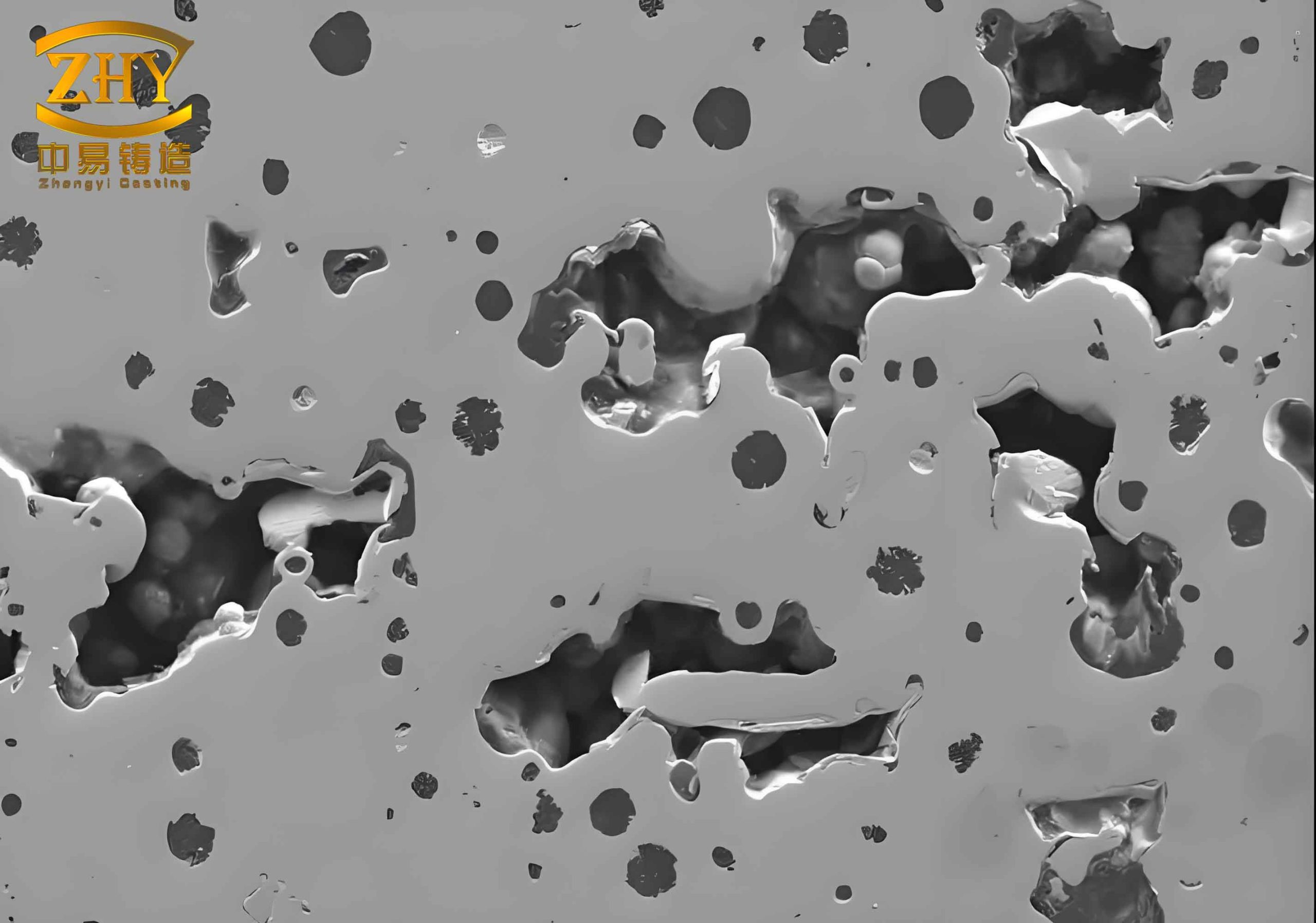
To visually illustrate typical sand casting defects, the following image provides a reference for common manifestations in sand cast components, underscoring the importance of defect analysis.
Integrated Defect Prevention through Modern Sand Casting Technologies
Traditional sand casting processes often rely on trial-and-error, but modern technologies enable proactive sand casting defect prevention. We have integrated computer-aided engineering (CAE) simulations to model fluid flow, solidification, and stress distribution. The governing equations for solidification simulation include the heat transfer equation with latent heat release:
$$ \rho c_p \frac{\partial T}{\partial t} = \nabla \cdot (k \nabla T) + \rho L \frac{\partial f_s}{\partial t} $$
where $\rho$ is density, $c_p$ is specific heat, $k$ is thermal conductivity, $L$ is latent heat, and $f_s$ is solid fraction. By simulating various scenarios, we optimize gating and risering to minimize sand casting defects. Additionally, we employ statistical process control (SPC) to monitor key parameters like sand moisture, binder content, and pouring temperature, using control charts to detect deviations before they cause sand casting defects. Advanced non-destructive testing (NDT) methods, such as X-ray radiography and ultrasonic testing, allow for inline inspection, ensuring that sand casting defects are identified early.
The table below contrasts traditional and modern approaches to managing sand casting defects, highlighting the evolution in defect mitigation strategies.
| Aspect | Traditional Methods | Modern Advanced Methods |
|---|---|---|
| Design & Optimization | Empirical rules, manual calculations | Finite element simulation, topology optimization |
| Process Monitoring | Periodic manual checks | Real-time sensors with IoT integration for continuous data acquisition |
| Material Engineering | Standard sand-binder mixtures | Engineered sands with nano-additives to enhance properties |
| Quality Verification | Random destructive testing | 100% non-destructive evaluation using digital tomography |
These advancements have not only reduced the frequency of sand casting defects but also improved yield and consistency, making sand casting more competitive for high-performance applications.
Conclusion: Towards Zero-Defect Sand Casting
In conclusion, sand casting defects such as shrinkage porosity, gas holes, and sand adhesion are significant challenges in producing reliable mining components. Through rigorous analysis and the implementation of targeted preventive measures, we have made substantial strides in mitigating these sand casting defects. Key to our success has been the integration of theoretical models, empirical data, and modern technologies to create a robust quality ecosystem. The continuous focus on sand casting defect prevention is essential for advancing manufacturing excellence and ensuring the safety of mining operations. As we look ahead, we will further leverage digital twins, artificial intelligence for predictive analytics, and sustainable materials to drive the sand casting process toward near-zero defect outcomes, ultimately elevating the standard for sand casting defect management in the industry.