
In our high-volume production foundry, specializing in engine components, we recently faced a critical and persistent quality issue affecting a key product: the medium-speed engine flywheel manufactured from grade HT250 grey iron. This defect manifested as severe depressions or sink marks on the upper planar surface of the casting, often exceeding 3 mm in depth and leading to an unacceptable scrap rate. The financial impact and disruption to delivery schedules were substantial, demanding an immediate and systematic resolution. This article details our first-hand investigation, root cause analysis, and the multifaceted corrective actions we implemented to eliminate shrinkage depression in these grey iron castings. Our journey underscores the complex interplay between metallurgy, process design, and simulation in modern foundry practice.
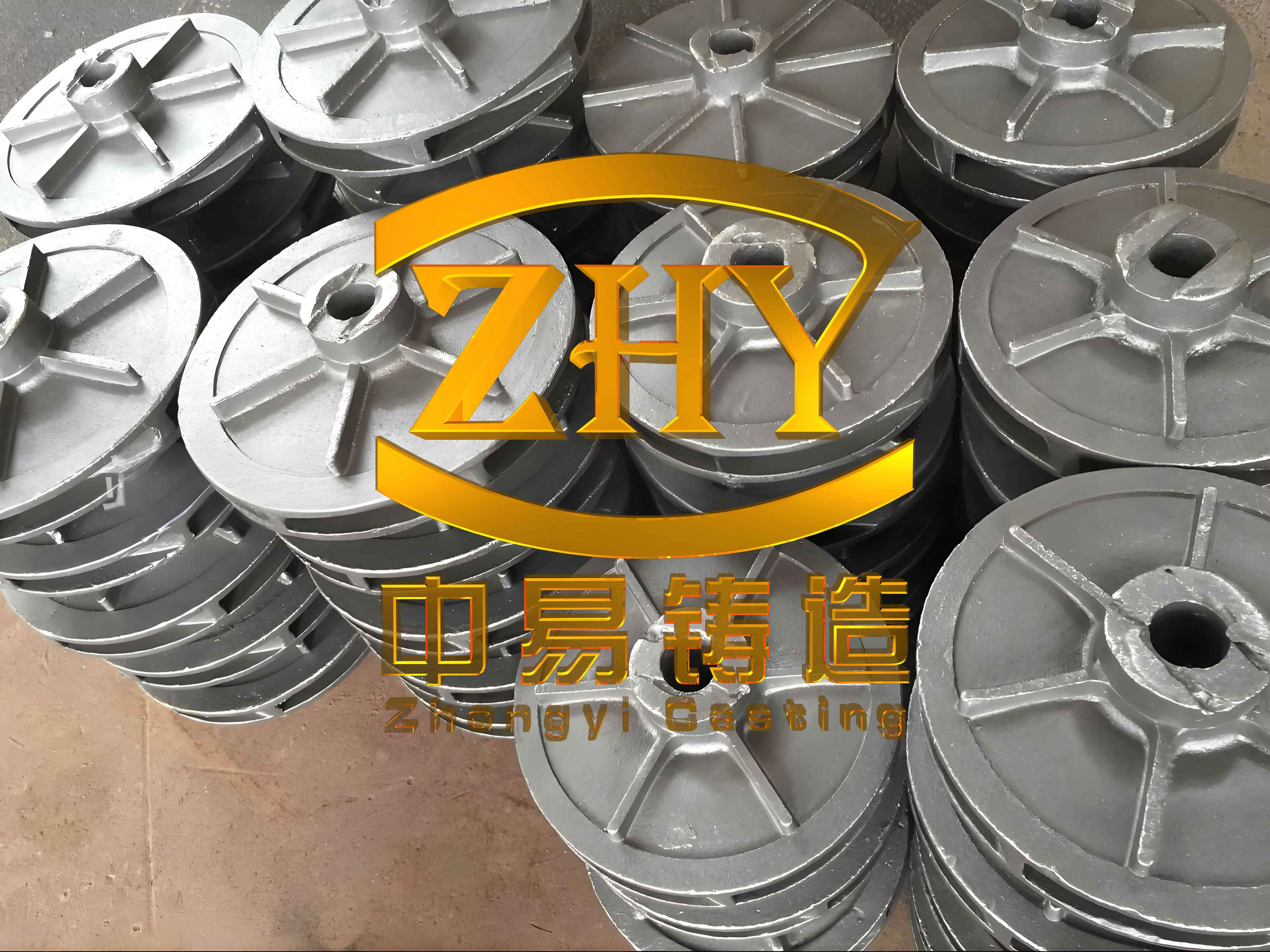
The affected component was a disc-shaped flywheel with a substantial mass, typical of many power transmission grey iron castings. Its specifications are summarized below:
| Parameter | Value | Unit |
|---|---|---|
| Nominal Diameter | 702 | mm |
| Height/Thickness | 133 | mm |
| Minimum Wall Thickness | 46 | mm |
| Cast Weight (Rough) | 245 | kg |
| Material Grade | HT250 (Grey Iron) | – |
| Required Hardness | 190 – 240 | HBW |
| Key Microstructure | >98% Pearlite, Type A Graphite | – |
The defect was not a surface irregularity but a genuine volumetric deficiency. Post-fettling and before shot blasting, the depressions were found to be lined with the refractory coating, and occasionally contained small, spherical “iron beads” that were free of coating. This observation was crucial. The coated depression indicated a cavity formed during solidification where the metal surface was in contact with the mold. The iron beads, formed from metal extruded in the final stages of solidification due to graphite expansion, confirmed the defect as a shrinkage depression, a form of shrinkage cavity occurring near the casting surface. In grey iron casting, shrinkage defects are primarily a result of the imbalance between the total contraction of the liquid and austenitic phases and the expansion due to graphite precipitation. The challenge was to identify why this balance was disrupted for this particular geometry under our standard process.
Our initial production process was well-established on an automated molding line. We used alkaline phenolic resin-bonded sand for mold and core production, with two castings arranged horizontally in a single mold (stacked pattern). The gating system was a traditional pressurized (choke) system. The key parameters of the original melt chemistry and process are listed below.
| Category | Parameter | Original Value/Specification |
|---|---|---|
| Melt Composition (wt.%) | Carbon (C) | 3.25 – 3.30 |
| Silicon (Si) | 1.85 – 1.95 | |
| Manganese (Mn) | 0.90 – 1.00 | |
| Phosphorus (P) | < 0.05 | |
| Sulfur (S) | < 0.10 | |
| Copper (Cu) | ~0.40 | |
| Gating System (Ratio) | Sprue (∑Asprue) | 1.0 (Reference) |
| Runner (∑Arunner) | 1.64 | |
| Ingate (∑Aingate) | 2.05 | |
| Pouring Practice | Initial Pouring Temperature | 1355 – 1360 °C |
| Mold Pouring Sequence | Two molds per ladle | |
| Molding | Sand Compaction (Jolt Time) | 15 seconds |
The systematic failure analysis led us to identify four primary, interconnected root causes for the shrinkage depression in these grey iron castings.
4.1 Metallurgical Root Cause: Sub-optimal Carbon Equivalent (CE)
The carbon equivalent is the paramount factor controlling the solidification behavior and shrinkage tendency of grey iron castings. For standard grey irons, it is calculated as:
$$ CE = C + \frac{1}{3}(Si + P) $$
Using our original median composition (C=3.28%, Si=1.90%, P=0.04%), the CE was:
$$ CE_{original} = 3.28 + \frac{1}{3}(1.90 + 0.04) = 3.28 + 0.647 \approx 3.93\% $$
This value placed the iron in a distinctly hypoeutectic region. Hypoeutectic grey irons undergo primary austenite solidification, which has a significant contraction associated with it. The solidification range between the liquidus and eutectic temperatures is wider, leading to prolonged periods of liquid and mushy zone contraction that must be fed. The relationship between volumetric change (ΔV) and temperature can be simplified for the liquid contraction phase as:
$$ \Delta V_{liquid} = V_0 \cdot \beta_l \cdot (T_{pour} – T_{liquidus}) $$
where $V_0$ is the initial volume, $\beta_l$ is the coefficient of thermal contraction for liquid iron (~$1.0 \times 10^{-4}$ /°C), $T_{pour}$ is the pouring temperature, and $T_{liquidus}$ is the liquidus temperature, which is a function of CE. A lower CE raises $T_{liquidus}$, potentially increasing the $(T_{pour} – T_{liquidus})$ term if pouring temperature is constant. More critically, the total contraction before the onset of graphite expansion is higher. The compensating graphite expansion volume, $V_{gexp}$, is proportional to the amount of carbon precipitated as graphite. A lower CE often means less total graphite, reducing this beneficial expansion.
4.2 Process Root Cause: Excessive Pouring Temperature
Our standard pouring temperature of 1355-1360°C was initially set to ensure good fluidity for filling the thin sections of other castings produced on the same line. However, for this thick-sectioned flywheel, it was excessively high. The high superheat directly amplified the liquid contraction, as evident from the formula above. Furthermore, it delayed the start of solidification, allowing more heat to transfer into the mold wall, potentially reducing its local strength and promoting mold wall movement. The thermal gradient was also affected, potentially shifting the location of the last point to solidify.
4.3 Mold-Related Root Cause: Insufficient Mold Stiffness
The rigidity of the sand mold is critical in resisting metallostatic pressure and the internal pressures generated during graphite expansion. If the mold deforms outward, it creates additional volume that the solidifying metal must fill, effectively exacerbating shrinkage. The mold hardness or strength is a proxy for this stiffness. Our standard jolting time of 15 seconds, while adequate for smaller castings, likely produced a mold with non-optimum uniform density and strength for a heavy 245 kg grey iron casting. The mold’s ability to withstand the internal pressure $P_{internal}$ during the expansion phase was compromised. The pressure from graphite expansion can be significant and is a function of the fraction of graphite formed and the constrained conditions.
4.4 Design Root Cause: Non-optimized Gating and Feeding System
The original gating system was a fully pressurized design with the choke at the ingates. This design leads to very high metal velocity at the ingates. We can estimate the ingate velocity $v_{ingate}$ using the Bernoulli equation for a choked system:
$$ v_{ingate} \approx \sqrt{2gh} $$
where $g$ is gravity (9.81 m/s²) and $h$ is the effective metallostatic head height from the top of the sprue to the ingate (~0.15 m in our setup).
$$ v_{ingate} \approx \sqrt{2 \cdot 9.81 \cdot 0.15} \approx \sqrt{2.943} \approx 1.72 \text{ m/s} = 172 \text{ cm/s} $$
Simulation later confirmed velocities near 200 cm/s. This high velocity caused turbulent and splashy filling. The consequence was twofold: First, air and mold gas entrapment could create localized hot spots. Second, and more importantly, the turbulent filling led to an unsteady rise of metal in the mold cavity. The pour was stopped based on the sight of metal rising in the overflow riser, but due to splashing and momentum, the metal level would drop significantly after the pour stopped. This reduced the actual feeding pressure head available during the critical liquid contraction phase. Secondly, the ingate cross-section was thin (5 mm height). This caused it to freeze off very quickly after pouring, severing the connection between the casting and the gating system long before the end of the liquid contraction and early solidification period. The casting was essentially isolated and had to cope with contraction stresses internally without liquid feed from the gating system, relying solely on inefficient atmospheric risers.
The solution required a holistic approach, addressing all four root causes simultaneously. We employed both empirical adjustments and advanced simulation tools.
5.1 Metallurgical Adjustment: Increasing Carbon Equivalent
We strategically increased the target carbon content while keeping silicon stable to move the composition closer to the eutectic point. The new target for Carbon was set at 3.30-3.35%. This modest increase had a direct impact on the CE:
$$ CE_{new} = 3.33 + \frac{1}{3}(1.90 + 0.04) = 3.33 + 0.647 \approx 3.98\% $$
This 0.05% increase in CE shifted the solidification mode slightly, reducing the primary austenite interval and increasing the amount of eutectic graphite. The increased graphite content promised greater expansion to counteract shrinkage. The comparative effect is summarized below:
| Parameter | Original (CE ~3.93%) | Modified (CE ~3.98%) | Impact |
|---|---|---|---|
| Liquidus Temperature (Approx.) | Higher | Slightly Lower | Reduces liquid contraction range |
| Primary Austenite Fraction | Higher | Lower | Reduces contraction from primary solidification |
| Graphite Expansion Potential | Lower | Higher | Increases compensating expansion force |
| Shrinkage Tendency | Higher | Lower |
5.2 Pouring Process Optimization: Controlled Temperature and Practice
We instituted a strict protocol for this specific grey iron casting:
- Lowered Pouring Temperature: The target initial pouring temperature was reduced to 1345-1350°C. This directly reduced the $\Delta T$ term in the liquid contraction equation.
- Dedicated Pouring Schedule: Flywheels were poured in dedicated batches at the start of a ladle’s sequence to avoid the temperature increase that occurs when holding metal for other jobs.
- Increased Pouring Weight/Overflow: We intentionally increased the amount of metal poured per mold, allowing a larger overflow in the risers. This ensured that after the post-pour slump, the ingates and sprue well remained connected to a liquid metal reservoir for a longer time, providing a feeding path.
- Monitoring: Infrared pyrometers and ladle-mounted cameras were used to strictly enforce temperature limits.
5.3 Mold Strength Enhancement
To combat mold wall movement, we increased the jolting time on the molding machine from 15 seconds to 25 seconds. This improved the sand compaction uniformity and the overall mold hardness. The increased mold stiffness, quantified by a higher mold hardness number (e.g., on a Brinell-type scale for sand), better contained the internal pressures during solidification. The increased strength $\sigma_{mold}$ reduces the mold wall displacement $\delta$ under internal pressure $P$:
$$ \delta \propto \frac{P \cdot L}{\sigma_{mold}} $$
where $L$ is a characteristic dimension. A higher $\sigma_{mold}$ leads to smaller $\delta$, minimizing created volume.
5.4 Gating System Redesign Using MAGMA Simulation
This was the most significant engineering change. We utilized MAGMAsoft simulation software to analyze the original filling and solidification patterns and to iteratively test new designs. The objectives were: calm filling, prolonged feeding capability from the gating system, and directional solidification towards the risers.
- System Type Change: We switched from a fully pressurized to a “pressurized-open” or partially choked system. A choke was placed at the base of the sprue, immediately after the sprue well. The system downstream of this choke was open (larger total cross-section). This drastically reduced ingate velocity. The new velocity, as confirmed by simulation, dropped to approximately 80 cm/s.
- Runner Modification: The full circular runner was modified to a 3/4 circle with a blind end acting as a slag trap, promoting calmer flow and slag separation.
- Ingate Resizing: The ingate height was increased from 5 mm to 8 mm (while proportionally reducing width to maintain similar area). This dramatically increased the ingate’s modulus (Volume/Surface Area), slowing its solidification. The solidification time $t_s$ can be approximated by Chvorinov’s rule:
$$ t_s = k \cdot \left( \frac{V}{A} \right)^n $$
where $k$ and $n$ are constants. Increasing the modulus $(V/A)$ significantly increases $t_s$, keeping the ingate liquid and open for feeding much longer.
The new design ratios were: ∑Asprue : ∑Achoke : ∑Arunner : ∑Aingate = 1.0 : 0.8 : 1.8 : 2.2. The simulation clearly showed a tranquil fill pattern and, critically, that the ingates and runner remained liquid long enough to act as effective feeders during the casting’s liquid contraction phase. The thermal analysis showed a more favorable temperature gradient, directing the last point to solidify towards the central hub area, away from the upper flat surface.
| Aspect | Original Practice | Corrective Action | Primary Mechanism of Defect Reduction |
|---|---|---|---|
| Carbon Equivalent | ~3.93% | ~3.98% | Reduces primary contraction, increases graphite expansion. |
| Pouring Temperature | 1355-1360°C | 1345-1350°C | Reduces liquid contraction volume ($\Delta V_{liquid}$). |
| Mold Compaction | 15s jolt | 25s jolt | Increases mold stiffness ($\sigma_{mold}$), reduces wall movement. |
| Gating System Type | Fully Pressurized | Pressurized-Open | Reduces ingate velocity, promotes calm fill. |
| Ingate Geometry | 5 mm height | 8 mm height | Increases modulus, prolongs feeding time ($t_s$). |
| Feeding Strategy | Atmospheric riser only | Gating system as feeder + overflow | Provides liquid metal feed during critical contraction phase. |
The implementation of this integrated set of measures was followed by a production run of over 100 flywheel castings. The result was a complete elimination of the shrinkage depression defect. All castings exhibited a sound, flat upper surface meeting the machining allowance specifications. Dimensional checks and non-destructive testing confirmed internal soundness. This success validated our root cause analysis and demonstrated the effectiveness of a systematic, multi-parameter approach.
Resolving the shrinkage depression in these heavy-section grey iron castings was an instructive exercise in modern foundry problem-solving. It reinforced that such defects are rarely due to a single factor but arise from the confluence of material properties, process parameters, and design elements. Specifically for grey iron casting:
- Carbon Equivalent is Fundamental: Operating too far into the hypoeutectic range for thick sections increases shrinkage risk. A strategic increase towards the eutectic point, within the grade specification, is a powerful tool.
- Process Discipline is Critical: Pouring temperature must be optimized for the specific casting geometry, not just for fluidity. Lower superheat can be beneficial for reducing liquid shrinkage.
- Mold Rigidity Cannot Be Overlooked: For castings susceptible to expansion-related issues, ensuring maximum mold strength is essential to harness the beneficial graphite expansion.
- Advanced Simulation is Invaluable: Software like MAGMA provides deep insights into filling and solidification dynamics that are impossible to gauge empirically. It allows for optimizing gating systems to achieve calm filling and controlled solidification, transforming the gating system from a mere delivery conduit into an active feeding mechanism.
The principles applied here—balancing contraction and expansion through chemistry, controlling thermal parameters, ensuring robust tooling (molds), and employing intelligent design via simulation—are universally applicable to improving the quality and yield of complex grey iron castings. This case study serves as a template for tackling similar volumetric defects in foundry operations, emphasizing that a holistic view is key to sustainable quality improvement.
To further generalize the learning, we can express the condition for avoiding shrinkage depression in a grey iron casting as an inequality that must be satisfied:
$$ \Delta V_{contraction} \leq \Delta V_{expansion} + \Delta V_{feed} $$
Where:
- $\Delta V_{contraction} = \Delta V_{liquid} + \Delta V_{austenitic}$ is the total volumetric contraction from pouring temperature through the austenitic solidification.
- $\Delta V_{expansion}$ is the volumetric expansion due to graphite precipitation, a function of CE and cooling rate.
- $\Delta V_{feed}$ is the volume of liquid metal fed into the casting cavity from external sources (gating system, risers) during solidification.
Our corrective actions positively influenced all terms on the right-hand side while reducing the left-hand side, thereby restoring the balance necessary for sound grey iron casting production.