
In my extensive experience with Full Mold or Lost Foam Casting (FMC) for producing iron castings, particularly for large components like automotive stamping dies and machine tool beds, one persistent and challenging issue has been the occurrence of slag inclusion defects. These are not simple, isolated non-metallic inclusions. Often, they manifest as large, flaky intrusions of coating material embedded in the casting surface, commonly referred to as “coating sheet” slag inclusions. This defect significantly compromises the mechanical integrity and surface quality of the final product, leading to high rejection rates and costly rework. The fight against this specific type of slag inclusion requires a systemic understanding of the unique dynamics of the FMC process. This article delves into a root cause analysis of these defects and outlines a multi-faceted strategy for their prevention, emphasizing process design, coating technology, and foundry practice.
The FMC process, where a polystyrene (EPS or STMMA) foam pattern is vaporized by molten metal within an unbonded sand mold, offers remarkable advantages in geometric freedom and near-net-shape capability. However, this very mechanism introduces complex interactions between the decomposing pattern, the coating, the sand, and the advancing metal front. Unlike in conventional hollow mold casting, the coating in FMC is applied directly onto the foam pattern. It does not penetrate and anchor into the sand matrix; instead, it forms a shell that is only in point contact with the surrounding sand grains after molding. This fundamental difference makes the coating layer inherently more vulnerable to mechanical damage and thermal shock during metal pouring, directly leading to potential sources for slag inclusion.
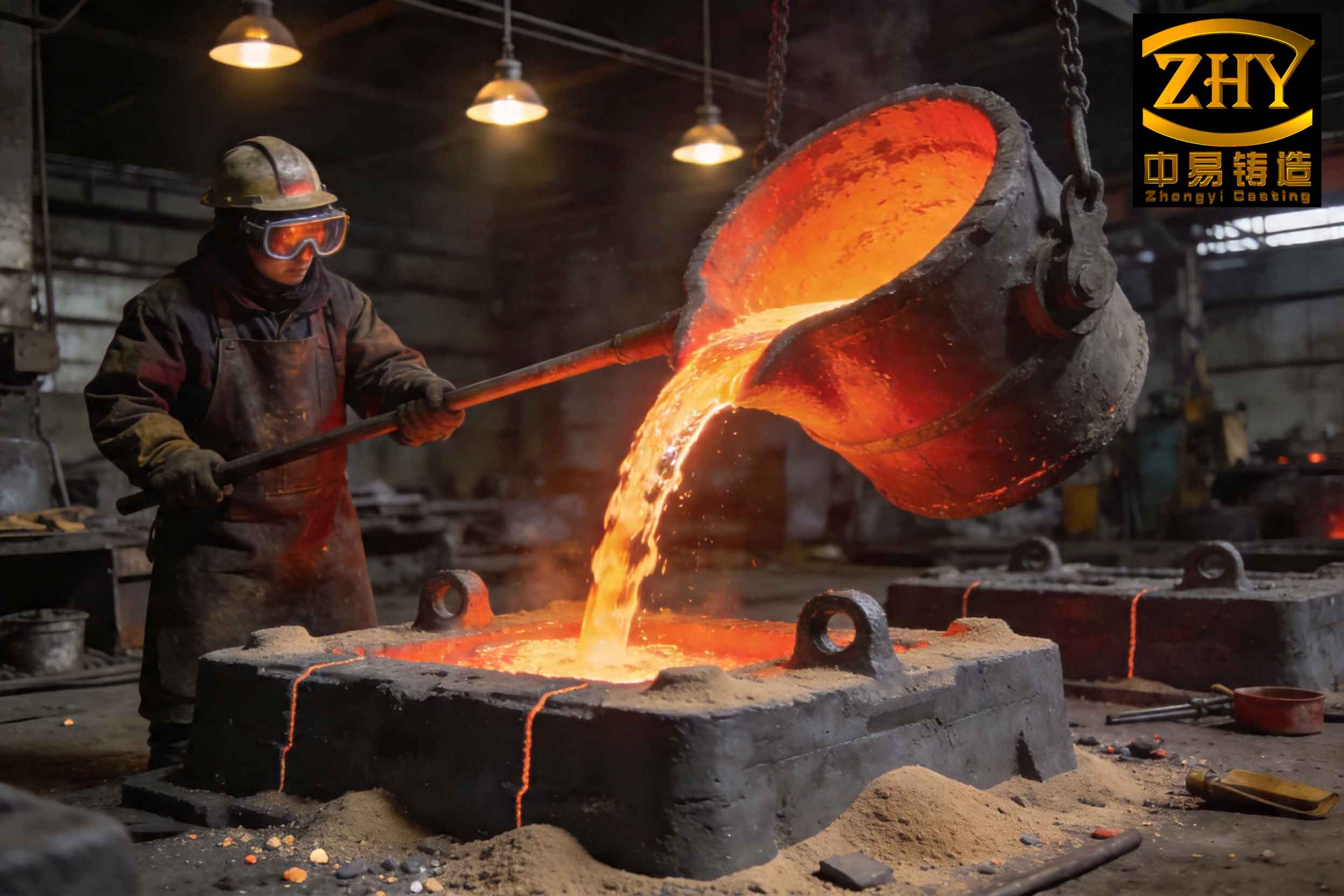
The visual manifestation of a “coating sheet” slag inclusion is typically severe. It appears as large depressions or scars on the casting’s upper surfaces, side walls, or at flow confluence points like corners and junctions. These scars can be elongated (30-100mm or more) or broad patches exceeding 300mm x 300mm. Before cleaning, these cavities are filled with a mixture of coating ash, sand grains, and other debris, with large flakes of refractory coating material often visible within the slag mass. Critically, the occurrence of this defect is almost invariably accompanied by severe metal penetration (burn-on/burn-in), indicating that the primary event is a localized failure of the coating barrier.
Root Cause Analysis: A Multi-Stage Failure
Attributing this defect solely to inadequate sand compaction is an oversimplification. Through systematic investigation, I have identified that coating failure is the precursor event, which then permits sand penetration and ultimately results in the composite slag inclusion defect. The root causes are interlinked across several stages of the process.
1. The Critical Role of Gating System Design and Metal Flow Dynamics
Conventional gating design principles based on choke-controlled flow in empty molds do not fully apply to FMC. Here, the dominant resistance to flow is the gas pressure generated by the vaporizing foam, not the friction in the gating channels. The flow is multidimensional and pulsating, heavily influenced by pattern geometry and the evolving gas gap between the metal and the receding pattern.
A poorly designed gating system is a primary instigator of slag inclusion defects. The goal is not just to regulate flow speed but to manage the stability of the metal-front progression. Two key, interrelated phenomena are crucial:
- Flow Instability and Turbulence: If the gating causes multiple streams to collide or creates rapid changes in flow direction, it induces severe turbulence. This turbulence entraps air, degrades coating particles, and carries them into the melt, directly contributing to slag inclusion formation.
- The “Pressure Loss” or “Pressure Let-Down” Phenomenon: This is a pivotal concept in understanding FMC defects. As metal flows from a narrow section (like a feeder rib) into a suddenly larger cavity (like a top flange), the flow velocity drops abruptly according to the mass conservation principle for incompressible fluids:
$$ v_1 A_1 = v_2 A_2 = Q $$
where $v_1$, $v_2$ are average velocities at cross-sectional areas $A_1$, $A_2$, and $Q$ is the volumetric flow rate. The sudden reduction in velocity ($v_2 \ll v_1$) disrupts the delicate equilibrium between the advancing metal, the vaporizing foam, and the gas gap. The gas pressure in front of the metal can momentarily collapse. This “loss of pressure” has two detrimental effects: first, it can cause the unsupported coating in that area to spall or crack under thermal shock; second, the reduced kinetic energy allows entrained slag and bubbles to settle and aggregate at that very location, creating a perfect site for a major slag inclusion defect.
The following table contrasts the effects of different gating approaches relevant to FMC:
| Gating Approach | Intended Function | Risk in FMC Context | Link to Slag Inclusion |
|---|---|---|---|
| Reverse Shower (Multi-in-gates) | Rapid, uniform filling. | High risk of multiple flow confluence points. Creates turbulence and slag agglomeration zones at meeting points. | Direct source of turbulence-induced slag inclusion. |
| Gating with Large Section Changes | Control filling pattern. | Triggers the “pressure loss” phenomenon at expansion areas. Coating in these zones is vulnerable. | Primary cause of coating spallation and subsequent slag inclusion. |
| Unoptimized Bottom Gating | Quiet filling from bottom. | Metal fans out horizontally; flow is thick near the ingate and thin farther away, creating pressure differentials and unstable fronts. | Can lead to localized coating erosion and intermittent slag inclusion defects. |
2. Coating Properties and Application Integrity
The coating is the first line of defense against slag inclusion. Its failure modes are numerous and often begin long before metal is poured. The key required properties for an FMC coating—high permeability, low gas generation, good refractoriness, and adequate strength—can sometimes be at odds. The weakness that most directly leads to “coating sheet” defects is insufficient low-temperature (green) strength. Coating failure can occur at several stages:
- Drying: Incorrect binder ratios or overly thick application leads to drying cracks.
- Handling & Molding: Inadequate green strength causes micro-cracks during pattern assembly, transport, or sand filling, especially at stress concentration points like undercuts and thin flanges.
- Metal Pouring: Thermal shock from the initial metal contact, combined with mechanical erosion from turbulent flow, can detach weak or cracked coating.
- Metal Static Pressure: During solidification, the metallostatic pressure can cause coating fragments to break off if adhesion is poor.
Furthermore, foam is a non-polar material, making it difficult for water-based coatings to wet and adhere properly. While surfactants are added to mitigate this, their degradation or improper use can lead to poor coating coverage, creating thin spots or discontinuities that are immediate failure points and direct entry points for slag inclusion formation.
| Property | Ideal Characteristic | Consequence of Deficiency |
|---|---|---|
| Low-Temp (Green) Strength | High enough to resist handling damage and initial thermal shock. | Micro-cracks form, providing initiation points for coating spallation and slag inclusion. |
| High-Temp Strength & Sintering | Maintains integrity under metal heat, then sinters for easy removal. | Coating disintegrates into melt, becoming a direct source of slag inclusion. |
| Permeability | Very high to allow rapid gas evacuation. | Back-pressure builds, increasing turbulence and the risk of coating damage. |
| Adhesion/Wetting | Excellent, uniform adhesion to foam pattern. | Poor coverage creates weak spots prone to erosion, leading to localized slag inclusion. |
3. Sand Compaction and Process Control
While not the root cause, inadequate sand compaction is a critical contributing factor. The unbonded sand must provide uniform, firm support to the fragile coating-shell. In areas that are difficult to access, such as undercuts (“backhand” pockets), deep cavities, or between closely spaced patterns, sand may not be compacted sufficiently. During pouring, the unsupported coating in these areas is more susceptible to deformation, cracking, or being pushed inward by the metal pressure, instantly creating a defect site ripe for slag inclusion. This highlights that FMC simplifies molding operations but raises the required standard of care and consistency in the molding process itself.
A Systemic Improvement Strategy
Eliminating “coating sheet” slag inclusion defects requires a holistic approach targeting all identified root causes. Isolated fixes are rarely successful. The following integrated strategy has proven effective in practice.
1. Redesigning the Gating System for Stable Filling
The primary objective is to promote a smooth, progressive metal front that minimizes turbulence and avoids sudden pressure changes. Key design modifications include:
- Avoiding Multi-Ingate Confluence Points: Design the gating and pattern layout to prevent multiple metal streams from meeting in hard-to-vent areas or on critical casting surfaces. If confluence is unavoidable, position it where a slag trap or riser can collect the resulting slag inclusion.
- Minimizing Abrupt Section Changes: Design the pattern and gating to avoid sudden, large expansions in the flow path. Use tapered transitions where possible. For “I-beam” type structures (common in die shoes), special attention must be paid to the transition from the vertical rib to the top flange—a classic site for the “pressure loss” phenomenon. Strategically placed chills or cooling fins in the pattern can help solidify the metal front more predictably in these zones.
- Implementing Effective Slag Traps and Venting: Proactively manage slag and gas. Use properly designed whirlgate or strainer core basins in the gating system to trap initial slag. Install auxiliary vents or risers (often simple foam rods coated and attached to the pattern) at the highest points, dead ends, and predicted flow confluence points. These act as escape routes for gas and collectors for lighter slag particles, preventing them from consolidating as a slag inclusion on the casting.
2. Optimizing Coating Formulation and Application
The coating must be engineered as a robust, functional barrier. Improvements focus on strength and consistency:
- Balanced Binder System: Employ a combination of organic and inorganic binders. Organic binders (e.g., latex, cellulose ethers) provide good green strength and flexibility, while inorganic binders (e.g., bentonite, phosphates) provide high-temperature strength. The ratio must be optimized to achieve:
$$ S_{total} = f(S_{organic}(T_{low}), S_{inorganic}(T_{high}), P, A) $$
where $S$ is strength, $T$ is temperature, $P$ is permeability, and $A$ is adhesion. The goal is a high $S_{total}$ across the temperature range without sacrificing $P$ or $A$. - Rheology Control and Layering: Use coatings with appropriate viscosity and thixotropy to ensure even build-up without runs or drips. Applying multiple thin coats is far superior to a single thick coat, as it reduces drying stress and the risk of cracking—a direct precursor to slag inclusion.
- Quality Control in Coating Process: Regularly monitor coating slurry density, viscosity, and pH. Ensure patterns are perfectly dry before coating and between coats. Implement rigorous inspection of the dried coating for cracks, thin spots, or poor adhesion before the pattern proceeds to molding.
3. Tightening Process Controls in Molding and Pouring
- Standardized Sand Compaction Procedure: Develop and enforce a detailed procedure for filling and compacting sand, especially for complex patterns with deep pockets and undercuts. Use vibration tables with controlled frequency and amplitude, and employ manual aids (rods, paddles) to ensure no voids are left behind the coating.
- Controlled Pouring Practice: Maintain a consistent, sufficiently rapid pour to sustain a positive pressure head and a steady metal front. A slow, intermittent pour exacerbates turbulence and thermal cycling on the coating, increasing slag inclusion risk. The pour time should be determined by the gas generation rate of the specific pattern volume.
- Pattern Quality and Assembly: Ensure foam patterns are of high density and free from defects. Glue seams must be tight and smooth to prevent localized coating buildup or crevices that can trap gas and cause localized erosion and slag inclusion.
| Improvement Area | Specific Action | Targeted Root Cause |
|---|---|---|
| Gating & Process Design | Design for progressive filling, avoid confluence, add slag traps/venting. | Unstable flow, turbulence, “pressure loss” phenomenon. |
| Coating Technology | Optimize binder blend for high green and hot strength. | Low coating strength, poor adhesion, thermal shock failure. |
| Implement controlled multi-layer coating application. | ||
| Foundry Practice | Enforce strict sand compaction standards; control pour rate. | Inadequate sand support; process variability inducing turbulence. |
Conclusion and Outlook
The battle against “coating sheet” slag inclusion defects in Full Mold Casting is won through deep process understanding and meticulous control, not by simple fixes. The defect is a symptom of systemic instability—often originating from a gating design that induces turbulent flow or pressure transients, exacerbated by a coating layer with insufficient mechanical integrity to withstand the process stresses. By re-engineering the gating to promote stable fill patterns, fundamentally improving the coating’s low-temperature and high-temperature performance, and rigorously controlling molding and pouring operations, the incidence of this pernicious defect can be dramatically reduced. The FMC process demands respect for its unique physics; mastering these interactions is the key to unlocking its full potential for producing high-integrity, slag-free iron castings. Continuous monitoring and statistical analysis of defect occurrence relative to process parameters remain essential for ongoing refinement and prevention of slag inclusion issues.