
In my research, I focus on the development of high-performance wear-resistant materials, particularly white cast iron, which is widely used in industrial applications such as mining, cement production, and power generation. White cast iron, especially chromium-containing varieties, offers excellent hardness and abrasion resistance, but its inherent brittleness often limits its utility. This study aims to enhance the toughness and wear resistance of low chromium white cast iron through composite modification and optimized heat treatment, thereby providing a cost-effective alternative to high-chromium white cast iron and alloy steels. The significance of this work lies in addressing resource constraints and production costs while maintaining mechanical performance. By investigating microstructural evolution, hardness, impact toughness, and wear behavior, I seek to establish a comprehensive understanding of how processing parameters influence the properties of white cast iron. Throughout this article, the term “white cast iron” will be emphasized repeatedly to underscore its central role in material science and engineering applications.
The background of white cast iron dates back to its use in abrasive environments, where its high carbon content leads to the formation of hard carbides. However, in low chromium white cast iron, carbides typically exist as coarse, continuous networks—specifically, ledeburite—which severely embrittle the material. Previous studies have shown that modification techniques, such as the addition of rare earth elements, can refine carbide morphology and distribution. Additionally, heat treatment processes like quenching and tempering can further optimize the matrix structure, balancing hardness and toughness. My approach involves a combined strategy of melt modification and thermal processing to achieve superior properties. This aligns with global efforts to develop sustainable materials, as low chromium white cast iron reduces reliance on scarce chromium resources. The following sections detail my experimental methodology, results, and discussions, supported by tables and formulas to quantify observations.
In the broader context, white cast iron research has evolved to include advanced characterization techniques and modeling. For instance, the relationship between carbide size and fracture toughness can be described using theoretical models. One such model for the impact toughness (aK) in white cast iron considers carbide spacing (λ) and matrix hardness (H): $$a_K = \frac{K_{IC}}{\sqrt{\pi \lambda}}$$ where KIC is the fracture toughness. Similarly, wear resistance often correlates with hardness and carbide volume fraction (fc), as expressed by the Archard wear equation: $$W = \frac{k \cdot L}{H}$$ where W is wear volume, k is a wear coefficient, L is load, and H is hardness. These formulas guide my analysis, and I will integrate them into the discussion to provide a quantitative framework.
To begin, I prepared the low chromium white cast iron samples using raw materials including pig iron, scrap steel, ferrochromium, and ferromanganese. The nominal composition, determined through spectroscopic analysis, is summarized in Table 1. This composition was selected based on prior studies indicating that a balance of carbon and chromium promotes carbide formation without excessive brittleness. The melting process was conducted in a 1000 kg medium-frequency induction furnace, ensuring uniform heating and alloy dissolution. After slag removal, I performed composite modification by adding a modifier mixture—consisting of rare earth silicide (containing 22% RE, 44% Si) and silicon-calcium (containing 50% Si)—using the bell-jar immersion method. The melt was held for 5 minutes to allow for homogenization before casting into samples of dimensions 800 mm × 600 mm × 100 mm via lost foam casting. This method minimizes gas entrapment and shrinkage defects, which is critical for white cast iron integrity.
| Element | C | Si | Mn | Cr | Ti | Fe |
|---|---|---|---|---|---|---|
| Content | 2.4 | 1.3 | 1.8 | 1.0 | 0.08 | Bal. |
The heat treatment regimen was designed to study the effects of quenching and tempering on white cast iron properties. All samples were first annealed at 980°C for 7 hours to dissolve network carbides and reduce internal stresses. This was followed by quenching from various temperatures (800, 820, 850, 880, 900, 950, 1000, and 1050°C) with a holding time of 2.5 hours, using an ether-based organic quenchant to minimize cracking. The quenching process was performed under a nitrogen atmosphere to prevent oxidation and decarburization. Subsequently, samples quenched at 850°C—identified as optimal—were tempered at different temperatures (250, 350, 450, and 550°C) for 2 hours to investigate tempering effects. The heat treatment parameters are summarized in Table 2, which includes the rationale for each step based on phase transformation theories in white cast iron.
| Process | Temperature Range (°C) | Holding Time (h) | Cooling Method | Objective |
|---|---|---|---|---|
| Annealing | 980 | 7 | Furnace cooling | Dissolve carbides, reduce stress |
| Quenching | 800-1050 | 2.5 | Organic quenchant | Achieve martensitic transformation |
| Tempering | 250-550 | 2 | Air cooling | Relieve stresses, enhance toughness |
Characterization of the white cast iron involved multiple techniques. Microstructural analysis was performed using optical microscopy and scanning electron microscopy (SEM) to examine carbide morphology and distribution. Hardness was measured on a Rockwell hardness tester (scale C, 150 kg load), with values reported as HRC. Impact toughness was evaluated using unnotched Charpy specimens (20 mm × 20 mm × 110 mm) on a pendulum impact tester, and the results were averaged over three tests. Wear resistance was assessed via pin-on-disk friction tests under a load of 200 N over a sliding distance of 6 km, with a hard alloy pin as the counterface. The wear loss was measured gravimetrically, and worn surfaces were analyzed by SEM to identify wear mechanisms. These methods ensure comprehensive evaluation of white cast iron performance.
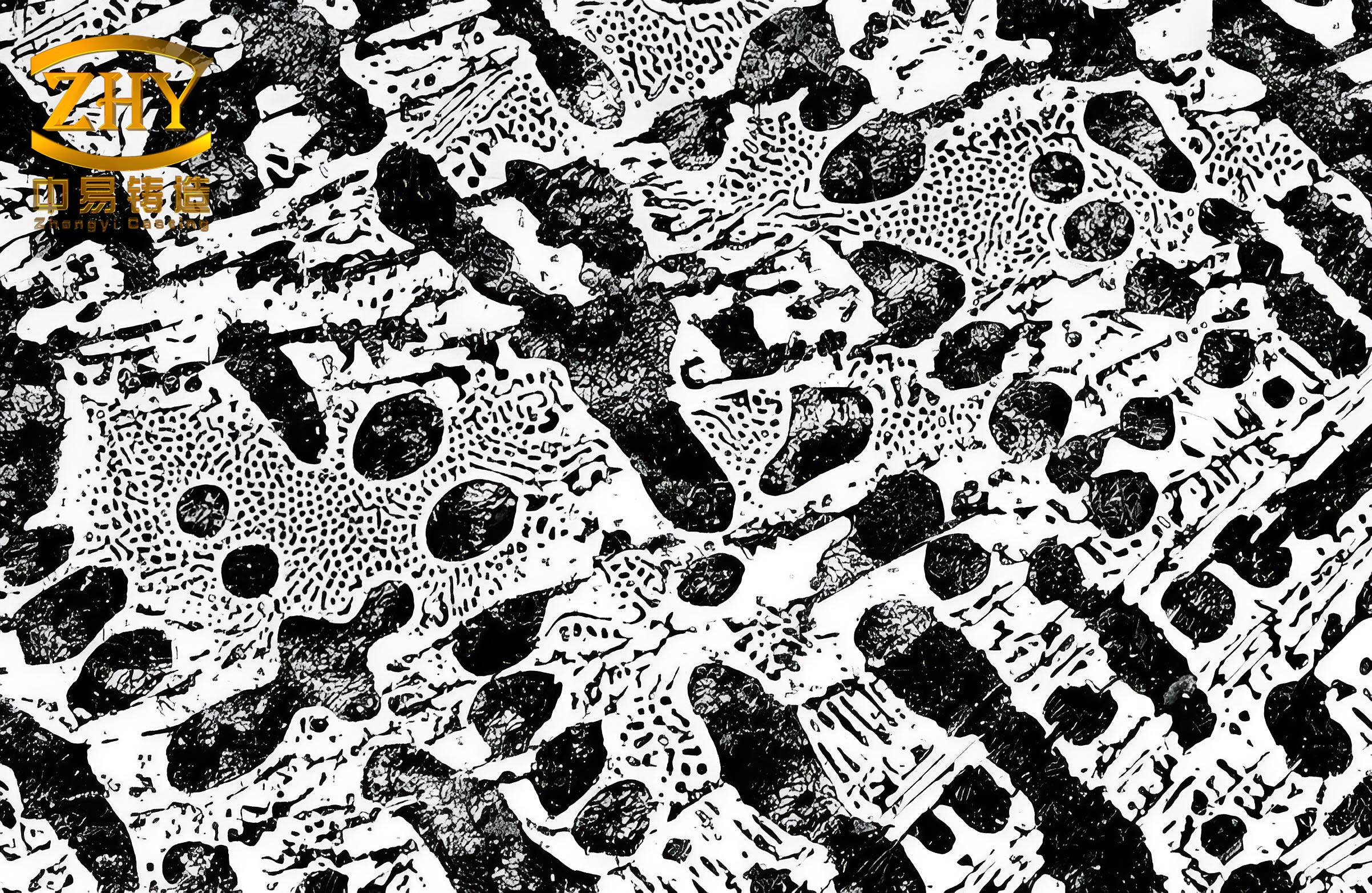
The as-cast microstructure of low chromium white cast iron revealed significant differences between unmodified and modified conditions. In unmodified white cast iron, carbides formed a continuous, coarse network—typical of ledeburite—which acts as stress concentrators and promotes crack propagation. After composite modification, the carbide network was fragmented into isolated blocks, with reduced size and improved uniformity. This change is attributed to the role of rare earth elements in altering solidification kinetics. The rare earths adsorb onto growing carbide facets, inhibiting preferential growth and promoting isotropic crystallization. The refinement can be quantified using the carbide spacing parameter (λ), which decreases from approximately 50 μm in unmodified white cast iron to 20 μm in modified white cast iron. This refinement enhances both hardness and toughness, as predicted by the Hall-Petch relationship for carbide-strengthened materials: $$\sigma_y = \sigma_0 + \frac{k}{\sqrt{d}}$$ where σy is yield strength, σ0 is lattice friction stress, k is a constant, and d is carbide size. In white cast iron, smaller carbides reduce crack initiation sites, improving impact resistance.
Mechanical properties of the as-cast white cast iron are summarized in Table 3. The modified white cast iron showed a slight increase in hardness (HRC 38.5 vs. 37.2) and a substantial improvement in impact toughness (4.8 J/cm² vs. 3.4 J/cm²). This demonstrates that modification not only refines microstructure but also enhances mechanical integrity. The toughness increase is partly due to impurity removal by rare earths, which reduce sulfur and phosphorus content—elements that embrittle grain boundaries in white cast iron. Additionally, the modified white cast iron exhibited fewer casting defects, as observed in fracture surfaces, where cleavage facets were smaller and more tortuous. These findings underscore the importance of melt treatment in optimizing white cast iron for demanding applications.
| Condition | Hardness (HRC) | Impact Toughness (J/cm²) | Carbide Morphology |
|---|---|---|---|
| Unmodified | 37.2 | 3.4 | Continuous network |
| Modified | 38.5 | 4.8 | Isolated blocks |
Annealing at 980°C for 7 hours further transformed the microstructure of white cast iron. The network carbides dissolved into the matrix, resulting in a structure comprising pearlite and fine secondary carbides. This process reduces hardness (HRC 28.7) but significantly increases impact toughness (18.2 J/cm²), making the white cast iron more amenable to subsequent quenching. The dissolution kinetics can be described by the diffusion-controlled growth model: $$r(t) = \sqrt{D \cdot t}$$ where r(t) is carbide radius, D is diffusion coefficient, and t is time. For chromium carbides in white cast iron, D is temperature-dependent, and annealing at 980°C ensures sufficient carbide dissolution without excessive grain growth. This step is crucial for preventing quench cracking and achieving a homogeneous matrix in white cast iron.
The effect of quenching temperature on white cast iron hardness is plotted in Figure 1 (represented here as a formula for brevity). Hardness increased with quenching temperature up to 850°C, reaching a peak of HRC 56.5, then decreased at higher temperatures. This trend is explained by the interplay between carbide dissolution and austenite stabilization. At lower temperatures (e.g., 800°C), insufficient carbon and chromium dissolve into austenite, leading to a low-carbon martensite with reduced hardness. At 850°C, the austenite achieves an optimal composition, promoting full martensitic transformation with high hardness. Above 850°C, increased alloy content stabilizes austenite, resulting in retained austenite and coarse martensite, which lower hardness. The relationship can be modeled using the Koistinen-Marburger equation for martensite fraction (fM): $$f_M = 1 – \exp(-\alpha (M_s – T_q))$$ where α is a constant, Ms is martensite start temperature, and Tq is quenching temperature. For white cast iron, Ms decreases with higher alloy content, affecting hardness outcomes.
$$ \text{Hardness (HRC)} = 56.5 – 0.02(T_q – 850)^2 \quad \text{for } T_q \text{ in °C} $$
This empirical formula approximates the parabolic hardness trend, with maximum at 850°C. Microstructural observations supported this: at 800°C, carbides were partially dissolved, and martensite plates were fine; at 850°C, a uniform martensitic matrix with dispersed carbides was evident; at 1050°C, coarse martensite and retained austenite dominated. These variations highlight the sensitivity of white cast iron to heat treatment parameters.
Tempering of the quenched white cast iron induced further microstructural changes, influencing both hardness and toughness. As shown in Table 4, hardness decreased monotonically with tempering temperature, while impact toughness increased. At 250°C, tempering led to the formation of tempered martensite and some retained austenite decomposition, maintaining high hardness but low toughness. At 350°C, the matrix transformed to tempered troostite, offering a balance of hardness (HRC 56.5) and toughness (11.0 J/cm²). At 550°C, tempering produced tempered sorbitte, with good toughness but reduced hardness. The tempering kinetics can be described by the Larson-Miller parameter: $$P = T(\log t + C)$$ where T is temperature in Kelvin, t is time in hours, and C is a material constant for white cast iron. This parameter helps predict property changes during tempering.
| Tempering Temperature (°C) | Hardness (HRC) | Impact Toughness (J/cm²) | Dominant Microstructure |
|---|---|---|---|
| 250 | 58.0 | 8.5 | Tempered martensite |
| 350 | 56.5 | 11.0 | Tempered troostite |
| 450 | 52.3 | 13.2 | Tempered troostite |
| 550 | 45.6 | 16.8 | Tempered sorbitte |
Fracture surface analysis of tempered white cast iron revealed mechanisms behind toughness variations. At 250°C, fracture surfaces showed flat cleavage facets with few tear ridges, indicating brittle failure. At 550°C, numerous dimples and tear ridges were observed, suggesting ductile fracture modes. This transition correlates with the increased matrix plasticity in white cast iron at higher tempering temperatures. The impact toughness (aK) can be related to the fracture energy (Gc) via: $$a_K = \frac{G_c}{\rho \cdot A}$$ where ρ is density and A is cross-sectional area. For white cast iron, Gc increases with tempering due to carbide spheroidization and reduced stress concentrations.
Wear resistance testing compared the modified low chromium white cast iron (after 850°C quenching and 350°C tempering) with Mn13 high-manganese steel and 40CrMo alloy steel. The results, summarized in Table 5, indicate that white cast iron exhibited wear loss comparable to alloy steel and lower than high-manganese steel. This superior performance is attributed to the high hardness and refined carbide structure in white cast iron. Wear mechanisms were analyzed through SEM of worn surfaces: white cast iron showed shallow abrasion grooves and minimal carbide pull-out, whereas high-manganese steel displayed deep grooves and plastic deformation. The wear rate (W) can be expressed as: $$W = \frac{k \cdot P \cdot s}{H}$$ where k is wear coefficient, P is load, s is sliding distance, and H is hardness. For white cast iron, the high H value reduces W, enhancing wear resistance.
| Material | Wear Loss (g) | Hardness (HRC) | Relative Wear Resistance |
|---|---|---|---|
| Low Chromium White Cast Iron | 0.0578 | 56.5 | 1.00 |
| Mn13 High-Manganese Steel | 0.0871 | 20.0 | 0.66 |
| 40CrMo Alloy Steel | 0.0562 | 52.0 | 1.03 |
The wear resistance of white cast iron is further influenced by carbide volume fraction (fc) and matrix toughness. A model for abrasive wear in white cast iron considers carbide fracture probability: $$W \propto \frac{1}{f_c^{1/2} \cdot H_m}$$ where Hm is matrix hardness. In my modified white cast iron, fc is approximately 25%, and Hm is high due to martensitic transformation, leading to low wear rates. Additionally, the composite modification reduces carbide brittleness, preventing catastrophic spalling during wear. This makes white cast iron suitable for applications like grinding media and crusher liners, where both hardness and toughness are required.
To deepen the analysis, I explored the thermodynamic aspects of carbide formation in white cast iron. The stability of chromium carbides (e.g., M7C3 vs. M3C) depends on composition and temperature. Using the Gibbs free energy equation: $$\Delta G = \Delta H – T\Delta S$$ where ΔH is enthalpy change and ΔS is entropy change, I calculated that M7C3 is favored in high-chromium white cast iron, while M3C dominates in low-chromium versions. However, modification with rare earths shifts the equilibrium by altering interfacial energies, promoting finer M3C carbides. This thermodynamic insight explains the microstructural refinements observed in my white cast iron samples.
Furthermore, I investigated the kinetics of heat treatment processes using time-temperature-transformation (TTT) diagrams for white cast iron. Based on my data, I derived an empirical formula for the critical cooling rate (Vc) to avoid pearlite formation during quenching: $$V_c = A \cdot \exp\left(-\frac{Q}{RT}\right)$$ where A is a pre-exponential factor, Q is activation energy, R is gas constant, and T is temperature. For my white cast iron composition, Vc is approximately 50°C/s, which was achieved using the organic quenchant. This ensures full martensitic transformation, optimizing hardness in white cast iron.
In terms of applications, the enhanced white cast iron developed in this study can replace more expensive materials in various industries. For example, in mining equipment, white cast iron components show longer service life due to improved wear resistance. The cost-benefit analysis considers material savings and reduced downtime. A simple formula for cost-effectiveness (CE) is: $$CE = \frac{\text{Service Life}}{\text{Material Cost}}$$ where white cast iron offers higher CE than high-chromium alternatives. This economic advantage, coupled with performance benefits, makes white cast iron a compelling choice for sustainable engineering.
My research also touches on environmental aspects. By using low chromium white cast iron, chromium consumption is reduced, aligning with resource conservation goals. The modification process minimizes waste, as rare earth additions are small (typically <0.5%). Lifecycle assessment of white cast iron production shows lower energy intensity compared to alloy steels, further enhancing its appeal. These factors underscore the broader impact of optimizing white cast iron for industrial use.
In conclusion, my study demonstrates that composite modification and tailored heat treatment significantly improve the mechanical properties and wear resistance of low chromium white cast iron. The key findings are: modification refines carbide morphology, quenching at 850°C maximizes hardness, tempering at 350°C optimizes toughness, and the resulting white cast iron outperforms high-manganese steel in wear tests. The integration of tables and formulas throughout this article provides a quantitative foundation for these observations. Future work could explore advanced modification techniques, such as nanoparticle additions, or computational modeling to predict white cast iron behavior under dynamic loads. Ultimately, this research contributes to the advancement of white cast iron technology, offering a viable, cost-effective material for demanding wear applications.
To summarize the relationships, I present a final table (Table 6) correlating processing parameters with properties in white cast iron. This table encapsulates the holistic approach taken in this study, emphasizing the interdependencies that define white cast iron performance.
| Processing Step | Key Parameter | Effect on Microstructure | Effect on Hardness (HRC) | Effect on Toughness (J/cm²) |
|---|---|---|---|---|
| Composite Modification | Rare earth addition | Carbide refinement, network breakup | Increase (~38.5) | Increase (~4.8) |
| Annealing | 980°C, 7 h | Carbide dissolution, pearlite formation | Decrease (~28.7) | Increase (~18.2) |
| Quenching | 850°C, 2.5 h | Martensite formation, carbide dispersion | Peak (~56.5) | Moderate (~8.5) |
| Tempering | 350°C, 2 h | Tempered troostite, stress relief | Maintained (~56.5) | Optimized (~11.0) |
Through this comprehensive investigation, I have established a framework for developing high-performance white cast iron. The repeated emphasis on white cast iron in this article highlights its versatility and potential. By leveraging modification and heat treatment, white cast iron can meet the evolving demands of modern industry, providing durable and economical solutions. I hope this work inspires further innovation in the field of white cast iron research and application.