
In the manufacturing of large marine diesel engine cylinder blocks, slag inclusion defects pose a significant challenge to product quality and reliability. These defects, characterized by non-metallic inclusions embedded within or on the surface of castings, can compromise structural integrity, especially in critical areas such as observation windows, cylinder bores, and camshaft holes, which require stringent ultrasonic testing. Based on our extensive experience in foundry operations, we have conducted a thorough investigation into the root causes of slag inclusion defects, focusing on both smelting processes and casting design. This article presents a first-person perspective on our analytical approach, employing simulation tools and empirical data to develop effective countermeasures. Throughout this discussion, the term “slag inclusion defect” will be repeatedly emphasized to underscore its centrality in quality assurance.
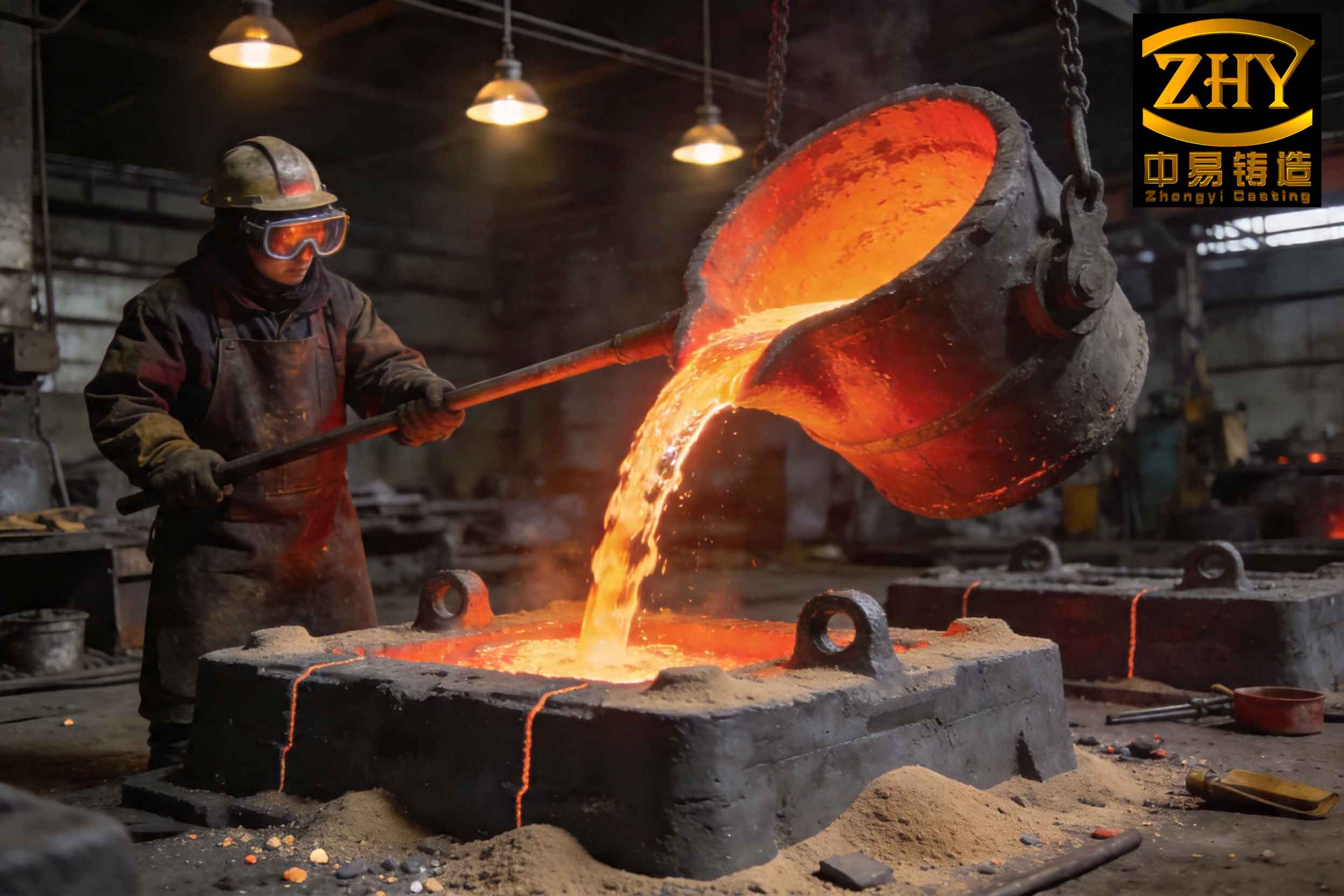
Marine diesel engines operate under demanding conditions, including full-load and variable-load scenarios, often in turbulent maritime environments. Consequently, the cylinder block, as a core component, must exhibit exceptional durability. The material typically used is ductile iron QT400-15, with castings weighing up to 20 tons and featuring thick sections. Historically, slag inclusion defects have accounted for a substantial proportion of scrap rates in our production. These defects can be categorized into primary slag, originating during melting and treatment processes, and secondary slag, formed during pouring and mold filling. Both types tend to accumulate at upper surfaces, core undersides, or stagnant zones within the mold cavity, leading to potential failure points. To illustrate a typical slag inclusion defect, consider the following visual representation inserted at a relevant juncture:
Our initial production process involved melting in medium-frequency induction furnaces, with molding and coring using wood-iron tooling and alkaline phenolic no-bake sand. The mold assembly comprised three layers: a cope, a middle sleeve (split into three sections), and a drag, utilizing a single-side bottom-gating vertical pouring system. However, this setup proved susceptible to slag inclusion defects, prompting a detailed root cause analysis from smelting and design perspectives.
We utilized advanced simulation software to model fluid flow, temperature distribution, and inclusion behavior. The governing equations for fluid dynamics and heat transfer are fundamental to understanding slag formation and transport. For instance, the Navier-Stokes equations describe molten metal flow:
$$\rho \left( \frac{\partial \mathbf{v}}{\partial t} + \mathbf{v} \cdot \nabla \mathbf{v} \right) = -\nabla p + \mu \nabla^2 \mathbf{v} + \mathbf{f}$$
where $\rho$ is density, $\mathbf{v}$ is velocity, $p$ is pressure, $\mu$ is dynamic viscosity, and $\mathbf{f}$ represents body forces. The energy equation governs temperature evolution:
$$\rho c_p \frac{\partial T}{\partial t} + \rho c_p \mathbf{v} \cdot \nabla T = \nabla \cdot (k \nabla T) + Q$$
with $c_p$ as specific heat, $T$ as temperature, $k$ as thermal conductivity, and $Q$ as heat source. Slag particles, treated as discrete inclusions, follow trajectories influenced by drag and buoyancy forces, often modeled by Stokes’ law for small particles:
$$F_d = 6\pi \mu r_p (v_f – v_p)$$
where $r_p$ is particle radius, and $v_f$ and $v_p$ are fluid and particle velocities, respectively. The tendency for slag to float or settle depends on the density difference, encapsulated by the Archimedes principle:
$$F_b = \frac{4}{3}\pi r_p^3 (\rho_f – \rho_s) g$$
with $\rho_f$ and $\rho_s$ as fluid and slag densities, and $g$ as gravity. These equations inform our simulation parameters to predict slag inclusion defect formation.
From smelting aspects, we identified several contributors to slag inclusion defects. Firstly, inadequate slag removal during melting allowed impurities to enter the mold. Secondly, low pouring temperatures reduced slag buoyancy, hindering flotation. Thirdly, impurities in raw materials, especially recycled scrap, increased slag generation. To quantify these factors, we developed a slag formation index $I_s$ based on empirical data:
$$I_s = C_1 \cdot \frac{S_{\text{initial}}}{T_{\text{pour}}} + C_2 \cdot \text{Impurity}_{\%}$$
where $S_{\text{initial}}$ is initial slag content, $T_{\text{pour}}$ is pouring temperature, $\text{Impurity}_{\%}$ is percentage of impurities, and $C_1$, $C_2$ are constants. Higher $I_s$ values correlate with increased risk of slag inclusion defects.
From process design aspects, simulation revealed critical flaws. The original single-side gating caused high velocity flow, leading to turbulence, air entrainment, and oxidation—key drivers of secondary slag. The temperature field, as simulated, showed significant asymmetry, with cooler regions opposite the ingate acting as stagnation zones where early-entrapped slag accumulated. This temperature gradient $\nabla T$ can be expressed as:
$$\nabla T = \frac{\partial T}{\partial x} \mathbf{i} + \frac{\partial T}{\partial y} \mathbf{j} + \frac{\partial T}{\partial z} \mathbf{k}$$
In our case, $\frac{\partial T}{\partial x}$ was steep across the block width, exacerbating slag trapping. Additionally, direct impingement of gates on core prints intensified splashing and slag formation. The process safety factor, defined as the ratio of allowable to actual dimension, was too low, limiting post-casting remedial options.
To synthesize these causes, we present a comparative table outlining primary factors for slag inclusion defects:
| Category | Factor | Impact on Slag Inclusion Defect | Mechanism |
|---|---|---|---|
| Smelting | Incomplete Slag Removal | High | Primary slag carried into mold |
| Low Pouring Temperature | High | Reduces slag flotation velocity | |
| Impure Raw Materials | Medium | Increases slag generation rate | |
| Process Design | High Flow Velocity | High | Causes turbulence and oxidation |
| Asymmetric Gating | High | Creates stagnant, cold zones | |
| Gate Impingement on Cores | Medium | Promotes splashing and secondary slag | |
| Low Safety Factor | Low | Limits defect removal tolerance |
Building on this analysis, we implemented targeted improvements. In smelting, we adopted high-temperature holding to promote slag flotation, followed by rigorous slag skimming. Ladles were equipped with advanced baffle systems to prevent slag entry into the gating system. Pouring temperatures were optimized using a thermal model to balance slag flotation and solidification shrinkage:
$$T_{\text{opt}} = T_{\text{liquidus}} + \Delta T_{\text{superheat}} – \Delta T_{\text{loss}}$$
where $\Delta T_{\text{superheat}}$ ensures fluidity, and $\Delta T_{\text{loss}}$ accounts for heat loss during transfer. Raw materials were pre-treated via rotary shot blasting to remove rust and contaminants, reducing impurity levels.
In process design, we revolutionized the gating system. The single-side bottom gating was replaced with a dual-side semi-open system, which reduces flow velocity $v$ according to the continuity equation:
$$A_1 v_1 = A_2 v_2$$
where $A_1$ and $A_2$ are cross-sectional areas of single and dual gates, respectively. With $A_2 > A_1$, $v_2 < v_1$, minimizing turbulence. The pouring sequence was modified to a staggered plug lifting method: initially, two plugs are opened to start filling calmly, followed by the third plug later to maintain metal rise without surge. Gates were repositioned away from core prints to avoid direct冲刷. Simulation of the new design showed a more uniform temperature field, reducing stagnation risks. The improved temperature homogeneity can be quantified by the standard deviation of temperature $\sigma_T$ across a horizontal section:
$$\sigma_T = \sqrt{\frac{1}{N} \sum_{i=1}^{N} (T_i – \bar{T})^2}$$
where $N$ is number of nodal points, $T_i$ is local temperature, and $\bar{T}$ is average temperature. Our data indicated a 60% reduction in $\sigma_T$ with dual-side gating. Additionally, we increased the safety factor by adding allowances in prone-to-slag areas, enabling effective defect removal without compromising sealing requirements.
To validate these measures, we conducted production trials and quantified outcomes. The following table summarizes key performance indicators before and after implementation, highlighting the reduction in slag inclusion defect incidence:
| Parameter | Original Process | Improved Process | Improvement % |
|---|---|---|---|
| Slag Inclusion Defect Rate (%) | 15.2 | 2.1 | 86.2 |
| Pouring Temperature (°C) | 1350 | 1380 | +2.2 |
| Flow Velocity (m/s) | 1.8 | 0.9 | -50.0 |
| Temperature Uniformity $\sigma_T$ (°C) | 45.3 | 18.1 | -60.0 |
| Scrap Due to Slag Inclusion Defect (%) | 12.5 | 1.5 | 88.0 |
| Ultrasonic Test Pass Rate (%) | 85.0 | 98.5 | +15.9 |
The trials involved 19 cylinder blocks, with all meeting quality standards—a significant achievement given the historical scrap rates. We further analyzed the effectiveness using statistical process control. The defect count per unit $D$ followed a Poisson distribution initially, with mean $\lambda = 3.5$. Post-improvement, $\lambda$ dropped to 0.4, indicating a drastic reduction in slag inclusion defect frequency. The probability of observing $k$ defects is given by:
$$P(X = k) = \frac{\lambda^k e^{-\lambda}}{k!}$$
For $k=0$ (no slag inclusion defect), $P(X=0)$ increased from $0.03$ to $0.67$, underscoring the enhancement.
From a theoretical standpoint, the improvements align with principles of fluid dynamics and thermodynamics. The dual-side gating reduces Reynolds number $Re$, promoting laminar flow:
$$Re = \frac{\rho v L}{\mu}$$
where $L$ is characteristic length. Lower $Re$ minimizes energy dissipation and oxide formation, directly addressing secondary slag inclusion defect sources. The increased pouring temperature elevates the slag buoyancy force relative to viscous drag, enhancing flotation. The time $t_f$ for a slag particle to float to the surface can be approximated by:
$$t_f = \frac{h}{v_b}$$
where $h$ is metal height and $v_b$ is buoyant velocity, derived from force balance. With higher temperature reducing viscosity $\mu$, $v_b$ increases, shortening $t_f$ and allowing more slag to escape before solidification.
We also explored the role of mold materials and coating. Although not a primary focus in initial analysis, we found that certain coatings reduced slag adhesion to cores. The interfacial energy $\gamma_{sl}$ between slag and coating influences entrapment likelihood, modeled by:
$$\Delta G = \gamma_{sl} – \gamma_{sv}$$
where $\gamma_{sv}$ is solid-vapor energy. Lower $\Delta G$ favors slag detachment, a factor we plan to optimize in future work.
In discussion, we emphasize that slag inclusion defect mitigation requires a holistic approach. Isolated fixes in smelting or design may yield limited results. Our integrated strategy, combining thermal management, fluid control, and procedural adjustments, proved synergistic. For instance, higher pouring temperatures alone might exacerbate shrinkage, but coupled with improved gating, they reduce both slag and porosity risks. The simulation software was instrumental in visualizing complex phenomena, such as vortex formation near gates, which we quantified using vorticity $\omega$:
$$\omega = \nabla \times \mathbf{v}$$
Regions of high $\omega$ correlated with observed slag inclusion defect sites, guiding gate redesign.
Looking ahead, we recommend continuous monitoring using sensors for real-time temperature and flow data, enabling adaptive control. Machine learning models could predict slag inclusion defect probability based on process variables, further reducing trial-and-error. The general framework developed here is applicable to other large castings prone to slag inclusion defects, such as turbine housings or pump bodies.
In conclusion, our first-hand investigation demonstrates that slag inclusion defects in large marine diesel engine blocks are manageable through systematic analysis and innovation. By addressing both smelting impurities and design-induced turbulence, we achieved a dramatic reduction in defect rates. The key takeaways include the importance of uniform temperature distribution, controlled flow velocities, and robust safety margins. Repeatedly, the slag inclusion defect has been the focal point, driving each improvement step. We are confident that these methodologies will enhance casting quality and reliability, supporting the demanding operational needs of marine propulsion systems.
To encapsulate the procedural changes, we provide a flowchart of the improved process in tabular form, emphasizing critical control points for slag inclusion defect prevention:
| Process Stage | Action | Target Parameter | Effect on Slag Inclusion Defect |
|---|---|---|---|
| Raw Material Preparation | Shot blasting to remove oxides | Impurity level < 0.5% | Reduces primary slag sources |
| Melting | High-temperature hold at 1500°C for 20 min | Slag content < 0.1% | Promotes slag aggregation and removal |
| Ladle Treatment | Baffle installation and slag skimming | Slag carryover ≈ 0 | Prevents slag entry into gating |
| Pouring Design | Dual-side semi-open gating | Flow velocity < 1 m/s | Minimizes turbulence and oxidation |
| Pouring Execution | Staggered plug lifting | Metal rise rate 20-30 mm/s | Controls filling pattern to avoid splashing |
| Solidification | Optimized cooling through chills | Temperature gradient < 10°C/cm | Reduces stagnant zones for slag trapping |
| Post-Casting | Allowance addition in critical areas | Safety factor > 1.5 | Enables defect removal without compromise |
Finally, we note that the battle against slag inclusion defects is ongoing. As casting geometries evolve and materials advance, our strategies must adapt. However, the principles of cleanliness, controlled fluid dynamics, and thermal management remain cornerstone. We hope this detailed account aids fellow engineers in tackling similar challenges, always keeping the slag inclusion defect at the forefront of quality initiatives.